Saturday, May 12, 2018

Cannes Day Five

I managed to arrange my schedule today so that only twice did I have to pass through a security check before a screening.  It is a tedious and nerve-racking procedure inching along with the crowd waiting to have one’s pack perused for contraband, never knowing how picky the guard will be, so it’s always a relief to avoid it.  I was able to  slip into the Palais complex of theaters from the Debussy after the day’s first film bypassing the guards out front.  Then I was able to see three films in the complex without further frisking.  The only headache was being blocked by a  massive clog of people scrummaging to get into the Christopher Nolan conversation at four pm.  I would have joined them if it looked possible to get in, but instead opted for the lone Depardieu film playing in the Market, missing the first few minutes due to the pileup of humanity.

The day began with the much dreaded Godard film “The Image Book.”  It was rumored to be ninety minutes of silence.  How was I  to manage to stay awake through that after getting less than six hours of sleep the last few nights.  Only the stream of people walking out could keep me awake.  The stream of people exiting the theater didn’t need to keep me awake, as the film surprisingly held my attention with its array of film clips and concocted images and monologue.  What it all meant I can’t say, nor could any of the early reviews.  They all agree that it will take months of study by academics and Godardomaniacs to find whatever meaning or sense there may be in it. It was another French film with the mention of Rimbaud. The critics gave it the benefit of the doubt.  It is the first film that earned an aggregate score of three from Screen’s panel.  Only Michel Simone, the noted French critic, gave it less than two stars.

For the first time I hadn’t been granted an invitation to a Competition film, so I saw “Ash is Purest White” from China, in the Soixante rather than the Lumiere.  My 45-minute wait was rewarded and my pack was spared review.  If I hadn’t gotten in I would have had to attempt to see it at the Olympia at ten pm, something I didn’t want to do as it was 144 minutes long. Usually I’m out of my last screening around midnight, late enough.  The length wasn’t objectionable in this superbly told tale of a small-time mobster and his devoted girl friend, who is someone not to be trifled  with. Zhao Tao’s charismatic performance puts her in contention for the best actress award.  The film abounds with energy and style while giving  a fine portrait of present day China. The film is given a jolt by three scenes with people dancing to “YMCA.”

“My Favorite Fabric” gave an even better view into its country—Syria.  A suitor comes from the US to marry one of three daughters living with their widowed mother in a cramped apartment in Damascus in 2011 with the country in chaos.  He declines the 25-year old somewhat dumpy daughter for the younger prettier one.  The mother doesn’t care, as she just wants a ticket out of the country for her family any way she can get it.  This will be in contention for an award from the Un Certain Regard jury.

Marion Cotillard is always a threat for an award.  She is superb as a gorgeous blond party-monster in “Angel Face.”  So is her eight-year old daughter, who is left alone for days at a time when her mother goes off on one of her benders.  She loves her daughter very much but likes partying even more.  If Coltillard weren’t such an unredeemable character this film would have been slotted into the Competition category rather than Un Certain Regard.  

Gerard Depardieu is similarly deluded and waylaid by his lusts in “The Other Woman” playing in the Market.  He has left his wife of twenty years for a younger, gorgeous woman.  His best friend, played by another French heavyweight, Daniel Auteil, who directed this farce, lusts without restraint after her when she comes over for dinner.  Auteil’s wife is initially adamantly opposed to having the woman in her house, and is outraged by her at first when she meets her, but comes to accept her.  Auteil is made into a bumbling fool by the young woman and is continually launched into fantasies with her.  The only redeeming fragment to this movie was a brief bicycling scene with Depardieu and Auteil coasting down a dirt road on mountain bikes in very baggy clothes to camouflage their girth.  Man-mountain Depardieu looked as if he’d never been on a bike.

Guys smitten by a woman was the premise of the Japanese film “You, Your, Yours.”  Three young goofballs who live in a very cramped apartment overlooking the apartment of a young Korean girl obsessively watch her every move.  They discover she is enamored by Brad Pitt, the rock legend Yutaka Ozaki and 19th century samurai icon Sakamoto Ryoma and assume their identities.  She is totally oblivious to them and they remain in the background, happy to simply regard her as their princess.  A Japanese audience might relate to the exaggerated buffoonery of the guys.  This wasn’t the wild romp I imagined it might be. 

The Italian drama “Youtopia” examines an 18-year old girl addicted to the internet engaged in a cyber-relationship with a guy she only knows through his cyber character.  She also earns money on the side stripping for internet lusters.  When she learns from her mother that she has to come up with 27,000 eruos or they will be out on the street she turns over a wad of money she has earned and encourages her mother to earn on the side as she does.  When they are still well short of what they need, the girl decides to auction off her virginity on line.  Her mother doesn’t object.  This Market offering had the relevance and disquieting impact that Cotillard’s movie lacked.  It was a nice little find amongst the mass of Market offerings.


Cannes Day Four

The producers of the adaption of revered French writer, illustrator and New Yorker cartoonist Jean-Jacques Sempé’s novel “Raoul Taburin” thought there would be enough interest in it to pay to have it screened in the second largest of the Olympia’s nine theaters and to have it restricted to buyers only.  This was a movie I had to see, as it was the second of two bicycle-themed movies in the Market.  Generally if a buyers only screening doesn’t fill those with Market badges are allowed entry, so I wasn’t too nervous about not being able to see it.

There were less than ten buyers waiting in line when I  arrived fifteen minutes before the six pm screening.  The representative of the film said I could count on getting in.  It attracted a mere thirty or so buyers and an equal number of non-buyers, not even filling a quarter of the seats.  The movie is narrated by its protagonist, Raoul Taburin, telling his life’s story of growing up in a small French village wishing to follow in the footsteps of his father, a bicycling postman.  Raoul is unable to fulfill his wish as he never learns how to keep his balance on the bike, a dark secret that haunts him all the days of his life. Growing up it ostracizes him from his friends, who all go bicycling.  He lines up for the town’s annual bike race, but remains at the starting line claiming his chain fell.  He forces himself to start out with his classmates on a sanctioned all-day bike ride and has a spectacular crash complete with a couple of aerial flips I nto the lake after a steep descent that makes him a legend in the town.  Despite his inability to ride a bike he has a great love for bicycles, taking them apart and putting them together, and becomes an apprentice in the local bike shop.  He eventually takes it over.

The parents of the woman he marries died in a tandem accident, so he vows to her he’ll never ride a bike again and keeps that vow until a famous photographer moves to their village and would like to take a photo of him riding his bike.  This leads to a grand denouement.  Though the movie is centered around the bicycle, what bicycling there is remains very simplistic, mirroring the story.  Even the passing of The Tour de France through the village is rendered as a bare sketch with only a local rider shown.  He wins the stage when there is a monumental crash wiping out the peloton, the remnants of which are shown in the far distance with the local riding past a long row of  cyclists laying on the road.  The winner of the stage returns to live in the village.  He steals Raoul’s girl friend and remains his nemesis for decades.  Whenever he appears in the movie, even into his fifties, he is still clad in his uniform and his cycling gloves.  Never once though is he shown with shaved legs.  Realism takes a holiday in this semi-sweet family movie.

I ended my day with a similarly sanitized and romanticized version of the short career of a legendary Argentinian boy thief who remains in jail 45 years after his crime spree, the longest-serving prisoner in the history of Argentina.  Many of his eleven murders and countless  thefts, large and small, are recounted in this Un Certain Regard entry entitled “El Angel,” alluding to what the angelic-looking, blond curly-haired thief was dubbed by the press—“The Angel of  Death.”  He seems born to be a thief and goes about his calling breaking into homes and jewelry stores and gun shops with a fearless, casual, almost naive, effortlessness, seemingly thinking he could never be caught.   This very polished film will no doubt be as big of a smash in Argentina as “Bonnie and Clyde” was in the US. 

The day began with the much-anticipated Polish film “Cold War” by Pawel Pawlikowski, winner of a best foreign picture Oscar for “Ida.”  As with that, it is shot in luscious black-and-white giving the rather ho-hum love story more gravitas than the script does.  The film spans several decades beginning in 1946 tracing the love affair of a musician-director of a choral group with a younger beautiful blond singer in the troupe.  He proposes they escape to the West when they go to perform in Berlin.  She fails to meet up with him, deciding not to go through with it without telling him.  They end up meeting over the years for quick, passionate flings in Paris where he ends up and other places her travels take her with the possibility that fate might bring them together for good.  Neither seems overly committed to their relationship failing to bring the movie to any kind of boil.  It agreed with some though, as it was the first of the five films screened in Competition to receive any four-star reviews from Screen’s panel with three of the ten critics giving it their highest rating, earning it an aggregate of 2.9, the highest so far.

As this was just another so-so love affair, the day’s other Competition film, “Sorry Angl” from France, was just another movie about a gay love affair that is derailed by AIDS.  The performances and script made it a perfectly enjoyable film, but it’s not a subject that hasn't been told countless times before.  It was laced  with many of those signature elements of a French film that added to my enjoyment—frank talk between lovers evaluating their sex including a woman who is concerned her boy friend is more gay than heterosexual, a boy whose name is Louis who doesn’t like his nickname Lou-Lou, a visit to Truffaut’s grave and a ten-year old who quotes Rimbaud.

My day also included a pair of documentarues—a standard Bergman doc with a series of talking heads and lots of clips from his oeuvre and a wacky Australian doc on fans of boy bands.  With this the 100th anniversary of Bergman’s birth, there are two documentaries on the master.  This was “Searching for Ingmar Bergman”  by Margareth Von Trotta, who knew him well.  She opens her film with extended clips from “The Seventh Seal” from 1957 which she saw in Paris in the early ‘60s, making her a lover of cinema and that Trauffaut wrote about in Cahiers du Cinema anointing him as a new talent who would elevate cinema..  She interviews many of his actresses and several of his children.  One of his daughters once complained to him that he’d saythat he missed the actors he worked with, but never his children.  He said that was because he didn’t miss them.  A son who went on to become  a filmmaker and worked with him also spoke of his father’s obsession with his art above all else.  One of Von Trotta’s themes is that Bergman’s skill as a writer isn’t fully appreciated, and that if he had been a writer rather than a filmmaker he might have won the Nobel Prize for literature.

“I Used to be Normal: A Boyband Fangirl Story” is among the contenders for the most eye-catching title of the festival.  Though the film is by an Australian and several of her subjects are Australian, she ranged to the US to find more.  She traces the phenomen of young girls obsessed with boy bands to the Beatles.  The most interesting of her subjects is a red-haired single mother of two who was one of those originals and is still fully devoted to her teenaged obsession. She used to,practice signing her name as Mrs. Paul McCartney.  The rest of her subjects are all young women who have dropped all to the exclusion of more contempary bands such as the Bsckstreet Boys..  One went on a cruise with Take That that was 99 per cent women.  She admitted it was a bit creepy being among others who all dreamed of being the girl friend or wife of one of the members of the band.  Another quality that most of them shared was being significantly overweight.  One is proud enough to have the vanity license plate Boybands that strangers frequently photograph.

I was able to slip in one other film—“Lives on Track,” a slight French film that turned out to be a small delight.  It is a series of conversations between seat mates on a train showing nothing more than the two conversationalists in their high-backed seats, most of them including a retired dancer of some note.  Most of those who sit beside her recognize her and know the significant performances of her career.  As we get to know her torments and prickly personality the film becomes more and more engaging.  This was a testament to giving anything on the schedule a chance.  Only six others cared to duck in to the twenty-five seat screening room in the Grey hotel.

Thursday, May 10, 2018

Cannes Day Three

This was a near dream day of cinema with bold and innovative films from Russia, Egypt, France and Sweden, any of which could have been a day’s highlight.  It began at 8:30 with the Russian Competition entry “Summer,” a black-and-white period piece of rock and roll rebels in 1981 Leningrad emulating what they knew of rock and roll on the other side of the Iron  Curtain.  They were as passionate about their music and expressing themselves as those who inspired them.  It wasn’t easy for them to perform, but when they did they had fans who fully responded.  

The film’s cinema-verité style with an abundance of music morphed on occasion into extraordinary dream sequences of outrageous behavior.  It will be difficult for any film in the festival to top a three minute scene of Psycho Killer on a train after some officials start harassing the long-haired musicians for their anti-Soviet behavior.  It was positively electrifying—one of many musical scenes of great impact and commentary.  The musician prancing down the aisles of the train belting out “don’t touch me, I’m a real life wire” is digitally enhanced with a white border outlining his body and other dazzling special effects.  This has to be seen to be believed—rock and roll in all its glory.  I am eager to see this again on the last day of the festival when all the Competition films are screened one last time. 

The day’s other Competition film, “Yomeddine” from Egypt, immediately afterwards was equally engrossing and sincere, though not of the same energy level.  It was a full immersion into the life of a man whose face and arms are deformed by leprosy.  He’s just lost his life and decides to embark on a trip across Egypt with his donkey in search of the family that abandoned him to a leprosy colony when he was an infant.  He is accompanied by a ten-year orphan by the name of Obama who is likewise ostracized by society. They encountered realistic adversity along the way.  This was another film unlike any before it and another remarkable achievement.  Two in a row was almost too much to take.

I was able to take a brieather with a lightweight Italian comedy in the Market with the catchy title of “Grannies on the Run.”  It stars 80-year old Claudia Cardinale.  She and a cohart plot to make a break from their nursing home to attend a concert in Venice.  In better hands this might have been hilarious, but I didn’t laugh once. 

 I didn’t object at all to the lukewarm nature of the film as I decompressed from my previous two exceptional doses of cinema  and looked forward to a conversation between film critic Elvis Mitchell and Ryan Coogler, director of “Black Panther” in the Bunuel.  These conversations had formerly been called Master Classes, but had been rebranded as a Rendezvous.  There were four of them scheduled this year, twice as any as usual, with three directors and John Travolta.  The festival recognized the phenomenon of “Black Panther enough to have screened it last night in the outdoor theater on the beach, the first time a film in current release has been accorded that honor.  And there was enough interest in Coogler that the theater was already filled 45 minutes before it was to start when I showed up for it.

That meant I could go see “Border,” an Un Certain Regard film from Sweden.  “Yomeddine” had prepared me for having a prolonged gaze at deformity.  The two lead characters in this movie both have pockmarked faces and quivering lips and hair in disarray as if they are a different species.  One is a border guard who has the uncanny ability to sense if someone is carrying contraband.  She miraculously discovers a well-attired young man has a chip hidden in his phone of child pornography and then is enlisted by the police to track down those involved.  Her senses are mistaken though when she questions a guy who has a tormented face and mannerisms remarkably similar to her. They later discover they both have scars from being struck by lightening and a scar on their backside.  When he passes through customs on another occasion she realizes they have a bond and tracks him down to the hostel he is staying at.  He is foraging maggots in the forest and eating them.  He dares her to eat one as well.  She resists, but then succumbs and is delighted by it.  This mirrored the day’s first two films with its amazing originality..  This was a dabble in the supernatural without pushing it too far.  

The day’s other Un Certain Regard film, “Sextape” from France, continued the theme of bold originality with its frank portrayal of two glib, fast-talking teenaged boys trying to convince  their girl friends to give them blow jobs.  It is at once comical and disturbing.  The girls are sisters.  The older, more experienced sister has already succumbed to her boy friend’s demands/needs and makes it acceptable for her sister to go along with it.  She’s not so sure.  She continually rolls her eyes at the outlandish arguments of the guy she’s been set up with.  The boys are clearly idiots and the girls wise to their ways. The boys can be sympathetic characters, but are all too often reprehensible.   Feminists will be divided between being appalled by this movie and applauding it as a cautionary tale for all women.  The girls are at times noble and heroic. The dialogue and acting by the Arabic foursome is something to behold, but it can be most disquieting at times.  It is hard to imagine that people could behave as they do, but it was a convincingly realistic and empathetic portrayal and cinema of merit.  There is so much to laugh at, one isn’t as disturbed as much as one should be.

My day was further highlighted by a film of yore—“Beating Heart” from 1940 by French master Henri Decoin.  I planned to watch the first hour and then go see the Chinese black comedy “Looking for Lucky” that purported to be a “biting satire on every conceivable ill in modern society,” but I was so engrossed by the love story of a young woman escaped from a reform school and a diplomat that I had to see it to its end.  This had all the twists of Farhardi’s bungled “Everybody Knows,” but each was plausible and well-earned.  The surprises came one after another, but rather than cringing at their contrivance one could admire them for their genuineness and ingenuity.  We were all fortunate to be treated to this.

Cannes Day Two

Today’s screening of the Belgian documentary “Holy Tour” on fans following The Tour de France had the potential of being my favorite film of the festival, if not of all the Canne festivals I’ve attended.  Those high expectations unfortunately were not met.  It began with great potential of black and white documentary footage of fans on the Ventoux cheering the gladiators of old accompanied by the resounding music of “Gloria.  But rather than pursuing a historical line or even following a particular Tour from start to finish,, the filmmakers encamped on the Col d’Izoard last year for ten days as Tour followers gathered before the 18th stage of The Tour and restricted their film to those ten days.

They failed to find any charismatic or particularly interesting subjects.  The early arrivals were all elderly in camper vans.  The filmmakers didn’t draw out their fanaticism—how long they had been Tour followers and what drew them to The Tour and memories of their first Tour as children and subsequent Tours.  They mostly just let them reminisce about their personal past, the men going back to WWII.  When a couple of British guys in their 30s wearing Sky jerseys stop for water and say they are from London, the French guys react with “boom-boom.  You had a lot of bombing.”  The Brits were totally befuddled.

Only a dozen showed up for this first of the film’s two screenings and half walked out in the first half hour.  I couldn’t do that.  I was still enthralled by this mini-immersion into a world I have been a part of the past fourteen years.  It was nice to be taken  inside the various campers and witness  their denizens react as they watched each day’s stage on television before it reached them, particularly excited by the exploits of the French riders Bardet and Barguil.  They didn’t take kindly to fans who joined them who they could identify as being from Paris by their license plates and by their demeanor.  As I well know, Parisians are less liked than Americans by the rural French.  One commented, “They look like dogs and act like hogs.”

The filmmakers counted down day by day until J Jour (D Day) arrived when the masses finally converged and barriors were put into place and all the other accouterments. They were able to include a few shots of The Devil gladly allowing anyone to take their photo with him, though they didn’t catch his antics when the riders trickled past where the filmmakers had stationed themselves three kilometers from the summit.  They capture the frenzy of the caravan dispensing it’s goodies. I didn’t have to look for myself as I was out in the Atlantic on the Queen Mary with Janina, having abandoned last year’s Tour after the tenth stage.  I only recognized one group of fans, though I could fully recognize the flavor of the experience. I have one more bicycling film to look forward to—a French feature about a bike shop owner in a small town who has a secret that he never learned to ride a bike without training wheels.

I had high expectations too for the day’s other documentary—“The Eyes of Orson Welles” by Mark Cousins, film scholar without peer. Not a one of Cousins’ many film esssys has been a disappointment, and I knew he couldn’t fail on this as he is such a Welles fanatic that two years ago when Janina and I talked with him at the Traverse City Film Featival, where he serves on the board of directors, he showed us a Welles tattoo he had gotten the day before after watching “Citizen Kane” on the big screen for the umpteenth time.  I barely recognized him here in a tight-fitting tuxedo introducing his latest film.  He said it was his 21st time at Cannes and that he had many fond moments sitting in the first row of this theater, the Bunuel, that specializes in showing classics.

In his introduction he said so many films have been done on Welles we were probably wondering if there was a need for another.  Cousins had been given access to the hundreds of sketches that Welles had composed during his whole life, going back to his early teens when he was a student at Chicago’s Art Institute.  The film takes the form of a biography, as Cousins visits the many places he lived, beginning with Kenosha, and places where he shot film.  As with all of Cousins’ films, it is so rich in material, it will merit viewing again and again.

When I noticed a Mapplethorpe film playing in the Market I assumed it had to be a documentary, but instead the American production company called You’re Outta Control Pictures attempted to make a feature of his life giving it the simple title of “Mapplethorpe.”. The actor playing Mapplethorpe was well cast capturing his energy and the ever present gleam in his eye, but this low budget film fails to give more than a by-the-numbers review of his life.  Patti Smith disappears to Detroit early on and isn't heard from or seen until the end on his death bed.

Two other of the day’s features could have been documentaries as well—“Aga,” a Bulgarian film about two eskimos in the arctic and “Rafiki,” a Kenyan film about two lesbians.  “Aga” played at Berlin and was seeking distribution in the Market here.  It was full of remarkably intimate footage of the daily efforts of a husband and wife struggling to survive in their inhospitable environment.  

“Rafiki” is a story of survival too, as two young women defy their parents and the norms of their society and become lovers. They are beaten and hounded.  This was the first Kenyan film to be invited to play at Cannes, playing in Un Certain Regard.  Julie from Telluride is one of three woman on the five person jury.  They will be very much predisposed to award this very fine film. The woman director said her film couldn’t be shown in Kenya,  though she said she was proud to be Kenyan,, bringing applause from the many Kenyans in the audience.

I began the day with another invited film, the Opening Night film “Everybody Knows” by the frequent award-winner Iranian Ashgar Farhardi known for his intricately plotted films.  It’s not until half an hour in that this film taking place in Spain starring Penelope Cruz and Javier Bardem answered the question of where it was headed after a wedding.  Then the question loomed, as it often does in Farhardi’s films, is it going to work or is he going to be too cute and convoluted for his own good.  It was too much for me and also for four of Screen magazine’s panel of ten critics who gave it a mere one star.  Janina reported that Milos mocked it mercilessly on his WBEZ review.  Ralph condoned the film and whenever we crossed paths later in the day he wanted to further discuss it. I didn’t care to give any more mental energy to justify or explain its many wrinkles than I had.  

My screening was somewhat undermined by having to check my mini iPad.  It hadn’t appeared on the list of banned items.  That was a tragedy as while I await films I compose these jottings, so I lost a valuable twenty minutes of writing time and then another few minutes after the screening to retrieve my bag.  It was absurd that I was denied my device when all around me people were pecking away on iPhones not much bigger than my iPad.  Those lost minutes left me twenty people short of getting into the next screening in the Debussy, the Un Certain Regard Opening Night film “Donbass.” So I dashed over to the Arcades for “Raising  Colors,”  a French film about a 23-year old woman who enlists in the army to the chagrin of her mother.  “Why can’t you just join the Green Party,” she asks, “if you want to help the country.”  She is put in the position of being a secretarial assistant to a career guy.  She is somewhat attracted to him and is frustrated he makes no pass at her.  The secretary of the CEO in yesterday’s French wheel chair movie was similarly frustrated, even complaining to him that not once in fifteen years had he complimented her scarf or sweater.  Such characters might now be written out of movies in this Metoo environment.  

Wednesday, May 9, 2018

Cannes Day One

My biggest concern when I arrive at Cannes is what new policies might have been instituted and will they make getting into the films easier or harder.  It is futile to hope that the bag checking and other security measures might be relaxed.  One can only hope it isn't intensified too much.  I wasn’t pleased at all to discover that all the barriers in front of the Debussy theater and the Palais complex that one could lock their bike to now all had signs prohibiting bikes.  They could accommodate thirty or more bikes and would be packed.  I’m generally among the first to arrive by bike each morning, so hopefully the three or four nearby poles will be available for me.

The biggest change is that the first screening of the Competition films will now be their gala presentation in the Palais with the cast walking up the red carpet and everyone in attendance attired in formal attire.  It used to be a press screenings the evening before and another at 8:30 the next morning that other pass holders could attend.  Now those attending the Palais screening will be watching the film without the press having had an opportunity to pass judgement and effecting their reaction to the film.  It had to be not so pleasant for those involved with a film to walk up the red carpet in smiles if the press had savaged it earlier in the day..  I don’t attend screenings that require formal attire, so now I won’t be seeing unreviewed films, unless I can manage to avoid the reviews.  My biggest concern though is whether this new screening schedule will make it easier or harder for me to get into the Competition films.  That remains to be seen.  This policy mostly effects the press.  The much respected and very personable festival director Thierry Fremaux was surprised to receive a standing ovation from the press at Monday’s  press conference when he explained these changes and others.

Another big difference from years past is this will be the first time I won’t have a chance to encounter Pierre Rissient, one of the powers behind the scene at both Cannes and Telluride, as he passed away at the age of 81 in Paris this past Saturday.  The intimacy of Telluride has allowed me to have  an occasional interreaction with him and even here at Cannes.  I was once able to get him a t-shirt at Telluride that he coveted and also to convey greetings to him from a mutual friend in Chicago who had once worked with him.  Whether at Telluride or Cannes he was always a magnet attracting significant figures in the world of cinema from Clint Eastwood to Werner Herzog.  I’d like to sit a few rows behind him and watch all the luminaries come by to pay their respects. I could always feel his great passion for cinema radiating whenever I was within range of him.

My first time through security this year I had my water bottle challenged with the guard pulling it out of my backpack and showing it to his superior.  The new regulations that had been handed out when I picked up my credentials and program stated one could bring in a 500 ml. bottle, about the size of my bottle.  I had brought the sheet along just in case, but the man in charge said it was okay.  I was happy to see the guard only looked in the main compartment to my pack and didn’t make me open the zippers to the three smaller compartments.  The initial long line was processed fairly quickly so I had no concerns about making it to my first screening.

With a minimal offering of films on Day One with only the Opening Night film of any significance, it didn’t much matter what films I chose.  Rather than  selecting films based on subject matter, I elected to go by nationality sticking with French films for my first four choices to see what glimpses of familiarity they would grant me.  I wasn’t expecting anything particularly profound, as they were all described in the program as comedies.  Not a one was described as dealing with “social issues,” as many of the films in the program were, though in a way it could be argued that each of these “commercial” films raised issues of some pertinence.

“The Freshmen” dealt with the extreme pressure of medical school with little more than ten per cent of  first year students qualifying to continue on to a second year.  The movie focuses on two guys who are on their second attempt to qualify.  They team up in their studies.  They know that getting one answer wrong on the final test can be the difference between becoming a doctor or being relegating to dentistry or being a vetinarian or physiotherapist or high school biology teacher.  They test each other bantering around all sorts of medical terms as if they are speaking another language.  They are fully consumed by trying to cram all they can into their heads.  Though the program described it as a comedy, as there were some comic elements, it was mostly an all-too serious indictment of how dehumanizing the learning process was.  One describes  medical students as being “closer to reptiles than human beings.”

“Family Council” was the only one of the four that didn’t take place in Paris and have at least one glimpse of the Eiffel Tower.  Paris was by far the most popular city mentioned in the program as a setting for a film.  An American film that played today, “Under the Eiffel Tower,” was among them.  The second most popular city was Berlin.  There is even a documentary celebrating Berlin (“Symphony of Now”).  “Family Council,” as did “The Freshman,” began with a pop song with English lyrics.  The family is three children who are tired of looking after their cantankerous aging mother and decide to kill her by putting rat poison into her drink when she comes for her weekly visit.  The mother has more spunk and vitality than her children, but like the father of one of the medical students, she is inclined to being spiteful towards her children.  There was no mistaking this as a comedy, though it was hard for me to laugh when a fast-riding, Lycra-clad cyclist is distracted by the beauty of the mother and plunges into the body of water he’s riding along.

“Rolling to You” was the lone romantic comedy of the lot, though the importance and value of sex was broached in all of them, as one might expect from a French film.  This comedy might challenge the tastes of some.  A brash, fast-talking CEO of a sports shoe company who is about to turn fifty is sitting in the wheelchair in the apartment of his recently deceased mother when a beautiful woman who just moved into the apartment building walks in through the open door and assumes he is handicapped.  She says she can help him whenever he wants as that is her vocation.  He decides to pretend he needs the wheelchair and takes on the challenge of trying to seduce her.  He’s thrown a curve when she invites her to her family home for lunch and she introduces him to her equally beautiful sister who is a world class violinist and confined to a wheelchair.  It isn’t always easy to go along with the quasi-seriousness of their  increasing interest in one another.  He doesn’t know how to fess up without losing her and even tries a trip to Lourdes with her to come clean.  The highlight of the movie for me was a round of menthe á l’eaus with a group of others confined to wheelchairs after the violinist competes in a tennis match.  No mention is made of the drinks.  One has to know the culture to recognize what the bright green drinks are at the table they are all seated at.  There was also a reference made to the French habit of doubling the first syllable of one’s name into a nickname such as Pou Pou for Poulidor.  The violinist asks the CEO, whose name is Jocelyn if she can call him Jo-Jo.  Then follows a repartee of double syllables of just random words.

“Sisterhood” rang a bell of recognition too when at the very start one of the characters takes a selfie, as “selfies” are one of the hot topics of Cannes.  All 40,000 of those attending the festival are handed a card when they pick up their credentials emphasizing that selfies are forbidden on the red carpet, though no threat was made of having one’s credentials withdrawn.  This comedy, like the other three, was based on a simple premise that might have.been given to a screenwriting class to develope into a script.  This premise was three young women all struggling to get by inherit a deluxe Parisian apartment from a father they never knew, nor did they know one another.  The three sisters are extremely disparate and don’t seem as if they can possibly get along.  There is an Arab, a Jew and a party girl among them.  But their  trying to get along is only half the story.  The other half is the rest of their father’s family contesting the will and wanting the apartment for themselves.  Like the other three films, this dealt with real issues that might not necessarily qualify it as a comedy in Hollywood terms.  It further distinguished itself as a French film with lots of smoking and kissing on the cheeks and a mention of a philosopher—Spinoza.  José Bové, the man who burned down a McDonald’s, also gets a mention.  

Though none of these rank as much more than ordinary films, they were valid representations of mainstream French cinema and a glimpse of present-day French society.  None left that feeling of exaltation that a significant film can.  I was lucky to have that from my final film of the day, an American documentary on the art world—“The Price of Everything.”  The only French film available in that final time slot was an animated feature.  Those I skip. There are about as many of them in the program as horror films.  Fortunately there are way more documentaries than either.  I skipped several today that I hope to catch up with later—a biopic on Roberto Duran, an assault on Everest by a Spaniard on skis and the account of a group that rafted across the Atlantic.  There are many other docs that I hope to include in my viewing—Jane Fonda, John McEnroe, Pope Francis, the making of “Platoon,” the story behind “The Great Escape,” women who are infatuated with boy bands, Joan Jett, Studio 54, The Best Sommelier in the World, Whitney Houston, Carrvaggio and on and on.

Today’s doc on the exploding value of  paintings and the increasing interest in the super rich to include them in their portfolios focused on a Sotheby’s auction where paintings sold for millions and millions.  The film included interviews with artists, art historians, gallery owners and collectors, strong personalities all, any of which could have merited a documentary of their own.  The woman handling the Sotheby auction was ecstatic at the skyrocketing prices of art.  She highly endorsed the sale of art rather than the donation of it to museums.  She thinks museums have too much art to show it at, so it is like consigning it to a cemetery where it will be buried and unseen.  When a very prominent collector featured in the film recently donated 40 films valued at $400 million to Chicago’s Art Inatitue it was with the stipulation that it would remain on display for 25 years.  This is a film I’ll be happy to see again with Janina.  She had already read about it so it ought to get some distribution back home.  It was a good film to end the first short day on, leaving me eager for more.


Friday, May 4, 2018

Draguignan, France


Spring has yet to fully arrive in France.  I’ve had to wear tights and my wool cap on six of the nine days I’ve been cycling.  Some years tights are never necessary.  When it was 42 degrees one morning when I emerged from my tent, I needed my fluff jacket along with my sweater and vest and wind breaker to ward off the cold.  

France can be a cyclist’s paradise, but that doesn’t preclude head winds and precipitation and cold.  One thing France lacks is an abundance of easy retreats from inclement weather.  Libraries and fast food franchises are in short supply.  Cafes and bars are not so plentiful or always open.  Tourist offices and train stations are places of refuge, but they are not in great abundance either.  I’ve had to keep my breaks short when I’ve had no place to retreat to and resume riding to stay warm.

I may have been spending more time on my bike than I might otherwise due to the weather, but the adverse conditions were limiting me to fewer miles than I’d prefer.  It worked out for the best, though, when I ended up twenty miles short of Lyon on April 30.  The next day, May 1, was a holiday, which dramatically reduced the  amount of traffic I had to contend with passing through France’s second largest city.  It made for almost a carefree ride.  I was camped along the road in a thicket of trees and bushes beside a car dealership the night before and was surprised I hadn’t been awoken by the roar of traffic.  Even at 7:30 there was just an occasional car.  The French do fully embrace their holidays and engage in only the barest of commercial activity. The dank weather contributed to people not wanting to be out and about.

 A day of off-and-on rain allowed me to take advantage of a municipal campground, one of the great amenities of France that I didn’t fully appreciate until last summer when cycling with Janina.  They are a most pleasant oasis of simplicity and civility. Town campgrounds don’t offer much more than the basics, but at a very modest price.  They mostly attract retirees in campers, who are pleasantly convivial.  Janina and I were usually the only ones in a tent. We were invariably told by whoever ran the campground that rarely did they have an American visitor.  We were always warmly welcomed by all and met many genuinely nice people, none of whom berated our country.  So as much as I prefer to wild camp, I no longer resist sanctioned camping.  There were a couple dozen RVs scattered around this campground, but no one was wandering around in the wet. 

The man who checked me in sent me off in the morning with a “Bon route.”  After an hour on the bike continuing along the Rhône I slipped into the city of Valence hoping to see billboards or banners or posters advertising itself as the Ville Arrivée for the thirteenth stage of The Tour on July 20, the day after the L’Alpe d’Huez stage, but there were none to be seen, not even at the tourist office.  The two women at the tourist office had to consult a folder to find out the peloton’s arrival point in the town.  In the past it had been in a nearby park, but this year it will be on the outskirts of the city at a sports stadium.  

If I reach Valence before the peloton on Race Day, I won’t be lingering long, as it is a fifty-mile transfer to the next day’s start in St. Paul-Trois-Châteaux, an excessively long transfer that I won’t be looking forward to at all, other than it will be relatively flat.  I was glad to be pre-riding it, as there were several tricky sections that required consulting my map—just outside Valence where bicycles were prohibited from continuing on the main road for a short spell and through the cities of Montélimar and Pierrelatte.  Though I had been this way before I had never ridden on this side of the Rhône, as it was a National Road, implying there would be more traffic than the Départmental Road on the other side of the river. There was plenty of traffic, but there was an adequate shoulder for cyclists, and an autoroute alongside that siphoned off most of the trucks.  The  road on the other side of the river might have actually had more traffic attracting those who thought they were taking the more quiet and scenic route.  It was nice to get a different view of a large nuclear plant along the river with its four smoke stacks, one of which was adorned with a painting of a young child.

As I entered the cozy town of St. Paul-Trois-Chateaux I was pleased to be greeted by an electronic countdown of the number of days until The Tour arrived.


It actually had space to break it down to days, hours and minutes, but was only registering days—80.  The last time it was a Ville Étape several years ago the countdown had been a chalkboard in the tourist office.  The town’s central plaza where the stage will commence had yet to be adorned by any Tour finery or even a yellow painted line marking the official start as many towns put down well ahead of time.  I was in the thick of wine country. The pockets of forest weren’t as plentiful as elsewhere, so when I came upon one a couple miles before my goal of 75 miles for the day I slipped into it.

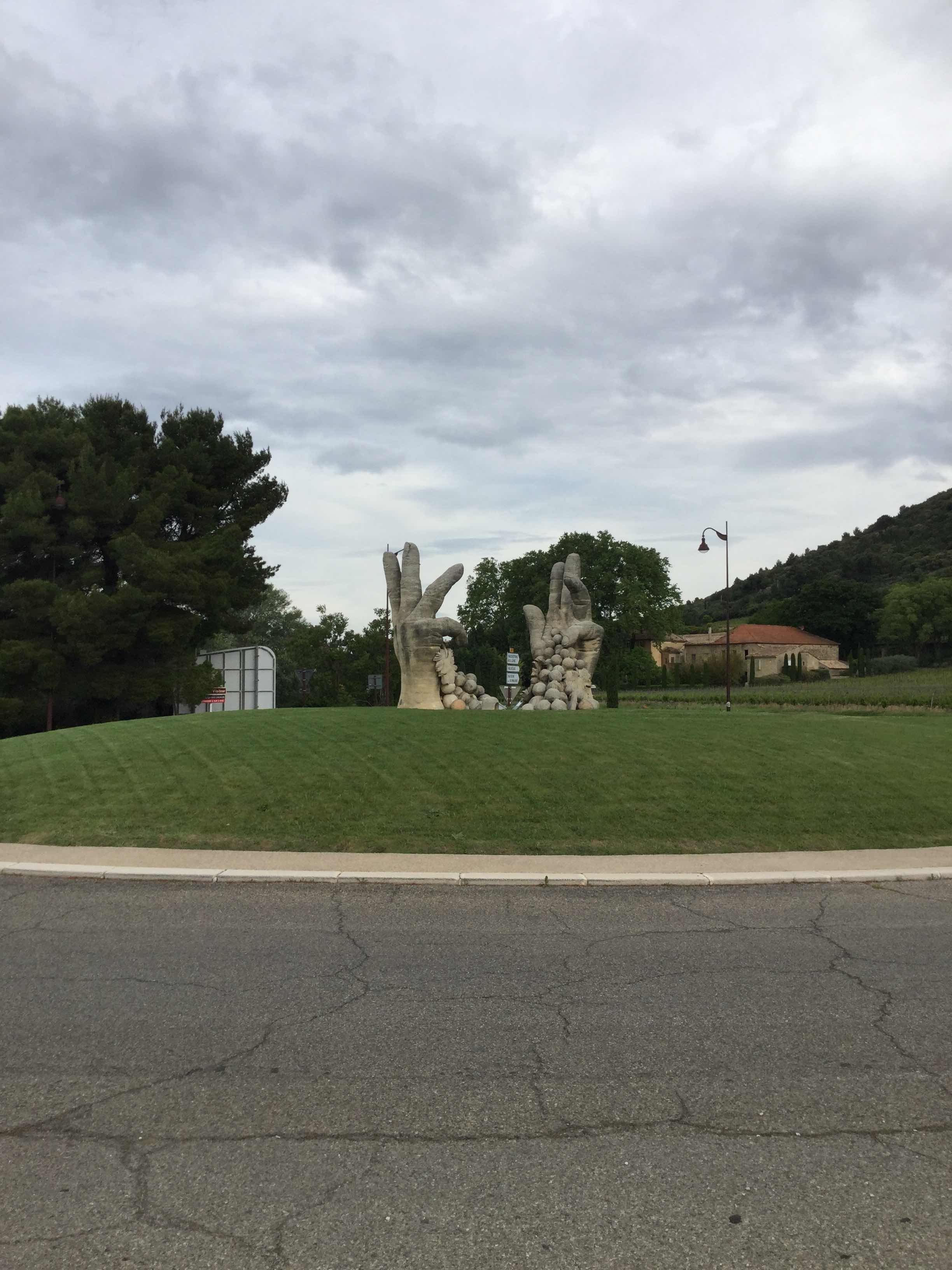
I arrived in Carpentras, the next big city, a little after ten the next day eager to take advantage of the WiFi at its tourist office.  I was disappointed to learn that due to budgetary concerns it was closed on the first Thursday of every month, as this was.  One year when strikes were sweeping the land, someone at a tourist office assured me the tourist offices would never strike, as they felt an obligation to be available to those visiting their country.  It’s hard to feel disappointed too long when cycling in France, as there is always something to lift one’s spirits.  It can be a work of art in a roundabout.


Or the many signs advertising a town’s vide grenier or an upcoming Johnny Hallyday tribute.


The arcades of plane trees and the pastoral scenery soothe the soul, and the occasional cyclist out for a ride, with panniers or without, dissipates whatever despair I might have for the future of the human race. And as I close in on Cannes, less than fifty miles away, I can be harkened by the world of cinema awaiting me.  It never fails to leave me with powerful memories and images that will last a lifetime.


Monday, April 30, 2018

Macon, France


This is the fifteenth time I’ve made the ride from Paris to Cannes.  I’ve varied my route every year always excited about what new discoveries I’ll make. I didn’t have to wait long, as my first came less than ten miles into my ride when I passed through the village of  Coupvray, and unexpectedly came upon the Louis Braille Museum.  It was in the home of the man, or boy, who developed the Braille system.  Braille was just fifteen when he devised the system of upraised dots in 1824 while attending a school for the blind in Paris.  He was frustrated by the present method of tracing one’s fingers over upraised letters.  It was particularly difficult to write in such a manner.

As always in France, one never knows when one will come upon a museum or monument to someone or something of significance, one of the many joys of traveling in France.  My trip was off to a great start, after fearing it was in jeopardy the day before when I received an email from Air France informing me my flight had been cancelled due to striking pilots.  When I called Air France to reschedule my flight I was relieved to learn the strike was presently effecting only ten per cent of flights and that I could take a flight through Detroit on the day of my original flight, delaying my arrival in Paris just three hours, not enough to cause me to be late to Cannes, as I’d allowed ten days to bike the 650 miles.

But I received another fright when I checked in with Delta for my connecting flight and was asked by the young clerk, who looked more suited to be working at a Walmart than an airline check-in counter,  if I had a visa.  I told her one didn’t need a visa for France.  She said that was only the case if one were returning within ninety days and my return flight was ninety-six days away.  Usually I am gone just around ninety days, but Cannes was early this year and The Tour de France a week later than usual due to the World Cup. 

I was certain there were years when I had stayed away more than ninety days, so asked, "Are you sure," hoping this wasn’t some new Trumpian regulation to limit Americans from spending money overseas.  She dabbled away at her computer and then handed me my seat assignments without saying anything other than asking me for my credit card to pay for my bike, evidently not wishing to acknowledge she had been misinformed.  Fortunately, the bike wasn’t an issue, as I had noticed too late that the Air France website stated that under certain circumstances one had to alert the airline forty-eight hours before flying if one were flying with a bike. It seemed unimaginable to the clerk that one would be going away for such an extended period.  She wanted to know if I would be staying in a hotel every night knowing how expensive that could be.

I was glad to be spared the seeming 90-day technicality, and the 48-hour advance notice technicality, but not the technicality from the crew inspecting my bike box and duffle bag that one is not allowed access to one’s luggage after turning it over to the airline.  I realized I had neglected to put an ID tag on my duffle bag and rushed after it as it was being wheeled to the special X-ray machines.  As the porter was unloading my gear for the inspectors, I tried to attach the tag to my duffle, but one of the TSA inspectors gruffly halted me, as if I were trying to thwart his inspection, and said he’d put the tag on for me.

I was surprised when I joined the long line of passengers for the TSA inspection that I was waved into the short line for VIPs.  I checked my ticket and noticed I had been upgraded to business class for my trans-Atlantic flight after the short one-hour hop to Detroit.  That was fine compensation for being rescheduled on a non-direct flight.  Except before I boarded that second flight I was told that my seat assignment had been changed and I was back with the commoners.  At least the flight wasn’t full and I had an empty seat beside me that I could somewhat stretch out on after dinner on the relatively short six-and-a-half hour flight.

I had just one more concern--would my bike survive the extra handling of two flights.  It arrived in tact, along with my duffle, at the oversized counter, although the French give extra large items a less insulting, more dignified name--"baggage hors format."  It harkens to the French term for the toughest of climbs in The Tour de France of "hors categorie"--beyond category.  The French also have a flattering, rather than denigrating, term for "wide loads" on the road of oversized trucks--"convoi exceptionnel."  They probably have a term for the obese that doesn’t impugn, perhaps “corps exceptionnel.”

Not that the French are adverse to insult.  A couple days into my travels when I was deep into La France Profonde, I paused along the road at a driveway to a house to shed my windbreaker.  As I was stuffing it into a pannier an amiable older gentleman in a blue workman’s smock ambled over and asked if I needed to rest.  I told him that I just needed to take off my jacket.  He asked where I was from.  At the mention of Chicago he blurted “Al Capone” and cradled his arms into a machine gun and slowly panned from side to side.  

“No, no,” I replied.  “It’s now known as the home of Michael Jordan and Obama.”

He said he had friends who lived in Harrisburg, Pennsylvania.  I asked if he had ever visited them.  

“No, I’ve never been to America,” he proudly replied, “There’s nothing good to eat there.  I’m 75 years old and I’ve never had a coca-cola or eaten at McDonald’s.  I have a garden and eat as much as I can from it.”

“Do you ride a bike?” I asked.

“Yes indeed.  I bicycled 2,000 kilometers from here to the Camino de Santiago across Spain.  And as you probably know we have the greatest bike race in the world and it’s free.  You can stand along the road and watch it go by.  In America nothing is free.  It’s money, money, money.”  

My country may have been an affront to him, but not me as an individual.  “You don’t look like an American,” he said.  “You’re too skinny. If I weren’t in the middle of a job I’d get on my bike and ride along with you for twenty kilometers or so.  I could show you a better road than what you’re on.”

I asked him if he at least liked American movies.  “They’re the worst!”   he erupted.  “They’re brainless, full of nothing but sex and violence.”

It’d been a long time since I’d encountered such an old-school, free-talking Frenchman, a charming stereotype that is not all that common, or at least so forthright. I couldn’t imagine an American going off on a French visitor in such a manner, not even the current resident of the White House in a one on one encounter, but he was a personification of French pride and superiority.  I couldn’t even get him to criticize his own president.  When I asked if he thought Macron was doing a good job, he replied, “Half and half” as he twisted a hand back and forth.  He, of course, thought Trump was an abomination.

My first destination on my way to Cannes was the small town of Cuy just north of Sens and about one hundred miles south of Paris.  I had recently learned from a new book about the inaugural Tour de France in 1903 by Peter Cossins that the rider who finished second in the first two editions of The Race, Lucien Pothier, was buried there and that the town plaza had been named for him.  Years ago I had  visited the grave of Maurice Garin, the winner, but knew nothing of Pothier.  The plaque overlooking Cuy’s modest plaza in front of a school said nothing of him coming in second, just that he was a “pioneer of The Tour de France.”  Perhaps it wished to avoid the issue that he along with the first four finishers of the 1904 Tour were all disqualified for cheating, including taking a train.


His grave was equally modest, making no reference to his cycling exploits.  It was distinguished by being the only red-hued tomb among the rows of grey stone.


From Cuy I continued south through up and down terrain while angling east towards the Rhône, which I would follow to Valence and Saint-Paul Trois-Chateaux, the only two Ville Étapes on this year’s Tour route that I could intersect on my way to Cannes.  They had both previously served as host cities for The Tour in the recent past since I began following The Race.  But I am always curious to see what early preparations they have made for The Tour’s arrival in a little more than two months.

As I descended to Macon I came upon vineyards for the first time indicating I had reached the warmer, temperate half of France.  The tourist office in Macon offered a 92-page booklet listing eight circuits of between 15 and 55 miles linking the many vineyards in the region.  Wine may be emblematic of France,  but my favored beverage is menthe á  l’eau, the dazzlingly refreshing  drink one makes by adding mint syrup to water.  It stimulates nearly every taste bud in my mouth and down my throat, many that I forgot existed, and keeps them in a state of delighted exaltation unlike any other food or beverage. That syrup was the first thing I added to my provisions when I came upon a supermarket.   750 ml bottle can keep my water bottle full of mint drink for five days.  I’ve been craving it since I saw a bottle in a French supermarket in Senegal going for twenty dollars compared to one dollar in France.  It is so delicious, and near addictive, it was very tempting even at that exorbitant price.  Obviously there are those in Senegal willing to pay it.