Sunday, June 21, 2015

Stage Seven, A Bounty of Bike Art


The 119-mile seventh stage from Livarot to Fourgéres was so rich in bike art that riding the route was like spending a day in a world-class art museum.  It was exhilarating and inspiring.  This was Brittany with a deep cycling traditional having produced icons Hinault, Bobet and Robic, so this was to be expected.  The communal art celebrating The Tour went well beyond the usual yellow and green and red polka bikes that are scattered along every stage of the route perched on rooftops and dangling from poles and occupying flower beds.  One never grows tired of such gestures, but they rarely merit a second glance.

Along this stretch there was such an abundance of original interpretations of the bike and figures mounted upon them, I was continually brought to a halt to give them a thorough study, just as one responds to an exceptional canvas or sculpture when meandering through a museum.  I was fortunate to be previewing the route and in no great rush so I could give in to my impulses and let them thoroughly touch my soul.   I'm looking forward to seeing them all again on race day, though I'll have to speed past and just give them a glance.

There was random art all along the route but three small communities stood out in particular, fully transforming their towns into full-fledged exhibition spaces.  The starting and finishing towns also had a nice array of tributes to The Tour and The Bike.  Livarot is one of six first-time host cities, and the smallest of the more than thirty Ville Étapes with a population just over 2,000.  As a first-timer it had bike decorations galore, but didn't go much beyond the usual. It is known for its cheese and had an over-sized package promoting The Tour in each of the round-abouts leading into the town.


And around the bend were the usual assortment of bikes.


Nearly every shop in the town had a bike-themed storefront.


Shop windows were adorned with jerseys or bicycles or painted figures on their windows.


But it wasn't until Vimouters, ten miles down the road, that I came upon something exceptional.  All through the town were extra-terrestrial-looking wooden figures mounted on bikes.  Some were solitary.


Others came in pairs.


And some were in a bunch.


The smaller village of Levaré further down the road featured art of an even more wacky nature.  The first was of a cyclist crashing head-first into a course vehicle with two spare bikes mounted on its roof as once happened to Eric Heiden during the 1986 Tour, the only one he rode, and is a danger all dropped riders face when they are trying to regain the peloton by illegal drafting.
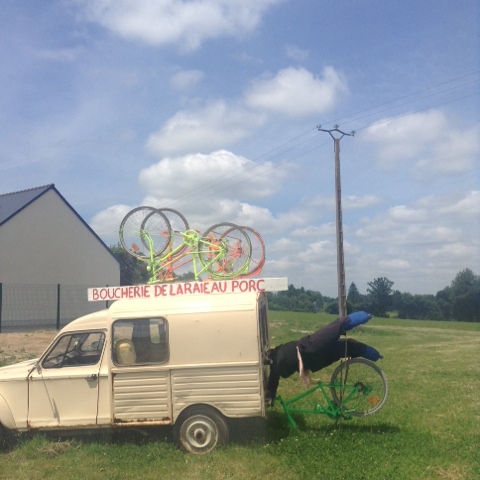

All through town were other stuffed figures, though in less traumatic poses.  One was of the town preacher in his vestments on a bike attacked to the town cathedral.  French have a long tradition of creating realistic scarecrows.  It is an art form that is recognized in festivals and competitions.  If it weren't for WWII canceling the first Cannes Film Festival in 1940, the first Palm d'Or winner could have gone to a scarecrow movie--"The Wizard of Oz."


A couple of stuffed elderly ladies, who'd certainly keep the crows off the corn, sat on a bench beside a pair of rusty old bikes.


The equally small town of Tanniére had a Vive Le Tour welcome on its outskirts with a stuffed figure on a bike in the distance.


All through the village were more stuffed figures, some on bikes and others masquerading as spectators, who represent The Tour as much as the racers.


One figure had a bucket for a head.


There were also a few giant bicycles along the route, a common sight, but with an uncommon figure.


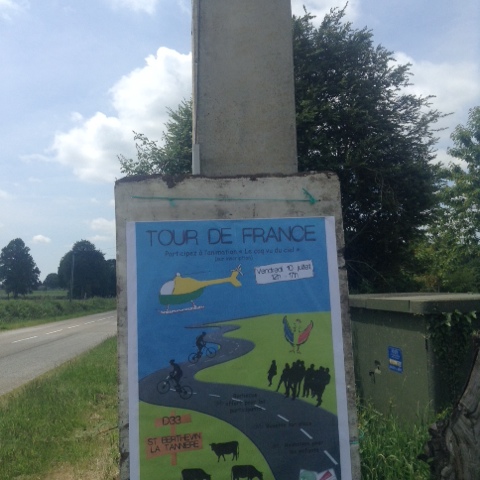
One town advertised its Tour party with a poster that had a yellow and green helicopter with red polka landing skids hovering above the peloton. 

The Tour is frequently compared to Christmas, as communities on the route anticipate it with fervor for months and then they are rewarded with all sorts of goodies from the publicity caravan.  One farmhouse on the route adorned itself with half a dozen Santa Clauses on bikes.  Two were on its roof by its two chimneys, another was across the street on the barn and a trio were on a bike on a wire.


At the finish in Fougères a round-about included several figures on bikes designed with a minimum of swooshes.


There was also a more solid figure, though still riding a minimal bike.


The light poles on the finishing stretch were all adorned with yellow wheels.  It is more than three weeks before the peloton and I will be riding past them.  There will no doubt be lots more decorations all along the route, especially when communities see what their neighbors have done and they will try to equal it.  I was told by one tourist office that they were late with their decorations, but there would be some.  I'll be riding past them all with a boundless sense of anticipation and gratitude.


Friday, June 19, 2015

Le Havre, Ville Arrivée Stage Six


The weather behaved in typical fashion along the Normandy coast, a cold, fierce wind blowing off the English Channel one day and a soupy drizzle the next, as I previewed the 120-mile sixth stage of The Tour.  I'll be bypassing this stage come July, saving myself one hundred miles by biking directly from the Stage Five finish in Amiens to the Stage Seven start in Livarot, rather than going north to pick up this stage.   I was glad to have the opportunity to ride the stage, as it will be a dandy with challenging and spectacular terrain.


And the roadside already abounded with decorated bikes and signs of welcome.


Although there are only three category four climbs on the route, there is a considerable amount of climbing and the stage concludes with an uncategorized, steep half-mile climb to the finish that will shed the sprinters and have the likes of Nibali, Gilbert and Sagan licking their chops. If the wiind is a factor, fracturing the peloton into echelons, this could be one of the pivotal stages of The Tour, along with Stage Four and its seven stretches of pavé.  

The organizers have designed a stage that is in the league of the Spring Classics.  It ought to instigate a day of inspired racing that could make it one of those stages that is talked about for years to come.  I could well imagine the fury of riders trying to stay away and others trying to catch up, as I pushed into the wind struggling to go ten miles per hour.  But rather than bemoaning my lot, I could only marvel at the beauty all round me and congratulate The Tour organizers for finding such roads.  It was a privilege to be riding them.

There were others out riding, some with panniers and some not, but none of The Tour riders, though I well knew that any of the cars passing me could contain representatives of the teams scouting out the route and making copious notes of its ups and downs and ins and outs, concocting strategies of places to attack or to be wary of attack.

Quite a few of the towns had tourist offices. I was happy to duck into them to warm up or dry out.  Many offered WIFI.  I would make use of it, more though for the opportunity to avail myself of their electricity and charge my iPad, than to take advantage of the Internet.  With all the tourist offices, I've hardly needed to search out cathedrals for charging.

The town of Étretat, twenty miles from the finish, had scattered painted bikes along the road for several miles, each with a placard honoring a French rider from year's past as well as a few current ones.  Most were painted the traditional yellow, green and red-polka dot of the preeminent leader jerseys, but there was the occasional white bike, the jersey color for the best young rider, also synonymous with ghost bikes marking the spot where a cyclist has been killed, though not the case here.  The cyclist honored with this bike, Gilbert Duclos  Lassalle, is still very much alive working as a commentator.  He wasn't a Tour contender, but twice won Paris-Roubaix.


They were a pleasing site all,


no matter where they might have been placed.


A banner across the road the peloton will be riding embraced The Tour, referring to it as "our Tour," as the French so fondly regard it.


After the peloton enters Le Havre it will continue to its extensive docks and then make a 180-degree turn and ride through the center of the city past its City Hall and old cathedral before the steep climb to the finish on a ridge overlooking the city. It will be dramatic.  I will be sitting in a bar with Vincent and David one hundred miles away imagining I was there and ready to head to the cemetery just beyond the finish to fill my water bottles.   I will be glad, though, not to have to make the fifty mile transfer to the next day's start from there, especially as it includes riding for miles through the docks and then over a high bridge in a narrow bike lane on a superhighway crossing the Seine with a steady torrent of traffic.  Instead the three of us will be riding late into the day trying to reconnect with the peloton as it heads into Brittany.  

I'll be pushing on a couple more days now down the course before I must turn around and head 600 miles or so back to the start in Holland.  The count down is now fifteen days until The Race start and thirteen days until the presentation of the twenty-one teams.


Wednesday, June 17, 2015

A Quartet of Ville Étapes


My simple question of where The Tour de France would finish in Cambrai was greeted with a rare level of enthusiasm from the fifty-year old woman behind the counter of the Tourist Office in Cambrai.  Though the vast majority of those staffing the many tourist offices throughout France are most cordial and helpful, not many go beyond simply being friendly.  This woman was full of exuberance and seemed thrilled that I was interested in The Tour and treated me like an intimate friend she hadn't seen in a while, wanting to know what I'd been up to and sharing things that would interest me.

"Its finishing just up the street in the big main plaza.  It's less than a month away and the anticipation is bubbling.  Every day there is a story in the paper about it. Yesterday the story was about the seventh section of pavé that is on the route on the way into Cambrai being named for a former racer who lives in the area.  Nearly 500 people came out for the ceremony.  Here let me show you."

It was a full page story with a photo of seventy-year old Robert Mintkewicz beside a plaque bearing his name.  He rode The Tour eight times in the '70s.

Seeing my avid interest in the article, she said, "We have a monument by a round-about not far from here honoring Jean Stablinski.  I'm sure you know who he is.  He lived in the area too.  Its too bad you weren't here last weekend.  We had a ride that was part of a Fête du Tour in all the Ville Étapes riding a portion of The Tour route."


I told her I had been in Mulhouse and participated in a bike ride there.  When she learned I had been biking around France the past month scouting out The Tour route and visiting various bicycling and historic shrines, she asked, "Do you know Louis Bleriot?  He's from here."  

I was sorry I had to tell her I didn't know him.

She charged from around the counter and said, "I'll show you who he is."  She led be to the front of the office and pointed up to his bust.   


"He was the first person to fly across the English Channel," she said.  "He did it in 1909, six years after the Wright Brothers first flight.  He won a thousand pound award from an English newspaper for doing it.  The same round-about that honors Stablinski also honors him. You really must go see them."


I assured her I would.  She was a whirlwind pulling out various brochures on things to see in the area from military sites to museums.  I asked if she had anything on Robespierre, as I was headed to Arras, where he was born.  She didn't, but she told me that Arras, like Cambrai has a network of subterranean passages and that I could go down stairs here for a sampling.  She was a wonder, someone who genuinely loved her job.  I didn't want to leave.  She was wearing a colorful sweater that matched her personality.  "I like your sweater," I said.

"You do?  I bought it in America."

"You'll have to wear it when The Tour comes to town.  I'll come by and I'll have a couple friends with me from Australia and Germany who would like it too."

"I'll be here," she said.  "It will be an exciting time."

It was a quick twenty-five miles to Arras, my legs fueled by her abundant energy, the start town for the next stage, a not too painful transfer.  Right at the starting point on a small hillside dotted with bikes painted the colors of The Tour leader jerseys, a digital sign on a Tour-decorated billboard had the number twenty-three on it, the number of days until The Tour will grace the town.


Before I set out on the route I paid a visit to the house where Robespierre lived until 1789, when he moved to Paris to serve as one of the ring leaders of the French Revolution, until he fell victim to the Reign of Terror and was sent to the guillotine.  His home on Rue Robespierre, a narrow one-way street, is now a museum and a tourist draw.


This fifth stage starting in Arras ends in Amiens, another large northern city, about the same size as Cambrai and Arras.  Riding the route I could feel the pavement humming in antipation.  I could feel the joy that would radiated by the thousands of fans lining the quiet countryside roads for hours, picnicking and hanging out with family and friends for hours.  This was the sensation I had been missing the last couple of weeks when I was making the huge jump from the Alps up to The Tour route in the north.  I followed the fifth stage route all the way to the finish in the center of Amiens across from the Cirque Jules Verne.


Two blocks away is the home of Jules Verne, now a museum with large paintings on a surrounding wall of some of his wild imaginings.


Equally distinctive is his grave in the huge Cimeterie Madeleine on the outskirts of the city.


The chief attraction of Amiens though is its World Heritage cathedral.  It would have made for a spectacular backdrop to the stage finish, but it was surrounded by narrow one-way streets too perilous for the peloton.  At least its start in Arras would pass a World Heritage site, a Belfry in the town center. 

I had another transfer of roughly twenty-five miles from Amiens to the start of the next stage in Abbeville, a lesser-sized city.  Tour fever was manifested here with painted cyclists in yellow and red polka dots on Its tourist office window.


There was another set on the glass doors of its city hall.


The round-about leading to the city offered more of a warning than a celebration of The Tour.


The route through the town included an artistic wheel arrangement.  I was hoping there might be a series of them, but it was the only one.  


No worries, as there will be plenty of bike art in the many miles ahead.


Sunday, June 14, 2015

Fontaine-au-Pire, France


This year's Tour de France route may be less of a tour of the country than any previous route since that first one on 1903. Rather than making a loop around the country, as was the initial practice, this year's route is nine stages across the top of the country and then eleven stages across the bottom before finishing with a largely ceremonial stage from a suburb of Paris into the city.  There will be two transfers by plane of 500 miles from the north to the south and then 300 miles from Grenoble to Paris.

After scouting out some of the route through the Alps I've been in Tour withdrawal the past two weeks as I've put nine hundred miles on my legs biking along the eastern edge of France through the demanding up and down terrain of the Vosges and the Ardennes up to Cambrai, the finish for the fourth stage, the first stage finish in France after two in Holland and one in Belgium. There has been plenty to see, including the birthplace of Rimbaud in Charleville-Mezieres, but I haven't been able to preoccupy my mind on the upcoming Race, now less than three weeks away, as much as I'd like.

About ten miles before Cambrai I stopped off in Fontaine-au-Pire, the smallest town ever to host a Tour stage, hoping to find some plaque or monument celebrating the event.  There was none to be found, not on the welcoming sign to the town of 1,217 or on its Town Hall or small stadium or in its central plaza.  The town hall had two plaques relating to the Second World War, but nothing on The Tour's finish there in 1983.


It might have been because the town was suppressing the memory of the tragedy of that visit.  It was supposed to be a Ville Arrivée in 1982.  It was going to be the greatest event in the town's history.  Great expense and effort had gone into winning the honor of hosting The Tour.  Striking workers, though, blocked the stage before it could reach Fontaine-au-Pire and the town was denied the thrill of having Benard Hinault and all the other great cyclists of the time grace its streets and being telecast all over the world.  It was devastating.  The Tour made it up to the town the next year with a Team Time Trial finishing there, but it wasn't the same. 

I camped in a small field on the outskirts of the nondescript town of largely brick row houses.  I was woken by a pack of barking dogs out for a run with a man who sells dogs.  He warmly welcomed me, thinking I might be a pilgrim following the Santiago de Compestelllo route, as it passes nearby.  He was delighted to learn I was an American, but confessed to not much caring for The Tour de France.  He said The Tour coming to his town was a "catastrophe" and best forgotten.

I wondered if that would be the case as well as I approached Varennes-en-Argonne two days before.  It was there in 1891 that Louis XVI and Marie Antoinette were captured in the middle of the night fleeing the country.  I had asked in the tourist office in Verdun, thirty miles away, if there was a plaque commemorating the event and where it might be in case it happened on a road outside the town.  I was told there was a plaque in the town square.

Actually there was a series of plaques, written in French, Englsih and German,  throughout the town detailing all the events relating to the capture of the King and Queen.  They were promoted as the "Tour de Louis XVI."


They had made their escape from Paris at 2:30 in the morning in two carriages, the King and Queen in one and members of their retinue in the other.  They reached Varennes at 11:30 p.m. that night.   They had stopped several times for fresh horses. Varennes was their final relay point, just fifteen minutes from crossing the border of France at that time to safety.  At their last exchange someone suspected who they were.  He and a companion set out after them, not catching up to them until Varennes.  While the royals waited for new horses they rounded up anti-royalists to waylay them. The two became  national heroes.  People from all over the country sent them money and presents.  Friction arose as others who had assisted were envious of their acclaim and the spoils they reaped.  Varennes for a time was also celebrated for its role in detaining the King and Queen, but the town went into decline when those of wealth, who sided with the King and Queen, left the town.  A year-and-a-half after the capture Louis was sent to the guillotine on January 21, 1793.  Nine months later Marie-Antoinette suffered the same fate. 

Varennes remains a quiet small town.  More prominence was given to the battles of WWI that were fought in the vicinity.  Verdun is nearby, where the most prolonged and bloodiest fighting of the war took place.  There was a musuem and a large memorial to the American fighting forces with the Stars and Stripes flying high above it on General Pershing  Road, the main street through Varennes. 


A few miles north of Varennes, outside the smaller town of Romagne-sous-Montfaucon, is the largest American cemetery in Europe with 14,246 graves.  It is one of twenty-five American military cemeteries scattered around the world, all in Europte except ones in Tunusia, the Philippines, Mexico and Panama. 


It is one of six American cemeteries in France from WWI.  There are six others containing WWII casualties.  There were scattered small German cemeteries as well, not as well maintained and with dreary brown crosses.


As I bicycle across the northern tier of the country scouting out The Tour route there will be plenty more cemeteries to come, including the largest of the French with 40,000 dead, north of Arras, start of Stage Five.  The legs are coming around.  I'm far enough north now that it doesn't grow dark until after ten p.m. 


Thursday, June 11, 2015

Mulhouse, France

When I last visited Yvon in Mulhouse eight years ago, we didn't have time for a side trip to the Peugeot Museum in Sochaux to see the bike Bernard Thevenet rode to victory in The Tour de France.   Every year since, Yvon has been asking, "When are you going to return to Mulhouse to see Thevenet's bike?"  We'd been to his birthplace in Le Guidon and had met up somewhere in France every year, usually somewhere along The Tour de France route, but it had never worked out to swing by Mulhouse over along the German border until this year.

I arrived in Mulhouse two days before Yvon, as he's been spending most of his time with his girlfriend on the other side of the country.  I chose to reach Mulhouse before Yvon, as I wanted to be in one of the larger cities in France on the first weekend in June when the entire country celebrates the bicycle with a Fête du Velo.  Mulhouse  would be a fine place to be, as it has a strong cycling community and an extensive network of bicycle paths and is on the Velo Euro route that goes from the Atlantic to Bulgaria.

The Mulhouse Fête du Velo activity was a ride around the city to various schools to encourage cycling to school as well as commuting in general.  More than a hundred cyclists gathered in the Place de la Reunion beside the town's central cathedral for the ride and not a one was wearing Lycra. The convivial crowd was accompanied by several police officers on bikes who corked intersections so we could remain in mass.  There were a good many children, most on bikes, but some also as cargo.


Before the ride set out I chatted with a guy who had been among those who campaigned to establish   the first bike path in Mulhouse thirty years ago.  There had been a commemorative ride a couple weeks ago. He was quite proud of the tremendous number of bike paths all over the city now.  It was comparable to a Dutch city with a bike way on nearly every street. 

He was one of several cyclists on Bromptons.  I rode along with one of them who said it was easier for he and his wife to put the fold-up bikes in their car rather than mounting a regular bike on a rack. His wife wasn't on the ride as she preferred to shop.  He had traveled extensively (Africa, Tibet, China, the US), but never by bike and was most interested in my experiences.  He was heartened to hear that Air France gladly accepts bikes and even provides boxes for them.  He was all set to book a flight.

The ride ended where we started after two hours of meandering all over the city. Cold water in five gallon jugs awaited us on a table under a tent.  And beside the jugs were bottles of mint syrup, my favorite additive, to please the taste buds, as is a national imperative.  


In the US, the water would have been laced with Gatorade or some other synthetic electrolyte that may or may not have been gastronomically sensible.  The French do-it-yourself menthe a l'eau was another shining example of their way of making life a little more liveable.  I was happy to toast one of my Bromptom companions with a "Vive la France."

It wasn't the only occasion that my palate would be pleased in Mulhouse.  Besides the fine cheeses and fruits and vegetables and olives that accompanied the meals Yvon prepared, our lone meal out was a uniquely French experience.  It was lunch at a cafeteria for city employees, current and former.  As a retired postal worker Yvon was entitled to partake of the bargain four euro meal and could bring a guest.  We had our choice of three entrees (steak, duck or omelet) including a heap of French fries and chopped green beans along with a variety of salads, deserts, cheeses and fruits.  Wine and beer were among the beverages.  It was a veritable feast. All larger cities offer such a service and Yvon could drop in on any.  

I was hoping Yvon would tag along with me after I left Mulhouse so I could take advantage of more of this fine dining but he had other matters to tend to.  We still had a fine two days biking and museuming.  Yvon is a volunteer greeter for the tourist office, so was well versed on all the city had to off.  Its automobile museum with the official title of "Cité de l'Automobile--National Museum--the Schumpf Collection" has the largest collection of automobiles in the world.  A sprawling, nicely reconditioned former factory contains 520 cars, mostly from the collection of Fritz Schlumpf, who made his fortune in textiles.  He had secretly amassed his collection and had it hidden away in this factory.  It didn't become known until his workers went on strike and took over the building.  The workers held the collection hostage for two years while they were on strike.  To raise money they began charging admission for people to see the cars.  The French government eventually bought the collection to pay off the debts of Schlumpf and his brother and made it an official museum in 1982.


The collection was Eurocentric with not a car from America nor even a mention of Henry Ford.  There was a heavy emphasis on the early French cars of Bugatti and De Dion-Bouton.  The only reference to America was a photo of an astronaut on the moon as a reference point for 1969.  There were scattered videos and a large screening room with racing footage from Monaco dating to the 1930s and also the Paris-Dakar race.  The museum is popular enough to be open every day of the year except New Year's Day.  Behind the museum motorists could race their own car on a small figure-eight course.  

There were a few Peugeots in the collection, but they were a mere sampling compared to the several hundred on display at the Peugeot Museum forty miles away in Sochaux.  Mulhouse also has a Peugeot factory, the city's largest employer with 12,000 workers, about the same number who work in Sochaux, where the Peugeot brothers started their business in 1810 originally manufacturing saw blades.  They were clever and innovative and manufactured almost anything steel-related that had a sizeable market--hammers and knifes and bands for corsets and coffee grinders and washing machines and radios.  They were among the first to manufacture bicycles in 1882 and then automobiles nine years later, which came to dominate their production line.  The museum likewise was dominated by the automobile.  It was as overwhelming as the musuem in Mulhouse. Its collection included 450 cars, though only 130 could be on display at a time.  In contrast to the Mulhouse museum, it had a heavy emphasis on accessories, and non-automotive products.  Only one small alcove, though, was devoted to the bicycle.


Sandwiched among the fifty or so bikes were two that were raced to victory in The Tour de France.  The 1967 bike of Roger Pingeon and the 1977 bike of Bernard Thevenet.  Missing was Thevenet's 1975 bike--the PX-10, an exact copy that I bought in 1976 with tubular rims for $250 and then rode coast-to-coast across the US the following year, though on clincher rims.


This museum was as French as the automobile museum in Mulhouse.  There was no mention of Eddie Merckx riding for the Peugeot team early in his career or Tommy Simpson either, winning the World Championship on a Peugeot.  America received a mention though in the list of Peugeot automobile wins.  The first came in 1894 in a race from Paris to Rouen and the latest up Pikes Peak in Colorado in 2013.  The gift shop had nothing bicycle-related, just books and models devoted to the car along with t-shirts and other garments with the Peugeot logo 

If these two automobile museums hadn't sated me, I could have spent a couple more days taking advantage of the many other museums of Mulhouse devoted to trains, electricity, wall paper, printed fabrics, history and fine arts.  One of the nicest features of the city was  free WIFI in the downtown district, something that ought to be available everywhere in every city and probably will be sometime in the future.  Yvon's branch library didn't offer WIFI.  Fortunately it was just a couple miles into the city center on a bike path paralleling one of the several tram lines in the city.  A tram ticket was little more than a euro and was quite popular.  One could hear the hum of the tram from Yvon's 16th floor apartment that he has had for thirty years.  As always, it was a great pleasure to be under the comforting wing of Yvon.  We are looking forward to connecting once again during The Tour after the peloton leaves the Pyrenees and heads to the Alps.  


Saturday, June 6, 2015

Le Corbusier, Hugo and Pottier

It may be a place of worship, but one still must pay a fee of eight euros if one wishes to lay eyes upon the Le Corbusier chapel on a hill high above the village of Ronchamp on the fringe of the Vosges Mountains in eastern France.  A fence and trees block the view of this celebrated shrine, considered one of the major architectural achievements of the 20th century by one it is premier architects. 

Though Le Corbusier's promince is largely due to his work in the urban sphere, this wildly original,  ultra-modern chapel, that is a dramatic departure from his principles of standardization, ranks among his most distinguished designs and is as much of an architectural attraction as the many notable works of Frank Lloyd Wright scattered across the US.   Signs began appearing for it from miles away up to the final turn across the street from Ronchamp's cathedral and tourist office.


The better than ten per cent grade up the slightly less than mile climb to the marvel was more of a strain than anything I had encountered in the Alps.  The road fed into a large parking lot and continued no further.  I had been anticipating a quiet picnic beside the chapel while I charged my iPad.  Instead I was greeted by a high fence and a visitor center and rules about what one could do on the premises.  At least there was a WC and I could fill my water bottles.

The grounds beyond the fence included a grass-roofed dormitory for pilgrims that originally served as the quarters for the construction crew, a rustic house for the priest, accommodations for the sisters of the chapel, a peace pyramid, a bell tower and the chapel. I thought there might be a barn and silo on the grounds as well, as that was my first impression of the chapel as I climbed the path towards it.


As I circled around it, each view offered a different impression.  There was no discernible front or back.  It might have been a deformed igloo or a military fortress or the laboratory of a mad scientist.  Its isolation and dead quiet made for a perfect retreat.


One side had a cluster of narrow slots that let light in, but could have been used by archers, if the glass were knocked out, to ward off attackers.


The interior was a large cavern with three small alcoves each hosting an open bible on a table illuminated by a candle.  All the light came from candles and the sun.  There was not an electrical socket to be seen in keeping with the original chapel dating to the forth century that stood on this spot that was destroyed in WWII.  Le Corbusier's version was completed in 1955, ten years before his death.  There are concerts and events all summer commemorating its sixtieth anniversary.

Ronchamp hadn't been on my itinerary.  It just happened to be on my way to Ballon d'Alsace, the so-called first climb in the history of The Tour de France in its third editon in 1905.  That wasn't entirely true, at it was only slightly higher and longer than the climb over the Col du Republique in the first two races up from St. Etienne that I passed on my way to Cannes, but Henri Desgrange wished to hype that third Tour with its first foray in a mountain range (the Vosges), wondering if the racers were capable of the eight-mile, 2,000 foot climb up and over the 3,700 foot summit of the range.  It may have been a feat 110 years ago on the one-speed clunkers of the day on an unpaved road, but on this day there was a steady stream of cyclists giving it a ride.  I was the only one with baggage though.  The five and six per cent grade was much easier to handle than the brutally steep climb to Le Corbusier's chapel.

A plaque at the summit commemorates the first rider over the pass, René Pottier, not only that year but the next as well.  He won The Tour in 1906.  In 1907 he became the first of several Tour winners to commit suicide, distraught over the infidelity of his wife.


Another bonus attraction on my way to this plaque was stumblimg upon the birth place of Victor Hugo. It was in Besançon in 1802.  The house he was born in is now a museum.  It is just two blocks from one of the first libraries founded after the Revolution, built nine years after his birth.


I must have had a premonition that Hugo was on my route, as just a couple days before I had downloaded his memoirs from the invaluable Project Gutenberg website.  The book doesn't mention anything of his youth or his hometown or his family or even his writing.  It was published in 1899, fourteen years after his death, and is a collection of remembrances mostly about his time as a legislator during the Rebellion of 1848 when another King was ousted. He was a famous figure by then, and recounts conversations with the King and many of the principals of the time.  He later went into exile but returned to France in 1870.  He was a much beloved figure who campaigned for the poor and universal suffrage and against the death penalty.  His funeral procession from the Arc de Triomph to the Pantéon, where he was buried, attracted over two million people.  Nearly every town in the country has a street or place or library named for him.

What awaits me down the road, as I head further north to connect with The Tour de France route, I know not, other than that there will be more notable sites and that the pedaling will be take me through scenery that never disappoints and pleasing small towns that all have a genuine allure.


Monday, June 1, 2015

Lyon--City of Cinema and Cycles

One of the valuable lessons I've learned in my years of bicycling around France is to not to pay attention to road closed signs.  Just because a road is blocked to motorists, doesn't mean someone on a bicycle can't get through whatever is causing the detour, whether it be road construction or a landslide or a carnival or some other local event.  It might be hairy, such as the cliffside Craig and Andrew and I had to negotiate two years ago, but it is always satisfying to defy those detour signs and save myself many, many miles of extra riding and also have the road all to myself sometimes for an hour or more.


There is always the danger that the detour could be legitimate, such as with a bridge being out, and that I will have to double back the distance I have ridden, which can be several miles, but such occurrences are such a rarity I'm never hesitant about continuing on past the "go away" signs.  I almost welcome them for the miles and miles of solitary riding they promise. 

I was a little bit nervous, though, a couple days ago when a sign at the summit of the 6,749 foot Col du Lautaret warned that the road was closed 25 kilometers away.  I wouldn't want to double back the fifteen miles from the closing point, as it would be a Category One climb. But my options weren't much better--either to continue climbing from the summit of the Col du Lautaret for five miles over the Galibier or to descend seventeen miles back to Briançon and make a wide circuit to Gap and then to Grenoble.  

The Galibier does have its allure.  It was Henri Desgrange's favorite climb, and there is a monument to him a kilometer below the summit.  But I've climbed it several times already, and didn't care to subject myself to it again, especially after doing the Col de Vars the day before, another Beyond Category climb.  My legs were ready for some respite after six days in the Alps, two more than The Tour de France will inflict upon the peloton this year.  The Col du Lautaret was to be my final big climb until the Pyrenees in a month-a-half.  Along with the views the highlight of the long climb from Briançon was a ski gondola in the middle of a roundabout promoting the skiing in the area, winning the award for the most distinctive roundabout so far of these travels.


There were no roundabouts on the descent even though I passed though a couple of small towns along the way.  At each of the towns more signs warned the road was closed ahead.  An occasional car passed me but none flashed their lights or frantically waved or nor did anyone shout at me to turn back as I passed through the towns, giving me some hope that I wasn't on an ill-fated mission.  If I had to climb back, at least it would prolong my time in this spectacular scenery and also put some more quality miles on my legs.   After ten miles the road flattened a bit, but continued to descend along a rushing torrent of a stream.  

A couple miles further I came upon a narrow, dam-created lake.  Just before it a dirt road descended to the lake.  It looked like it might be a detour, but I continued on the paved road, high above the lake.  After a mile I came to a blockade I could easily get around.  There were road construction vehicles along the road, but it being a Saturday, no one was working.  If it was just this bit of construction that was the cause of the road closure, I could start celebrating.  

Around a bend I came upon two guys walking my way.  They waved their arms to make me halt, just what I didn't want.  They said I wouldn't be able to get through, as a tunnel had been sealed up and there was no getting through or around it.  With a sunken heart, I asked if the dirt road down below might get me around the lake, though I could see that it had disappeared below the sheer cliffs down to the water's edge. "No, no," they said, but that road I had seen led to a small ferry that would take me and my bike across the lake.  That was too good to be true, but it was, as we could see the pontoon ferry that very moment approaching the landing, not even docking, just barely coming up to the sandy shore.  I didn't care that I'd have to wait for its return, however long that might be, I was just thrilled to have my daring rewarded once again.

After the twelve-person shuttle of a ferry, which I shared with just one other, I continued descending to Bourg d'Osians at the base of L'Alpe d'Huez. I was a week early for a gathering of 20,000 Dutch cyclists who come there every year the first week of June, most of them making the climb six times as the word six in Ditch is similar to the word Huez. I camped a little ways beyond the small town and then continue on to Grenoble, thirty milers away, just as I will do when The Tour de France rolls around.  I needed to scout out the train station in Grenoble, as for the first time I plan to take the train to Paris rather than biking the three hundred miles.  It will be an early morning train so I can arrive in Paris in time to see the peloton on the Champs Élysées. Though I knew the location of the train station, I've learned its best to confirm the route ahead of time so there will be no surprises, especially when I'll be pressed for time.

Another of those lessons France has taught me is not to feel too crushed when a road I'm riding suddenly presents me with a no bicycles allowed sign. Though it is certainly disheartening, I know that it may be only for a short stretch and that I'll be able to return to the road after taking a secondary road or bike path paralleling it or sometimes a bit more of an alternate route.  Twice that happened to me on D1006 on my seventy mile hop from Grenoble to Lyon.  I'd never entered Lyon from the east before and didn't see a better route than D1006.  An autoroute (super highway) ran near it, so I presumed D1006 would be bike friendly.  It mostly was, but I did suffer the frustration of having to pull out my map several times to figure out what was going on when I was inflicted with that dreaded French sign of a bicycle with a red circle around it (red circle rather than slash). When I returned to D1006 for another try after my second eviction it was clear sailing the final twelve miles into Lyon.  

Just before the sprawl of France's second largest city with two million inhabitants began, I passed its airport, named for Saint-Exupery, the famous pilot and writer. As I frequently see at French airports, someone had parked their car to watch the take-offs and landings.  When the urban congestion began, the highway assumed a name--Avenue Franklin Roosevelt.  A couple miles before the city center I came upon a huge monument celebrating the Lumiere brothers, the inventors of cinema.  It was appropriate that right in front of it was a row of rental bikes, as Lyon was at the forefront of the urban bike rental programs that have swept the world.  Paris was inspired by Lyon, which inspired all the rest.


This plaza was right beside the neighborhood where the Lumieres lived and worked.  A small side street leading into the plaza was called "Rue de Premier Film," as it was on that street the Lumieres shot the first film ever on March 19, 1895.  It was fifty seconds long and showed the workers streaming out of the Lumiere factory, some of them on bicycles. A plaque marks the exact spot where the camera stood.


And just across the street beyond the actual walls that all those workers passed through, the factory has been converted into a movie theater.  For the month of June it will pay tribute to Orson Welles.  


It was an unexpected thrill to stand at this seminal spot, as thrilling as standing where the inaugural Tour de France set out from on the outskirts of Paris in 1903 or standing where Lincoln stood when he delivered the Gettysburg Address.  The images of that first film are so deeply embedded in my movie consciousness I felt transported back to the actual filming and good vividly perceive those fifty seconds  even without closing my eyes. One of my most memorable experiences at the Telluride Film Festival was in 1995, the centennial of that first film, when Bertrand Tavernier and Thierry Fremaux gave a presentation of the films of the Lumieres.  Among the films they showed, including that first one, was the first film ever with a narrative--a cyclist being pummeled by snow balls and then having his bicycle stolen.  One of the images on the walls of the institute taken from the films of the Lumieres was of an acrobatic bicyclist.


But it wasn't the Lumieres, though it could have been, that brought me to Lyon, but rather to pay homage to Paul de Vive (Velocio), the father of my greatest passion--cycle touring. Back before 1900 he was the first advocate of venturing off into the countryside on one's bicycle, and made it his life's work.  He is buried in the huge Loyasse Cemetery high on a ridge overlooking the city.  The road up is so steep, one can take a funicular.  Luckily the cemetery is such an attraction it has an office and maps in English and French listing the significant graves.  Velocio was among the forty-nine listed.  It would have been impossible to find him otherwise among the thousands of graves.  Even with directions it wasn't so easy to locate him, as he was buried in a family plot of a name other than Vive and his name was near the bottom of those listed on the tomb.  


It was the two plaques on the tomb devoted to him that caught my attention.  It was almost as much of a thrill to prop my loaded bike up against the fenced-in grave of this great as it had been earlier in the day to gain a personal relation to the first film ever shot.  But this was my third pilgrimage to a Velocio site.  I'd been to his birthplace on a previous trip and just a few weeks ago climbed a road named for him to his bust at the summit of the Col du Republique outside St. Etienne, where he had spent most of his life.


My visit to Lyon lacked just one thing--a tribute to the first stage of the first Tour de France in 1903 that concluded in Lyon.  The best I could do was to linger in the huge Place Bellecour where the racers set out from on the race's second stage.  In the middle of the plaza is a statue of Henri XIV on a horse and overlooking it the high ridge with a huge basilica and the Loyasse Cemetery and a communications tower that is a replica of the Eiffel Tower, erected in 1893, ten years after the original.


The narrow streets of the old part of the city are a UNESCO World Heritage Site.  Among the labyrinth of streets is the Gadagne Msuem with a collection of over two thousand puppets, the only one of its kind in France.  But it was Monday and its many museums were closed, so I was denied it along with the Lumiere Museum and a museum devoted to the confluence of the two rivers that converge in Lyon, the Rhone and the Saône, right there at their merging point south of the city center.  Also closed were all the libraries, the way of the French, catering to the workers rather than the public..