Monday, October 28, 2013

Cycling Book Number Five from Richard Moore

Richard Moore is establishing himself as the premier English cycling journalist of our time.  His is a by-line I am always happy to see, whether on the cover of a book or in a magazine.  He always has something cogent and well-informed to offer, writing with the enthusiasm of the fan he once was growing up and the expert he became as a racer.

He has contributed five significant books on cycling in the past seven years beginning with a biography of the elusive Robert Millar, "In Search of Robert Millar," in 2007, trying to get to the bottom of an enigma that had all racing fans wondering.  Continuing his emphasis on the UK, he has also written books on the emergence of Great Britain as a cycling power on both the track and the road.  His book on the trackside, "Heroes, Villains and Velodromes," centered on Chris Hoy and his six Olympic gold medals, the most ever by a Brit.  Team Sky was the subject of his book, "Sky's the Limit," documenting Britain's increasing success on the road, culminating with two Tour de France wins after the book was published.

His masterpiece though is "Slaying the Badger," as fine a cycling book as has ever been written.  It dissects the battle between teammates Greg LeMond and Bernard Hinault at the 1986 Tour de France, one of the most exciting ever.  Moore watched it on television as a thirteen-year old, fully infecting him with a love for the sport. It was the first time The Tour had been broadcast in the UK in its entirety.  To interview all the principals was like a dream come true for him.

It was only natural that Moore would be enlisted to write a book on The Tour de France celebrating its centenary race this year.  He provided the copy for the hefty coffee-table picture book "Tour de France 100."  He was somewhat shackled though with only 37 pages of the 224-page book given to copy.  The photos are sensational, but Moore unfortunately isn't able to thoroughly cover the rich history of The Tour, all too often giving an abbreviated, and not entirely correct, version of a storied event.  Two of those involve Eugene Christophe, the first man to wear the Yellow Jersey.  The first was in regards to his repair of his broken fork on the Tourmalet in 1913.  He wrote that he was given a ten-minute penalty for allowing a boy to assist him, operating a bellows, but not that the penalty was subsequently reduced to three minutes.  The penalty was a minor slap on the wrist anyway, as he lost over two hours doing the repair, knocking him out of contention after being in the lead.

Moore doesn't give the full story either on Christophe being the first rider to wear the Yellow Jersey.  It happened before the eleventh stage of the 1919 Race.  Moore writes that the color yellow was chosen by race director Henri Desgrange, as it was the color of the pages of his newspaper "L'Auto" that sponsored The Race.  Other histories say that isn't so clear.  It may have been the only brightly-colored jersey available when Desgrange gave in to the demands of the press and fans to make the race leader more visible.  Christophe wasn't happy at all to be so easily spotted by his rivals.  They mocked him and called him a canary for his bright plumage, sides of the story too that Moore couldn't include.

Moore's fact-checkers also missed a couple of blatant errors, uncharacteristic of his other nearly flawless books. The book states that three of the top four finishers in the 1904 Tour were disqualified.  It was actually the top four with the fifth placed rider nineteen-year old Henri Cornet elevated to victory.  The book also gets it wrong when it states there was a lone rest day between each stage from 1903 to 1924.  Some of those early years the stages had three to five rest days between them, not just one, and on occasion they did race back-to-back days.  More faulty information was the statement that The Race was changed from a time competition to a points competition in 1904.  That didn't happen until 1905 after the disaster of all the cheating in 1904.

Moore probably can't be blamed for a sloppy caption calling the fans lining the road four-deep on the Puy-de-Dome for a time trial in 1978 "supporters" of Joop Zoetemelk.  Hardly any of them were even applauding as he passed and it would be impossible to call them the supporters of any one rider unless it was a local hero and the fans were all wearing something relating to his uniform or holding up signs or truly going berserk as the rider passed.  It was a great picture nonetheless, one of the few in the book capturing the fervor of the fans.  The fans were neglected, with not even a photo of The Devil.

Nor did the book's rather paltry index do full justice to the sport.  It neglects to include its mountains, who are as noteworthy as the racers.  Moore recognizes this.  L'Alpe d'Huez is mentioned over sixteen times, more than any racer other than Anquetil, Merckx and Hinault.  The index is almost exclusively racers other than a few odd exceptions--Shelly Verses and  Willy Voet.  The only non-people listed are domestique, soignieur, caravan publicitaire and  voiture balai.  Moore mentions the great sports writer Antoine Blondin, but he is overlooked in the index.

One thing Moore does not neglect is tears.  He knows how intrinsic they are to the sport citing six such incidents.  Two were significant enough to mention twice.  One of them includes a full-page photo--the iconic shot of Rene Vietto perched on a wall after having given up a wheel to his team leader.  Two pages after the photo, Moore describes the incident again as one that "instantly captured the hearts of the French people." 

Richard Virenque's tears over his drug involvement with the Festina team in 1998 also merit two mentions.  The first came when he was protesting his innocence when his team was expelled from The Race.  The next came when he broke down at his trial two years later having to confess, after having written an autobiography the year before called "My Truth" proclaiming his innocence. 

There are three instances of racers crying over having to abandon The Tour--Pascal Simon in 1983 while wearing Yellow, Ottavio Bottecchia in 1926, after having won The Tour the previous two years, in atrocious weather in the Pyrenees and three-time winner Louison Bobet in his first Tour in 1947, earning him the nickname "Crybaby," which he eventually shed.

There is one incidental reference to tears relating to the USADA report that revealed the extent of Lance Armstrong's doping.  Moore wrote that it outlined its case in "eye-watering detail."  It indeed had to bring any devotee to the sport to tears or near tears.  He had to be speaking of himself.  And it is that deep emotional passion and devotion that makes him the writer he is. He genuinely cares about the sport.  Keep the books coming.


Monday, October 21, 2013

Cindie's Version of the Travis Travels in China

Ever since 2002 when Cindie and Tim Travis set out on a bike tour with enough money to keep them on the road for seven years, I have been haphazardly following their travels, wondering if they would stick with it.  Indeed they did, fully embracing the life and writing three books about it.  It was big news, then, two years ago when Cindie announced she'd had enough and wanted a divorce. She was tired of the nomadic life and wanted to settle into a Buddhist community in India they had recently visited.

When I learned that she had written a book of her own, "Finding Compassion in China" under the name of Cindie Cohagan, I was hoping it would fully explain her decision to stop traveling, especially since her website described the book as a quest that left her questioning her seven-year marriage.  It didn't say though that this book about China came three years into their travels and that she stuck with Tim for another six years before calling it quits and ending their marriage.

The book is only minimally about her disenchantment with her husband and the traveling life.  Rather it is the usual, though better than average, self-published travel book about their experiences on the road.  She does mention from time to time her sense of loneliness and increasing alienation from Tim and her need for a sense of community, but does not harp on these issues.  She expresses the typical traveler's frustration of having just fleeting moments with people she'd like to know better.  It seems to touch her a little deeper than most.  When an eight-year old boy starts crying when he learns that she won't be coming back, she cries too. 

Its not the only time she is brought to tears.  The long and high climbs in the Himalayas weakened her, making her vulnerable to tears of relief and gratitude, once when a Dutch woman gave her some chocolate and another time when she crawled into her tent after an impossibly hard day in the rain.  The rigors of the road also reduced her to tears earlier in their travels in Costa Rica, thrilled to come  upon air conditioning for the first time in months at a Burger King, as Tim mentioned in his first book.

Cindie expresses occasional doubt about the value of what they are doing.  She felt troubled that people were so nice to them, especially people who had so little, and that she couldn't adequately reciprocate, not realizing that she brought joy to others, allowing them to meet someone doing something out of the ordinary and giving them the opportunity to be kind and generous.

Her biggest grievance with her husband was that he had turned their travels into a business proposition, spending more time on the computer than exploring the areas they found themselves in.  She felt she had no choice in the matter and that their relations had been reduced to a "get-by mode,"  but does not explain why she chose to endure it.  When they would arrive somewhere,  Tim would bury himself in his computer while she went out to give it a look.  It was a happy day for her when the computer broke.  Telling Tim so led to a full-blown fight.

Though the book didn't tackle these essential issues, it at least gives a better portrayal of the touring life than those written by her husband, which are filled with inane, simple-minded detail and a naiveté that knows no bounds, making comments such as, "the Dutch are people from Holland," and "Cindie loves trying food she has never eaten before."  After reading his first book, "The Road That Has No End, How We Traded Our Ordinary Lives for a Global Touring Adventure," about their first year on the road bicycling from Arizona to Panama, hoping it would be more reflective than his blogging, I had no desire to read another.  But I did have a sense from some of Cindie's blog posts that she was a more perceptive and sensitive writer. I was perfectly willing to make  her book my first Kindle purchase, especially since she was offering it for a mere 99 cents, money well spent.

A better book though might have been about their final travels together through India, reflecting on their nine years on the road and her decision to stop.  As I know all too well, the challenges of biking in India would have given her as much material as China.  It is far different than biking anywhere else and would have made for a fine read.  But I can understand, as well, why she'd want to write about China. I too spent a couple months bicycling there several years after they did and had many noteworthy experiences.  

I was joined by my friend Stephen, who was nine months into an around the world bike tour, for part of my travels.  It was at the top of his list of countries he'd like to return to for further biking, just like me.  And for both of us, India would be near the bottom.  The Chinese were remarkably hospitable, and it was exciting to be in such a rapidly changing and increasingly influential place.  Cindie agrees with that, though she lets that aspect of their time in China be overshadowed by their paranoia of being spied on.  

As they were, I was detained briefly by the police, me for venturing into a Forbidden Zone and they for taking a photo of a prison.  They were much more rattled by the experience than they needed to be, almost making it the defining moment of their travels.  It should have been all the compassion they were showered with, as is the title of her book.  But instead, she prefers to lament government policies, rather than accentuating the great warmth of the people, as that is the essence of the travel experience and what ought to have kept them going all those years.

She does lapse into an occasional lame brained comment symptomatic of her ex-husband, such as, "I believed one should have the freedom to practice the religion of one's choice."  And she managed to twice use the word "peddled" when she meant "pedaled."  But one needn't fear being distracted by too many such typos.  There are fewer than one often finds in self-published books.  She did quite well with this her first solo attempt at a book.  I hope her sales have been enough to encourage her to write another.


Friday, October 11, 2013

More Inside Racing with CVDV

Recently retired Christian Vande Velde spent more than an hour on stage at Chicago's Garmin store offering articulate and insightful answers to a wide range of questions last night, demonstrating why NBC  has hired him to be a commentator for its cycling broadcasts. He'll also continue his association with Garmin, mostly in a PR role.  He doesn't intend to do any coaching.

His last race was less than three weeks ago at the World Championships in Italy, where he competed in the team time trial.  He hasn't shaved his legs since, something he ordinarily does two or three times a week, and is happy to no longer have to pay sharp attention to what he eats. He said it was a great pleasure to make huge sundaes this past weekend for everyone in his family and to be able to eat as much as he wanted.  

When asked what were his proudest moments from his sixteen-year career in the pro peloton, he unhesitantly said they all came from The Tour de France.  It was a slight surprise that nothing else merited a mention, not even winning Colorado's USA Pro Challenge last year or wearing the pink jersey in the Giro in 2007 or his two Olympic appearances or his big breakthrough winning the Tour of Luxembourg in 2006 or perhaps winning the Tour of Missouri in 2008.  The magnitude of the Tour de France trumps all. His three proudest moments were being a part of Lance Armstrong's first Tour win in 1999, finishing fourth in The Tour in 2008 and helping Garmin win the team award in the 2011 Tour along with winning the team time trial that year and defending the yellow jersey for a week.  

Later a young cyclist asked him what it was like being a teammate of Ryder Hesjedal when he surprised the cycling world and won the Giro in 2012.  Christian was his roommate and to this day he still doesn't know how Ryder did it. He said when it became evident that Ryder had a chance to win the race, it was not a subject that anyone discussed.  When Christian would make his nightly phone call to his wife, he would leave the room so Ryder wouldn't hear him talking about his own excitement about the possibility.  When the race came down to the final two days and all was on the line, Christian gave it his all setting a hard pace for over an hour weakening Ryder's rivals before the serious climbing began, putting him in position to take control.  He remembers that as one of the finest moments of his career, a career that was always noted for his service to others.  

As with all his answers he made a fascinating story of it with multiple asides.  He spoke with such great warmth and sincerity, he made it seem as if he were the privileged one to be able to share his experiences rather than us his audience listening in. His life story will make a great book.  It is something he is considering, but he's not quite ready to do it.

He rode for four of the most prominent directors of his era during his career--Johan Bruyneel, Manola Saiz, Bjarne Riis and Jonathan Vaughters and learned much from all of them.  When he rode for Riis, he would sometimes stay over at his house in Lucca, Italy.  He was extremely devoted to his riders, happy to drive a motorbike for Christian to train behind.

When Christian switched from Bruyneel's Postal Service team to ride for Saiz, he was the only English-speaking rider on the team.  He didn't speak a word of Spanish at first.  He helped his former teammate at Postal, Roberta Heras, win the Tour of Spain, before moving on to Riis' team, the best in the world while he was there.  Before he and Dave Zabriskie left CSC to join the new Garmin team, as they stood on the podium in Paris after winning the team award at The Tour de France, they told each other to enjoy the moment as they never expected to be in such a position again, so when they were in 2011, it made it all the more thrilling.  Christian so genuinely expressed that sense, we could feel it ourselves.

For the first time in these annual appearances at the Garmin store someone brought up the subject of doping, asking Christian if he would be in favor of a Truth and Reconciliation Board for cyclists to unburden themselves.  Christian is fully in favor of confession.  He said it was a great relief when he went through the process before a Grand Jury, allowing him to clear his conscience.  But he isn't so sure how much he would trust others who would come forth, uncertain if they would give a full, or just a partial confession, so as not to diminish their results.  Erik Zabel is an example of that.  A few years ago he confessed to taking EPO briefly in 1996 before The Tour, outed by the book of a teammate.  He claimed he quit because he didn't like the side effects. However, this past year when it was revealed that a urine sample of his from the 1998 Tour tested positive when it was retested in 2004,  he had to greatly expand his confession.

As he reflected on his career, he said the sport is almost unrecognizable from what it was when he started, that the attention to detail has accelerated so much from recovery drinks to team buses and all their amenities.  Helmets were not required when he started.  He shudders to remember descending the Tourmalet at 65 miles per hour without a helmet.  His mother was right to worry about him, he said. So-called skin suits back then were ridiculously flappy, no tighter than the shirt he was wearing.  There was little attention paid to aerodynamics compared to now. There were no special time trial helmets. "I'd just wear a cycling cap turned backwards," Christian said.

The suffering though is no different.  Someone asked, "How do you get through the pain?"  Christian said that his dad, a two-time Olympic cyclist as well, told him to remember that everyone is suffering.  There is simply no way around it, but it is part of the gamesmanship to try to hide it.  For Christian, the hardest suffering is when he is training and having to push himself to his limits without the pay-off of a result or serving a teammate.

Someone asked where he trains locally, as he still lives in the southwest suburb of Lemont where he and his wife grew up.  He said he has a route that takes him towards Joliet.  Janina blurted out, "Do you ride on 52 and 53," as she and I had just done a ride out that way the weekend before to Midewin National Prairie.  There was a fair amount of traffic on the roads and she actually wondered at the time if Christian would dare such roads.  I thought he would, and Christian confirmed that was the case.  

Afterwards when we had a private chat with him and when he autographed a Garmin poster for Janina he signed it, "See you in Joliet?  Maybe.  Not."  He annotated my poster with "George, Push me next year."


I was able to introduce another friend to Christian, Tim, founder of Urban Bikes that has been renamed Uptown Bikes.


He joined Janina and I on our overnight ride to Midewin.  Tim mentioned to Christian that I had told him about our encounter in a Corsican cemetery before this past year's Tour as I was filling my water bottles and the Garmin team passed by on a training ride. Christian said that it was David Millar who had first spotted me and called out, "Hey Christian, there's your friend up ahead."  Christian peeled off for a quick greeting and then sped off to rejoin his teammates.

During the Q&A, I asked Christian how Daniel Mangeas, the long-time official voice of The Tour, would introduce him at the official sign-in before each stage, a Tour ritual for the fans that I rarely see as I am well down the route at that point.   It varies, as the riders can roll up to the stage any time they wish during a ninety-minute window.  If there is a bunch of riders at the time, it is very quick, but if there aren't others Mangeas might give a long dissertation citing the accomplishments of a rider, as Mangeas talks non-stop like an auctioneer for those ninety minutes.  Christian said Mangeas often surprises him, mentioning some result, such as finishing third on a stage of the Tour de Dunkirt, that he has totally forgotten about. I asked if he ever mentioned that his dad was one of the Team Cinzano riders in "Breaking Away."  He didn't think so, though his French isn't the best, so its possible that he might have.

As with many of his responses, Christian offered an unexpected insight into a racer's mentality and thinking process.  Mangeas' voice is so ubiquitous at The Tour, it becomes engrained in the mind of all Tour followers and can trigger a wide range of associations. For me it is a sense of great delight. For Christian it is at times a "sense of horror," as he associates it with the start of a stage and the torture to come, especially since the first hour of a stage is often the most difficult with 180 guys riding like bats out of hell trying to establish a breakaway. 

I was curious to learn what tricks Christian might have picked up over the years to minimize the effect of long trans-Atlantic flights and others on his legs, as they invariably leave my legs feeling tight and heavy.  He said he tries to get a bulk-head seat so he can stretch out his legs or hope to get upgraded to business or first class.  And he'll wear compression socks.  He makes no point of getting up and walking around.  He'll just sit and catch up on his movie-watching.  But it still usually takes him a week to fully recover from long flights.

As always, some of the most interesting insights into life in the peloton that Christian offered came in small asides.  Talking about the chatter in the peloton, he told about a couple of Italian teammates arguing over the use of hair driers on their team bus.  Three of them had had their hair driers going simultaneously, shorting out the bus electrical system.  

NBC is to be commended for presenting the bicycle racing community the gift of Christian's expertise and personality.  TV audiences will be greatly educated and entertained by his vast reservoir of knowledge in the years to come.

Before the event I emailed Christian asking if he had need of another course marker or two, as I usually provide him.  He replied just as I would, "I will always take a course marker. I put them up everywhere and they make great gifts."


And there were gifts for all attending the event--a slice of a chocolate cake with the inscription "Congrats Christian on Your Stellar Career," an autographed poster and a  seven-dollar DIVVY pass that permit one 24 hours of use of one of the new rental bikes scattered all over Chicago in 30-minute increments.  Janina can use it, as she has just begun giving them a try without a bike at present in the city. The day before she took advantage of the bikes for four rides, sparing her of public transportation each time.

For a full set of photos from the event, including the cake, click here -- http://flic.kr/s/aHsjKD7HLa


Monday, September 30, 2013

A Police Escort on the Home Stretch

I wasn't overly surprised when a car pulled off the road near where I was camping on the outskirts of Victoria, Illinois and I heard the heavy step of someone approaching my tent with a high-powered flashlight.  As I feared, someone had summoned the police.

When I had disappeared off the road to set up camp a half hour before in virtual pitch dark, a car had just happened to be passing and seemed to slow a bit to give me a look.  This was isolated rural America, where someone evidently took issue with a stranger lurking in the vicinity.  

I emerged from my tent before the officer ordered me out.  I was confronted by a husky, boyish-looking young man, who seemed like he wanted to be a nice guy but knew it was his role to be stern. He asked if I knew I was on private property.  It wasn't clear that I was, as I was in a clump of bushes on the other side of a village limits sign.  I told him I had been caught by dark, as I had been, and didn't think I was trespassing on anyone's property and that I would be gone first thing in the morning.  

He said he'd had a complaint from the person who owned the property.  He could recognize that I posed no threat to anyone, and said he would call the complaintant to see if they would let me stay.  Then he asked me my name.  I asked if he'd like to see some ID.  He responded almost with embarrassment that he hadn't thought of that.  When he saw my address, he assumed that I no longer lived in Chicago, as it was nearly 200 miles away.  It was beyond his conception that I would be biking there and that I had already biked over 1,300 miles from Colorado.

He called in my particulars to his dispatcher and learned I wasn't wanted for anything.  Then he called the property owner and gave her my story.  He couldn't convince her though to let me stay.  He apologized and said there was a state park just up the road that he would lead me to.  It was so small that it wasn't on my map.  It had no official campground, but that was of no concern to me or the officer.  It was nice to get a little further down the road, as I was in a final hard push to make it back to Chicago in time to join Janina for a dance performance at the old Shakespeare Theatre put on by her dance instructor from Hubbard Street Dance.  I didn't care so much about the performance, but I did care about pleasing Janina, who I hadn't seen in nearly a month after a fabulous two weeks together at Telluride.  If I hadn't had that deadline, I would have camped a little earlier in one of the many cornfields I had been passing.  The camping was so plentiful, I had no qualms about riding until the final few drips of light remained in the sky.  

Despite my deadline, I did not let that prevent me from stopping at a handful more Carnegies, including two I had visited two years ago on my way back from the Ozarks before I had a digital camera.  I was nearly twenty-five miles into Illinois before I came to my first in Monmouth.  It wasn't the local library, as it had a fine library already, in fact the first in the state, established in 1868, well before Carnegie started providing them.  But Monmouth College accepted funds from Carnegie for its library in 1905.  It didn't stand out as most do, as it was designed to fit in with the rest of the campus architecture.  It was still a fine, sturdy building, but long ago supplanted as the university library by a much larger facility.  It has been renamed Poling Hall and now serves as an administration building.


Monmouth also takes pride in being the birth place of Wyatt Earp.  I didn't take the time though to detour to his home.  Twenty miles up the road I likewise bypassed the home where Carl Sandburg was born in Galesburg, saving that too for another visit, and limited my site seeing to its Carnegie.  Unfortunately it had burned down in 1958 and been replaced by a non-descript one-story building without a speck of character.  I biked past it without recognizing it as a library.  That would have been impossible to do if the Carnegie with its pillars and majesty had still stood, as is the case with the majority of Carnegies.

My post-dawn start the next day brought me to Galva and its Carnegie before eight a.m.  


It was in a quiet residential neighborhood.  As I sat at its doorstep trying to tap its WIFI, a woman next door emerged from her house.  She was the town librarian and was coming in to work early.  She gave me the password for the WIFI, a series of numbers that began with my bicycle messenger number, 567, and let me take a peak inside.  The library had been expanded, almost doubling its size with an addition that was a near replica of the original.  She told me it had been done in 1929, twenty years after the library had opened, thanks to a donation from a local.  The town's population hadn't grown much since then, and the current size of the library was perfectly adequate.  I asked to see where they had hung the standard Carnegie portrait that had been provided to all the Carnegie libraries in 1935 to commemorate his 100th birthday.  Not all the Carnegies have it on display.  Galva's was just around the corner from its entry.  As some do, she said they vary where they hang it, so he doesn't get bored with the same view all the time.

The larger town of Kewanee was granted such a large library with a $30,000 grant in 1908 that it hadn't needed to be expanded over the years.  It is a grand, stately building that would be the pride of any town of any size with a beautiful domed ceiling over the central part of the library.


The small town of Sheffield, with less than 1,000 people, was given just $4,000 for its library, that likewise has not needed an addition.  No where on it does it even say its a library, leaving that to a posted sign to the side, that also said, "Having fun isn't hard, when you have a library card."


After Sheffield my final one hundred miles was on a diagonal that I had previously biked when I was in a race to make it home by Thanksgiving past Carnegies in Spring Valley, Peru, LaSalle and Marseilles. I didn't have to make a detour of even a block to renew acquaintances with the Carnegie in LaSalle


and the Carnegie in Marsailles.


The next time I'm in Marsailles, its Carnegie will have new blinds, thanks to a just completed fund drive.


It was the final of forty-two Carnegies I visited in twenty-two days and 1,500 miles.  As always, it is nice to be home, but as each trip does, it reinforces how wonderful it is to be out and about exploring on the bike, seeing the new and the familiar, spending the better part of each day pedaling away in the great out doors, not only exercising my legs, but all my mental faculties.  It never grows old. When I return, I am eager to get back on the road.  

I don't have to wait long as Janina and I have a weekend trip planned to Midewin State Park, repeating a ride we made last January that included a visit to Abraham Lincoln National Cemetery for veterans, where her parents are interred.  We'll have the fall foliage to look forward to as well as more daylight and much warmer temperatures than we experienced in January.


Friday, September 27, 2013

The Carnegie Library that Led to Hundreds More

Arguably the most significant of the 1,679 libraries that Andrew Carnegie funded in the United States is the one in Fairfield, Iowa. It is ground zero when it comes to his world-wide construction of libraries.  It was the first in the United States that he built outside of his steel empire in Pennsylvania and the first community that he had no connection with and the first he constructed at the bequest of another.

Iowa senator James Wilson, who lived in Fairfield, ought be eligible for library saint hood, along with Carnegie, for asking Carnegie to fund this library for his home town, in effect launching Carnegie's unprecedented library philanthropy.  That was in 1892.  By 1903 Carnegie had funded 44 libraries in Iowa, raising the number of public libraries in the state to 77.  In the next fifteen years Iowa gained 59 more libraries, all but six provided by Carnegie.  And so it was across the nation, a quarter-century library boom thanks to Carnegie.


Fairfield's library was a three-story hulk of a building that might still be used as a library today, but instead now houses a museum and collegiate offices.  The new more patron-friendly, one-story library is just two blocks away.  It emphasizes the modern computer-oriented age with "ain'tjustbooks" as the password for its WIFI.

Carnegie also provided a library for the now-defunct Parsons College in Fairfield, one of seven academic libraries he was responsible for in Iowa and the only one that has been razed.  It met its demise in 2000 some twenty-five years after the campus was taken over by the Maharishi University of Management (MUM) that was initially established by the Yogi of the same name in Santa Barbara in 1973.  It acquired the Parsons campus a year later, bringing to Iowa its unique Consciousness-Based theory of education with Transcendental Meditation practiced by all its students, faculty and staff.  

I gave the campus a wander in search of its library before learning that the original was no more.  MUM may have the most diverse student body anywhere with nearly two-thirds of its 1,200 students from outside the US.  Along with a contingent of 77 students linked to the college from South Africa, more than eighty countries are represented in its student body.  As I meandered about the campus, I overhead quite a few conversing in their native language.

The campus conveyed an otherworldly aura.  There was no hint of a party atmosphere.  The literature promoting the school emphasized the satisfaction the students have with their experience there.  It cited a survey that said 73% of its students said they would choose this school again, compared to 32% for other schools--86% said it prepared them for caring for their physical and mental health compared to the 22% national norm.  That was the most lopsided of all the survey questions.

As in Nebraska, pride of place wasn't restricted to school, but also spilled over into state and community.  The state's NPR station was featuring a week-long series of one-hour shows on famous Iowans.  The only show I caught was devoted to famous fictional Iowans.  Number one was Ray Kinsella from "Field of Dreams."  Others were Captain Kirk from "Star Trek," Marian the Librarian from "The Music Man," Gilbert Grape from "What's Eating Gilbert Grape," Hawkeye of the Avengers comic strip and Radar from "M*A*S*H."  They were all said to personify qualities typical of Iowans--strength of conviction bordering on stubbornness, purity of heart, loyalty, sincerity, wholesomeness, hard-worker, and a degree of healthy innocence and integrity.  

Local radio shows emphasized state pride except when they were complaining about President Obama and his health care program.  A Des Moines station did a story on its Saturday Farmer's Market.  There are some 8,000 such markets around the country and its had recently been ranked number two among all of them, second only to one in Seattle that had the advantage of being coastal and including fish.

Mount Pleasant presented the eleventh and final Carnegie library on my route across Iowa.  The first eight still served as their community library, but the final three had all been replaced.  Mount Pleasant's, built in 1903, was now part of Southeastern Iowa Community College.  It was solidly built and looked as if it were good for another century or more.


The town didn't build a new library, but rather converted a portion of its former high school into a library. It seemed to be haunted by delinquent students, as there were signs declaring it a Bullying Free Zone and warning that "Disruptive minors" would be banned for one week or permanently, signs I'd never seen before in a library.

From Mount Pleasant I had crossing the Mississippi as the next great event to look forward to before I could begin feeling the anticipation of the Carnegies of Illinois.  It is always a great moment to cross the Mississippi.  East to west or west to east does not matter.  As I entered Illinois for my home stretch, I could feel a surge of my own state pride.  I've been cycling past corn waiting to be harvested through four states since eastern Colorado and by far the heartiest has been that of Illinois.  It was more than eight feet tall, a veritable forest almost to the roadside, providing a legitimate shield from the wind. 


Wednesday, September 25, 2013

The RAGBRAI State

The first words out of the first person to speak to me in Iowa were, "I rode RAAM a few years ago."

My ears heard "RAAM" but my brain registered "RAGBRAI," as among cyclists Iowa is synonymous with this acronym for the Des Moines Register Annual Great Bike Ride Across Iowa that just celebrated its 40th anniversary this July.  I fully expected to excite Iowans left and right as a reminder of this great event and to be continually having conversations with people who had participated in it or had relatives or close friends who had.

So it was no surprise to immediately meet someone who wanted to talk biking.  But before I responded to his greeting, I thought maybe I had misheard him and asked, "Did you say you rode RAAM."

"That I did," he proudly affirmed.

I stuck out my hand and said, "Congratulations.  That's quite a feat."

I would have offered congratulations to anyone who had ridden the 400-mile Iowa ride across the state from the Missouri River to the Mississippi, but not with the same ardor or respect as for someone who had ridden RAAM, the non-stop 3,000 mile Race Across America, a truly super-human feat.

The man I was talking to had been part of a two-man team in 2008.  I asked him how much sleep he got.  "Not much," he said.  It wasn't something he'd do again, though he did crew for his daughter since, who was part of an eight-person team.  Surprisingly, neither of them had bothered with RAGBRAI, even though their home town of Glenwood, where we were chatting, was an occasional starting point for the ride, near as it was to the Missouri.  

We were standing in front of the town's Carnegie library, the first of eleven on my route across the southern portion of the state.  Its blood-red brick exterior was extra bright in the setting sun.


It had a matching brick addition to its rear.  Two small statues of a boy and a girl sprawled on their chests engrossed in a book adorned each side of the steps leading to the library's original entrance, still in use, with an auxiliary handicap-accessible entry to the side.


The RAAM-rider had never done any touring.  He wanted to, but was leery of having to carry weight on his bike and camping.  I assured him that camping was one of the best parts of touring.  I was afraid he would invite me to camp in his back yard denying me my nightly pleasure of finding a place to camp where no one had ever camped before.  But he was headed to a bar to meet some friends and apologized for having to cut short our conversation, as he was late already.  He asked though if he could take my picture.  He said he had a gallery of photos in his barn of interesting people he has met.

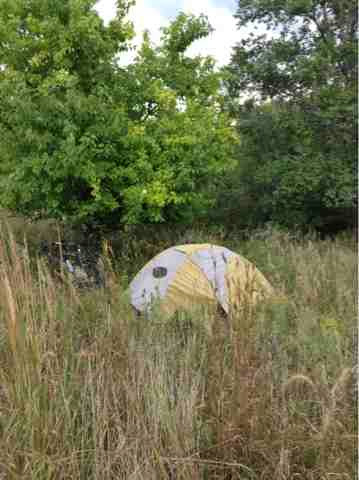
I continued 40 minutes down the road before dark, leaving highway 34 to go down a gravel road to find a place for the night in an overgrown field I saw a few deer romping through.


Iowa had gotten off to a wonderful start with a strikingly nice Carnegie, a good conversation with a genuine cyclist and an idyllic camp site.  The wonderful Carnegies kept coming, with not a one demolished, and pleasing camp sites available whenever I was ready for one, but in the four days since, as I have nearly completed my transit of the state, there has not been a single mention of RAGBRAI or cycling unless I initiated it.  I had been braced to have to put up with people continually telling me I was lagging way behind, like two months, though I had been looking forward to people asking me if I knew about the book that had just been written about the history of RAGBRAI, as I would be able to tell them the author, Greg Borzo, was a friend.  Even though 25,000 people participate in RAGBRAI every July, it has not converted locals into ardent cyclists, nor even made them extra-friendly towards cyclists.  It has been a surprise.

But still the cycling has been perfectly fine, other than battling a strong headwind that has kept my daily average speed the lowest of the trip, right around ten miles per hour.  It is jeopardizing my weekend return to Chicago and a dance performance by one of Janina's teachers.

But the Carnegies have not disappointed, other than having staggered hours, not the standard nine to seven or eight, allowing me entry to just a few of them, forcing me to just peer in to the others just imagining their homey warmth and denying me the pleasure of giving the Carnegie portrait a nod.  Of the eight I have so far visited, only Albia's had Carnegie chiseled into its facade.


The libraries in Villisca, Oscelo and Charitan identified themselves as a "Free Public Library."  Villisca hadn't had an addition, though one had been proposed if the funding could be found.


Malvern and Red Oak were simply identified as "Library," while the monumental Ottuma library included the word "Public," with the "U" spelled using the letter "V."  


Ottuma, like Villisca, hadn't had an addition, but only because it was so large when it was built with a $50,000 grant, five times the usual amount.  Ottuma had been a large important city on the Des Moines River.  It was still a sizeable city, but hadn't outgrown its grand original library.

The Red Oak library had had three tasteful additions since it was built in 1909, the first a hasty fifteen years later, then on its 50th and 100th anniversaries.  I was there on a Sunday when it wasn't open, but was joined by two teen-aged boys out front using its WIFI.


The Malvern library didn't expand until ninety years after it was built in 1916.


The substantial  Charitan library was only open from one to seven the first three days of the week, then ten to six on Thursday and Friday.  It was a block from the town's main square with a gigantic courthouse and city hall in the middle and surrounded by small shops, including a Trek bicycle store, many of which would instantly be put out of business if a WalMart moved in.


I was able to relax on a couch in front of a fireplace at the very homey Osceolo library.  Fireplaces in these old libraries are a regular feature.  Even moreso are distinctive globes of some sort out front providing illumination.


I'm closing in on Illinois and three more of the 108 Carnegies that were built in Iowa, three less than Illinois.

Last night I camped in an open field near a stream just over a hill that blocked me from being seen by traffic on the nearby small rural road.  It was the first time in Iowa that the sun dried the dew on my tent before I took it down.  For the first time since I left Telluride I found an NPR station.  One of the stories this morning was that REI has rescinded its lifetime no-questions-asked return policy on its merchandise, reducing it to just one year.  That means I won't be able to return this tent when its zippers go, as I have been able to do several times over the years.


Monday, September 23, 2013

Done with Nebraska, on to Iowa

If there hadn't been so many people in the buffet line waiting to be fed, I might have joined in and had my first meal in a Carnegie Library, or at least in an auditorium-sized room adjoining a Carnegie, that was a dining area for an organization affiliated with the Catholic Church that serves the needy in Lincoln.

The still magnificent Carnegie, a former branch library,


has been renamed the Matt Talbot Kitchen and Outreach, taking its name from an Irishman who lived from 1856 to 1925. After overcoming alcoholism early in his life through prayer, he assumed the role of a 6th century Irish monk, while continuing to work in the timber yards of Dublin.  The Catholic Church has adopted him as an inspiration for alcoholics and addicts throughout the world.  The present Pope holds him in such esteem he wrote a paper about him early in his career.  In 1975 Talbot was declared Venerable, making him eligible for sainthood.

The center serves dinner 365 days of the year from 5:30 to 6:30 and lunch from 11:30 to 12:30.  I happened to show up at 5:45 and had no time to linger with a couple more Carnegies to track down in Lincoln before dark.  Besides food, the center provides medical attention, reading classes, nutrition consultation, showers, hair cuts, counseling, and assistance for housing, though it does not offer any itself.  A sign on the entry warns "No sleeping." It feeds about 150 people a day, with more towards the end of the month when people exhaust their food stamps.

It was one of three former Carnegies in Lincoln that had made the transition from library to another function.  The next on my agenda was now the Marketing and Communications office for Union College, founded by the Seventh Day Adventists in 1891.  It had a set of three sections of steps up to its entry from the sidewalk.


I was initially thwarted in my efforts to find it,  as I was given the wrong address by someone at Nebraska's Library Association.  I had been put in touch with the Library Association by a librarian at Lincoln's Main Library, who couldn't find the information on the Internet.  I spent more than ten minutes on the phone with the Association, as a woman tried to locate the address for it and another local Carnegie that the librarian at the Main Library couldn't locate.  She finally thought to go to a book on Nebraska's Carnegies called "A State of Readers, Nebraska's Carnegie Libraries," by Oliver Pollak.  It was great to learn about this book, but disappointing that no one at any of the Carnegies I had visited in Nebraska had mentioned it.  Such books exist on the Carnegies of Illinois and Indiana and are an invaluable resource.

Unfortunately the book had the incorrect address for both of the Carnegies I was trying to track down, though by just a block or so.  Both were on 48th street--this one reportedly at 3800 South.  There was a library at about that address set off from the street on the campus, but it had a date of 1936 on it and did not have the dignified look of a Carnegie.  After circling around the campus a bit I found the actual Carnegie further south down 48th street with an address of 3938 on it.

From there it was seventy blocks north on the fairly busy 48th street to 2719 North for the other Carnegie. On the way I passed the National Museum of Roller Skating.  Once again I had a faulty address and had to do some searching.  The library was actually on the other side of the street and a block down at 2820 and was now the offices for an Engineering Company.  It wasn't visible from 2719.  I picked the wrong person to ask if there was a former library in the vicinity.  It was a Friday evening and he was on his way to a liquor store with his girl friend.  I told him I was looking for a Carnegie library that was supposed to be in the vicinity.  He just sneered at me, saying "So what," oblivious to the nearby historic and magnificent Carnegie.


I didn't have to search out the suburban Havelock Carnegie, as it had been demolished and replaced by a new library on the same site.  The same was sadly true of Lincoln's main downtown library.  It had been a grand, monumental building funded by an $86,000 grant, bigger than that of Colorado Springs.  If it had been preserved, it would be one of the finest buildings in Lincoln, if not all of Nebraska. 

I had a final two Carnegies to look forward to the next day before crossing the Missouri River into Iowa on a toll bridge (25 cents for bicycles). I continued on the Cornhusker Highway, Route 6, out of Lincoln.  All sorts of businesses, and even roads, take on the Cornhusker name, the nickname for the University of Nebraska. My final day in Nebraska began with an hour-long morning radioshow called  "Gromaha," hosted by two ardent civic-minded boosters of Omaha.  They welcomed a series of guests asserting what a great place Omaha was to live and have a business. They managed to go the whole show without mentioning Warren Buffet.  But the college football team could not be overlooked, something that is a virtual state religion.  One of the show's topics was the sale of pizza at the games and how sales are up when the team is winning.

Husker football seemed to come up at least once a commercial break on any local radio show, especially this week after the team suffered a devastating loss to UCLA, squandering a 21-3 lead and then someone releasing a profanity-laden tirade by the team's head coach from two years ago after the Cornhuskers came from behind to beat Ohio State at home after the fans had seemed to give up on the team.  The big issue was who taped it and why they waited so long to release it, rather than the coach's rant.  A lesser issue brought up by one radio host was over fans releasing the red helium balloons many take to the games after the team kicked a field goal for their first score of a game, when the tradition is that they should be held until after the team's first touchdown.  He claimed the Pope issued an edict condemning such impatience. 

The Carnegie in the small town of Ashland was quite charming and in its original state,


but so small and little used that the waitress and the cook in the town's lone cafe, where I loaded up on biscuits and gravy, as they were a better bargain than hotcakes, couldn't tell me where it was, even though it was just three blocks away.  An old-timer in the cafe gave me directions, down one block then over two and just past the church.  The town has a site picked out for a new larger library on its Main Street, but was awaiting funding for it.  Unlike many of the Carnegies in Nebraska, it did not have Carnegie chiseled into its facade, but did have a marker in a flower bed out front acknowledging its lineage.


The Carnegie in Plattsmouth had had two additions over the years that so seamlessly extended behind it, matching the original red brick, that they hardly seemed like additions.


A plaque by its entry paid tribute to the original librarian who served for over fifty years.


There were also two dignified portraits honoring her in the library, one a photograph and the other a painting.  The present librarian said her successor also served for fifty years. She has a long ways to equal them, but would be pleased if she did.  I had the library all to myself as it was Saturday afternoon and the Cornhuskers were playing.  With no competition on the WIFI, I was able to have an uninterrupted Skype call with Janina out front of the library with cicadas chattering away and an occasional freight train passing.  It was our first chance to Skype in a while, enabling me to catch up on the four classes she is teaching at Columbia this fall and also hear more about the three profiles she wrote for New City's recent issue on the movers and shakers of  Chicago's art community.  One of her subjects, the owners of the Dempsey-Corbett gallery, ranked seventh.

Now its on to Iowa and another stretch of Carnegies and cornfields.

In my final miles of Nebraska I passed a restaurant that holds an annual "Testicle Festival." Though it is the Cornhusker state, beef contributes more to its economy than corn.


Carnegie funded sixty-nine libraries in Nebraska.  I was able to check in on seventeen of them. Five had been torn down.  Only four of them still were used as libraries with two still in their original state without an addition.  Of the eight that were being used as something else, all retained their striking stature other than the one in Lexington, whose exterior had been dramatically altered.  Most still had Library chiseled into their front facade.  The thrill of discovering each was as strong as ever.