Thursday, June 20, 2013

A Pair of Memorialized Cols

I've put my legs to extra strain the last two days going out of my way to climb a couple extra cols.  It wasn't for additional training, as I've had plenty of that, but rather to pay homage to a pair of cyclists.  One was the professional racer Andreï Kivilev of  Kazakhstan, who died young in a crash during Paris-Nice while riding for the French Cofidis team in 2003.  The other was Robert Marchand, a French bicycling enthusiast, who was honored for riding old, still at it as a one hundred year old.

Kivilev is remembered by a memorial on the Col de la Gachet near where he lived while racing just north of St. Etienne.  Marchand is remembered by a col named in his honor a half day's ride south of St. Etienne.

Thanks to my invaluable GPS device, I was easily able to locate these obscure climbs off on minor roads.  What wasn't so easy to find though was the memorial to Kivilev.  I had assumed it would be at the summit of the col, and as easy to spot as the sign at the start of the four-mile climb acknowledging his memory. 


The climb is a favorite training route for cyclists in the area.  I was passed by quite a few--individuals, pairs and even a team of eight in matching jerseys and a team car following behind.


When I reached the summit, an intersection with another road, I circled around looking for the memorial.  Not spotting it, I asked a couple of cyclists who had paused if they knew where it was.  They pointed to a village two miles away and said the road continued on up to it and I would find it there.


I didn't mind too much continuing on, even though I was eager to descend to a potential camping site two miles back, as the town's cathedral, poking up high and that had just chimed out the seven o'clock hour, beckoned my iPad.  I could start in on my dinner while it got a little extra charging.  I'd had two churchly recharging sessions earlier in the day and was up to 70%, enough for two or three days, but when there's electricity to be had, I can't resist.  I now take so much satisfaction in slipping into open cathedrals and finding a socket somewhere, when I spot a cathedral or church steeple in the distance my heart takes a leap of delight, thinking "Electricity!," even if I'm not in particular need.

When I reached the town there was another sign similar to the one at the start of the climb, but not the memorial plaque I was looking for.  I asked a guy in his garden if he knew where the plaque was.  He didn't fully understand my question, so I pulled out the iPad and showed him a picture of the plaque.  He immediately recognized it and started to explain that it was back below the summit sign.  Since there were four arteries leading to it, I switched to the GPS feature of the iPad and he was able to precisely pinpoint the bend in the road where it could be found. 


I missed it because it was on the outside bend and I was turning away from it, my eye not catching the  lovely, well-manicured flowers nor the plaque off to the side, not even facing the road.


It was a warm evening, so I had shed my helmet on the climb.  I felt a little guilty and thought I might receive a reprimands from passing cyclists, as it was after Kivilev's crash that it was mandated that professional cyclists had to wear helmets when racing.  Everyone who passed me wore a helmet, but no one said anything other than a "bonjour," but then again, no one else on their stripped-down racing bikes was sweating as heavily as I was.

St. Etienne offered another cycling memorial, a bust of Velocio, the father of cycle touring, at the summit of the Col de la Republique south of the city.  I had long ago visited that highly important site.  It nearly warrants a yearly visit.  The Col  has added significance of being included in  the first two Tours de France. During the second one in 1904 some riders were attacked on the climb by fans who wished to delay them in favor of riders they supported.  As much as I would have liked to make the climb again, I preferred to avoid the snarl of St. Etienne's traffic and instead bypassed the city. 

I still had a goodly climb over the Croix de Chaubouret that went on for nearly ten miles out of St.-Chammond, and that was made a little more painful by a cyclist in the village of la Valle-en-Gier who was filling his water bottle at the village fountain. I asked him how much further it was to the summit.  He said four kilometers when it was actually eight, a rather dirty trick.  That earned me a long descent to Annonay and then another long climb going the opposite direction I needed to be going for the Col du Robert Marchand.  I wasn't at first able to locate the climb on my GPS device, as it only recognized it as the Col du Marchand.  When I noticed that was how it was referred to on a map I picked up at the Annonay tourist office, then it turned up.  I haven't been visiting many tourist offices this year, not needing their assistance to find the local Internet cafe.  I've somewhat missed them, as they frequently provide me with interesting information.  Annonay had a list of all the festivals held during the year in nearby towns.  Annonay holds an annual hot air balloon festival, as it was there that the hot air balloon was invented.

Another town I passed through was preparing for a bicycle festival.  It was already decorated with bicycles as if it were a Tour de France Ville Ètape. 


I was hoping there would be some sort of tribute to Marchand at the summit of his col, but the only tribute was two different signs announcing the summit, one with just his last name.  


And another, more honorific, in purple with his full name.


Still, it was a fine tribute to name a col after a local cyclist who'd had such a long devotion to his two-wheeled companion.  The French are extraordinary in acknowledging anyone who has had a long devotion to something they deem commendable.  The critic Todd McCarthy was given a medal by the Cannes Film Festival for covering it more years than any American.  The Tour de France bequeathed a similar honor on the New York Times writer Samuel Abt.  And this is no recent trend.  Everyone who participated in the storming of the Bastille on July 14, 1789 was given a medal.

I frequently see memorials along the road to those who lost their lives fighting for the Resistance.  I passed one on the outskirts of St.-Chammond before beginning the long climb to Chaubouret.


As I descended to the Rhone River Valley after Marchand's col the countryside was dotted with fruit orchards.  They make for easy camping.  But before I stopped to camp I was suddenly climbing out of a gorge before reaching the Rhone.  It was nearly eight o'clock.  I'd had enough climbing for the day, but the gorge offered no camping with a cliff to one side and a steep drop to a river on the other.  But at one elbow in the road, there was an overgrown trail that offered a flat spot a little ways back.  It wasn't likely I'd be interrupted by any hikers, so made it my campsite for the night.


The only interruption in my sleep came in the morning when starting at 6:30 every fifteen minutes or so a car would stop at the slight wide spot in the road near where I had camped and out would hop some guy for a "pipi rustique,"  voiding his morning coffee.


At least I was far enough into the forest not to hear more than the opening and closing of their car door.  But I well knew why they were stopping.  Taking a less than discreet leak in public is a common French custom.  It is such a fully accepted practice that it is not considered "public urination," but rather a "pipi rustique." It is another of those qualities of France that make it so agreeable for cycle touring. There is no need to seek out toilets in France.  One can just stop anywhere along the road for a pee.


Monday, June 17, 2013

Tati Town: Sainte-Severe-sur-Indre

A wide range of representations of Jacque Tati's loopy bicycling postman adorned shop windows and assorted signs in Sainte-Severe-sur-Indre where in 1947 he filmed the masterpiece "Jour de Fête."   The first was more than ten miles out of town, making sure anyone headed that way wouldn't miss the turn to the small town.


The small town didn't have any significant intersections meriting a round-about that could have been Tati-themed, so it had to settle for another sign at its entry.


The town plaza is home to a Tati statue, museum and movie theater, where the film plays several times a day.


A well-weathered plaque is at a corner of the plaza.


The paintings on shop windows were akin to the bicycle paintings in Tour Ville Ètapes.  


This wasn't the only shop with a for sale sign.  The tourist office had also been closed down.  There were so few people about, the town barely seemed inhabited.  Tait portrayed it as a bustling little burg.  Now it is more sleepy than alive.  I had no qualms about leaving my iPad plugged into an electrical outlet at the town cathedral, four blocks from the plaza, as I made a reconnaissance of all the Tati sights.


It had been relatively flat terrain from Tours to Sainte-Severe through the extended Loire Valley in the central part of the country.  The province of six dèpartements I was in is actually called Centre.   But then the road began climbing on to the fringe of the Massif Central.  The rest of my ride to Nice and the ferry to Corsica will hold plenty of climbing and descending.

I was caught by surprise last night by a two-mile climb to the large city of Thiers and then another eight miles of climbing through a gorge.  It had been hot enough during the day that I had been dousing myself whenever I came to a cemetery.  Only one of my four water bottles was filled as I reached the sprawl of Thiers.  I stopped at a MacDonalds to fill my empty bottles.  It's washroom was one of those that only dispensed hot water.  That was okay, as the water would cool down before I needed it, though it didn't need to cool down much to reach the temperature of the air.

After I exited the city the road was a succession of small towns with no space between for camping.  I had drunk one of my bottles and felt it wise to refill it. The only water fountains I saw had signs warning the water was not drinkable or was untreated.  After a hot day of riding I knew I would need all four of my water bottles.  I stopped at a bar to fill my empty, maybe the best thing I did all day, as the barman filled it with ice cold water from the bar tap, a blissful nectar that replenished my energy.  I was hungry and tired and getting desperate for a place to camp. At last, after ten miles of climbing, farm land appeared and I found a small cluster of trees to disappear into.  I was almost too exhausted to eat, though I knew I had to.


Sunday, June 16, 2013

Fête du Tour


Rather than the expected obvious yellow, the t-shirt given to all those who came out for the Fête du Tour ride in Tours yesterday,  commemorating  the upcoming 100th edition of The Tour de France, was a deep sky-blue. It was dappled with flying wedges of yellow and white that might have been asteroids or angel dust cascading through the galaxy celebrating the creation of The Tour.  A splotch of yellow, as bright as the sun, illuminating the t-shirt, represented the front wheel of a bicycle. Bent over it was a cyclist created out of the letter "r" in the word "Tour."  The design affirmed the magisterial essence of the bicycle and those who ride them.

A good many of the several hundred participants in the ride couldn't wait to put on what would now be the favorite t-shirt in their wardrobe, including Florence and Rachid, my long-time friends who have lived in Tours the past twelve years after living almost that long in Chicago.  For years Florence was the queen of Chicago bicycle messengers, while Rachid worked as an architect and had occasional exhibitions of his art work. They are sensitive, enlightened souls both.  No visit to France is complete without joining them for a ride on the bike.


The Tours version of the Fête du Tour wasn't much of a ride compared to those being staged at some of the other 35 Tour Ville Ètapes this day.  Some were riding 30 or 40 miles or more of The Tour stage that was arriving and departing from their town.  The one in Tours would only follow the five miles of the neutralized, processional start of the stage through the city.  It was advertised as a family-friendly ride.  It attracted a great number of small children, some on bikes and others in trailers, one wearing a replica yellow jersey.


Someone older wore the climber's polka dot jersey while riding one of the city's rental bikes.


The ride began along the Loire River across the street from the library and the Pont Wilson, named for the US President who came to the French aid during WWI.  The bridge had just been restricted to one lane  of car traffic, as two sets of tracks for a tramway had taken it over.  The city had just completed a massive four-year project to introduce the tramway to the city.  The tracks went straight through the heart of the city on Gaumont Avenue, turning it into a virtual mall, eliminating motorized traffic.  On all previous occasions when The Tour has visited Tours, it started or finished on Gaumont.  It will no longer be able to do that, finishing instead at an exhibition space on the outskirts of the city, and starting where we were but winding through the city rather than promenading down its main avenue.

Our group of several hundred was led by a police car and doodled along at a coasting pace.  It was a Saturday version of a Critical Mass ride, as we took over an entire lane of the road and stuck together through red lights and green.   Florence couldn't help but shout out "Happy Friday" here and there, the mantra of the Chicago Critical Mass that we had happily ridden together so many times.  The ride was so leisurely and children-friendly that we stopped for a water break half-way through.

The brochure for the ride promised a "Buffet Gourmand" at its conclusion.  And that was no exaggeration.  When it comes to food, the French certainly do not skimp.  The ride ended at an exhibition hall not far from the city's IKEA. After we arrived a woman gave a brief welcoming speech and then led us to a bar lined with glasses of juice and wine and trays of hors d'oeuvres.


There were also tables set up outside that waiters filled with trays of delicate bite-sized morsels of salmon and salami and cheese and vegetables.  It was food fit for a state dinner.  There wasn't a complaint as one and all heartily grazed.


After several rounds out came trays of desserts, even more delectable.  There was no final cheese course, but coffee, tea and hot chocolate were provided.


 After the fantastic feed, Florence, Rachid and I set out on The Tour route for 25 miles as far as Loches, a picturesque town with a chateau on a high point and a medieval warren of narrow streets in its center.  It is among the hundred towns in France with the official designation of a town "Worth Making a Detour To," one of several categories that the French board of tourism has contrived.  There is also a list of "Most Beautiful Towns" and "Ville Fleuries" and probably a few others too.  Nearly every French town could qualify for some such category, as they are all so uniformity picture-pefect and charming, as if designed by a French Disney.

Florence took the lead and only relinquished it for brief spells here and there when Rachid or I would catapult  ahead on a descent from our extra weight and could maintain it if the climb wasn't too steep.  Her legs would soon grow impatient with our slackened pace and she would smoothly glide back to the front, not even ruffling the thick pony tail that lay docilely on her back.   It was a pleasure to be "chicked" by one of such élan and an equal pleasure to sit in and have an easy ride, reveling in the countless miles we have ridden together.  She is a high priestess in the cult of those  "Born to Bike."  She is among those who live to bike and can't bike enough.  She would love to return to her life as a messenger.  All their many Chicago friends will be thrilled to know they plan to pay a visit to Chicago this fall, scouting out the possibility of a return.

I was so energized by our time together I continued riding until after nine, nearly reaching one hundred miles for the day, all but ten of them after the noon-time gourmet banquet compliments of The Tour de France.  I made it past the large city of Chateauroux, where I have twice witnessed Mark Cavendish win a stage.  The last was two years ago with Vincent of Melbourne and David of Hamburg.  How sweet it was to reflect on those memories as I rode up the finishing straight of both of those stages.  I had another fine campsite in one of those small clumps of forest that the French so fastidiously preserve.

.


Friday, June 14, 2013

Tours, Ville Arrivé/Départ

I wasn't the only one scouting the 135-mile Fougéres to Tours stage yesterday in the rain.  Six members of the Belgian Lotto Belisol team, wearing bright red tights, trailed by a sponsor-plastered team car, flew past me as I negotiated my way through the large city of Laval in mid-morning.  There was no chance of sticking with them, especially since my load has gained about five pounds thanks to Andrew.

Besides the three pounds of stove and cookware and fuel canisters he left me with, I am also carrying nearly two pounds worth of mint syrup in a steel can that I added to my load at his suggestion.  A week ago before we reached cold and wet Brittany we had a brief spell of summery 80 degree temperatures.  I needed to flavor the warm water in my water bottles to make it more palatable.  There is no Tang or other powders to be found in French supermarkets, just various flavored syrups.  Andrew knew from childhood experience in Australia, that such syrups have so much sugar in them they don't need to be refrigerated, as I had thought.  I should have realized that, as French bars often have a row of such syrups on a shelf with all their liqueurs.  A mint-flavored drink, menthe à l'eau, is my preferred drink when I watch a Tour stage in a bar.

Before I could even drink up half the bottle of syrup the weather turned cold and I no longer needed to flavor my water.  Andrew didn't care to help me drink the menthe a l'eau, turned off not only by its ingredients, but also its bright green color.  To some it is most attractive and to others rather ghastly.  He thought it looked like anti-freeze and didn't think it smelled much better, though not as disagreeable as my favored lunch meal of pâté.  He is not alone in his regard of the drink.

Coincidentally, the day I bought the syrup, the narrator of the book I'm reading on France, the best-selling and National Book Award-nominated novel "Le Divorce," mentions that someone introduced her to the drink.  She thought it tasted like mouth wash.  Such prejudices have not undermined my enjoyment of this popular French beverage.  I was slightly concerned that if I drank too much of it, I might no longer appreciate it.  But it still dazzles my taste buds and tastes as refreshing as ever.  I am slowly finishing it off to make more space in my panniers and also to lighten my load.

I will be adding a t-shirt to my load tomorrow compliments of The Tour de France when I join Florence and Rachid and hopefully hundreds of others on La Fête du Tour ride here in Tours celebrating the 100th edition of The Race.  Each of the Ville Ètapes will be conducting such a ride on a portion of The Tour route entering or exiting their town.  It is free and the first 500 to register get a t-shirt.  That will be a souvenir I will gladly carry for the next 3,000 miles before I return home in six weeks.

None of the round-abouts I passed yesterday or today were bicycle-decorated, at least yet.  But many still offered up some interesting art.  On the outskirts of Tours a round-about had recently been dedicated to DeGaulle with a most distinguished looking statue and fine landscaping. 


A round-about thirty kilometers before Tours advertised sites to see in the town ahead.


The day before a round-about celebrated the popular French game of boules.


None of these were as striking or has stuck with me as vividly as the flamingoes in a round-about in a small town outside of Nantes that I passed five days ago.


Wednesday, June 12, 2013

Fougères, Ville Dèpart

There are those who make art the point of their travels.  When I'm on my annual Tour de France quest, I am one of them, though it is bike art that is my focus.  It is no different than art found in museums.  It uplifts and gladdens and inspires and amazes and gives hope.  There is an astounding quantity and variety of bike art along The Race route, almost beyond imagining even for a veteran such as me, particularly in those towns that host a stage start or finish.  This may be my tenth Tour de France, but I am still often left agape by the many different and original ways the bicycle, "man's most noble invention," can be portrayed and celebrated.

That was once again the case in two more of Brittany's Ville Ètapes.  Fougères offered up a pair of mini-round-abouts in its city center each decorated with a trio of elegantly designed arches with bicycle wheels attached.


One was in the process of being erected.


A larger round-about at the town's entry also featured wheels.  And in the background was one of the many of the banners around town mounted on towering poles announcing the coming of The Tour.


And above the narrow streets of the old part of the city fluttered mini-versions of the yellow, green and red polka dot jerseys.


From Fougères it was 28 miles north to Avranches, start town for the time trial that will end at Mont-Saint-Michel.  I had intended to bypass it and head south from Fougères, following The Tour route to Tours, to begin my return to the Mediterranean for the start of The Tour.  With the need to be in Nice in two weeks to catch the ferry to Corsica, I have been eager to start my migration south.   But I couldn't resist the lure of another Tour Ville Ètape and what art it may have to offer, so decided to squeeze in an extra 70-mile loop up to Avranches then over to Mont-Saint-Michel following the 20-mile time trial route along the English Channel and then back to Fougères.  One of the lures was that Fougères had a new four-story library (mediatech) with lots of electrical outlets.  Libraries aren't so easy to come by in France, and only those in larger cities are open more than a few hours a week, so I was eager to take advantage of it a second time, and maybe a third during The Tour when I return, as the stage from Fougères will start in the plaza in front of the mediatech.

Avranches more than rewarded me for my efforts.  It was easily the best and most innovatively decorated of the dozen or so Ville Ètapes I have scouted out so far this year.  The main round-about into the city though had no bicycle theme.  It was taken over by a tank and a monument honoring Gen. Patton and the American D-Day troops.


Facing it was the Patton Hotel.


But further into the city I was gladdened to see a digital count down on its Town Hall of the number of days until The Tour's arrival. Not too many Ville Ètapes have a count down, though all should. That is always an indication of a heightened appreciation for the monumental honor of being a Ville Ètape.  The Town Hall faced a large plaza where the racers will be launched down a ramp beginning their solo ride against the clock.


The nearby tourist office had an exhibition space devoted to The Tour.  Three panels had newspaper clippings from the three other times Avranches had been a Ville Ètape--1990, 1993, and 2003.  Display cabinets were filled with old magazines and Tour souvenirs.


A panel paid tribute to long-time voice of The Tour, Daniel Mangeas, who lives in the vicinity and is beloved by all.


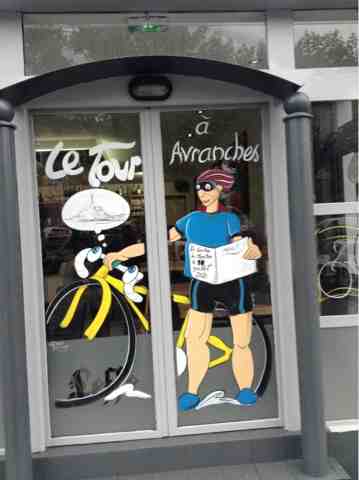
The artist who goes around to Ville Ètapes painting bike art on shop windows had left his mark.


Perhaps Avranches' most original feature was yellow, green and red polka dot jerseys painted on the cycle figures designating bike lanes, something that every Ville Ètape ought to do.  Each brought a smile to my face as I biked around the town. Like the bike wheels in Fougères, they were a simple, but fine tribute.


There was also a magnificent cluster of green-painted bikes forming a tree in front of the city's cathedral.


It may have been another typical misty, rainy day in Brittany, but it didn't detract in the least from my excitement at seeing the many manifestations of bike-love in Avranches, nor make me regret in the least that I hadn't chosen to plunge south to escape Brittany's inclement weather.  After several days of it, I hardly noticed the wet.  It was negligible enough that the road was still dry under trees, though it had me dripping.

Mont-Saint-Michel will only be visible to the racers the last few miles of their ride, that is if they dare take their eyes off the road ahead.  Luckily I had that luxury and privilege.  This was my third time biking past this monumental shrine, France's most visited site after the Eiffel Tower, but it still took my breath away.  I stopped at a picnic area for some paté, even though there were no electrical outlets, to prolong my time in its majestic presence.  
 

While I ate and gazed I was joined by a 50-year old German on a recumbent.  He immediately launched into a spiel as if I were the first non-French speaker he'd encountered in days--"I've come 1,500 kilometers from Hamburg but this rainy weather is too much.  The forecast is for days more, so rather than going all the way to Brest I am going to take a train to Nantes where the weather is supposed to be better."  As he ranted on and on I figured this had to be his first touring experience.  No, he'd biked around  Poland three summers ago.  "Remember how hot it was that summer?" he asked.  "It was worse than this rain." Then he asked, "Are you Dutch?"

"No, I'm from America."

"America!  That's impossible.  I never meet Americans on bicycles."

When I told him a little about my travels, he asked if I had written a book.  He said if I were German, I would have written many.  I've biked with a handful of Germans over the years, though all were a generation younger than he, and none had his braggadocio.  He had the same demeanor as the 60-year old German cyclist Andrew, Craig and I encountered more than a week ago, perhaps a new species of cycle tourist or perhaps a symptom of older Germans. It will certainly make me wary of older German cyclists.

Andrew left me the stove he bought when he arrived in France, as it requires fuel canisters that are unavailable in Australia.  So for the first time last night I cooked up a meal in France, some bacon that Andrew also left me and some eggs.  I was camped in a small forest surrounded by farm land, so I had no worries of the frying bacon attracting wild boars.  It was a fine meal, but delayed my eating, which I am always eager to start in on after I set up my tent.  I'll have to decide whether it is worth the effort or the added weight.