Thursday, February 13, 2014

Sagada, Philippines

I had been in the Philippines for a week before I ventured into a grocery store, quite a contrast to touring in most other places where it is nearly a daily event. Roadside cafes are just so common and their food so cheap, not much more than a dollar for a bowl of noodles or a pile of rice with a wide range of stews, that I have been doing little dining on my own food.  I'd hardly made a dent in my peanut butter and had only eaten one packet of ramen.  And the snack food I'd brought was also holding out just fine.  

I've bought some bread and bananas from small stores that are everywhere, but don't amount to more than a few shelves, rather than aisles, of bare essentials.  From the very start I have been curious to see what kind of food/fuel a full-sized grocery store might offer. So it was a significant event when I finally introduced myself to a Philippine grocery store.  I was delighted to discover a variety of locally-manufactured peanut butters, perhaps a byproduct of the Philippine's past as an American colony.  I no longer needed to ration what I had brought, and in fact began eating it by the spoonful with bananas to finish it off so I could give  the local variety a try.  I was also happy to discover a tasty calorie-packed yogurt drink and also a wide range of ramen, some for as little as fifteen cents.  And this was at a small grocery store in a small town in the mountains.  These discoveries boded well for what I might find at one of the full-size supermarkets in the large cities.

I didn't have to worry about my bike as I perused the shelves of the grocery store as it was back at my lodging for the night, a small room above a small restaurant in the small town of Sayangan high in the mountains that rarely attracts an overnight guest.


I felt lucky to have found it.  When I asked a policeman if there was a hotel in this small town I fully expected a "no."  Then I was going to put myself at his mercy and ask if he would  let me put my sleeping bag down somewhere in the police station, even in an empty cell.  I was desperate.  It was thirty minutes until dark and for all thirty-one miles I had ridden that day through the mountains, I had not seen anywhere to disappear to off the road to camp.  I had climbed to over 7,000 feet and all along the way any wide spot along the road had a home or a business, often someone doing auto repair.  The slimmest of spots, sometimes perched on a cliff, had all been appropriated.  That has been the story of the Philippines so far.  There is not much elbow-room in this densely populated country.  

I was plenty exhausted after back-to-back days of extreme and prolonged climbing.  The grades were as steep on this stretch out of Baguio as they had been up from the coast.  It was not unusual to gain 400 feet or more, eight per cent, in a mile.  Despite my late morning start from Baguio, I had still put in nearly five hours on the bike, averaging just a little over six miles per hour for the day.  If Baguio had been more attractive I would have spent the day there resting my legs after the huge effort to get there, but the legs were surprisingly willing.

The rugged mountain scenery beyond the roadsides at least gave my gaze something to enjoy.  Unfortunately it wasn't a steady climb as the climb up from the coast.  I was now in the thick of the mountains and would climb up one ridge and then plunge a few miles and have to repeat the effort.  I couldn't have the satisfaction of gaining a few hundred feet knowing that I could soon lose it.  A bigger pain though was all the trucks overloaded with hefty bags of stinking chicken dung hauled up from the coast for the mountain folk to fertilize their fields of vegetables.  Not only were the trucks slow, but the pungent stench from the dung was powerful enough to knock me out.  I tried to speed up when I could begin smelling such bags ahead stacked along the road waiting to be lugged up or down the steep paths to the fields.

This was farming one does not see in the US.  My lodging was similarly third-world rustic.  The restaurant had no shower.  I bathed from a five gallon bucket of water heated up by a rod placed in it.  The walls in my room were plywood thin.  I felt as if I were in Nepal or Bolivia and was thoroughly charmed.  At last I was off the beaten path and having a genuine travel experience.  The woman who ran the restaurant thought I was German, as have been the majority of her occasional foreign guests. She was pleased that I was American and could speak an English she could understand.  She warned that it would be too cold to start too early the next morning, but I knew that my day would begin with a two-mile climb to the highest point of any road in the Philippines at 7,400 feet, so I knew that would warm me up.


The temperature was 51 degrees in my room when I awoke at seven.  I put on four layers, shirt, sweater, vest and wind-breaker, and had gloves warmer than my cycling gloves at the ready.  But the strong sun quickly warmed the air and a 7:30 start was not too early.  I needed as much time as possible to reach Sagada sixty miles away knowing that an untold amount more of strenuous climbing awaited me.  But it was through some spectacular scenery that gave me a foretaste of the World Heritage terraced farming in Banaue that awaited me.


I only had a few miles of these terraces but they helped make this stretch of nearly one hundred miles through the mountains a world-class ride that I was happy to have the strength to manage.  It could easily make a list of great, little known places to ride one's bike. 


After descending for a few miles from the highest point I had to make another climb to almost the same altitude.  Then began a long gradual descent that went on much longer than I wanted to 3,000 feet.


I knew I would end my day at 5,000 feet at Sagada.  I was hoping that it wouldn't be much more than a few hundred foot climb from the main highway, not a couple thousand. Sagada was seven-and-a-half miles off the main road. When I came to the intersection I was tempted to continue my gradual descent to Bontac five miles away, and then to return and make the climb with fresh legs the next morning.  But that would almost be conceding defeat, so I chose to make the climb.  

I had two hard boiled eggs for extra energy.  I ate one at the start of the climb and the other mid-way up.  Several stretches of gravel where the road had washed out was a further strain on my legs.  With eight per cent grades I had to push the bike through several patches of the gravel.  The last mile I was like a car running on fumes.  My legs were so depleted they were throbbing from emptiness keeping me awake later that night when I thought I would immediately plunge into sleep.  I had no concerns, as the next day would be a day of rest, just doing a little hiking in search of Sagada's famous centuries old hanging coffins on the surrounding limestone cliffs. 

On the outskirts of Sagada I encountered a couple of European backpackers emerging from the forest, the first travelers I had encountered in my time here.  They recommended a place to stay.  They said it wasn't the cheapest place in town, but easily the best value.  There were a handful of inns catering to the backpacker-set drawn to the serenity and the oddity of this isolated mountain village.  I was too exhausted to dine with anyone else.  I saved my conversation for some FaceTime with Janina.  She said she had never heard me so worn-out.


Tuesday, February 11, 2014

Baguio, Philippines

The Philippine broadcast of the Olympics with its restrained announcers and Asian slant focusing mainly on the Chinese and South Korean athletes made for good background entertainment while I ate dinner and studied the Lonely Planet guidebook.  No need to make conversation with Tomas as he had bowed out of the travels earlier that morning and I was on my own.

He had come to the grim realization that his 67-year old legs didn't have enough in them for the climbing ahead.  They'd barely been managing what minimal climbing we'd already encountered.  He'd immediately drop to his lowest gear for any incline we came to, no matter how slight or abbreviated, spinning his legs at 3.5 miles per hour, a speed just fast enough to remain upright.  If the climb went on for more than a couple of minutes, he'd have to stop and catch his breath.  He took consolation though that at least he wasn't reduced to walking his bike.  

Even though we had been riding short days and even one half day, his legs weren't coming around.  With a twenty mile climb to 5,000 feet loomimg ever nearer, he knew there was no way he could manage that and the climbing beyond.  He was struggling as it was on the flats, putting some of the blame on all the excess weight he was carrying, including a large bear-proof cylinder atop his panniers for his food.

So for the first time I was able to put in a full day on the bike and end the day with that great sense of exhilaration having pushed myself a bit to get a little further down the road than I anticipated.  I was pleased to have put myself within range of making it to Baguio the next day.  I made it as far as Dagupan, a large, utterly charmless city clogged with jeepnays.


No one could tell me where I might find a cheap hotel or even a not so cheap hotel. Evidently this city drew no visitors.  It was less than an hour until dark.  I was reconciled to pushing through and hoping  to find some camping along the beach when I came upon a hotel by the bus station.  It was another of those with three, twelve and twenty-four hour rates and a classic dive, just as I'd hoped to find.  It was 5:30.  I waited until six to check in as a six a.m. depature would be ideal, just as it would be getting light.

Of course it didn't have WIFI, but the bus station actually did.  I learned that from the 7/11 next door. Some 7/11s have WIFI, but not this one.  I filled my Tupperware bowl with a rice and stew dish from a nearby restaurant and grabbed a couple of hard-boiled eggs from a street vendor.  I ate until six at the bus station and then hauled my gear up to the hotel to commandeer a room.  I opted for a room with a fan rather air conditioning, not only to save a few bucks, but because I was just overcoming a cold I'd picked up from having slept in air conditioning the first three nights here.  I might have opted for the a/c had I known my cement block cell wouldn't cool below 83 degrees.  And a closed window might have blocked out the noise of buses arriving and departing all night.  

My night was also marred by the Olympics being pre-empted at eight p.m.  in the middle of a speed skating event for a basketball game.  It was game six of the semi-finals for the Philippine  professional league championships.  That made for interesting viewing as well.  The teams didn't seem to have any American auxiliaries, but the play was fast and fairly polished and the crowd quite vocal.  Basketball is popular.  I've seen more kids shooting hoops along the way than kicking a soccer ball.  But the most popular sport here is cockfighting.  Every town and city has a stadium specific to cockfighting.  We've passed quite a few.  On Sunday I was able to duck into one for some of the action.


Before I noticed the arena, my attention was grabbed by the dozens of motorized tricycles parked along the road and then in the parking lot in front of the arena.  Anyone with a motorcycle can attach a buggy to its side with a third wheel and use it to transport people or goods.  One hardly sees a taxi with the hoards of these contraptions that are the dominant vehicle in most urban areas.  One can purchase a similar attachment for a bicycle.  But those are not nearly as common. The Philippines, as  Thailand and Vietnam and now China, and any other place of increasing affluence, leaves the bicycle behind.

Though cockfighting is a betting sport, there is still an entrance fee.  They waived the charge so I could just peak in for a quick look.  The ring was glassed in and surrounded on all sides by men standing at rapt, if not morbid, attention.


The sport is televised but I have yet to find any in my channel surfing, though I'm not sure how long I would give it a look.  I've attended a few matches in Mexico, but they weren't on the scale of here.  When the Philippines  were a Spanish colony for 400 years up until 1898, it was administered by the same department as Mexico, so there are many similarities between the two countries, not the least of which is the cockfighting.  All the Catholic Churches is another.  The country is 85 per cent Catholic.

Despite my not so restful night in Dagupan, my legs were strong and eager in the cool of the morning.  I reached Agoo twenty-four miles away shortly after eight, where I turned inland on the former Marcos Highway to Baguio, thirty miles away.  The first ten miles were fairly flat until Puzo, when the real climbing started.  There were no more towns on the map, so I stocked up on food and water.  I needn't have, as this stretch, like every mile I've ridden here, was lined with businesses and homes and cafes.  There were places where trucks could stop and use hoses to cool down their vehicles, that I was able to take advantage of as well. The grade ranged from minimal to severe, with some stretches of more than ten percent.  

Every five hundred, even one hundred, feet gained was a triumph.  When I reached 4,000 and had five miles to go, I thought I was in for a relatively easy four per cent finish.  But I was wrong.  The road did climb some more but then dipped back to 4,000 feet with two miles to go, leaving a final brutal two mile ten per cent ramp that steepened even worse for a bit.  It was a climb that The Tour de France would love to end a stage with.  The heavy-laden trucks weren't climbing much faster than me. When they'd inch past spewing their exhaust I'd be gagging so badly I'd have to stop.

When I reached the summit the road followed a ridge with a few more ups and downs into Baguio.  I joined another road that entered the city and was swallowed up by a throng of suffocating bumper-to-bumper traffic.  It grew worse as I entered the city, another maddening metropolis with an absurd density of people and traffic.  Baguio may have been picturesque at one time up in the mountains, but no more.  It wasn't so much in a valley, but built amongst a series of steep ridges.  It was pleasantly cool at least.

The American colonizers loved the tolerable temperatures of Baguio and developed it into a significant city.  They enlisted Chicago's master architect Daniel Burnham to design it. It has his trademark boulevards and a central park, which is named for him and has a bust honoring him.  


Its accompanying plaque describes how honored the Philippines were that this esteemed architect made this significant contribution to their country.


The next morning was a gathering spot already for many.  There was music playing and a group doing dance-aerobics.


Others were jogging and riding bikes around its rim.  There were bikes for rental for kids as well as adults.


There were signs prohibiting gambling and picking of flowers and smoking.  Security guards patrolled the park on bikes and foot.  When I was looking for a hotel the evening before a local backpacker said I could camp in the park, though it wouldn't be safe.  Instead I opted for a hotel run by his aunt.  No need for air conditioning or even a fan here.  I had to close all the windows to keep the cool out.  I needed to put on my sweater and vest when I went out to dinner.  Luckily I had my Tupperware bowl with me and could escape the restaurant I chose when a slightly inebriated guy who had served in the American  military started up a somewhat belligerent conversation that wasn't going anywhere.


Sunday, February 9, 2014

Alaminos, Philippines

Tomas and I aren't the only sporting cyclists pedaling the busy highway up the west coast of Luzon, the largest of the 7,100 islands comprising the Philippine archipelago.  There are occasional locals smartly attired in lycra on quality bikes out for a ride, some solitary and others in pairs or more.  Saturday morning a peloton of twenty sped past us as we ate our usual breakfast of rice and some stew at a roadside cafe.  They were looking spiffy and radiating good cheer, clearly delighted to be riding their bikes.

Late in the afternoon on day two of our travels we hailed one of these serious-looking cyclists and asked if he could recommend a bargain-priced hotel in the vicinity.  We had just passed through Subic Bay, a former American naval base.   We had seen some nicer hotels for those vacationing on a bigger budget than ours a ways back and also a trio of hotels that had some appeal but passed them hoping for something closer to the town center.  But now we appeared to be leaving the town and didn't really care to go back.  He said he knew of a hotel that catered to locals twenty kilometers further down the road in the next town, but none nearby. That was further than we wished to go.  

As we were talking, another cyclist stopped to offer assistance and to make sure everything was okay.  He was a slightly suspicious sort, and immediately flashed some credentials identifying him as being retired from the American navy. He was concerned that the cyclist we were talking to might not have our best interests at heart.  He later told us that an American cyclist had disappeared along this stretch six months ago and his disappearance had yet to be solved. He feared we might be the next victims and thought maybe he could solve the crime. But both these fellows were well-meaning and good-hearted.  The ex-military man took charge and said he could take us to a handful of hotels back the way we had just come that catered to Americans for a reasonable price. Loathe as we were to double back, we accepted his offer.

He introduced himself as Andy.  He was wearing a Saxo Bank jersey of Alberto Contador's team.  I asked him if he was a Contador fan.  He said he didn't know who he was and that he just liked the jersey.  He admitted a friend of his had made a copy of it and that it was contraband.  It was steamy hot in the nineties, but Andy was wearing a black Lycra hood under his helmet.  He said it kept the sun off the back of his neck and kept him cool.  I glanced at his cyclometer and noticed he had biked 154 kilometers, almost 100 miles, for the day, so he had to know what he was doing, though Tomas and I couldn't imagine wearing a layer under our helmets and around our necks in such heat.


Andy took us four miles back, further than we cared to go, and past the three somewhat rundown hotels that looked no worse than our hotel of the night before.  "What about those?," I asked Andy.  He said they weren't safe, even though they were along the main highway.  He wasn't the first local who had warned us about the dangers of their country.  It was no different than what Janina and I experienced the month before in our travels in the southern US, with locals warning us about venturing into certain neighborhoods, though we did and without experiencing any alarm.  Local concerns may not be totally unfounded, but they always seem exaggerated and unfortunate.  Paying them much credence could paralyze one from ever leaving the safe confines of their home.

Andy did find us a respectable hotel, but no bargain.  It was in the heart of a string of hotels catering to single, sixty year old white guys who may have served in the military at Subic Bay and taken a liking to it.  Before Andy left he gave us his telephone number in case the hotel threw any surprise charges at us or if we needed his assistance in any other way.

Unlike our hotel of the night before, this one had a water cooler in the lobby meaning we didn't need to filter any water and could drink and drink to our heart's content.  Cold, filtered water has actually been one of the great amenities along the road.  All of the small cafes have a cooler of cold, clean water.  I have yet to resort to a soft drink for something cold.  I am awaiting my first coconut though.  I thought I might have had one last night, as the campground we stayed at along the beach was full of coconut trees, but this is the off-season for camping, so the staff wasn't gathering coconuts for guests.  We had the entire complex of bungalows all to ourselves, just as we had been the night before at another campground, with no one to share the sunset with other than a stray dog.  The beach resort season doesn't begin for another month, though its plenty hot now.


Tomas' friend Edwin had advised us it would be wise to be equipped with pepper spray to ward off the dogs.  We had seen quite a few scraggly dogs along the road, but none have given chase or even snarled.  There is so much traffic and congestion there is no need for them to bother.  And maybe they are deadened too from the heat.

We've stayed at campgrounds the past two nights as wild camping has been a virtual impossibility.  With over 100 million people packed into a land mass the size of Arizona, there is not much spare land.  The country is parceled into small land holdings. There are not even large pastures for cattle.  Rather cows are staked out in unfenced fields.  Maybe if we were bicycling until dusk rather than letting the heat cut our days short much earlier, we might have been able to find some nook to disappear in to, but during the daylight hours there is always an abundance of people out and about.

After five days of the heat we're finally becoming somewhat accustomed to it and don't need to take as frequent breaks as we initially did.  But in two days we'll be climbing up to Baguio and  the cool of the highlands and then to the UNESCO rice paddies of Banaue, crossing the highest road in the Philippines at almost seven thousand feet.  The twenty-mile climb to Baguio at nearly 5,000 feet will be a good test of our conditioning.


Friday, February 7, 2014

San Fernando, Philippines


On night two in the Philippines after our first day of cycling we were abruptly awoken by someone knocking on our hotel room door with the announcement, "It's 4:18, fifteen minutes until checkout."  Drat, they were enforcing the twelve-hour rule.  Tomas and I had ended up in hotel that had rates for three hours, twelve hours and twenty-four.  We had opted for twelve hours, not expecting it to be rigidly enforced.  We had planned to be up and out by six a.m. and were hoping for some grace, if only for being out of the room for a couple hours over dinner. Not so.  Rather than scrambling to beat the deadline we elected to fork over another five dollars for a couple more hours of sleep. We'd already had eight after turning in at eight, but we could still use some more as neither of had fully recovered from jet-lag.

Night one was also  a night of abbreviated sleep spent in a hotel, though a more standard hotel near the airport that even offered free shuttle service. I checked in at one a.m. after my midnight landing, a day after Tomas.  I had gotten some sleep on my fifteen hour flight from Chicago to Hong Kong and also on the 90 minute final hop, but not much. We were up until two discussing our plans and could have stayed up much longer, but knew better.  

We were so eager to be underway, we had no problem arising at six.  I had assembled my bike and was all packed by seven when a friend of Tomas arrived to take hold of our bike boxes until our return flights, a friend from his days when he used to regularly fly into the Philippines to check on the quality control at the factory that manufactured micro-chips for his company based in Greenville, North Carolina.  Tomas had been coming to the Philippines on business since 1981, a year after we met in Puerto Escondido, Mexico.  Tomas had biked down the Pacific coast from San Francisco, his longest bike trip ever.  I was hanging out with a few racing cyclists from Canada maintaining our conditioning.  I joined up with Tomas for a three-day ride over the Sierra Madres to Oaxaca.  We have wanted to do another ride ever since, but his entanglements in the working world always interfered.  After he finally retired this past summer, a trip to the Philippines seemed a natural.

We began this trip infiltrating the eight-lane wide Roxas Boulevard along Manila Bay just a few blocks from our hotel.  It had been designed by Chicago architect Daniel Burnham over 100 years ago, one of the few remnants of his master plan for Manila.  The boulevard emulaties Chicago's Lake Shore Drive, except that bicycles and other slow-moving vehicles are not excluded.  Despite the bumper-to-bumper traffic we didn't feel threatened in the least, as the speed was moderate and motorists were clearly accustomed to us slower-moving vehicles, even guys pushing carts.

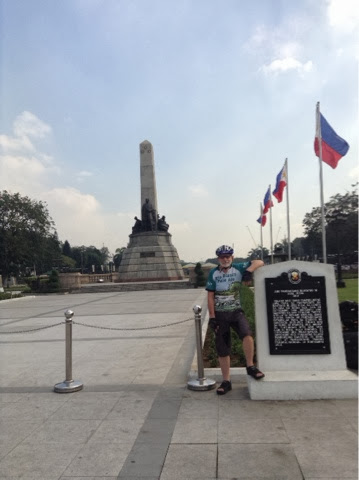
It was five miles to the city's sprawling central park named for national hero Jose Rizal, who was executed just a little to the left of this monument in 1896 by the Spanish, two years before the US gained possession of the country.  The park too was part of the Burnham plan.


We proceeded north continuing on Roxas Boulevard for some ten miles and then on over to MacArthur Boulevard, the traffic still thick, but manageable.  More of a menace was the horrific pollution, a heavy haze, worse than anything I had encountered in China or anywhere else.  It was accompanied by a wide variety of noxious odors, including urine.  The slums and disorder rivaled that of India.  When we stopped after two hours and twenty miles for a soda, we were immediately surrounded by a cluster of barefoot urchins all with their hands out, but without muttering a word.  

The poverty was counter-balanced with a regular chorus of friendly guys along the road and sticking their heads out of passing vehicles commenting, "Nice bikes," and "Where are you going?"  When we'd mention a town fifty miles away, the standard response was "Too far."   Though it wasn't the most pleasant of cycling we were still excited to be part of a throng of traffic unlike any other we had biked in with distinctive Philippine vehicles--the sinister-looking jeepnays (an elongated jeep with benches that is the Filipine version of an urban bus) and two types of tricycles, one motorized and the other pedaled that servie as taxis and also cargo vehicles.  We had to contend with not so good signage.  Fortunately there were frequent traffic cops who all spoke English and could direct us.  Sometimes we had to negotiate intersections of main arteries designed by senseless traffic engineers that did not continue straight through, but rather sent traffic we knew not where, as we could slip through the barriers that blocked motorized traffic. 

It was thirty miles before we saw our first patch of green, a small rice paddy, but it did not signal an end to the urban mayhem.  It did not look likely we'd be wild camping our first night, not that we particularly wanted to unless it was on the beach and we could wash off all the grime from the air and the layers of sweat.  By the time we reached San Fernando, a city of over 300,000 after fifty miles we were too drained to continue, even though we had a couple hours of light remaining.  A cyclist directed us to the hotel we ended up at on the outskirts of the city.  Even though it had no hot water and only a bucket shower, we didn't care to push on.  Our chief complaint was that the cold water wasn't as cold as we would have liked.  It would have been nice too if there had been Internet.  

Saturday, January 25, 2014

Wrapping Up Three Weeks On the Road

Quite often a search for a Carnegie library leads to a discovery that almost upstages the library.  So it was on day one of our travels at our first Carnegie in Brownsville, Tennessee with the Mindfield Sculpture Complex, a staggeringly intricate maze of towering metal structures down the street from the Carnegie, now the town's Chamber of Commerce.   It happened again towards the end of our trip in Fulton, Missouri, a few miles east of Columbia, Missouri, home of the University of Missouri in the center of the state.  We made a slight detour up to Columbia to visit a couple of colleagues of Janina's from Chicago who had moved there two years ago to work for the university.

Fulton is a college town too. Despite a population of just 13,000, it is home to a pair of institutions of higher learning (Westminster College and William Woods University), and also the National Winston Churchill Museum.  When we noticed the Churchill Museum on the map, our immediate reaction was to wonder what it was doing in Fulton.  We speculated it might be that Fulton was the home of his mother.  She was American, but she was actually born in Brooklyn. 

Instead, Fulton established a Churchill Museum to commemorate his visit to the town in 1946 with President Truman, when he gave a speech proclaiming the erection of an Iron Curtain across Europe.  The term had been used before, but this speech brought the term into prominence and is known as "The  Iron Curtain Speech."  The museum resides in a huge cathedral, almost as majestic as a Carnegie, formerly of London, the Church of St. Mary Aldermanbury, dating to 1181.  It had been destroyed by the great fire of London in 1666, rebuilt by Christopher Wren and destroyed by bombing in 1940.  The rubble was amazingly transported from England and rebuilt in Fulton in 1966, a feat worthy of a Herzog film.


It is accompanied by two statues of Churchill, the one on the left above and another beyond at the far corner of the cathedral.


Several panels of the Berlin Wall also reside in the Cathedral's plaza.


It was all an extraordinary discovery, though not our first Churchill encounter of the trip.  We also came upon a couple of his paintings in the Dallas Museum of Art, part of the Wendy and Emery Reeves Collection from their French villa.  It even included a box of Churchill's painting supplies.

Our three weeks on the road, driving nearly 4,000 miles, included multiple pairings of such unexpected oddities.  There was also the private jets of two people of prominence--LBJ and Elvis.  We saw two stray calico cats that Janina was tempted to adopt.  We patronized two Trader Joe's (Baton Rouge and Dallas) and two Landmark Theatres (Dallas and St. Louis for ""Inside Llewyn Davis" and "Great Beauty").  We paid homage to the graves of Richard Halliburton and William Faulkner.


Quite a few other things came in greater multiples.  We found ourselves in three cities with assassination sites (King in Memphis, Long in Baton Rouge, JFK in Dallas).  We passed through four state capitals--Baton Rouge, Austin, Jefferson City and Springfield.  Four noteworthy bike shops dotted our travels as did four state university campuses--Mississippi, Louisiana, Texas and Missouri. We tromped through art museums in four cities--New Orleans, Fort Worth, Dallas, and St. Louis, two of whom had recently opened up new wings.  

We were accompanied through the new wing  of the St. Louis Art Museum with CJ, one of three of Janina's college professor friends we visited during our travels.  When Janina noticed two twenty-year olds sitting on a bench studying a painting, she asked if they were artists, one of her areas of expertise.  They said they were theater students. That perked up CJ, as he is an actor and knows the St. Louis theater scene.  That led to a delightful fifteen minute conversation/lecture with Janina and CJ unable to resist their roles as educators.  

Noteworthy sculptures was another theme of our travels.  The St. Louis Art Museum offered an extraordinary Andy Goldsworthy of twenty-five tightly packed limestone arches each ten feet high in a courtyard between the new wing and the old entitled "Stone Sea."   A New Orleans sculpture garden included a giant safety pin by Claes Oldenburg.  The downtown St. Louis City Museum contained a mass of contorted sculpture extravaganzas inside and out, including slides for children of all ages, that left Janina gasping in wonderment.

Not a day passed that we didn't have at least one encounter with a fascinating character who we couldn't stop talking about as we drove along.  There was so much to discuss and digest, we rarely turned on the radio.  We met so many kindly librarians, Janina regretted she hadn't shot portraits of all of them at their desks or in front of their stacks.  It would have made a fine gallery, worthy of any museum.  

When we stopped at a pecan orchard in Oklahoma just across the border from Texas to buy a couple pounds of pecans, the wife of the husband-wife owners so appreciated our interest she gave us a half-hour tour of their operation.  Pecans are the American nut, grown no where else in the world.  Two-thirds of their 150,000 pound harvest had been bought by the Chinese.  Their 17,000 tree orchard is so beautiful, weddings are regularly conducted there.

Though this was by no means a Carnegie-quest, we managed to stop off at twenty-one of them, at least one in seven of the eight states we passed through, all but Kentucky.  It was the first time I had visited a Carnegie in Mississippi, Louisiana and Oklahoma, bringing my total to 23 of the 48 states with a Carnegie.  That puts me near the half-way mark, but I'm well below the half-way mark of Carnegies in the US, having gotten to only 218 of the 1,679 so far.

Janina has become infected by my Carnegie quest and admitted that it almost seemed as if each Carnegie we came upon was more magnificent than the last.  Each distinguishes itself in some stately manner, proudly emanating a quiet dignity that immediately gives one a jolt of uplift the moment one spots it.  Each stands eminently above all the other nearby buildings.

Last Sunday Janina and I were able to string four of them together as we made our exit from Texas, angling northeast across the state to Caddo Lake State Park, home to the state's only natural lake.  It being a Sunday, none of the libraries were open.  Our first was in Bryan, just north of College Station and Texas A&M.  We had no address for the library, just the confidence it would be near the town center, as most are.  It is far more satisfying to be seeking the recognizable features of a Carnegie than to be seeking an address.  After bisecting the center of Bryan on its main east-west artery and not spotting it, we headed south on its other axis and there it sprung up in four-pillared grandeur with "Carnegie Public Library" ornamenting its facade. 


We sat on a bench in front and tapped into its WIFI for our first Internet check of the day.  After soaking up its eminence for several minutes we went across the street to a hotel cafe for Janina to fill her mini-thermos with coffee.  Then it was on to Franklin.  The town was on the fringe of the highway.  We didn't even realize we had reached Franklin when Janina's eye caught the features of a building that had the aura of a Carnegie.  Indeed it was.  As with Bryan's, it had not been added on to and its facade prominently identified it as a "Carnegie Library." It was uncharacteristically several blocks from the town center, truly standing apart and above all the other buildings in the town.


Tyler was a sizable city, but we were still able to hone in on its Carnegie without having to ask anyone.  The library is now a Historical Society.  It had been added on to, but the city still outgrew it.


We needed help finding the fourth Carnegie of the day in Marshall, as we didn't realize it had been built as an academic library on the campus of Wiley College, one of the few black colleges west of the Mississippi.  We found the new library in Marshall and used its WIFI to locate the Carnegie.  It's not likely anyone would have known, as it is now an administrative building unadorned with any Carnegie inscription.


We began the next day with a bike ride along Caddo Lake, where we had camped beside one of its beguiling bayou-like arms.  It was less than twenty miles to our seventh and final of the thirteen remaining Carnegies in Texas in the small town of Jefferson.  It had undergone a stunning $500,000 restoration a few years ago.  It was Martin Luther King Day, but the devoted librarian kept the library open.


Its upstairs meeting room was in pristine condition and served as a great asset to the community.  As is so often the case, we were delighted that the Carnegie had drawn us to this small gem of a town.  It was lunch-time so were were able to acquaint ourselves with a first-rate cafe that had a meat loaf lunch special with yams and mashed potatoes and coconut cream pie.  It was another dose of small town America at its finest.


Our time on the pecan farm later in the day delayed our arrival in Tahlequah, Oklahoma and its Carnegie until dark.  It had a huge addition to its side that didn't match the old, but one could still appreciate its fine features.  We could well return to appreciate it in the light of day as we feel beckoned by the town's Cherokee Museum.  We might have overnighted there if we weren't pressed to be in Columbia the next afternoon. 

We did take a quick detour from Interstate 44, one of the few Interstate stretches of the trip, to give the Joplin Carnegie a look.  It was closed and fenced in, awaiting a new tenant after most recently housing the International Institute of Technology.  It is a sterling building that needs a worthy tenant.


The Carnegie in Fulton had an addition that tried to blend in with the original.  The librarian we spoke with mentioned that until the late '50s, the town's black residents had to enter the library through a back door.  The daughter of one of those blacks now works as one of its librarians. 


My final bike ride of the trip was a 36-mile circuit of St. Louis the next day in sub-freezing temperatures to the four of its seven Carnegies that had evaded me on previous visits to the city.  Its main library built in 1912 is a veritable palace and one that I am eager to visit again.  I didn't have enough time to fully absorb its many exemplary features.  The outside of the building is ringed with an all-star line-up of writers--Goethe, Moliere, Hugo, Racine, Shakespeare, and on and on. Each of its four exterior walls is also inscribed with a quote extolling the virtues of books and reading and libraries.  


Chiseled over the three welcoming arches is a quote from Frederick Crundan: "Recorded thought is our chief heritage from the past, the most lasting legacy we can leave to the future. Books are the most enduring monument of man's achievements. Only through books can civilization become cumulative."

Carnegie is quoted on another side of the building: "I choose free libraries as the best agencies for improving the masses of the people because they only help those who help themselves.  They never pauperize a taste, for reading drives out our lower tastes."  Longfellow is also quoted praising "the sweet serenity of books."

As has happened several times on this trip, I was warned about venturing into a certain neighborhood.  I might have heeded such advice after dark, but I had no qualms about riding a stretch through blocks and blocks of mostly boarded up buildings on the north side of the city between the Cabanne branch and the closed down Divoll branch.


The Carondelet branch way to the south had a similar portico to the Cabanne branch, unlike any other Carnegies I have come upon.  None of the libraries allowed WIFI use without a library card, so I couldn't keep Janina and our hosts appraised of my progress and return-time for our museum outing, arriving back to their house just as they were finishing lunch.  There was plenty left for me, though I had been well-fortified by Nancy's fruit-laden oatmeal, some of which I ate at my various stops.


Our drive back to Chicago the next day took us past the Cahokia Mounds.  We had stumbled upon three other sets of mounds along the way.  The Emerald Mound towards the end of the Natchez Trace Parkway is second in size to the Monk's Mound in Cahokia.  There were also mounds just across the border from Cairo, Illinois in Kentucky. We also climbed a mound by the state Capitol Building in Baton Rouge.  Upon it were two canons.  

Though it was just single digit temperatures I climbed the 150 plus steps to the top of the highest of the many Cahokia Mounds and had a fine view of The Arch and downtown St. Louis and the surrounding snow-covered farmland and Interstate 55 just below me.  It had been decades since either Janina and I had been to this World Heritage site, one of only 21 in the US. It was accompanied by a most impressive visitor center with an excellent movie and many superb exhibits explaining the Native American mound culture.  Those of Cahokia accommodated over 20,000 people at its height.

The final stop of our three week road trip, other than for gas, was in Lincoln, just north of Springfield, to see its Carnegie.  It was a fitting finale, crowned with a rare dome and a circulation desk to die for.


Its exterior proved Janina's premise that every Carnegie we came upon was more magnificent than the one before.  The library had expanded across the alley behind it into an old Wieboldt's store.  It had celebrated its 100th anniversary in 2003 and looked good for at least another 100.  A plaque in front of the library stated,"The library's history typifies the combination of national wealth, grass roots initiative and cultural ideals which generated the free library movement and its goal of a free and educated American society."  We saw those qualifies reflected in a multitude of ways throughout our foray through small-town and big-town USA.  Our trip could have hardly been better, other than maybe spending more time on the bikes.


Sunday, January 19, 2014

Austin, Texas

Lance may have been stripped of his seven Tour de France titles, but seven framed Yellow Jerseys, representing each of his wins, still prominently hang in his Austin bicycle shop Mellow Johnny.  It couldn't be otherwise, as the shop takes its name from Lance's mangled pronunciation of  those Maillot Jaunes, French for Yellow Jersey.


The glitzy and spacious interior of the shop belie its rather humdrum exterior, retaining the rough facade of its previous existence as a beer brewery then homeless shelter in the former warehouse district of Austin on the fringe of its downtown business district.  The shop is so centrally located that it provides showers, six of 'em, three for males and three for females, for commuters at the cost of just one dollar.  The shop opens at seven a.m. for the early birds, and is actually open more than an hour before that for those who wish to come in super early for some training in the store's basement workout center.  It is so popular that its six a.m. session is fully booked.


The shop's name is not the only play on a foreign language.  The coffee shop in the front of the shop goes by Juan Pelota, a pun on the Spanish for One Ball, which Lance was left with after the removal of one of his testicles due to cancer.  There is no evident wordplay though on the password to use its WIFI--spaceman. 


The French may regard the garbled Englishism of that most sacred of garments as a slur, but they ought to be honored that the lone quote on the walls of the shop, a poetic ode to the transformative power of the bicycle, is from the French racer and journalist Jean Bobet, younger brother of  Louisson Bobet, three-time winner of The Tour in the 1950s.  Bobet the younger was a better writer than rider.  He wrote a most exemplary memoir evocatively titled "Tomorrow We Ride," a favorite expression of his brother after he retired.  That too would have looked fine up on a wall of the shop.  If the store had been more Lance-centric, it might have included some of his favorite sayings--"Pain is temporary. Quitting is forever," "Go hard or go home," "Whatever your 100% looks like, give it," and the like.


The coffee shop had a handful of customers sipping its brew, all glued to their computers. Otherwise Janina and I were the lone customers in the shop packed with Mellow Johnny ware and bikes and accessories.  The coffee shop also offered a wide array of bicycle magazines.  There was also a chart of an assortment of weekly training rides of various distances and speeds open to all that departed from the shop, just as the Richardson Bicycle Mart offered.  

We had a pleasant, unhurried conversation with two young employees, who Janina termed "sweet," exuding more of that Texas and southern wholesome friendliness we've so often encountered that is such a marked contrast to what we are accustomed to. They clearly enjoyed working at the shop and were deeply ingrained bicycle enthusiasts.  Even though the shop rents bikes, they were pleased Austin had just started a city-wide rental program the month before similar to what Chicago and New York instituted earlier in the year.  It thrilled them whenever they saw one of the hundred or so bikes being used.


It was my third such Texas bicycle shop experience in four days. The day before I'd had another at the Hill Country Bicycle Works in Fredericksburg, a thriving German-themed town of 10,000 inhabitants.  It was a much smaller shop than the two others I'd visited, with just one employee on hand in the slow offseason.  I was lucky it was one of the co-owners, Lisa Nye-Salladin.  She did have one customer come in with a flat hour during our half-hour of bike talk, but the interruption allowed me to give the shop a thorough investigation.  It was adorned with six Lance posters and others of Jan Ullrich and Bjarne Riis and Tyler Hamilton and others tainted by drug use. Lisa and her husband Adam got their start in cycling as touring cyclists, but later became involved in racing, so much so that Lisa served thirteen years on the board of USA Cycling getting to know many of the principals of the sport and gaining a full understanding of all its facets, so isn't one to condemn those who "cheated," even devoting the shop's bathroom to posters of "cheaters."

Though Austin was less than one hundred miles away, Lance's current home and home during his racing career, he wasn't known to train on the region's famed hills.  He did pay one lone visit to compete in a mountain bike race staged by Lisa and Adam after his first retirement as training for his first attempt on the Leadville 100.  When Lance's manager contacted the Salladins telling them Lance wanted to ride their race, they thought friends were pranking them.  It took a second communication to prove it truly was a Lance representative.  He arranged for Lance to preview the course with Adam, the best mountain biker in the region.  Adam had a three-and-half ride with Lance all to himself and was thoroughly charmed.

I stopped in to meet Lisa and Adam on the recommendation of Lance-expert Jim Hoyt, the first of my bike shop immersions.  He told me that not only were they experts on cycling in the Hill Country, but that they were touring authorities as well, having completed a thee-year round-the-world tour before opening their bike shop. I was curious if their travels had included the Philippines, my next destination.  They hadn't, but it was still wonderful to hear Lisa so enthusiastically recount many of their experiences from twenty years ago.  They began their trip in New Zealand in February of 1992.  They next went to Australia, then Southeast Asia and on over to India where they spent four-and-a-half months after only intending on spending two weeks. They flew from Delhi to Nairobi and proceeded south to Cape Town, arriving in South Africa just as apartheid was ending.  

They flew back to America from Africa.  As they cycled from Florida to San Francisco, their starting point, they passed through Kerrville, Texas.  The town bike shop was for sale.  It was still available when they completed their trip, so they decided to buy it and take up residence in Texas, even though Lisa had grown up on the east coast and Adam on the west.  It brought an end to their touring, but they've had no regrets, enjoying the business so much, opening a second shop, the one where we were talking, two years after buying the first.  When they retire they look forward to biking Europe, which they bypassed on their world tour, and riding The Tour de France, one subject I knew more about than Lisa.

At one point in our conversation Lisa mentioned she had baby sat for Tyler Hamilton, as they grew up in the same town in Massachusetts.  When Tyler began making a name for himself in the world of cycling, even before distinguishing himself as Lance's chief lieutenant in his first Tour win in 1999, her mother alerted her to the news that the five-year old Tyler Hamilton she used to babysit for was now a world-class cyclist.  Years later Lisa reintroduced herself to Tyler at a Las Vegas Interbike show.  He had no memory of her, but the following year when he saw her again at Interbike, he immediately called out, "My babysitter."

One of the most notorious climbs in the Hill Country was just fifteen miles from the shop up to the summit of Tunnel State Park, named for a former railroad tunnel that had been retired from train traffic in the 1940s.  It was now the summer home to over three million bats, presently wintering in Mexico.  Texas could be called the State of Bats, as 32 of the 53 species of North America bats reside in Texas, the most of any state.  The route sheet I picked up of an 88-mile loop that included the climb  described it as Beyond Category.  It was no where as extreme though as some of the climbs of Bloomington, Indiana's Hilly Hundred.  It was just a half mile long and a five per cent grade, providing some explanation for why Lance didn't go out of his way to train on these not overly demanding hills.

There was no camping at this state park, but with over ninety such parks scattered around the state it wasn't far to another.  We were somewhat tempted to backtrack to Enchanted State Park, named for the Ayers Rock of Texas, a huge granite rock that rises nearly five hundred feet and requires a half mile hike to reach its summit.  It was a spectacular place to camp and has been the site of sacred ceremonies by various peoples going back to pre-Columbia America.  It was another of the many wonderful discoveries we have made in these travels.


It was another of the many wonderful discoveries we have made in these travels.  Among the oddities was as Air Force Half, LBJ's private jet on his ranch outside Johnson City, a town of just 1,000 people named for Johnson's uncle.  It was the second noteworthy personal jet we've come upon.  The other was in Memphis across the street from Graceland, that used to fly Elvis around.

It hasn't been so bad intermixing the driving with biking.  After a couple hours in the car it makes a good bike ride all the more liberating.  Lately the ratio of time spent on the bike has been double of that spent in the car.  Janina injured her knee doing some dancing in Dallas so she has been restricted to short rides around our camp sites and doing a lot of reading while I'm off on my rides.  Yesterday she constructed a small shrine of piled rocks at our campsite in a state park that suffered a forest fire two-and-a-half years ago.   It could well inspire others to do the same.  It would be a good project for the army of Boy Scouts who arrived after dark and were gaily going about their chores early the next morning.  We didn't mind at all to have the quiet interrupted by such boisterousness.


The Texans certainly take advantage of their parks.  Two of the parks we had camped in earlier in the week were booked for the weekend.  But it is the peak season, we were surprised to learn.  We slipped the off-season rate into our after-hours envelope at the Enchanted State Park before we more closely studied the charts and learned the lower rate applies to the hot months of June through August.

There is a palpable state pride in all things Texan.  It is a state of historical markers.  Each is numbered and there are over ten thousand of them.  Zach, the 28-year old son of Greg in Dallas, said that every high school student takes a course in Texas state history.  The most popular tattoo of the people he knows is the Texas state flag.  A large supermarket chain is called H.E.B., standing for "Here Everything's Better," what could well be the state motto.  Not only do Texans consider things better in Texas, but also bigger.  "Texas-sized" is such a common term, it was used to describe the baked potatoes on the menu in the cafeteria of the grand Dallas Museum of Art.

But Texans aren't overly brash in their state pride.  It gives them such a strong measure of self-respect and confidence that they hardly need to brandish it.  Nor does it diminish their respect for others.  I've never been called "Sir" so often, nor Janina "Ma'am," and with an unobsequious sincerity.  Not only does the 60 degree weather make Texas an attractive place to be in the winter, so does the demeanor of its residents.  We'll be sorry to leave.


Monday, January 13, 2014

Plano, Texas

It was no surprise that there was no sign on the outskirts of Plano announcing "Birth place of Lance Armstrong."  But it was a surprise to discover it was a sprawling town of a quarter million people without any real central district, just a serious of shopping malls and clusters of businesses along the many six-lane highways intersecting it. I had envisioned it as a small Dallas suburb from my memory of how it had been portrayed in Armstrong's "It's Not About the Bike," and other biographies.

It was certainly smaller when Armstrong was a youth thirty years ago, but it has grown large enough to support three public libraries.  Neither of the two I perused had much of a collection of Armstrong books. One chose to feature atop a book shelf Floyd Landis's defiant 2007 autobiography, "Positively False" proclaiming his innocence, over any of Lance's books.

I was hoping to find some plaque or monument honoring Armstrong in the town he grew up in.  But there was no such thing to be found, past or present.  The local Plano bike shop that he patronized growing up did not acknowledge him in any way.  What Lance memorabilia it once had on display was long gone, though none of the employees, nor anyone else in Plano, I spoke with expressed any animosity towards him, just disappointment.

But it was a different story at the huge Richardson Bike Mart in the town just south of Plano where Armstrong's mother bought him his first BMX bike and that also sponsored him early in his career.  The store is owned by long-time Armstrong supporter Jim Hoyt, who loaned Armstrong the money for his first car and served as a father-figure, mentioning in an aside as we talked, "I raised Lance."  Though they've had some differences over the years, they remain on good terms.  Lance was a surprise guest at a group ride celebrating Jim's 60th birthday a few years ago.  They most recently spoke over the holidays when Lance called to let him know he was doing okay, other than not being able to compete.


Hoyt now owns three bike stores. I was most fortunate to discover him at his flagship store when I stopped in. He couldn't have been more affable nor generous with his time, happy to talk Lance and bicycling.  He acknowledged that he took down the seven signed yellow jerseys from each of Armstrong's Tour wins after his Oprah confession last January in response to assorted Internet threats, but other Lance jerseys still hang around the shop, including his World Championship jersey.


There was also a painting of Lance over the door to a back room and one of Lance's early bikes hanging from the ceiling in another room.


Hoyt is often mentioned in Lance biographies, including the latest indicting Lance, "Wheelman," by two Wall Street Journal reporters.  He said he declined to be interviewed by them and that all the material relating to him had been culled from other books, including Daniel Coyle's "Armstrong's War," a book that did not have his favor. 

We discovered that we had both been on L'Alpe d'Huez for the 2004 Tour time trial, Jim at the Dutch Corner and I at the summit.  Jim had arrived by helicopter to the summit and then descended to the Corner.  He was also in Paris at Lance's first Tour triumph in 1999.  He hadn't planned on attending The Tour that year, but when Lance devastated his competition on the first mountain stage at Sestriere, a friend of Jim's decided to fly over and Jim arranged to make the trip too.  He had to trick the gendarmes by feigning an illness to get beyond the barriers to join Lance and the Postal team at their team bus on the Champs Élysées.  I could hardly believe I was hearing these first-hand stories so fondly recalled by someone so close to Lance.  Jim was clearly enjoying sharing all his experiences and didn't want to stop talking.

As we walked around his Texas-sized bike shop, several times bigger than Lance's Mellow Johnny store in Austin, I kept looking for a Tour course marker.  Jim said he had had a few hanging at one time and some from the Giro as well, but now the only Tour memorabilia he had on display was a Champion supermarket banner, sponsor of the Climbing competition, that was a delight to see and further stirred the memories.


We also talked touring.  One of the photos behind Jim's desk was of the bike he toured on back in the '70s.  He said he went off on his bike for a several day tour when he had reached a critical crossroads in his career and had to decide whether to relocate to Chicago and accept a promotion with Schwinn, who he was working for as a sales rep, or remain in Texas and buy a small bike shop.  He decided to stay in Texas.  The small store he bought has now grown into one of the largest in the country.

We also shared memories of riding the thousand mile stretch of Vietnam from Saigon to Hanoi, which we had both ridden a few years apart, Jim as a Vietnam vet and I as a venturesome touring cyclist.  His most recent long-distance tour was a coast-to-coast ride across the US from Portland, Oregon to Portland, Maine.  I told him I had driven down to Texas with my girl friend to get in some winter cycling and training for a ride around the Philippines next month and asked if he could recommend any place for some good miles.  He immediately suggested Fredericksburg, 250 miles south.  It is known as the cycling capital of Texas and has a number of good routes through the hills.  It had the added benefit of a bike shop owned by a couple who were ardent touring cyclists, having completed a three-year tour of the world before settling down.

Jim was another of the many warm and gregarious Texans and southerners Janina and I have met in the past two weeks as we drove down to New Orleans and on to Grand Isle, the lone resort on Louisiana's 300-mile Gulf coast, and then over to Dallas, where we are presently visiting a friend of Janina's from her art school days at Indiana University.  It was a twenty-five mile ride from his house in Irving to Jim's bike shop.  Despite the sixty degree temperatures, I was the only person I saw on a bike there and back and on up to Plano, my longest ride in a couple of months.

Janina's  friend Greg teaches art at the University of Texas Dallas branch.  He keeps up with his own art as well, having been named the best artist in Dallas three times in the past ten years by a poll of readers for a Dallas newspaper.  He is most famous for his Cow Pope, transported in a Pope-Mobile, that he debuted in Houston's annual Cow Parade a few years ago and still makes appearances here and there.  He also has the distinction of appearing in the Ninth Inning of Ken Burns' baseball documentary in a photo as a ten-year old standing in line for Mickey Mantle's autograph, one of the most memorable events of his life. 

Even though we are traveling by car and aren't using our bikes as much as we'd like, it has been a great road trip full of encounters with fascinating folk and delightful surprises, including an outrageous sculpture garden in Brownsville, Tennessee called Mindfield, a life-long project by a fellow named Billy Tripp.  We were drawn to Brownsville to see its Carnegie library and as part of an homage to the travel writer Richard Halliburton, who was lost at sea in 1939.  Brownsville was his birthplace.  Fifty miles south we visited his grave in Memphis, as well as a memorial at Rhodes College.   The Brownsville Carnegie was the first of a handful I have added to my life list.  I tracked down three more in New Orleans and others in Vicksburg and Lake Charles.  The only one we've seen so far in Texas was in Palestine, one of only thirteen that remain standing of the thirty-two constructed in the state. Like all but one of those I've seen on this trip, it no longer serves as a library, but still remains a beautiful, prominent building in the town center.


Another theme to these travels is assassination sites.  Dallas is the third.  The first was Memphis. The hotel where Martin Luther King was shot is now a Civil Rights Museum. Huey Long was shot in the state capital building in Baton Rouge in 1935.  It is the tallest state capital, 27 stories high.  Long had it built in 1932.  He is buried in a garden facing the capital.

We had one of our better meals of the trip in the capital cafeteria served by inmates in their jumpers.  It was as southern as could be--beans and rice, lima beans, greens, corn bread and banana pudding.  We also had several bowls of gumbo along the way and a fine cat fish sandwich.  We have been camping in state parks and have had a few nights indoors at cheap Indian-owned motels and a night in a hostel in New Orleans that did not have much heat.  Many of the travelers, unprepared for the record sub-freezing cold, were walking around the hostel wrapped in blankets from their beds.  It was cold enough further south in Grand Isle to kill all the butterflies in the town's Butterfly Dome.  It was the first time the dome was bereft of butterflies since Hurricane Katrina.

The joys of travel are many.  None are greater than meeting up with friends along the way.  Besides Greg we also connected with Bob and Catherine in Baton Rouge and Robin and Ellwood in Dallas.  Bob and Catherine had just moved to Louisiana from California.  Bob was one of several Trader Joe's managers brought in to open up its first store in the state. Robin and Ellwood just happened to be flying in to Dallas from St. Louis the day after we arrived en route to a family reunion.  Bob and Catherine were loving their new environment and Robin and Ellwood were in equally good spirits on the start of a month of travel.  We had a wonderful time catching up with all. 

We've got another week of fun times before Janina has to be back teaching at Columbia.