Saturday, October 9, 2021

Ironwood, Michigan


I hardly expected to find a college town in the far reaches of Michigan’s Upper Peninsula, but that’s what Houghton, a former mining town, has evolved into.  It’s Carnegie Library, now the Carnegie Museum, on a steep road up from the Portage Canal that connects the town to Lake Superior, gave a full pictorial history of this town of 8,300, its largest population since its was founded in 1860 and 3,000 more than when its handsome, red-stoned Carnegie was built in 1908.


A set of solar panels in the parking lot of Michigan Technological University is the first site one sees upon approach to the town.  A plaque explains they were a student project designed to provide electricity for the nearby president’s home.  A large dormitory just up the road provides instant evidence that this is no small community college, but a substantial institution with 8,000 students and a faculty and staff of 2,000, by far the largest employer in the town.  

And just across the Canal, the smaller town of Hancock is also home to a university, Finlandia, founded in 1896 as The Suomi College and Theological Seminary to preserve Finnish culture and train ministers for the Lutheran Church.  It is much smaller than Michigan Tech with just four hundred students.  It lives up to its name, changed in 2000, with a Finnish American Culture Center on campus.  


I wouldn’t have ventured across the Canal to Hancock and Finlandia if Jeff H. of the Reader, authority in all things Finnish and Upper Peninsula, hadn’t recommended it.  He also recommended the pasties at a nearby bakery, but neither Finnish Center nor bakery were open in the late afternoon when I came by.  I had to be satisfied with a monument beside the Finnish Center to Lauri “Big Louie” Moilanen, a legendary 8’ 3” Finn, who was born in Finland in 1886 and died in Hancock twenty-seven years later.

When I’m crossed back over to the canal, the late afternoon traffic was gruesome on Highway 26 leaving Houghton for a couple of miles to the Walmart and a cluster of stores including a cannabis outlet.  A large billboard channeling Grant Wood advertised it outside of Houghton.  Such billboards have outnumbered the obnoxious personal injury attorney billboards that are a pestilence around larger towns.  The most common billboards though have been those seeking workers offering high wages and benefits and to train.  There is a tremendous labor shortage, especially if one is to believe MacDonald’s.


Beyond the Walmart I had the road and the stunning changing-of-the-leaves scenery to myself.  It was nothing but forest for a hundred miles to Ironwood on the border with Wisconsin.  There was no sign of agriculture other than occasional advertisements for wild rice, including one of soup, and blueberry juice.  What few logging trucks that passed gave me plenty of space.

Ironwood joins Iron Mountain and Iron River as towns in the U.P. who adopted names relating to the mining that established them and is now long gone.  Ironwood is one of seven towns in the U.P. with a Carnegie, all of which still stand, unlike the rest of the state where eleven of the fifty-four in the lower Peninsula have been razed, including three of Detroit’s eight.   


I had visited the Ironwood Carnegie three years ago on a drive across the state with Janina on our way to Telluride after attending the Traverse City Film Festival.  We didn’t have the time to make detours to the four I gathered on this trip.  I was happy to drop in on it again, especially since it still functioned as a library, just one of two in the U.P. And also because I hadn’t had a library visit since Houghton.  There were a couple in small towns along the way, but they had limited hours and weren’t open when I stopped by. The only thing better than visiting a Carnegie for the first time is returning to it years later.  And it is always much more satisfying to arrive by bike than by automobile.

Ironwood’s Carnegie is a relic, little different than when it was built in 1901.  A bond issue to expand it failed.  “Carnegie” is fully acknowledged with a sign out front announcing “Ironwood Carnegie Library” and a plaque beside the entry saying it had been placed on the Register of National Historic Places, as well as “Carnegie Library” in bold letters chiseled into the stone above “Free to the People”  above the entry.  It is the oldest still functioning library in the state.  

Rather than the traditional Carnegie portrait, it had a different version with his famous quote about the importance of libraries.  


It faced the circulation desk, now adorned with plexiglass panels.


Thursday, October 7, 2021

L’Anse, Michigan


The leaves are a-changin’, and they are falling fast.  My tent has been bombarded the past two nights, even interrupting my sleep as if I were being pelted by rain. My bike seat and rack are covered with leaves in the morning.   The technicolor foliage show amped up after I left busy Highway Two and continued on my way north to Lake Superior on much lighter-travelled roads. 


The terrain is less settled and more thickly forested.  Logging roads, old and new, continually offer up entry to places to camp.  I can be assured of a quiet night when i venture down a road overgrown with weeds and with a locked gate that I can either duck under or pass around.  This is truly getting away from it all.

But before this idyll I had to endure one hundred miles of Highway Two from Escanaba to Iron Mountain and Stambaugh, large towns that had been bequeathed Carnegies.  Highway Two runs the length of the U.P. after starting in Everett, Washington north of Seattle, then traversing the top of the West through Idaho, Montana, North Dakota, Minnesota and Wisconsin. There is no interstate to siphon off the traffic so it attracts truckers and all too many others. It’s just two lanes wide, but has an adequate shoulder for cyclists. 

The constant whizzing traffic made it hard to imagine I was in the far north and difficult  to appreciate its scenery. With all the traffic, there were tourist attractions here and there—a couple of corn mazes, a bat viewing area, mine tours and museums. Though the weather has been balmy, near eighty, the tourist season has past.  There is hardly a vehicle towing a boat and even fewer adorned with bicycles.

I stopped at a service station with a restaurant attached hoping for a soft drink and ice dispensing machine, as all the MacDonald’s continue to be drive-through only.  It seems to be a corporate cost-saving conspiracy.  Even worse it’s an environmental catastrophe with long lines of cars idling, inching their way to the drive-up window spewing fumes. Environmentalists ought to be raising a ruckus, demanding MacDonald’s to close those drive-throughs and make the masses get out of their cars and come inside to order their food.  

Evidently MacDonald’s profits didn’t suffer when Covid forced them to close their inside service, so they have continued the policy under the pretense of staff shortages, even though rarely does a MacDonald’s have a “hiring” sign as they did during Covid and many other stores presently have. Every MacDonald’s I’ve stopped at, if only to use their WiFi, has had a sign posted on their doors complaining of staff shortages as explanation for there being no indoor service.  That’s bogus, as it would take no more staff to serve people inside rather than through windows if they chose to make that choice. All those indoor play stations meant to make kids want to go to MacDonald’s are now sitting idle.  Maybe they weren’t such a necessary ploy to attract young-uns and their parents.

There was no ice or soda dispensing machine at the service station, so I made do with cold tap water and a few spoon fulls of Tang.  While I was drinking and eating a peanut butter sandwich, a hefty young man came out of the restaurant and asked if I’d ever had its biscuits and gravy.  He said they were quite good and offered me his takeout container.  I hadn’t been there long enough for him to have bought it for me.  It was simply a spontaneous gesture.  It may have been a side dish that he didn’t care to eat at the time and seeing me realized I needed  the calories more than him.  Whether he saw in me someone short of funds or someone off on an adventure that he wished to endorse, I know not, but whatever his motivation, I appreciated it, especially since  it was the first act of such kindness on this trip, much later than usual.

It’s not the food or money that heartens me, but rather the assurance that some humanity still lurks on the planet.  One has to wonder if one pays too much attention to the news.  Among the podcasts that keep me abreast of current events, three are an unrelenting barrage of man’s darker side, portraying Planet Earth as a cesspool of injustices.  Amy Goodman, Michael Moore and Ralph Nader spew an endless litany of grievances.  They are a non-stop avalanche of negativity and hostility, foaming with rage and anger. I only keep listening to validate my urge to have as little as possible to do with their world and to get away from it all on the bike, knowing life is nowhere as horrific as they make it out to be. What keeps them going I know not.  It’s fortunate they have an outlet for their continually being upset, otherwise they’d explode.

Every podcast, they lament the mistreatment of one group or another from Palestinians to Sikhs to prisoners fighting forest fires.  They have an endless array of topics to rail against—the evils of Facebook, the practices of Amazon, the horror of drones, Guantanamo, the super rich not paying taxes, the danger of Roe vs Wade being overturned, the absurdity of the Electoral College, the travesty of holding the Tokyo Olympics, undocumented workers killed in the World Trade Tower collapses, January 6, gerrymandering, obstinate senators, toxic masculinity, vaccine deniers, the many repercussions of climate change, another oil pipeline break and on and on, all as if there is only one side to every issue and that there is no good news to report.  Every day it’s something  else, and if its not something else, they just recycle.  If they all took a break from their injustice-mongering and went off on a bike for a few weeks and gained some perspective, they and we all would be better off for it.


Out in rural America on the bike, one needn’t be weighed down or preoccupied by the seemingly dire state of the universe because the universe isn’t as dire as all too much of the media portrays it.  There is a quiet calm and order.  The clamor coming out of the urban morass is an aberration.  One needs to take an occasional break from it to be capable of coping.

As I pedal along I can unburden myself of all such concerns.  I constantly come upon things to regenerate my spirit, not the least of which are the Carnegie libraries.  The one in Iron Mountain may have lost some of its luster with all it’s windows boarded up, but it still stood tall and proud now serving as the Menominee Range Museum.  A plaque in front of this Neo-Classic Revival building stated that when Carnegie had been in the region in 1901 checking in on the iron mines that supplied his Pittsburg steel factories, he made the offer of a library to the community, contrary to the usual manner of communities making the request.  It was replaced in 1971.


The Carnegie in Stambaugh, adjoining the town of Iron River, was now the administrative offices of the nearby school. It sat in a park adjacent to the high school and was constructed with yellow brick in contrast to the red of the school.  Both Stambaugh and Iron River have their own libraries just two miles apart.  Stambaugh’s had a rack of Halloween costumes along with cake tins that could be checked out. 


Fifty miles north I finally reached one of the goals of this trip, an inlet of Lake Superior at L’Anse.  


I will continue thirty miles further north along the shore of the lake to Houghton and it’s Carnegie, the northernmost point of these travels.  And with it I will be able to celebrate completing Michigan’s slate of Carnegies.


Tuesday, October 5, 2021

Escanaba, Michigan


Sunday night’s Game of the Century had me looking for a motel for the first time in these travels.  It was three o’clock when I arrived in Oconto, a town with a couple of motels, four hours before Tom Brady took on his former team in Boston. The Packer/Steeler game was about to start.  I wasn’t all that interested, but being in Packerland and having paid a visit to Lambeau Field the day before, I was feeling infected by the urge to join everyone all round to give it my attention.  

I didn’t mind cutting my day short, as I was overdue for an abbreviated day.  More motels awaited me twenty-five miles up the road in the neighboring towns of Marionette and Menominee on the Michigan border.  It would be a nice ride with the road all to myself while everyone within miles would be glued to their televisions, but I needed to show my legs some mercy after ten straight seventy-plus mile days, plus I had a fair amount of washing to do and would need as much drying time as possible.

So I denied myself the pleasure of staying on the bike and stopped at the first motel I came to, an Econ Lodge.  I was concerned it might not be open as there was only one car in its parking lot.  That was because most of those staying there were at Lambeau Field for the Packer game thirty miles to the south.  I could have had a room, but the price was inflated to $130 due to the game.  

I was told there was a cheaper motel down the road,  but that it might be filled with out-of-towners in for the game.  It was a “Florida Project” motel with seventeen rooms catering to long-term rentals.  It had a room available for about a third the price of the spiffy chain motel. It was barebones, with the dimmest of light bulbs in the two lone lamps and the WiFi so weak I feared I’d have to go to the nearby MacDonald’s to use my iPad and the heat hadn’t been turned on, so my gear and clothes couldn’t fully dry,  but the TV worked and there was plenty of hot water for all the washing I needed to do, so I couldn’t complain.

I nearly stopped earlier in the day in Shawano, tempted by the Silo Inn and it’s advertisement of “Weekly rates starting at $110,” compared to the $260 where I ended up, but that would have left me over one hundred miles the next day to the next Carnegie in Escanaba, and I wanted to get closer than that. 


I didn’t care to go two days without a Carnegie, as there’d be none this day after averaging two a day for the first ten days of these travels.  The last had been in Clintonville at dusk the evening before. It sat nobly on a hill, unmarred by any additions, though no longer a library.  It was now home to a real estate firm.  A plaque acknowledging Carnegie had a variation on the usual tribute, stating “this building was erected with means donated by Andrew Carnegie.”


A little north of Clintonville I passed through the tiny town of Embarrass, which took its name from the Embarrass River, named by the early French lumberjacks for its many snags that made floating logs down it difficult.  Embarrass is a French word meaning to impede or obstruct.  There is also an Embarrass in Minnesota, a couple of hundred miles away and much further north not far from the Canadian border.

The Packers were handling the Steelers, so I could tune into the hour-long pre-game show on NBC for the big showdown in Foxboro.  Loads of New England fans came to the game wearing Brady jerseys, so it was no surprise when he was greeted with cheers by the fans he had played for the previous twenty years.  But once the game began, their allegiance all turned to the home team and they treated him like any visiting player with boos.  He was a bit shaky and his former Coach Bellichek, as great of a coach as Brady is a quarterback, devised defensive schemes that kept him off-balance.  


Tampa Bay was a touchdown favorite.  Many thought Brady would annihilate his former team with four or five touchdown passes. He had none, partially due to the rain, but still managed to eke out a narrow victory when an end of the game field goal attempt hit the goal post.  It wasn’t the best of games, but I was glad I had been able to see it and didn’t have to wait until the next day to learn it’s outcome and all it’s ebbs and flows.  It kept me up until eleven, more than an hour later than if I had been in my tent.


None of my clothes had dried in the morning.  I put on a nearly dry jersey and strapped the rest on top of the gear on the back of my bike.  After an hour when the jersey I was wearing had dried, I put on another damp one to dry it. An overcast day was no help as I biked along the northern shore of Lake Michigan for fifty miles to Escanaba.

The forest was thick and inviting to my left with modest homes along the lake to my right, some abandoned.


I had my most luxurious campsite so far, with the easiest access and mosquitoe-free.


Once again I had a morning mist but it had burned off by the time I reached Escanaba and it’s monumental  red-stoned Carnegie.


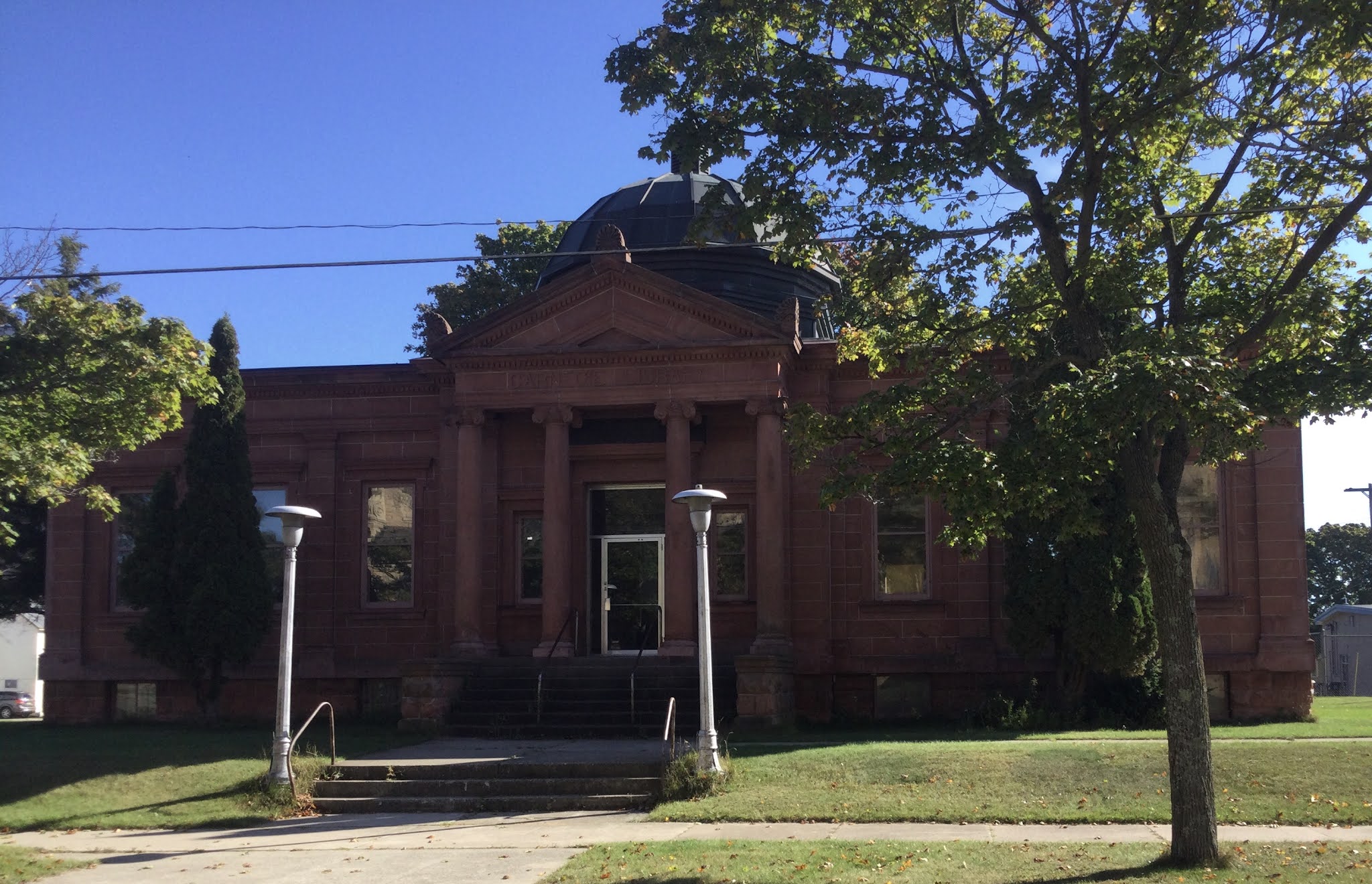
It had been replaced twenty-seven years ago and was now privately owned, undergoing renovation   The new library attached to the city hall several blocks away overlooking Lake Michigan had a painting of the Carnegie entitled “Old Friend.” It was the first of these travels with a dome, elevating it to the most distinguished of the trip so far.

The new library also paid homage to the Little Free Libraries in the area with a flyer listing the locations of all of them—three in Escanaba and others in Bark River, Ford River, Gladstone and Wells. They are always a welcome site. 


Sunday, October 3, 2021

Green Bay


For the third time in these travels Wikipedia had it wrong on a Carnegie.  It was wrong on the address of the Carnegie in Wisconsin Dells.  It was wrong that the Carnegie in Kaukauna still functioned as a library. And it was wrong that there was still a Carnegie in Two Rivers.  It is now a parking lot and has been for quite some time according to a woman in a beauty parlor facing the parking lot.


The first person I spotted to ask about the library was sitting in a wheelchair on the porch of a retirement home facing 1516 16th Street, where it was supposed to be located.  She was lucid, but didn’t know anything about a library having been located there, as she’d recently moved to Two Rivers from Chicago.  All she knew was that there was a library a block down and then a block over.  It was 8:30 in the morning, too early to go over there to find out about the Carnegie.  Fortunately, the beauty parlor was open, so I didn’t have to linger and could commence my ride up along Lake Michigan into Door County,  as my legs were eager to do on this sunny autumn morning.

I had camped five miles out of Two Rivers, declining to arrive in the early evening fearing it would be too dark for a photo of the library.  That fear of not being able to get a photo was resurrected as I biked into Two Rivers swallowed by heavy mist blowing in off the lake. It didn’t burn off until just before I arrived in Two Rivers.  I was lucky to have a decent shoulder to ride on, as visibility was greatly limited.  A shoulder of bike lane proportions has graced most of the non-county roads I’ve ridden.  No need for a shoulder on the county roads as they have little traffic.  The roads have been pleasingly amenable.  Wisconsin has a most enlightened transportation department, which has added roundabouts to many intersections, some even landscaped.

As I headed up the peninsula of Door County, named by a Frenchman in the 1600s initially as Death’s Door for a narrow perilous passage at the tip of the peninsula, the traffic greatly diminished.  Suddenly I was transported to Japan where I experienced a similar sensation when I headed up a peninsula that led to a ferry to Hoikado, Japan’s northernmost island.  The traffic had been relentlessly thick for over two hundred miles from Tokyo, and then it instantly evaporated, just as it had here, a most dramatic, almost miraculous, event that left a deep impression.  What a relief it had been, and here too.  

It was nice to go down my Japanese memory lane for a spell and wonder how different it would be cycling in Japan now, nearly twenty years later.  Noodles and politeness and bowing and extreme obedience to the speed limit would no doubt still predominate, but I doubt there would be as many, if any at all, discarded girlie magazines on the roadsides.  

I had never encountered such a proliferation.  I used to occasionally come across Playboy and Penthouse and Hustler and such in the US, jettisoned by men who couldn’t bring such magazines home, but no more, what with the easy accessibility of such material for free on the Internet. I suspect it would be the same in Japan, as I was there in the early days of the Internet before pornography became so widespread on the net.   Girlie magazines, mostly featuring Japanese school girls in their ubiquitous uniforms, were on prominent display in convenience stores.  Hardly a day went by that I didn’t see one along the road.  I’d gather them up and deposit them in boxes of sand along the road in the mountains for motorists who got stuck in the snow as a little surprise for them.


As I sped along on the porn free roads of Door County with an occasional glimpse of Lake Michigan and pristine scenery all round, I could revel in fully leaving behind all the nonsense of the everyday world.  All that mattered was absorbing the simple beauty of my surrounding and the pleasure of being outdoors, my legs spinning without any prodding.  It was glorious to know it would only get better as I penetrated further north to the UP and Lake Superior after my dalliance with Door County for it’s lone Carnegie in  Sturgeon Bay. 


My reveries were 
interrupted by the first cyclist I had encountered since leaving Chicago, a sixty-year old guy on a Cannondale who came up from behind me. He greeted me saying he looked forward to doing what I was doing when he retired in a few years. He was from upstate New York and had his heart set on bicycling a relatively new 3,000 mile route from Maine to Florida, about a third of it so far on trails converted from rails.  “My wife will be happy to have me out of the house,” he said.  

He was in Door County, as he was meeting up with ten of his high school buddies the next day who were gathering to attend Sunday’s Packer game against the Steelers.  They had all grown up in Pittsburgh and for the past dozen years or so had met up somewhere for a Steelers game.  They had scattered all over—to LA, Houston, Indianapolis and elsewhere.  Only two still lived in Pittsburgh.  He and one other weren’t football fans, but they still participated in the reunion.  Most were flying in.  He had driven, making it easier to bring his bike.  

He was the only cyclist among them.  He was delighted with this fine ride.  I would have liked to talk more, (to hear of the other stadiums they had visited, if wives ever came along, how easy it was to get tickets and if they could get seats together, if the media had learned of them, what he knew of Carnegie’s Pittsburgh roots and more of his biking and how his drive was from New York, which included taking a ferry across Lake Michigan), but he was impatient and wished to ride harder than I could on my loaded bike, so he bid me farewell.  I hardly had a chance to tell him of the extent of my travels, other than my football biking event, pedaling to the Bears Super Bowl in New Orleans in 1986.

Sturgeon Bay’s Carnegie was now the offices of an accounting firm, which was honored to be in the Carnegie.  A pair of placards propped up against each other in the lawn out front had reprints of two articles from the Door County Magazine which gave a history of the Carnegie and the efforts of the accounting firm to restore it when it took possession of it in 1981 after it had stood empty for several years.  The woman head of the firm said the library had fallen into significant disrepair with mushrooms even growing in it.  The renovation cost a lot, but she said, “It’s like when you fall in love.  You don’t care what it costs.”


The ivy-covered Classical Revival building was across the street from the first-rate Door County Museum packed with several rooms of material, including a tribute to the Packers Golden Girl cheerleaders and their dedication, showing them bundled up at the legendary Ice Bowl.  The entry to the museum is a magnificent wilderness recreation with an array of stuffed animals (a deer, a bear, a raccoon and others) and over one hundred birds, any orthinolgist’s delight. There were videos among the exhibits, including one of a huge community fish boil, intrinsic to the local culture.  The museum, which was free, would more than justify biking up from Chicago to see.  


Another noteworthy attraction fifty miles away in Green Bay was the vast Packers gift shop attached to Lambeau Field, which might have had as much space as the museum. It was mobbed on a Saturday afternoon with young and old, male and female, many in Packer attire. 


The Stadium is on Lombardi Drive facing a neighborhood of modest homes.  Statues of Curly Lambeau and Vince Lombardi, the teams first and winningest coaches, graced its entry.  Nearby was a statue commemorating the Lambeau Leap, originated in 1993 by Leroy Butler who spontaneously flung himself into the arms of fans in the stands after a touchdown, a tradition which continues to this day.  An accompanying plaque titled “Love at First Leap” explains, “It declares nothing gets in the way between Packers players and their fans.  In all of football nothing symbolizes a greater connection between players and fans than the Lambeau Leap.”


Green Bay’s Carnegie, three miles away in the center of the city on the other side of the Fox River, was in a cluster of prominent buildings matching the grandeur of the Carnegie, now a US District Court. It still bore it’s original inscription of “Carnegie Building,” implying that it had been more than a library, as some were with a theater and meeting rooms as part of the facility, sometimes even a swimming pool.


It was no strain to bike into and around Green Bay.  It is more of a large town than a city.  Many were out for a morning jog, a few wearing Packer garb.   Packer tributes abounded, including a street called Packerland and another adjoining it named for an old receiver Don Huston from the 1930s.  There are doubtlessly many others.


I  encountered the first homeless of these travels, a few in tents in a park across from a large homeless shelter run by the Catholic Church four blocks from the Carnegie.  A large cluster of bikes were locked out front. And for the first time in these travels I was taken for being homeless, or an indigent, outside a supermarket.  As I was packing the food I had bought into my panniers by a garbage can, a man approached with an aluminum can to throw away, first asking if I was collecting cans.  Ten days without any one offering me money is the longest I’ve gone on my recent tours in the US. Evidently Wisconsinites are accustomed to touring cyclists and recognize I’m on an adventure of a sort.  Several have asked where I’m headed and where I’ve come from.  Not a one was familiar with Carnegie Libraries. 

Friday, October 1, 2021

Kaukauna, Wisconsin


One of the saddest days in a town’s history has to be the day when it’s Carnegie is replaced as the town’s library. An even more heartbreaking day is when the building is razed.  Fortunately, more often than not the extinct Carnegie transitions to another municipal building, such as a museum or historical society, or falls into private ownership and becomes a law office or restaurant or someone’s residence or, horror of horrors, a car dealership, as in Racine. About a third of the time when a town outgrows its Carnegie it retains its identity as a library with an addition, some a nice blend and others an unfortunate distortion. 


The closing of the library can also lead to a seminal day in the town’s history, the day of the transfer of the books from the Carnegie to the new library when it is done as a community effort, particularly when that transfer is made the old-fashioned way with a chain of residents handing books from one to another often for several blocks.

Ripon was a community that had such an event in 1973.  It had to have brought out hundreds as the new library was four blocks away.  The intersections would have had to have been blocked, and there would have no doubt been a celebratory picnic afterwards with food provided by local restaurants.  It would have been a huge community event.  On occasion I have met a librarian who has participated in such a transfer.  They have such fond, vivid memories of it, they enthusiastically recall it as if it happened just the week before, though it may have been decades ago.  

It conjures up images of a barn-raising, a massive community effort that is a celebration of a sort.  What joy it would be for the many involved having the privilege of laying hands on hundreds of books, glancing at their titles as they pass them on and trying to remember those they’d like to give a read.  It would give them a connection to all the books in the library’s collection, a life-long sensation that would trigger ripples of joy whenever they enter the library.


I didn’t have the good fortune of finding anyone in Ripon who had participated in its transfer nearly fifty years ago, but it lives on, featured on a plaque outside the Carnegie, which now serves as the office of the president of Ripon College.  It has to be one of the grandest collegiate presidential offices anywhere.  The neo-classical building is a gem with a pair of columns at its entry and sides with arched windows.  The bold “Public Library” chiseled above its entrance hasn’t been buffed out nor the “Carnegie 1905” just below.  It’s on the periphery of the small campus. Just a block away is the Museum of the Birth Place of the Republican Party.

The Carnegie in Berlin fifteen miles north was another dandy on a slight rise, but it’s grandeur was undermined by a horribly designed addition obstructing one’s view of it. If there were a posse of Carnegie-preservationists, this addition would be high on their list to bull doze, or at least that portion that inexplicably extends out in front of it. 


I continued north to Waupaca, a Menominee word meaning Place of Tomorrow Seen Clearly.  It’s Carnegie, now a Historical Society, had several panels out front tracing the centuries of Menominees in the region until a treaty in the 1840s ceded much of the land to white settlers.  A Little Free Library also graced its grounds.  I’ve seen several a day, no surprise, as it was Wisconsin where this world-wide phenomenon originated. 


As with many libraries, Waupaca’s new library four blocks away had a feature unique to itself—a sign in its men’s room that said, “Do not urinate in the floor drain.”  It had just one urinal.  Evidently there are farm hands in the community unaccustomed to indoor latrines or those with a weak bladder unable to wait.

My zigzag about the state next took me east to New London.  For the first time I was besieged by mosquitoes in the forest where I took refuge for the night.  It was just sixty degrees, not quite cold enough to stymie their blood lust.  But forty-five degrees in the morning kept them at bay, sparing me the frantic dance I went through erecting the tent as I took it down. 


The New London librarian was the first of these travels to gladly and proudly usher me around her Carnegie pointing out its many features.  It was also the first of the fifteen I’ve visited so far with the framed portrait of Carnegie on display that the Carnegie Corporation made available to all the Carnegie Libraries in 1935 on the centennial of his birth.  It was relegated to the basement though, in a hallway leading to a meeting room that had a fireplace just below another on the first floor.  I asked when the fireplace had been last used.  The librarian didn’t know, but she deferred to her assistant who’d been at the library longer than her. She said she could remember it being used in the early days of her tenure thirty years ago.  

The library had an addition to its side, built in 1932 originally as a museum.  The museum was later moved downstairs and the library extended into the museum.  The librarian said that when they moved books into the addition the husky farm boys thought they could heft the shelves of books onto rollers, not realizing how heavy they were.

I continued east another thirty-five miles to Kaukauna, another town name taken from the Menominee language, meaning portage. My route took me past Appleton, whose Carnegie at Lawrence College was no more, and by the impressive football stadium of Appleton North High School, which has the unique nickname of Lightning. One can hardly imagine the antics and costume of its mascot.  I also passed a church whose pastor didn’t take kindly to locals who don’t live up to promises of attending a service.  His message board read, “There are seven days.  Someday is not one of them.”


The Kaukauna Carnegie was on an island in the Fox River sitting all by itself in a small park.  It had been replaced six years ago and was presently vacant after a short spell as a dance hall.  It is soon to be converted into apartments.  The new library a few blocks away was part of a large municipal complex.  An electronic message board inside the lobby of the library said that occupancy was limited to fifty people and that there were only six there now.

I will continue east as far as the road will take me and will at last set eyes on Lake Michigan in the town of Two Rivers.  Then it is on to Door County.  My GPS tells me I’m 165 miles due north, as the bird flies, from Countryside, where I started out from, and that I have another 210 miles to the northernmost point of these travels in the UP.  I’ve meandered nearly six hundred miles in eight days.  There will be less meandering and mostly heading north after I duck down from Door County to Green Bay. Biketober has finally arrived with the promise of more superlative fall cycling.  Heading north brings the possibility of colder days.  So far, after a couple of unseasonably cold days at the outset, the days have been pleasant enough for shorts and short sleeves for much of the day.  With swarming mosquitoes the last two nights in the increasingly forested terrain, I’m more concerned with fending them off than the chill.  


Wednesday, September 29, 2021

Waupun, Wisconsin


The further I get out into the hinterlands, towns become more  individualistic, asserting an identity of their own. The town of Waunakee, north of Madison, announced itself as “The only Waunakee in the world.”  The repetitive nature of town names can become tiresome, all the Springfield’s and Jefferson’s and Rome’s and Paris’ scattered about the US, so cheers to Waunakee for recognizing this.

Lodi, up the road from Waunakee, advertised itself as “home of Susie the duck,” a mallard that took up residence in a park with a creek near the town center in 1948.  The mayor’s young daughter christened her Susie.  Susie is long gone, but mallards continue to inhabit the park and benefit from the goodwill of the locals who have feed stations for them.  As with many small towns, it’s initial library was established by a woman’s club. But Lodi is a rare town that retains the name—Lodi Woman’s Club Public Library. It’s not a Carnegie, but I still ducked in for some charging and WiFi and learn of the local lore.


The nearest Carnegie was nearly twenty miles away in Baraboo across the Wisconsin River, which required a ferry to cross, the only functioning ferry in the state other than those that cross Lake Michigan.  It’s a quick crossing, less than five minutes.  It can handle fifteen cars and runs non-stop back and forth much of the day and at no cost. 


I was a bit chagrined when I arrived just as the ferry was pulling out, not knowing how quickly and frequently it made the crossing.  I ducked into the nearby rest room to wash a few garments.  I was shocked when bright red, seemingly fresh blood, filled the basin as I rinsed my socks.  I thought I must have had a cut on a finger, but no, the blood was coming from one of the socks, which had absorbed some blood from a scrape on my shin pushing through the brush one evening.  I was shocked again when I left the rest room and saw the ferry back already and  departing once again, so quickly had it made the trip.


The Carnegie in Baraboo is the front-runner as the most notable of the trip with its noble, classic features unmarred by an addition to the rear.  “Carnegie Free Library” chiseled into its facade and entry made up eight steps and through a pair of columns added to its charm. That climb up, however brief, always heightens the glorious moment of entering a library.  The only disappointment was the absence of the traditional Carnegie portrait or any plaque acknowledging Carnegie, just a plaque stating the library had been designated a National Historic Place.  As in Lodi, it was inhabited by a handful of the elderly sitting and reading newspapers and magazines in the living room setting common to Carnegies with wooden floors and tall windows letting in beaucoup natural light and a fireplace.

The Carnegie in Reedsburg, fifteen miles to the west, had lost its identity having been joined to the modern city hall next door.  If there had been a library inscription on it, it was long gone.  The new library with a large parking lot frowned upon it from across the street.  


The road into Reedsburg was being resurfaced and was closed to traffic making it my own private road of smooth sailing for seven miles on a stretch that had been completed all but for a center line. I was halted six miles short of Reedsburg where construction crews were at work. I had to backtrack half a mile and then go over a mile to pick up a smaller parallel road.  The route took me past one of the early themes of these travels—skeletons on tractors.  This was by far the most creative.


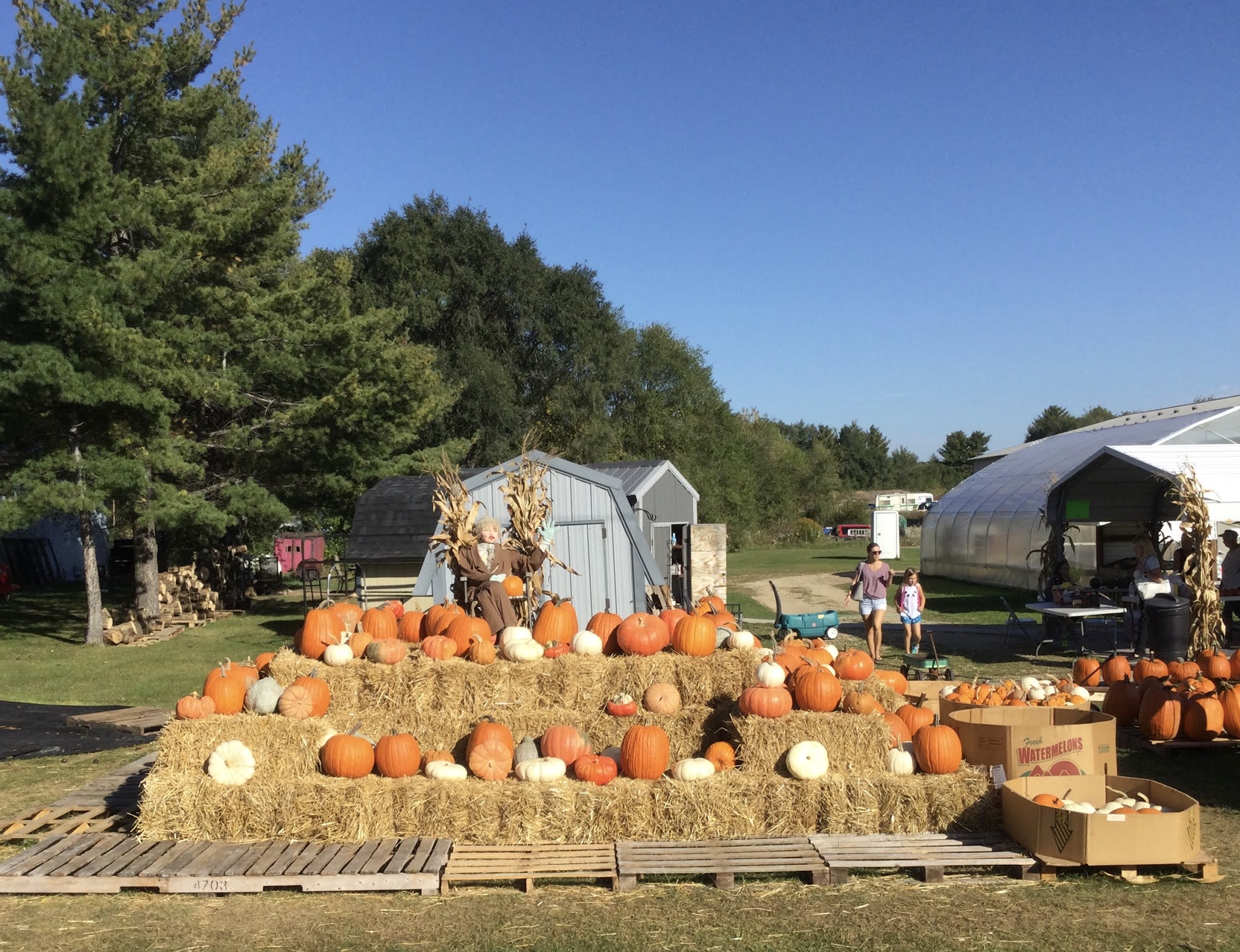
Pumpkin stands pop up so frequently it’s a wonder Wisconsin isn’t known as the Pumpkin State.   They certainly predominate over cheese, at least this time of the year.


I camped a few miles out of the town of Wisconsin Dells where the next Carnegie awaited me.  The town was densely populated with motels and tourist attractions and souvenir shops, one unabashedly called Souvenir City.  An arena hosted Lumberjack shows.  Wikipedia listed the address for the Carnegie on Broadway the main thoroughfare through the town packed for several blocks  with one shop after another catering to tourists, everything from the House of Jerky to a paintball shooting gallery.  I could hardly imagine a stately Carnegie on this stretch and it wasn’t.  It was a block over at 631 Cedar in a large park known as Library Park.  The tiny Prairie Style Carnegie in one corner had been replaced by a much larger building.  It was presently vacant.  It would make a nice home, but it’s zoned commercial.


I spent much of the rest of the day biking over sixty miles east on small county roads designated by a single letter that intersected no towns and that I had all to myself. The route passed near where John Muir lived and roamed after he came to America from Scotland with his family when he was eleven. 


 Even along this quiet stretch there were pumpkins for sale, and as with many stands, on the honor system.  I didn’t see any pumpkins dotting the fields, as they were largely taken up with brown corn stalks.  


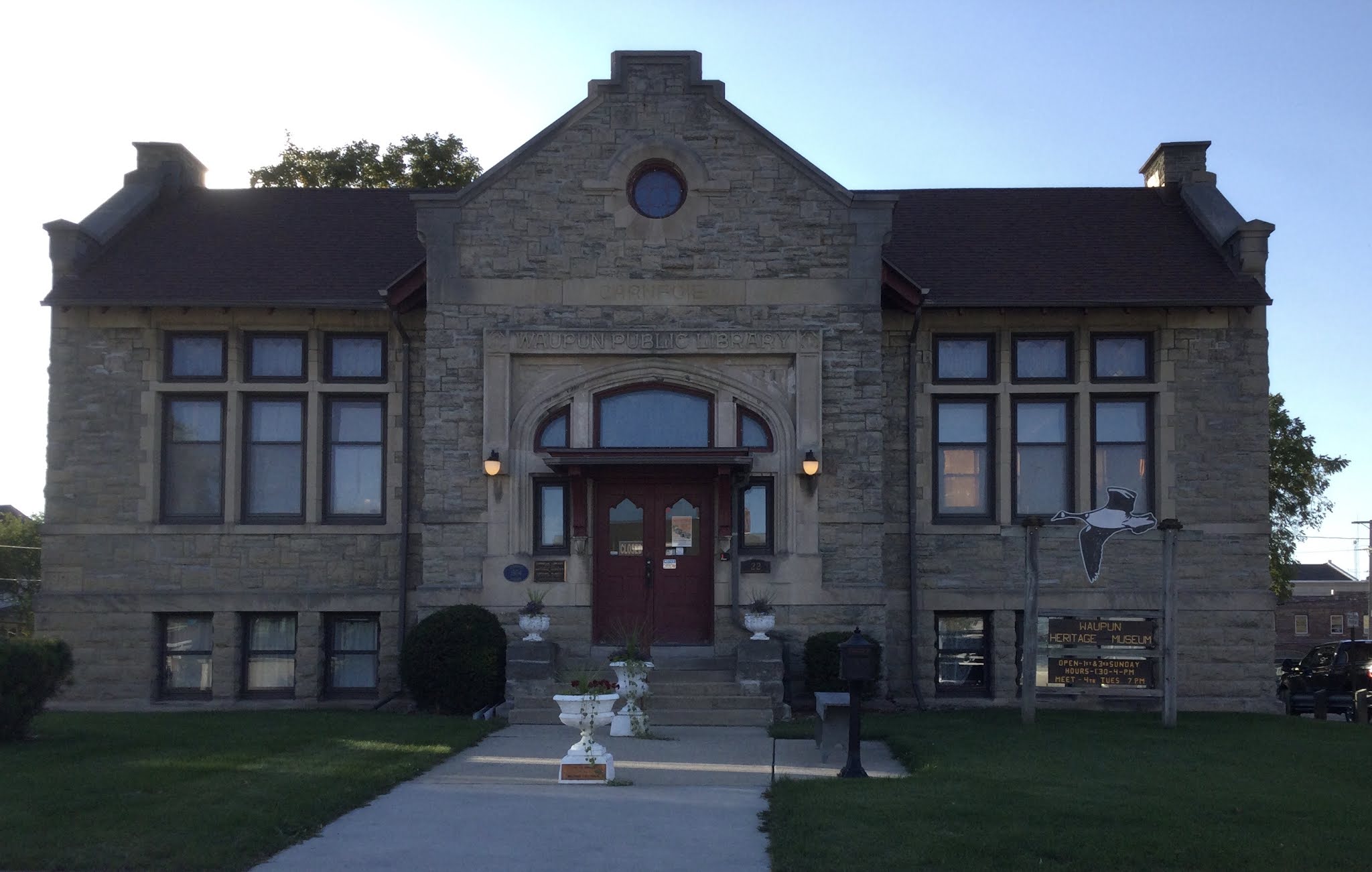
I made it to Waupun just before five in time to enter the Carnegie, now the Waupun Heritage Museum, except that it was only open on the second and fourth Sundays of the mouth.  It was another beauty, comparable to that in Baraboo, well worth whatever effort it might take to visit.  It was constructed of local stone and had Carnegie carved into its facade just above Waupun Public Library.  


It had been a pleasantly warm day in the 70s with thirst not much of an issue.  I was still hopeful of packing my bottles with ice at the nearby MacDonald’s, but as with the last few it was drive-through only with a sign on its door blaming it on a shortage of employees, a sign common to other MacDonald’s.  


But unlike a year ago, and earlier this year on my bike journeys, there have been no hiring signs on the MacDonald’s.  It does seem as if management is content to not having to clean bathrooms and stock toilet paper and empty indoor trash cans and wipe tables and all that.  The savings on staff must offset the loss in revenue from those such as me who want a place to sit.  It is a valuable place for me to charge my devices as well as fill my water bottles with ice.  Hopefully this isn’t another example of the Amazoning of America of people not wanting to leave their homes and now their cars to make purchases.  I regret to see it expanding into the dining experience.


Monday, September 27, 2021

Madison, Wisconsin


It’s hard to fully appreciate a campsite when one is setting up one’s tent in the dark, as has been my lot so far on the first four nights of this trip.  I’m appreciative of wherever I end up, but it is often not until morning that I can marvel at its charms.  My late campsites aren’t because I’ve been desperate to find a place to camp, just that I’ve been unwilling to stop when there’s still daylight in these increasingly short days, unrelentingly confident that I will find a last-minute spot for me and my tent. I pass up innumerable enticing places to camp in that last half hour of light not wishing to rein in my legs.


So far so good, even last night on the outskirts of Madison.  It took me a little longer than I expected to pass through this capital city and college town after dropping in on its Carnegie, a former branch library a couple miles north of where the main library, also funded by Carnegie, had stood.  It was in a bohemian neighborhood, sharing a parking lot with a food coop.  It now houses ZebraDog, a design firm.  A plaque on its side acknowledged Carnegie and it’s architects Claude and Strack, who designed the building in 1912 in the collegiate gothic style, emulating the academic buildings of Oxford and Cambridge, with red brick and limestone arches, niches and banding. It’s backside was as striking as the front.  


There had been wilderness to the south of Madison on my way into the city from Stoughton, twelve miles south, where I stopped for a more classic Carnegie, so I felt assured there’d be more of the same on the other side of the city.  Stoughton’s Carnegie was centrally located at a major interaction on the main thoroughfare bisecting the city.  It still functioned as a library, though its original entrance had been replaced by another in an addition along the Main Street. 

With just two hours of light remaining I was hoping to fill my water bottles with ice and water at a MacDonald’s a mile down the highway on the way to Madison, but like another MacDonald’s I had tried earlier in the day it’s lobby was closed, harkening back to earlier Covid times.  It’s not the case with all MacDonald’s now, but I fear the ease and popularity of the drive-throughs may have encouraged some managers to keep their lobbies closed as a cost-saving measure, just as businesses are happy to have their employees working at home.  I will be greatly saddened by the loss of access to the MacDonald’s self-service ice and beverage machines.  

I was in need of cold water for the first time in these travels, as the temperature had jumped back into the 80s, twenty degrees warmer than my first couple of days when I set out from Chicago.  It had been so cool, I wore long pants the first two days and sweated so little that I hadn’t had cramps, as I ordinarily do the first couple days of a tour as my legs grow accustomed to the effort and I sweat out essential electrolytes.  

Rather than being able to fill my insulated bottles with ice at MacDonald’s, I had to be satisfied with just one bottle’s worth from a 32-ounce cup at a service station.  I could really take advantage of MacDonald’s ice dispensers, as I had found another deluxe Camelback insulated water bottle along the road near a resort lake, easily the best find of the trip so far, bringing my total of such bottles to four, all found along the road, two at the Hilly Hundred.  If I just put ice in the bottles and bury them in my panniers, the ice will last for hours.  It is always a great luxury in my tent at night after a long dehydrating day in the heat.

My GPS showed some pockets of forest just north of Madison, so I pedaled in the increasing darkness with little worry.  I just hoped I didn’t come upon a cheap motel that might entice me to stop in for the Packer/Forty-niner Sunday night game and all the days’ highlights.  I was spared that temptation and soon had a forest to disappear into.  I didn’t mind at all needing my headlamp to clear a spot for my tent and then to find the notches to attach my rain fly.  


Once I’m in the tent every campsite is the same and I can begin my nightly ritual of getting food into me and removing my constricting accouterments (gloves and socks and watch) and begin charging my iPad and Garmin and jotting down my stats for the day—miles and average speed and feet climbed and items scavenged along the road (coins, neckerchiefs, bungee cords, license plates, etc) and what food a dumpster may have added to my larder. The latest of note were two Panino trays of hard salami, prosciutto and pepperoni wrapped around mozzarella cheese.  

The night before I had the added chore of repairing a flat.  I had discovered a slow leak late in the day.  Rather than repairing it on the spot and losing some riding time, I was able to nurse it along, adding air three times half an hour apart, enabling me to get a few miles further down the road.  It was such a tiny hole I had to wait until the next day to immerse it in water to find it.  I can go a long tour without a flat, so this early flat is no reason for alarm. I traditionally find many more neckerchiefs along the road than suffer flats.  They are tied right now.  The lone neckerchief was a white one, my least favorite, but a color that is turning up with increasing frequency.  Janina promises to make a quilt of them one of these days.  


The Madison Carnegie was my fourth of the day.  The first had been in Watertown.  It mirrored that of Stoughton, likewise located at a prime intersection and also with an addition to its side extending it along the main thoroughfare it was on and usurping its original entrance.  It was adorned with picnic tables out front and wooden chairs, including a quite over-sized one.


The Carnegie in Jefferson, fourteen miles south, had been replaced by a new library a block away. It now was occupied by a land title company.  The small building had been attached to an old small Episcopal church, making for a most odd pairing.  Despite the striking alteration, the Carnegie had been given National Historic Place Status.


The day before I had stopped at the Carnegie in Waukesha, west of Milwaukee.  It being a Saturday I could gain entrance.  A massive construction project, the latest of many over the years, had the tiny Carnegie portion of the vastly expanded library off-limits.  It was  now referred to as merely the “Carnegie Room,” though what remained of its exterior gave evidence that it had been something of magnificence.  The many additions had so swallowed it up the librarian couldn’t even tell me where the orignal entrance to the library had been.


Two young librarians at the new West Allis library, a suburb of Milwaukee, twelve miles from Waukesha, were so little versed in their Carnegie, replaced in 1989, they didn’t even realize it was two blocks away and was now an assisted living center called Carnegie Place.  It’s original entrance up a set of stairs had been blocked off, greatly undermining the beauty of the building.

As I head north into the woodlands the camping will be even easier and with the towns smaller, the Carnegies ought to be more true to their origins.  I have yet to have a good sit-down in a Carnegie this year and have yet to come upon a portrait that so many have mounted in a position of prominence.  I’m always happy to give him a nod of appreciation.  With luck I’ll have that pleasure at the next Carnegie in Baraboo.