Thursday, June 18, 2020

Marion, Ohio


I was at a Speedway gas station digging in my front pannier for my scrub brush to clean the residue of chocolate milk from my water bottle before filling it with water, when a guy who looked like a traveling salesman interrupted me and said, “It looks like you could use this,” then handed me a jar of vitamins.  It was weightier than I would have expected, indicating some heavy-duty pills.

It wasn’t until later that night in my tent that I gave the bottle a closer look.  It was a Bausch and Lomb product with vitamins specific to the eyes.  The recommended dosage was two a day, one in the morning and one in the evening with food.  I’ve never taken vitamins, other than some vitamin C pills that Andrew of Sydney shared with me while we were touring France simply to flavor the warm water in my water bottle, but I was willing to give these a try.  When I opened the bottle I discovered why it was so heavy—it was filled with coins.  There were eighty-eight quarters, twenty-nine dimes, twenty-three nickels and forty-eight pennies—a total of $26.53.  

I couldn’t imagine what he was doing driving around with such a stash in a town without parking meters. Was he actually looking for some charity case to bequeath it to?  I only hoped it wasn’t the hoard of the guy’s child that he had confiscated as punishment for some misdeed.  Once again I was torn between gladness for such goodheartedness, but saddened that I was mistaken for someone down on his luck.  The sight of an old guy on a bike seemingly loaded with all his worldly possessions must certainly pull at the heart strings. Few seem to recognize that person as someone to be heartened by, someone who is still enduring at his age and off on an adventure that is bringing him joy.  

The next chance I had at WiFi I immediately went to Facebook and searched the page of Randy Warren, the cyclist extraordinaire who I dropped in on last March in San Luis Obispo at his training camp for racers.  He had mentioned on his podcast that he was using his upcoming Everesting ride as a fundraiser for The Poor People’s Campaign: A National Call for Moral Revival started by Martin Luther King Jr. in 1968.  He hoped to raise $1000. Randy, as a coach, is highly attuned to benefiting others, and as a churchgoer would well know what charity merits support.  I was happy to contribute this minor windfall to his fund, which was already near $800 a week before his ride.  The charity though would only accept whole dollars, so I rounded my contribution up to $27 including some of the random coins I’d picked up on the road, saving a few for the next lemonade stand. 

Everesting is the latest craze among cyclists started by George Mallory’s grandson in 1994 as a feature to honor his grandfather who died on Everest after possibly reaching its summit a few years before Sir Edmund Hillary. It is climbing the equivalent of the height of Everest, a little over 29,000 feet, in one day on a circuit of one’s choosing. The record is seven hours and thirty-two minutes set just five days ago by Lachlan Morton, an Australian who rides for the EF Education First team, who did it in Colorado.

Randy isn’t going for any record, except maybe for his age group (58). He has picked a route an hour from where he has lived in Wilmington, North Carolina the past six years, after having had enough of Chicago’s winters.  He will make twenty circuits of a 6.8 mile course with an elevation gain of 1,453 feet on each at an average grade of 8.1 per cent to reach that 29,000 feet figure, a most formidable effort. It will take him 136 miles. Whenever I go over 5,000 feet in a day when I’m touring I’m wiped out. 

It was tempting to swing over to Wilmington and hand him water bottles, but I’m too committed to this Carnegie quest, plus I have the impending rendezvous with the cyclist I mentioned in my first post of this trip who had bicycled from the Bay Area to Florida to visit his grandfather and then continued riding.  He next visited an uncle in Virginia then headed to Pittsburgh and into Ohio to join me for some Carnegie-hopping.  We’ll be meeting in a day or two.  

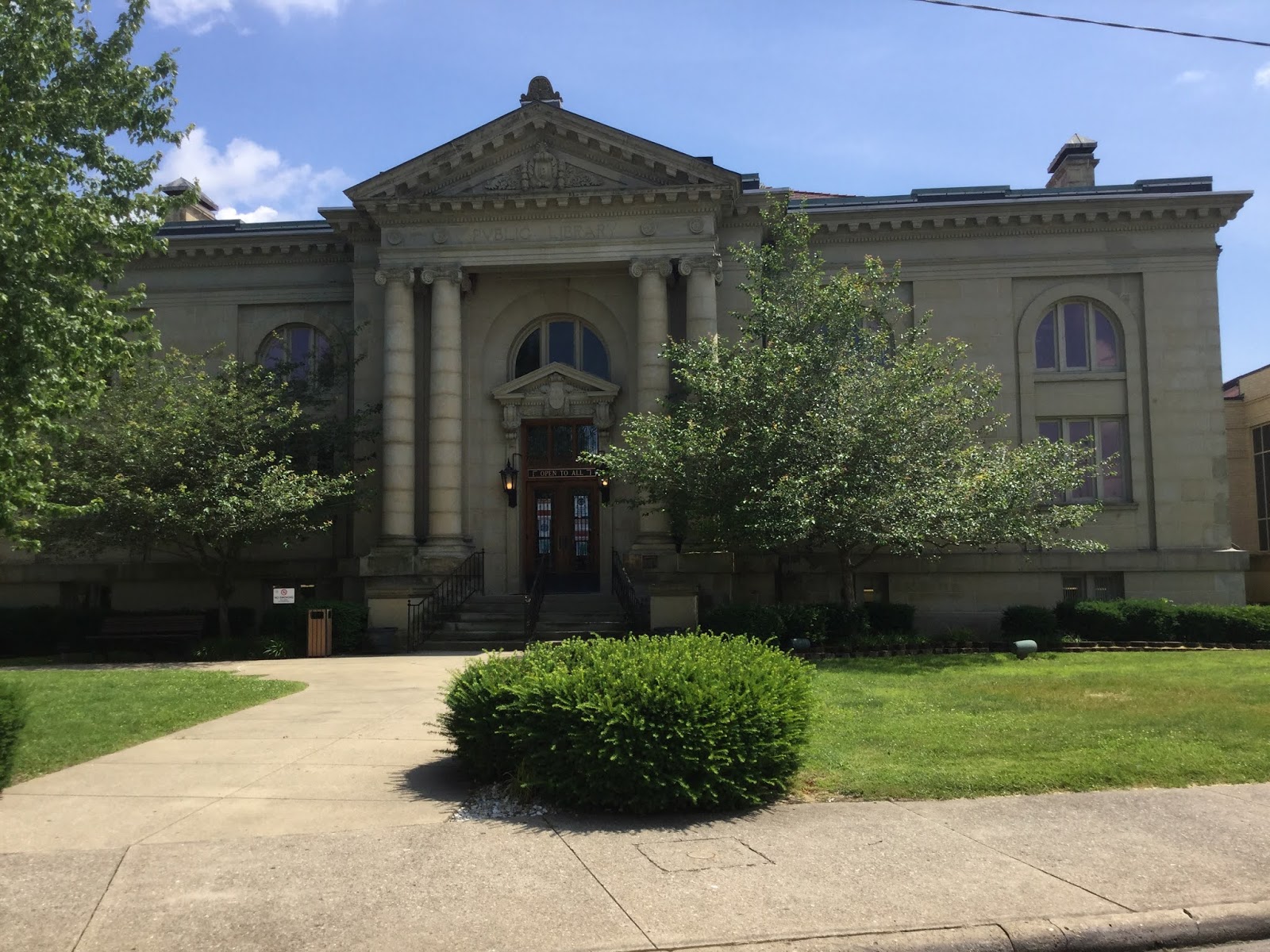
I had my first three-Carnegie day in a while after a lone Carnegie the day before in London.  Of the four latest Carnegies London’s was the only one that still served as a library, though I was unable to take advantage of it as it had yet to reopen.  It was a gallant fortress of a building with an unobtrusive addition behind it.


The welcoming sign to Bellefontaine announced that the first concrete street in the United States had been laid there in 1891.  A block of it remains on Court Street right by the Carnegie along with a statue of the man who pioneered it.   The Carnegie Library looks out on the Main Street of this bustling city.  Its original entrance facing the busy four-lane street had been closed off, but it’s front side still radiated its original dignity and nobility with the label of Carnegie Free Library despite its present use as the Logan County Court Center.  One now enters to the side through a large addition tacked on behind it.


Twenty miles to the north through freshly planted fields of corn and wheat the Carnegie in Kenton had  been converted into a dental office of a husband-and-wife team.  I’ve come upon many taken over by lawyers, and others by accountants and realtors and engineers and restaurants and barbers and hair salons, but this was the first in the medical field. They began their drilling there in 2006, taking over from a hair salon that had acquired it for $1000 in 1997 after it had sat vacant for fourteen years and had deteriorated badly.  But it has been fully restored and certainly merits the National Register of Historic Places plaque by its entry.


I went over to the new library a few blocks away.  I had to sit outside to use its WiFi as it hadn’t reopened.  A librarian came out and offered me a cold bottle of water and a pack of juice and some snacks, a sampler of what it distributes to children every day between noon and twelve-thirty.  None came by while I was there.  She said, “It looks like you’re traveling.”

“Yes, I’m riding around to the Carnegie Libraries in the state,” I told her.  

She said this library replaced the Carnegie in 1968 and how fortunate the community was that someone had sunk over $200,000 into it after it had fallen into disrepair after initially being taken over by the Historical Society.

After she went back in a few minutes later the director of the library came out with a book for me and said, “My children’s librarian tells me you’re visiting Carnegie Libraries.  Have you read this book on the Carnegie Libraries of Ohio?”

“I have, but it’s been awhile.  I’d love to give it another look.”

He left it with me and told me to just put it in the book drop when I left.  He also left me with his card, the second person to do so, likewise saying to give him a call should I run into any problems. That makes Janina very happy, as she’s concerned I could wake up in my tent any night with a high fever and need hospitalization.

Two pages of the book were devoted to every Carnegie in the state, one page its history and the other a photo or two.  I read up on a few I was curious about.  I was most pleased with a map indicating them all, so I could verify that I had no more Germantown surprises in store for me.  


The director told me I would be impressed by my next in Marion, twenty-six miles east.  He was right. I had my first spontaneous “Wow” when I caught my first glimpse of its extra ornamentation and sumptuous grandeur.  Rather than a library, it was now a Children’s Museum, also known as an “Explore-it-Torium.”


A mile away in the city’s vast cemetery were the graves of President Harding and his wife under an imposing memorial.  Harding died in office in 1923, part of that long string of presidents elected in a year divisible by twenty beginning with Lincoln who didn’t survive their term.  His wife died a little over a year after him.


While I was doing a little washing at a water pump in the cemetery proper, a retired teacher stopped and told me he had cycled coast-to-coast in 1996, sticking to a northerly route, even slipping into Canada for a while. At last someone who recognized me as who I was.  He advised me I might not want to drink water taken from a water reservoir under a cemetery.  I had already taken a sip to see how tainted with iron it might be.  Not too bad, but it would be water I’d save as a last resort to drink, trying to reserve it for cleaning my Tupperware bowl and teeth and giving my face a wipe. 

It was getting on towards evening.  I could have pitched my tent in his yard,  but he lived twenty miles away and opposite the direction I was headed.   As with many, towards the end of our conversation, he said, “I hope you don’t mind me asking, but how old are you?”  I could interrupt the preamble each time and say 69, but I politely let them finish.  After I answered his question I added, “I’ve ridden 63 miles so far today.  I try to do at least 69 every day, so I’m almost there.”

Tuesday, June 16, 2020

Mount Sterling, Ohio


Germantown’s Carnegie didn’t look as if it had aged a day since it was built over a hundred years ago.  It was in pristine condition, but it’s beauty was undermined by the jarring “The Historical Society of Germantown” sign covering its original identity as a library.  

The town maintained an aura of small town Norman Rockwellian idyll complete with two girls selling lemonade and nary a fast food franchise.  When I asked the girls if the lemonade was cold one ran inside and returned with a cup full of ice.  She put the ice in my water bottle and filled it with lemonade, all for fifty cents.  I was able to unload a couple of quarters I had found at a railroad crossing a few miles back.  The girls had had a good day, nearly emptying their container that had started the day full.  They were very happy with their day, but hoped to do better the next day.


They had nary a concern, seemingly oblivious to a world in crisis.  Michael Moore is in a tizzy wanting to dismantle police forces and abolish prisons.  He learned that George Floyd’s birthday is right around Columbus Day, so proposed renaming it George Floyd Day, siding with the Native Americans who toppled a Columbus statue in Minneapolis, accusing him of ruining the world he discovered and being a generally despicable person. Maybe so, but Floyd wasn’t exactly exemplary, having served five years for armed robbery of a pregnant woman as well as twice doing time for possession of cocaine.  

I felt fortunate to have gotten to the Columbus Carnegie before it is stripped of its name.  If Columbus Day goes, next could be anything bearing his name.  Would the city of Columbus take Floyd’s name as well?  While they’re at it, anything with the name of Jefferson or Washington, both slave-holders, could likewise be banished.   Trump might even go along with it if the capital was given his name.  How much longer can their monuments last in DC, especially the phallic one?  What next? Reparations for all descendants of slaves?  Would a million dollars to every African American be enough?  Nah, make it two.  Zuckerberg and Bezos could cover it.

Moore has no objections to HBO withdrawing “Gone with the Wind” even though he was in full censorship rage for nearly two weeks when his latest documentary “Planet of the Humans” was made unavailable by YouTube for its portrayal of various environmental groups. It had already had eight-and-a-half million downloads since it was released a month ago.  In box office terms it would have been the second highest grossing documentary of all time.  He called “Gone with the Wind” a racist film and “Casablanca” too for its portrayal of the black piano player.  Tarantino’s proclivity for the n-word could get all his films banned.  Vigilantes could be going door-to-door checking people’s dvd collections.

The world has become an arena where everyone is vying to be the most outraged over whatever injustice they can concoct.  There is an unending supply.  Don’t forget adjunct professors and the pittance they are paid compared to full professors despite teaching similar classes.  And an end must be put to the discrimination that bicycle messengers suffer, relegated to freight elevators because they are too unsavory to share regular elevators with the more respectable. 

Give me Germantown and unconcerned ten-year old girls selling lemonade.   All seems tranquil and at peace out in rural, small-town America, other than the occasional shrine to Trump.  


Pedaling through small communities filled with people minding their own business and quietly going about their lives is a perfect tonic to the anger and rage convulsing the planet. The flag reflects pride in country on many homes, only a few of which are accompanied by a Trump sign.


It is an ideal time to be out of the maelstrom pedaling all day and spending the night in a tent in a quiet forest as if it were pre-Columbian times and property rights were an alien concept.  Each campsite is such a beauty I hope I’m not hurting their feelings for making them just one-night stands.  After such intimacy, they deserve full devotion. I head off each morning expressing my appreciation and hoping for another time.


It was a long sixty-seven mile jag from Germantown to the next Carnegie in Mount Sterling.  If I hadn’t missed Germantown two weeks ago when I was just five miles from it when I visited the Carnegie in Miamisburg, I could have quickly zipped up to Mount Sterling from Washington Court House, seventeen miles due north.  But those girls probably weren’t selling lemonade two weeks ago, and I wouldn’t have wanted to miss them.  The long ride back took me through Xenia again.  I was hoping it’s library might have reopened since then, but no such luck.

But the Carnegie in Mount Sterling had and with full hours, the only library in the county to have reopened. It had an addition to its rear doubling its size.  It retained its original light fixtures and wooden tables.  It offered another relaxing refuge from the chaos.


The only reminder of the times were plexiglas slabs guarding the circulation desk and the librarian wearing a face shield.


Mount Sterling was the 29th of the 53 Carnegies I had yet to get to in Ohio.  Just 24 to go.

Sunday, June 14, 2020

Washington Court House, Ohio


When I discovered a mini-bicycle pump along the road I celebrated it as the best find of the trip not realizing it was an omen and that I would be putting it to use before long.  I’ve found water bottles and lights that have fallen of bikes on routes that cyclists are known to follow or at events such as the Hilly Hundred, but never a pump.  Though I had a pump, and a spare, I am always happy to add another to my collection, as they do wear out.  One doesn’t want to be caught without a pump, why I carry two.

I wasn’t expecting a flat for days, if not weeks, after having just put on new tires in Columbus, but one of the several patches on the tube in my front tire starting slowly leaking, possibly because I may have blasted in a little too much air with the pump at the bike shop.  I realized the tire was going soft as the bike wasn’t holding steady on a steep climb through Hocking Hills State Park, slightly swerving as if my headset was awry.  But I knew the feeling of a deflating front tire all too well.

I stopped to give it a feel.  My thumb could only slightly depress it so I could keep riding until I came to the entry to the Cantrell Cliffs, the centerpiece of the park, a little over a mile away.  I made it fine, but was denied entry by a roadblock and “No trespassing” sign.  That was a bummer, as I had made a slight detour to the park upon the enthusiastic recommendation of Jeff H. who sent a photo and description of the cliffs in this most uncharacteristic Midwestern terrain of gorges and waterfalls.  But the lightly used road through the thick, almost old-growth forest was worth the detour.


Another of his recommendations, several clusters of Hopewell mounds around Chillicothe, were accessible, though the visitor center at this National Park Historic site was closed.  The array of mounds was almost mystical.  Some were burial sites and some were used for celebrations and ceremonies.


Mounds can be found all over southern Ohio and are very much in the vernacular.  Towns are named for them (Moundsville and Mounds Crossing) and many towns have a Mound Street, including Columbus.  None are as spectacular as those in southern Illinois in Cahokia, which qualify as a UNESCO World Heritage Site,  but they all have an appeal.

I didn’t have to go out of my way for the mounds outside of Chillicothe as I was headed there for its Carnegie, which still serves as a library with only a token addition to its rear despite the growth of the city, thanks to a large Kenworth factory and a sprawling penitentiary near the mounds.  It was the first capital of Ohio and remains the largest city in the region.  There were “Now hiring” signs everywhere, one offering $14.50 an hour.   Even the McDonald’s was trying to entice workers with $10 an hour.  Evidently so many people are enjoying their unemployment checks, they’re not eager to go back to work.   Chillicothe wasn’t alone in this.  Fast food franchises all over Ohio had signs out front begging for help.  

The library wasn’t open and it was the first with inoperative WIFi though a sign out front said it was a WiFi zone.  A plaque celebrated its first librarian rather than the library, Burton Egbert Stevenson, a rare early-day male librarian.  He was appointed in 1899, seven years before the Carnegie and served for 58 years, five years before his death.


The Carnegie in Pickerington was now home to a Historical Society.  It was closed so I couldn’t ask about the plaque out front and who came up with the figure of 1,946 as the number of communities in the US to receive a grant for a Carnegie Library since there were only 1,679 of them built in the US with many cities having multiples, including Cleveland with fourteen and Cincinnati with nine.


The Carnegie in Washington Court House, thirty-five miles west of Chillicothe, was the first in a while to have reopened, but only three days a week and only four hours at a time with one of those days devoted to people of “high risk,” a euphemism for the elderly.  The “Carnegie Library” etched in stone in this bunker of a building was barely visible, but one of its two additions flanking the original building spelled it out in prominent black lettering.


Washington Court House, the longest town name in Ohio, was another town with a labor shortage.  It’s McDonald’s was advertising crew positions for $11 per hour and managerial positions for four dollars more.  I had hoped with the library having semi-reopened, the McDonald’s might be as well so I could sit down and eat a burrito and take advantage of its WiFi, but it hadn’t even opened for takeout service as most have.  So it was over to the nearby Walmart to use its WiFi to check in on the world and do some charging.  And how did the town get it’s name?  It was originally just Washington, but to distinguish itself from the other Washington's in the state, it added the Court House over a century after its founding.  I wish the two Germantowns had done something similar, as I’m now backtracking to the one with a Carnegie I missed near Dayton because I mistook it for another Germantown on the opposite side of the state near Marietta.

Friday, June 12, 2020

Columbus, Ohio


Scattered throughout Columbus, capitol of Ohio and it’s most populous city with more inhabitants than Cleveland and Cincinnati combined, were “Black Lives Matter” signs, including on the home of Nikki, daughter of cycling friend Harold in California, who arranged an overnight stay for me.

There were blocks and blocks of boarded up windows on High Street, the main commercial street through the city where Paradise Garage, a first-rate bike shop I sought out, was located.  I was in need of new tires.  I had set out figuring I still had a thousand miles on the front tire I’d been riding since Belém, Brasil and that Columbus would be a good place to replace it a thousand miles into my ride.  

Though Paradise Garage, which took its name from a renowned New York disco, had been vandalized, it still had plenty of tires to choose from.  Only a few of its bikes had been stolen, one of which they’d already repossessed from a pawn shop. The bikes they were sorriest to lose were those left by customers to be repaired.

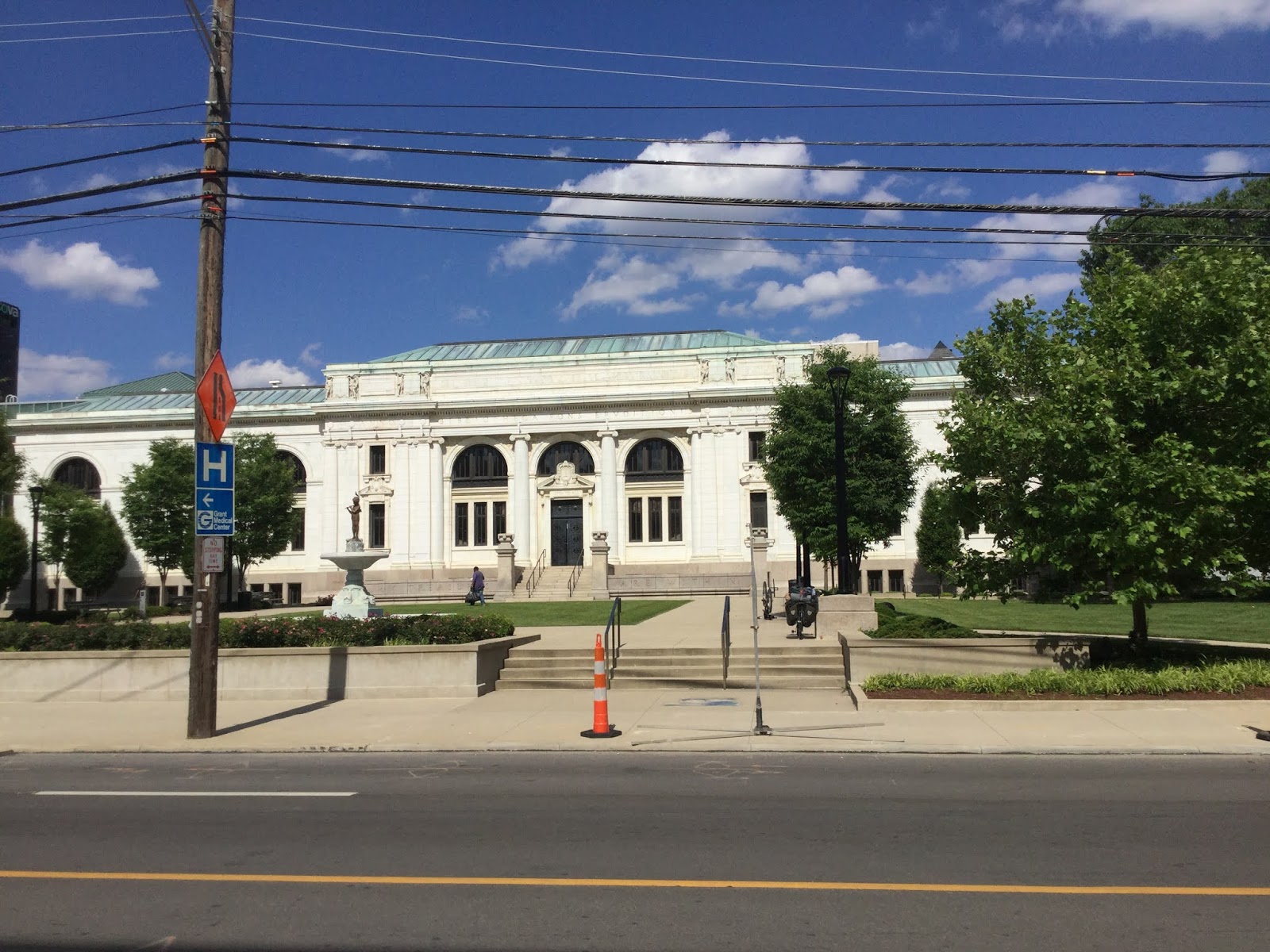
The looters had spared the Carnegie Library, a monumental building constructed from a $200,000 grant, considerably more than the usual small-town $10,000 grant.   Just below the roofline was etched “Erected with funds donated by Andrew Carnegie and dedicated to the advancement of learning.”  Below it was the Latin phrase “Bibliotheca Fons Erudionis” (The library is a fountain of learning). Though “Open to All” was inscribed over the entry, in these times it was open to none.  There was no notice of any potential reopening, just a phone number for homeless assistance.


Nikki and her partner lived just a mile from the library and the capital building a couple blocks over in the old German part of town in one of its many original red brick homes.  


Their yard had a patch of grass for my tent.  The early German settlers brought beer-making with them.  Columbus was an early brewery town, though none remain.  I had my best night of sleep in the quiet residential neighborhood well away from any main thoroughfare.

Both Nikki and her partner Kurt teach at Ohio State, she in environmental psychology and he in economics.  Amazingly, one of his doctoral students (Peter Nenka) had just completed a dissertation on Carnegie Libraries—“Knowledge Access: The effect of Carnegie Libraries on Innovation.”  He was able to determine that towns who received a Carnegie Library in contrast to those who didn’t had eight to thirteen percent more patents in the twenty years after a library was built.  I am eager to read his paper.  It can be found at Peternencka.com

Thanks to the virus Nikki and Kurt were still in Columbus.  If not, they would have been traveling or possibly back at Nikki’s parent’s home near Anaheim, not far from Disneyland.  Growing up Nikki had a yearly pass to the amusement park and has the fondest of memories of all the time she spent there.  Her favorite visit though was returning two years ago.  She had been eager to revisit the park again this summer, but that’s not likely to happen.  Both she and Kirk landed visiting professorships at Stanford for this fall and winter, but those are very much in jeopardy too.

We talked into the night on their patio over a superb vegetarian lasagne, featuring onions, French-style.  I had been eager to hear about her summit of Kilimanjaro seven years ago, the gift she requested from her parents for earning her PhD at USC.  I had heard about it from her dad when
I visited him a year ago on my California Carnegie-Roundup and also from her uncle Bobbie in Chicago, who gave a slideshow of it at a Chicago library.  

As it would be for anyone, it was a proud accomplishment.  Her summit photo with her dad and uncle is featured on her computer.  But it somewhat cured her of backpacking, as she doesn’t like to be dirty.  She brought along a huge stash of wipes to clean herself with every night.  The guides were most attentive.  One tied her shoes for her every morning despite her best efforts to do it herself, a service neither her father or uncle were rendered.

Kurt had adventures to share as well, both as a touring cyclist and as an economist.  He went to Alaska one summer on an economics project while he was an undergraduate at Cornell to research the earnings of commercial fisherman on the most distant of the Aleutian Islands.  Nikki was surprised to learn that only three of the hundred fishing boats, many of which come up from Seattle for the bonanza, had a female among their four or five member crews and wasn’t willing to accept that the work was too hard for them.

Kurt had the prowess to figure out how to close a Bowie knife I had found along the road and was happy to take it off my hands. I was also able to leave him and Nikki three bungee cords and a hefty screw driver and  a neckerchief I had recently scavenged along the road as offerings for their hospitality.  

Just before Columbus I added two more Carnegies to my collection, the first in Delaware twenty-five miles due north.  It was a premium example with columns and a dome and “Carnegie Library” and “Free to All” inscribed on its facade and National Register of Historic Place designation.  But it was no longer a library, now serving as the offices for the County Commissioners.


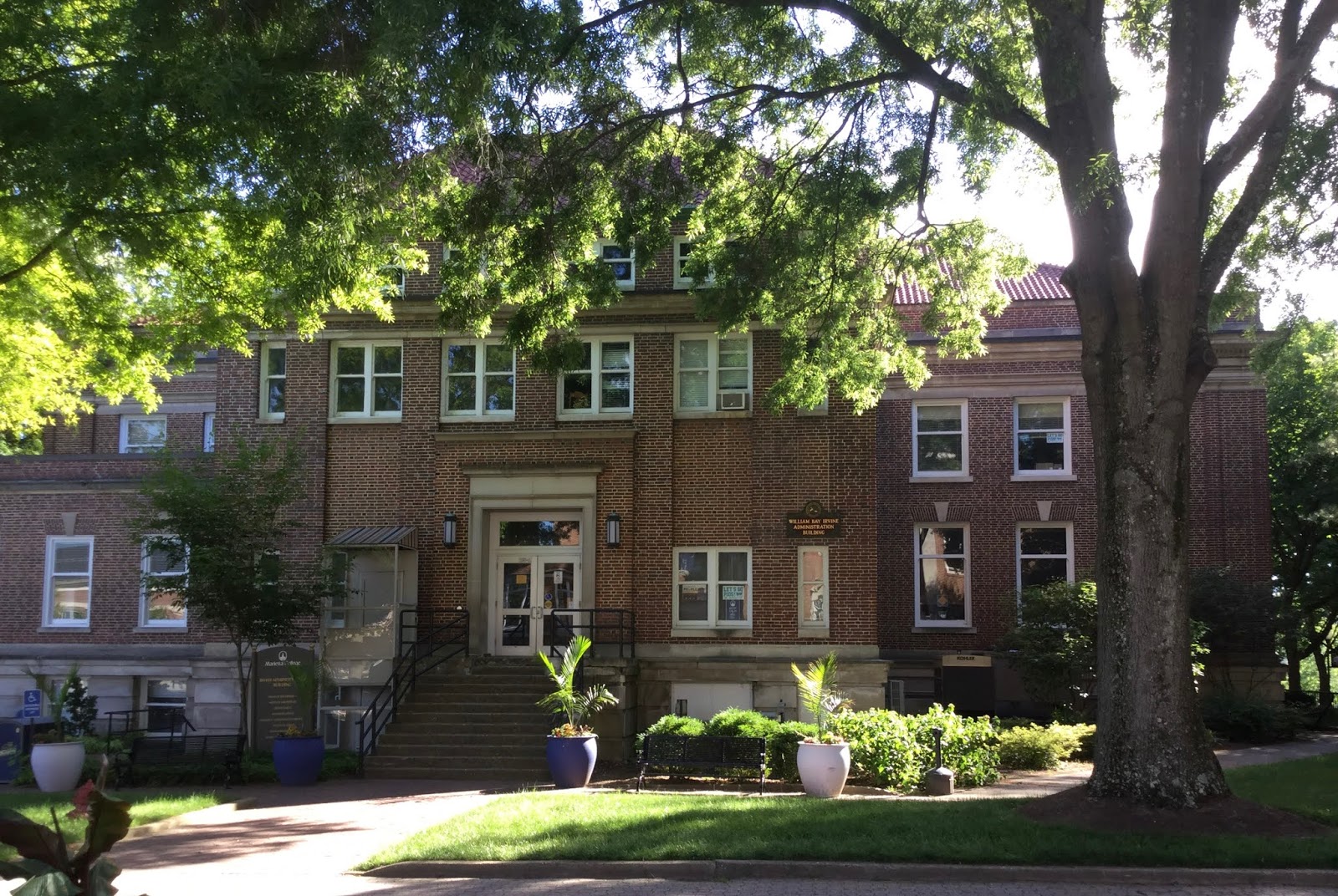
Halfway between Delaware and Columbus the town of Westerville offered a classic Carnegie on the campus of Otterbein University,  a Methodist college with 3,000 students founded in 1847.  The library had been converted to an administration building, but retained all its luster.


My ride to Delaware from Warsaw was through more Amish country.  I shared the road with horse-pulled buggies and was passed by a woman in skirt and bonnet flying by on an ebike with a heaping full basket on the bike.  There was no mistaking her extra power, something that was a little more subtle in the days before when I’ve twice been passed by men of my vintage on mountain bikes pedaling with very little effort.  They all look like they’re enjoying themselves and that’s the point.

I at last came upon a McDonald’s that allowed dining in.  It was in Mount Sterling, but it was only an aberration as the next two I stopped at still only allowed takeout, forcing me to eat my dollar special burrito outside sitting on the ground.  That allowed three people, including an older black woman, to offer me money, which I was able to decline, as well as the offer of someone in a car in the drive-up window line who asked if he could get me something.  I take no offense, just gladdened by the goodwill.  I was heartened that one of those offering takeout-only service allowed me access to their self-serve drink machine so I could fill my water bottle with ice, the first such opportunity I’ve had.  It is a glimmer of hope that normal could be returning.

Wednesday, June 10, 2020

Warsaw, Ohio


It was a little before seven, time for me to take a quick break and crunch up a pack of ramen into my Tupperware bowl and cover it with water so it’d be softened and ready to eat when I stopped to camp in the next half hour.  I pulled in to the small post office on the outskirts of Warsaw for the quick operation.  I took a look at my GPS and noticed there was a campground just ahead.  

I thought it might be a nominally-priced, low-key municipal campground so was willing to give it a look, especially since it had been a 90-degree day and a shower would feel mighty nice.  It was a church campground with no evidence of anyone being around.  The office was closed and the rows of parked RVs were barren of their car and truck attachments. The toilet complex with showers was open.  I took advantage of that before finding a place to set up my tent.  It was my first official shower of the trip, having made do with faucets to pour water over my head, and a soaked  neckerchief to wipe down my extremities.

As I set up my tent in an open space near a set of picnic tables beside the Faith Pavilion a woman came by in a golf cart.  She was a resident and said she’d try to find the manager.  He pulled up shortly after, a burly forty-seven year old guy with a cut-off t-shirt and baseball cap, both adorned with logos of the Reds.  

He was initially perturbed that I hadn’t checked in with him and said this was a church campground and not for the public.  But he quickly softened when he realized I wasn’t too much of a ne’er-do-well.  Among other factors I had in my favor was that I had set up my tent in the open and wasn’t trying to hide.  He said that the vast majority of RVs are only used on weekends or when there’s a church activity, so I’d have the campground pretty much to myself and that there was no reason to pay.   There was going to be a large gathering this weekend, virus or no virus. He was of the school that it wasn’t something to be overly concerned about, though there had been sanitized wipes in the toilet complex. 

He wondered how I’d coped with the hot day and offered to bring me a cold drink—water or a coke.  He said about the only disturbance I might have would be he making the rounds after dark and maybe the sheriff too.  I’d been seeing lots of dead raccoons along the road and wondered if any of them might come by.  No, but possibly rabbits, as he’d stirred up quite a few while cutting the grass earlier in the day.


He acknowledged there are lots of raccoons in the area. He used to have a hundred acre farm growing corn and he reckoned the coons got about a quarter of his crop.  He couldn’t shoot ‘em until the hunting season started at the end of November, and they were too smart to be trapped.  He did like hunting them.  He got 286 last year, some of which went to make a coat for his daughter and the rest he sold.  He could get between two and four dollars a pelt.  When he was a teen thirty years ago, the market was much better and he could get as much as $45 for a pelt.  Most of them now go to Russia, though the Russians prefer pelts on the other side of the Mississippi where there are larger parcels of land and fewer barbed wire fences.  The barbed wires damage the pelts when the coons crawl under them.  

We talked a little baseball too.  He was a great admirer of Pete Rose and thought it a travesty he wasn’t in the Hall of Fame.  What a joy to have a lengthy conversation without dwelling on all the unrest that is dominating the podcasts I’m listening to, news as well as sports.

It made a pleasurable end to a day sitting under a tree capturing a cool breeze after being unable to find an air-conditioned refuge from the heat all day. None of the three libraries on my route were open and the Burger King in Coshocton had walk-in service but not seating, unlike all the other Burger Kings I had stopped at.  I even went a mile out of my way for it, desperate as I was for a cool place to sit.  Coshocton’s Carnegie was vacant and the new libary a few blocks away was only providing drive-up service.  The Carnegie had been neglected and was deteriorating into an ancient ruin. 


The new library traced its lineage to the Carnegie. A sculpture acknowledged the hundredth anniversary of the Carnegie and a plaque laid claim to the library being the thousandth Carnegie funded.


The Carnegie in Zanesville, forty miles to the south, was only open from two to six, no good to me as I was there at ten a.m. after another nice ride along a river, this one the Muskingum.  A plaque beside the former entrance to the library commemorated the 100th anniversary of its having been flooded in 1913 by the overflowing river, overwhelming the city eight years after the library opened.  It had a huge addition jutting out from it in a giant V.  “Open To All” was above the entry below “Public Library.” 


Halfway between Coshocton and Zanesville the non-Carnegie library in Dresden wasn’t open so I had to sit outside a Circle K for my rest. I sat as far from the entrance as I could sipping an ice-filled cup of soda, eating a peanut butter and banana sandwich while reading Jack London. I cringed whenever anyone pulled up fearing I might stir their sympathies, but only one, a young woman with two children came by and asked, “Sir, can I get you anything while we’re in here?”

The day before was my first day without a Carnegie since I began making the rounds in Ohio.  I was headed to Germantown outside of Marietta and then Kinsman, but discovered fortunately before I reached them that they were small hamlets without a library and that the Germantown and Kinsman with Carnegies we’re elsewhere in the state. But not so fortunately, the Germantown with a Carnegie was near Dayton, which I had already passed though.  I was heading back that way, but it would still require nearly fifty miles of backtracking if I wanted to complete the entire slate of Carnegies in Ohio.

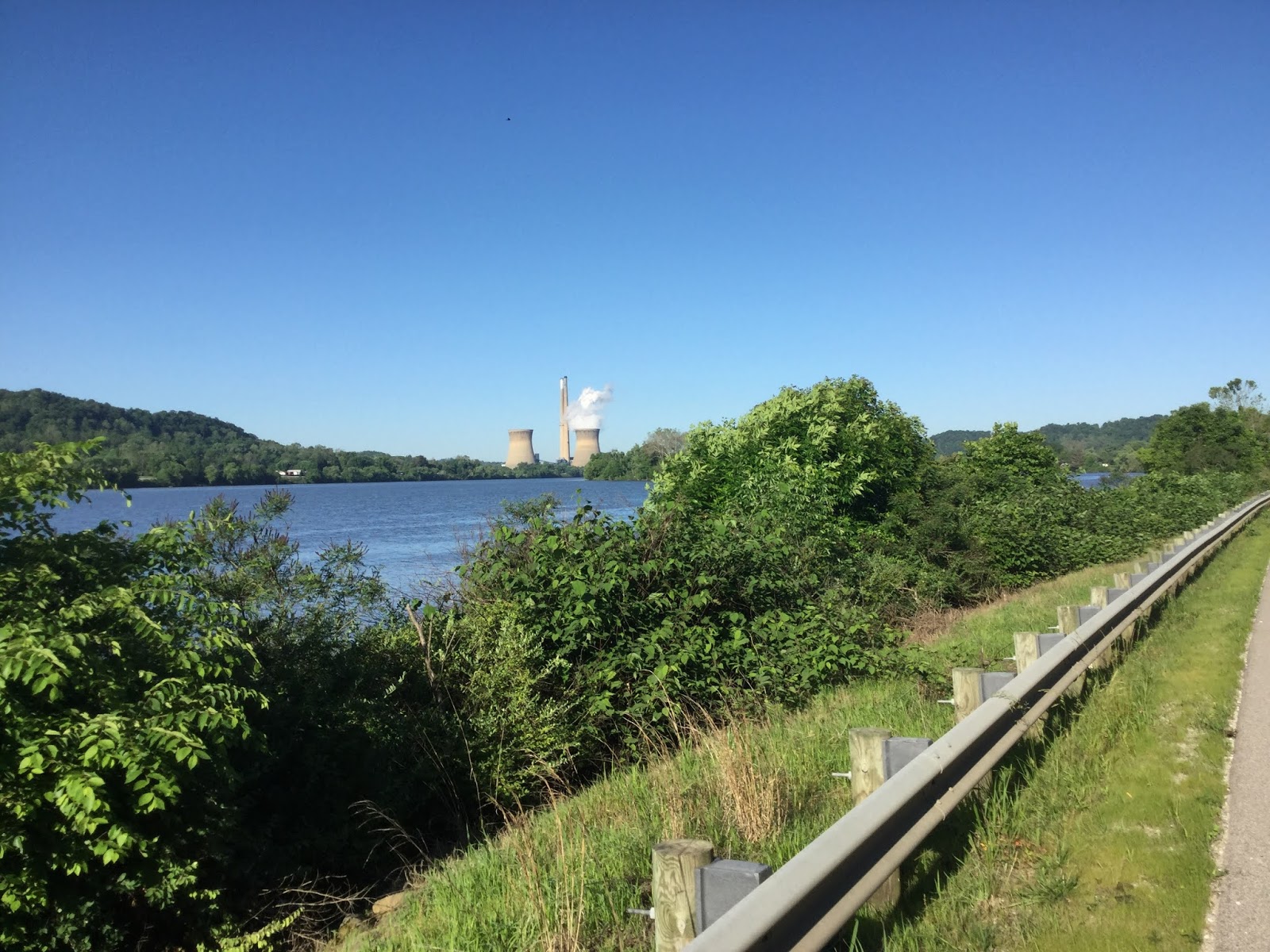
Luckily the Kinsman with a Carnegie was among a cluster of towns with Carnegies in the northeast of the state that I hadn’t gotten to.  It was a relief not to have gone all the way to Kinsman, over 80 miles upriver from Marietta before I made this discovery.  I had gone fifteen miles beyond Marietta along the Ohio River and camped across from an ominous non-nuclear power plant on the West  Virginia side of the river.  It was in my tent when I tried to find the precise location of the Carnegie in Kinsman that I discovered it was just a tiny hamlet.  


At least doubling back to Marietta allowed me a second chance at its Carnegie.  It was open, but not beyond fifteen feet into the building in the addition to a desk where one could pick up books.  Not even my having biked over six hundred miles from Chicago to see it was enough for the trio of librarians on duty to allow me a glimpse of the library proper. 

One told me there was another Carnegie in Marietta and that it was the only city with two Carnegies. I told her that wasn’t true, as this past fall I was in Iowa Falls that had a public and an academic Carnegie at Ellsworth College, and that later in Ohio I’d be visiting Tiffin with a public and an academic Carnegie (Heidelberg University), not to mention of course numerous cities with multiple branch Carnegies, including Cincinnati, Cleveland and Toledo.  She was another example of one with an inflated pride in her Carnegie similar to those who think their town is the smallest with such a library.

She said there had only been minor protest when the library was built on the site of an Indian mound.  In later years when it became more of an issue in the public mind, it was ruled that if there were to be any any further expansion to the library requiring digging, even for a deeper shaft for its elevator, it would not be allowed.

One of the other librarians overheard our conversation and that I was headed to Zanesville sixty miles north for its Carnegie.  She was sorry to report that it wasn’t open, though it turned out it was, but with just afternoon hours.

Monday, June 8, 2020

Marietta, Ohio


It wasn’t until Day Thirteen that someone with a gun and a badge wanted to know what I was about.  I had stopped when the bike path out of Athens ran out and was looking at my GPS device to decide what to do next, whether to continue on the shoulder of the busy four-lane highway 50 to Marietta forty miles away, or to take the slightly shorter secondary road route that would probably inflict me with more climbing.

After deciding on the shorter and more scenic and lesser traffic of the secondary roads I put away my iPad and was about to resume riding when an officer pulled up and asked if I needed any help.  He said he had a bunch of detailed county maps and could recommend a route on lightly traveled roads.  He told me the route I had decided on attracted a lot of motorcyclists and could be treacherous.

That was actually an endorsement. If it attracted motorcyclists that meant it made for a pleasurable ride and it also meant the possibility of finding a neckerchief, as they often blow off the heads of the riders. 

“Motorcyclists never give me a problem,” I told the officer. “They often give me a thumbs up.”

“Not me,” he replied.  “It’s the middle finger.”

The officer told me the route I had chosen had been flooded a week ago just before Amesville.  I told him I was seeking out Carnegie Libraries.  Knowing that I had an interest in libraries, he told me Amesville had a Coonskin Library Museum.  That closed the deal.  Even if it wasn’t open, that was a town I had to visit.  

Before I was on my way the officer said, “I grabbed a couple extra Gatorades this morning.  You're welcome to them, if you’d like.”

I couldn’t say no to that.  In exchange I gave him a black rubber bungee cord I had picked up and was waiting to bequeath to someone who did me a good turn. He said he could use it for his chicken coop. He asked if I had a cell phone so I could give him a call if I had any problems. He was shocked I didn’t have one.  He gave me his card anyway and said to give him a call if I had trouble of any kind.

I was surprised that I didn’t have an encounter with an officer earlier in the day as I roamed the totally desolate Ohio University campus in Athens in search of a Carnegie Library.  It was a virtual ghost town.  Barriers had been placed blocking various routes through the campus and fencing erected to prevent entry elsewhere.  I was enjoying the tranquil collegiate atmosphere, but was nervous about being evicted.  My entry to Athens via a roundabout just before crossing the Hocking River, my first roundabout since Xenia, had given me an initial good taste for the town which only increased.

I had to go around some fenced-off areas on the campus and ride on a sidewalk through a quad before reaching the Carnegie, now Scripps Hall.  It was next to the new library and was on the fringe of the campus.  It had actually been the city's public library before it was replaced and taken over by the university and greatly expanded.  There were no plaques indicating its origins.  It was a bit frayed with its wooden window frames all peeling white paint.


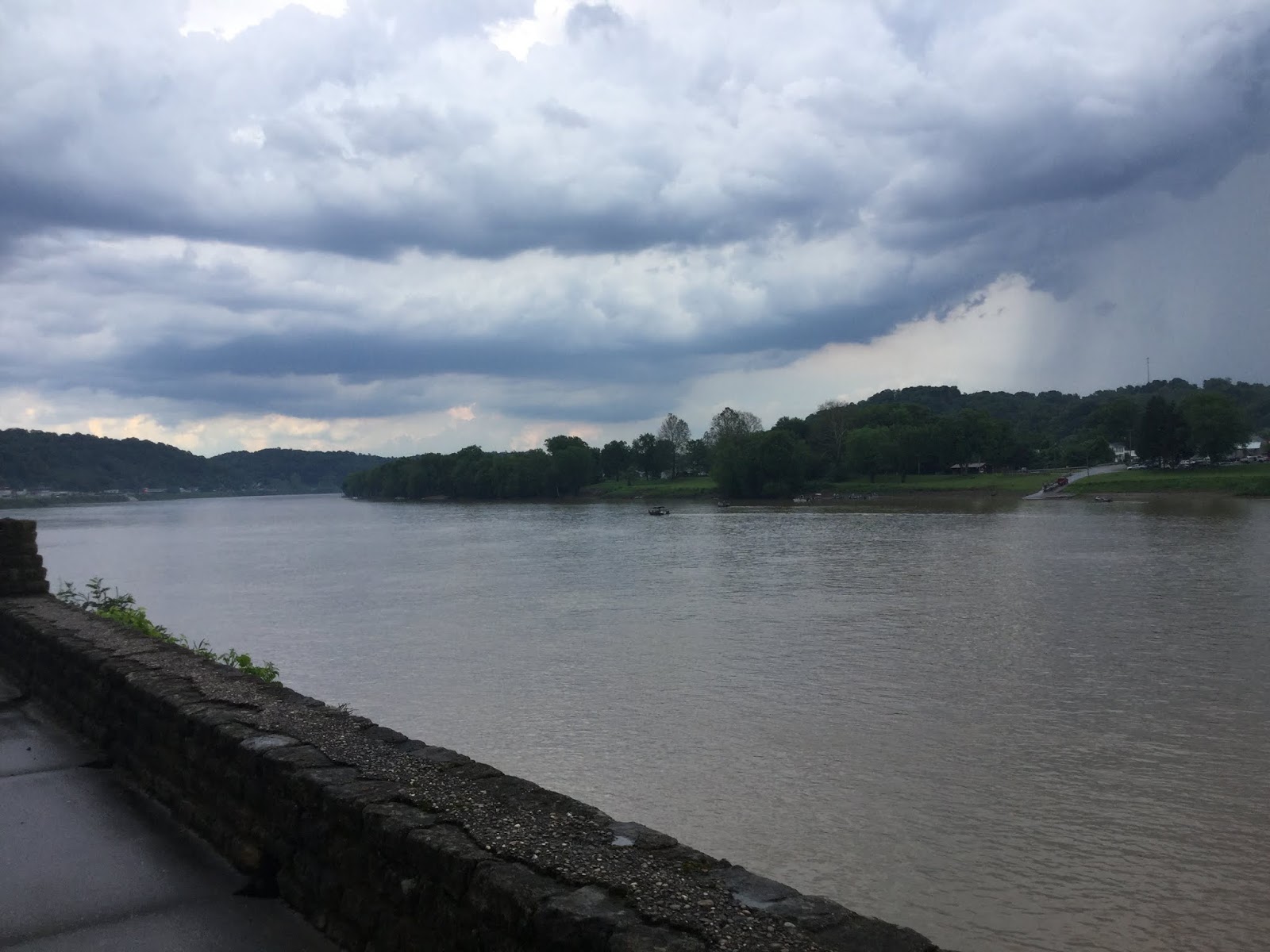
I’d had a steady twenty-five mile climb to Athens from Pomeroy and the Ohio River where I saw a handful of fishermen in the evening hour in a cluster of boats on the West Virginia side of the river. 


The Carnegie in Pomeroy was a block up from the riverside road.  It was now a law office.


The quaint Carnegie in Middleport, just three miles before Pomeroy, still served as a library and had just reopened six days before.  The circulation desk was entirely encased in plastic hung from a network of unfinished two by fours.  It looked like a construction site.  The young librarian said there had only been “five or eight” cases of the virus in the county, but the plastic barrier still made her feel safe.  Rather than a Carnegie portrait there was a portrait of an older woman behind the circulation desk who had been on the library board from 1908 until 1964.


Middleport took its name from being the halfway point between Cincinnati and Pittsburgh.  It was much smaller than Pomeroy, which had a McDonald’s right on the river, maybe the most scenic location of any.  It had a gazebo one could eat under.  It offered walk-in orders, but no seating indoors.  Quite a few were happy to walk in to place their order rather than wait in the long line of cars at the drive-up window.  All those idling cars spewing pollutants were making up for the diminished numbers of cars on the road.

There was no library in Amesville, a town of just 154, but there was a set of lock boxes for locals that books they ordered from the Athens library could be deposited in.


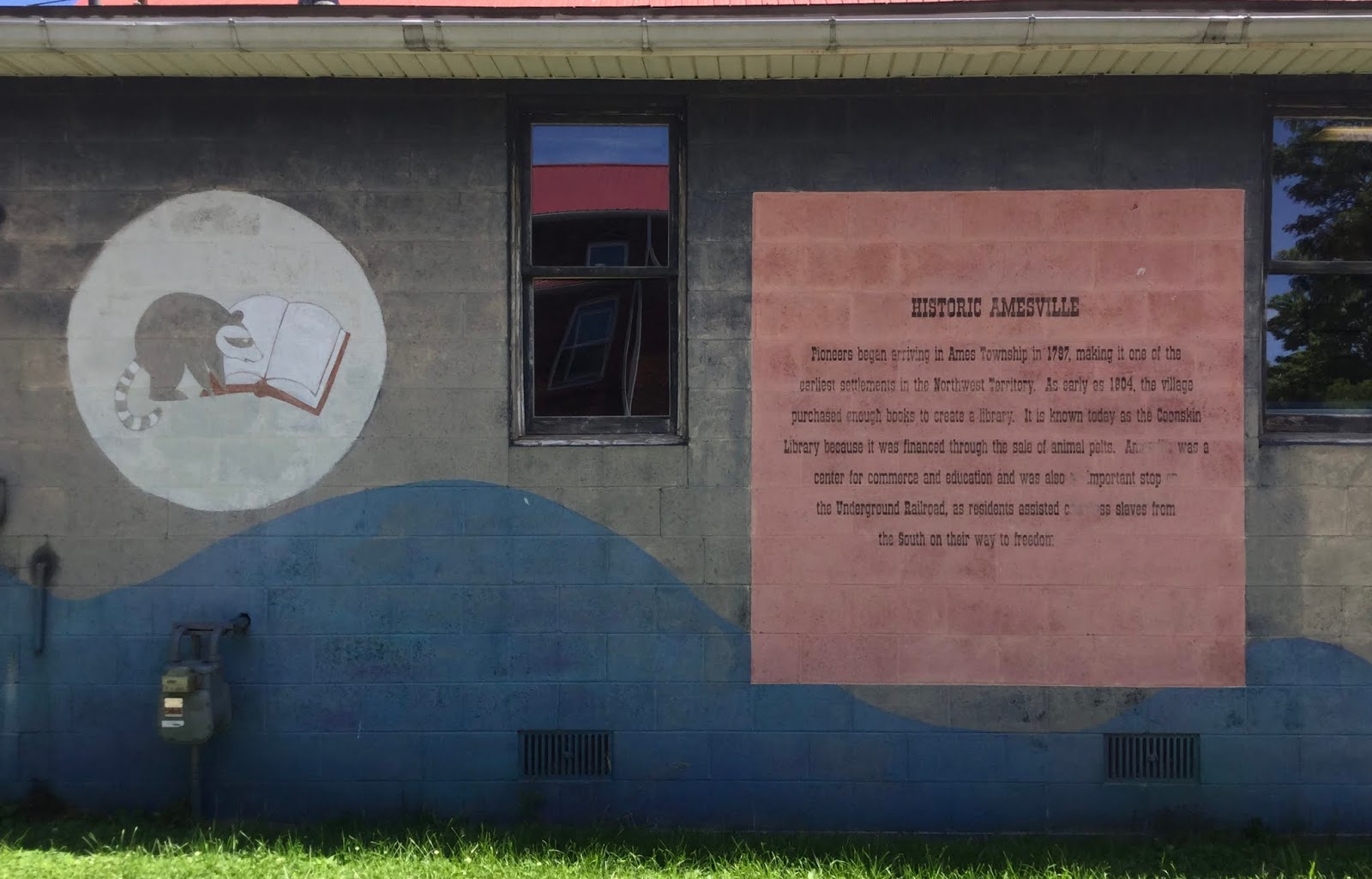
 That was almost as noteworthy as its heritage of establishing a rotating cache of books in 1804 that had largely been funded by the pelts of coons.  A historic marker in the town park recounted the story as did a mural including a coon reading a book.


The forty miles to Marietta were the hilliest of the trip, mostly up and down with rarely a flat interlude.  I was lucky it was ten degrees cooler than the day before with the temperature hovering around 80.  Those two bottles of Gatorade wouldn’t have lasted long if it had been in the 90s.  Instead I only needed one and saved the other for the next day.  The officer was right about the motorcyclists.  There were quite a few but they weren’t a menace at all, always passing wide.  They were a fine sight, especially those with a helmetless, bare-shouldered woman with hair blowing in the wind on the back. And I did find a neckerchief, a black one, still knotted having blown off the head of some rider.  It was my second of the trip, half as many as license plates.

Marietta, back on the Ohio River, offered up a pair of Carnegies, one at the university and the other for the public, both on 5th Street less than a mile apart.  The public library was built on an Indian mound of the Hopewell tribe.  It had reopened but was only allowing one patron at a time.  That didn’t effect me as it was Sunday and not open.


There was an even bigger mound between the two Carnegies that had been turned into a vast noteworthy cemetery where more Revolutionary War officers are buried than in any other.  The Carnegie at Marietta University was now an administration building with the office of the president and others.  


Saturday, June 6, 2020

Gallipolis, Ohio


For sixty miles as I bicycled along the Ohio River Scenic Byway between Ripley and Portsmouth I had glimpses of the Ohio River through the trees, though never long enough to notice any of the barges that ply its waters flowing into the Mississippi. There were campgrounds here and there along the river to my right and inland in Shawnee State Park to my left. But there were even more dilapidated, abandoned barns that were more enticing as a place to pitch my tent, offering the genuine camping experience of peace and solitude plus little threat of the deadly virus.

Not that I have much concern of the virus here.  It’s not much of an issue in these parts.  Rarely does any one tell me of more than a handful of cases in a county or of any deaths.  When I told one young man who was curious about my travels that my Carnegie quest had taken me to South America this past winter, the first time I had mentioned it to anyone during these travels, he stuck out his hand and said, “Congratulations, it sounds like you’ve led an interesting life.”

I hesitated and said, “Is it safe to shake hands around here?”  

“Sure.  I don’t know of anyone who‘s contracted the virus except my aunt and she lives one hundred miles from here.  She thought she had the flu and got tested.  It was the virus, but she was fine in a few days.”

As I repaired a flat tire, my second of the trip just after writing of how I’d been free of flats since Day One, outside a bar in the late afternoon, locals were flocking in convivially greeting each other with no concerns of social distancing.  A few asked if I needed any help with my repair.  One guy told me he had two sisters who were librarians who would be fascinated by my Carnegie odyssey.  Not a one questioned my sanity for wandering the country in these times, nor has anyone else. Nor has anyone expressed alarm at me being an outsider and a possible transmitter.

Unfortunately the Carnegie in Portsmouth wasn’t without concerns and hadn’t  reopened, just providing pickup service.  I had been hoping to be dazzled by its dome as I had been when I visited it in April of 2011.  Instead I had to be content with a mere peek of its interior through the door of this glorious temple of a building. 


I was hoping to ask a librarian how much of an event TOSRV is in Portsmouth.  A pair of murals at the entry to the city celebrated this annual bike ride, the Tour of the Scioto River Valley, that has been going on since 1962.  It is one of the premier cycling events in the country along with the Hilly Hundred in Indiana and the Apple Cider Century in Michigan. 


Portsmouth is the mid-point and overnight spot for this 210-mile ride that starts and ends outside of Columbus.  It was established by Charlie Siple and his son Greg.  Greg went on to be one of the co-founders of Bikecentennial, devising the coast-to-coast trail across the US for the country’s Bicentennial in 1976 that thousands have followed.  The Bikecentennial organization lives on as Adventure Cycling, headquartered in Missoula, Montana.

Father and son are acknowledged on a panel between the the murals at the top of a map of the TOSRV route.  Greg recently retired from Adventure Cycling.  I met him when I ventured to Missoula to visit its Carnegie library and had my photo taken by him for his vast gallery of touring cyclists.  I spent the afternoon at Adventure Cycling reading a rare copy of Ian Hibbel’s book “Into the Remote Places” from 1984.  The bike that Hibbel rode across the Sahara resides at the offices. Siple and his wife June met Hibbel in 1972 in Central America when all three were engaged in rides of the hemisphere.


I left the Ohio River just beyond the sprawl of Portsmouth after a several mile stretch of the most franchises I had been subjected to in days, including a Walmart and the first Aldi’s in over a week, whose dumpster provided a handful of bananas.  I cut inland for the fifty-mile stretch to Gallipolis where I was reunited with the Ohio River.  I camped along a stream infested with mosquitoes.  It was my first chance to test the patching job Janina had done of my tent covering the many quarter-size holes created by the Leaf-Cutter/Scissor ants of Brazil.  She couldn’t cover all the holes, as some were too tiny to deal with, but the mosquitoes didn't find them and the rest of her patching job was a great success.

The Carnegie in Gallipolis resided a block from a large park that overlooks the Ohio River.  The park was dotted with historic signs tracing the history of this prominent river town originally settled by French fleeing their Revolution.  It’s location also made it a pivotal spot during the Civil War.  The stature of the city earned it a little larger than normal grant from Carnegie, funds enough to include a large domed rotunda.   It opened in 1905 and served as the city library until 1978.  It now houses the administrative offices for the school system.  


The new library was open, just the fourth I’ve come upon and the first to require facial covering.  There were signs everywhere warning people to stay six feet from others.  Reunited with the Ohio River I will follow it for twenty miles to Middleport and Pomeroy for their Carnegies and then turn inland to Athens and eventually Columbus.