Friday, May 17, 2019
Cannes Day Three
So far my on-line requests for Invitations have been granted for the first eight films playing In Competition, three of which have already played. I’ve never been so fortunate. Maybe seniority means something. If this continues for the remaining thirteen films, I won’t have to play catch-up on the final three days of the festival when Competition films are given another screening. Instead I’ll be able to give my favorites a second viewing, which I’m always happy to do.
My day’s first two films were both competing in the Competition field and playing in the Palais. The day got off to a bad start when the guy checking bags found my pâté sandwiches in the flap of my pack that no one had checked before. There went my lunch. Fortunately I’d brought along a few extra madeleines, so didn’t have to take time to find food and made it through the day okay.
“Bacurau” opened with a truck driving through spectacular rural Brazilian scenery. The cinematography immediately stamped this as a Competition-worthy film as did the initial immersion into a funeral going on in a small, isolated village. This looked like another worthwhile dose of cinema-veritè. But then the film derails, degenerating into mere Market fare when it introduces a cast of western wannabe mercenaries who intend to shoot up the town. They are all silly caricatures whose motives make no sense other than to be a Brazilian fantasy of how the country feels dominated by the Land of Trump. The audience cheered when the Brazilians repel the assault and start killing off the whites.
There was no fantasy in “Les Miserables,” just hard-hitting reality in this gripping portrayal of a housing-project neighborhood on the outskirts of Paris dominated by gangs. It is seen through the eyes of a cop from Cherbourg on his first day patrolling the neighborhood with two ten-year very-hardened veterans of the beat. It turns into a veritable nightmare that the rookie calls the worst day of his life. It is the first film by Ladj Ly, who grew up in the neighborhood.
This becomes the first film that I will want to see again of those I’ve seen so far. He managed to insert a view of the Eiffel Tower in the opening montage of scenes of fans gathering in Paris to watch the World Cup championship game last summer that France won. It’s too early for any films this year to include scenes of the Yellow Vests. Next year they will no doubt be a dominant theme.
Thierry Fremaux was on stage in the Debussy to introduce the cast of the French animated feature “The Swallows of Kabul,” and as he likes to do after the director has said a few words, hopped down the short staircase from the stage ahead of the cast so he could lend a hand to all the women as they descended, and any of the men who didn’t reject his outreached hand. He is always a bundle of energy.
The film takes place in 1998 when the Taliban ruled Kabul. Women had few rights. There is an early stoning of one, and then another awaits public execution. A prison guard who knows she isn’t guilty of the crime she is accused of, killing her husband, tries to help her escape. The animation is somewhat sketchy, barely two-dimensional. The film manages to hold one’s attention but without fully engaging it.
“Lost and Found” was my lone French film in the Market today. A 35-year old man decides to give up his acting career and become a museum guard. This comedy portrays all the guards as a neurotic of some sort or another. Chief among them is a woman who tries to run him off, but then enlists him in a plot to steal uncategorized items from the museum’s storage and sell them. The script only gives a faint echo of what it is to work as a museum guard, written by someone who only imagines what the job must be like making this the least satisfying of the French films I’ve seen so far.
I finally ended my documentary drought with “The Ghost of Peter Sellers” by Peter Medak, who directed Sellers in the 1973 pirate movie “Ghost in the Noonday Sun.” The movie was beset with one disastrous problem after another, beginning with the Greek captain who delivered the ship to the shoot location in the Mediterranean crashing the boat. Sellers was wildly popular coming off the first two Pink Panther movies and “The Shining.” Medak too was at the top of the game having just directed “The Ruling Class,” for which he received an Oscar nomination.
Sellers had just broken up with Liza Minnelli and wanted out of the production, faking a heart attack at the start of the shoot. He was prevailed on to continue but sabotaged Medak from start to finish, resulting in the film getting a minimal release and savage reviews. It undermined Medak’s future as a director. Among those Medak interviews for the film are others who have directed Sellers saying how impossible he was, but all agreeing upon his genius. Late in the movie Medak speaks to the camera with a Telluride Film Festival poster in the background. As a commentary on film lore, this could well end up at Telluride in the Backlot, where films on cinema are screened.
When I fell two people short from getting into the Russian film “Beanpole” at the Debussy, which Ralph liked, I dashed to the Soixante for another documentary, “5B” about a special AIDS section set up in a San Francisco hospital in 1983 when the disease first broke out and there was no understanding of how contagious it was. This was a special screening introduced by Fremaux. Fremaux is denied his pleasure of helping those introducing films off the stage, as there isn’t one in this large warehouse of a theater.
The film is intermixed with footage from the time with interviews of many of the heroic nurses and doctors who were willing to work in the unit unsure of how safe it was. It wasn’t until 1996 that a drug was discovered that could stem the disease. Until then the disease was a virtual death sentence. 5B was a care unit, not a cure unit. Many of those working in the unit bravely made physical contact with the patients, holding their hands and giving them massages, when many staffers were afraid to come near them without being encased in a space suit. This was a quite moving testament to those worked in 5B. It wasn’t until 2003 that the special section was no longer needed and AIDS patients were intermixed with all others.
Ralph and I treated ourselves to a Cannes Classic to end the day—a freshly restored “Moulin Rouge” from 1952 by John Huston. The restorers introduced it along with a woman who worked on the film who said she hadn’t seen it in over forty years. She had been thrilled to be in Paris for the first time where it was partially shot along with a studio in London. The film was beautiful, opening with an extravagant can-can at the Moulin Rouge. There’s not much dancing afterwards as the movie tells the story of Toulouse-Lautrec. This nice biopic made for a relaxing, stress-free cinema experience in the hands of a master filmmaker.
Every time I see an adult on a bicycle I no longer despair for the future of the human race--H. G. Wells
Thursday, May 16, 2019
Cannes Day Two
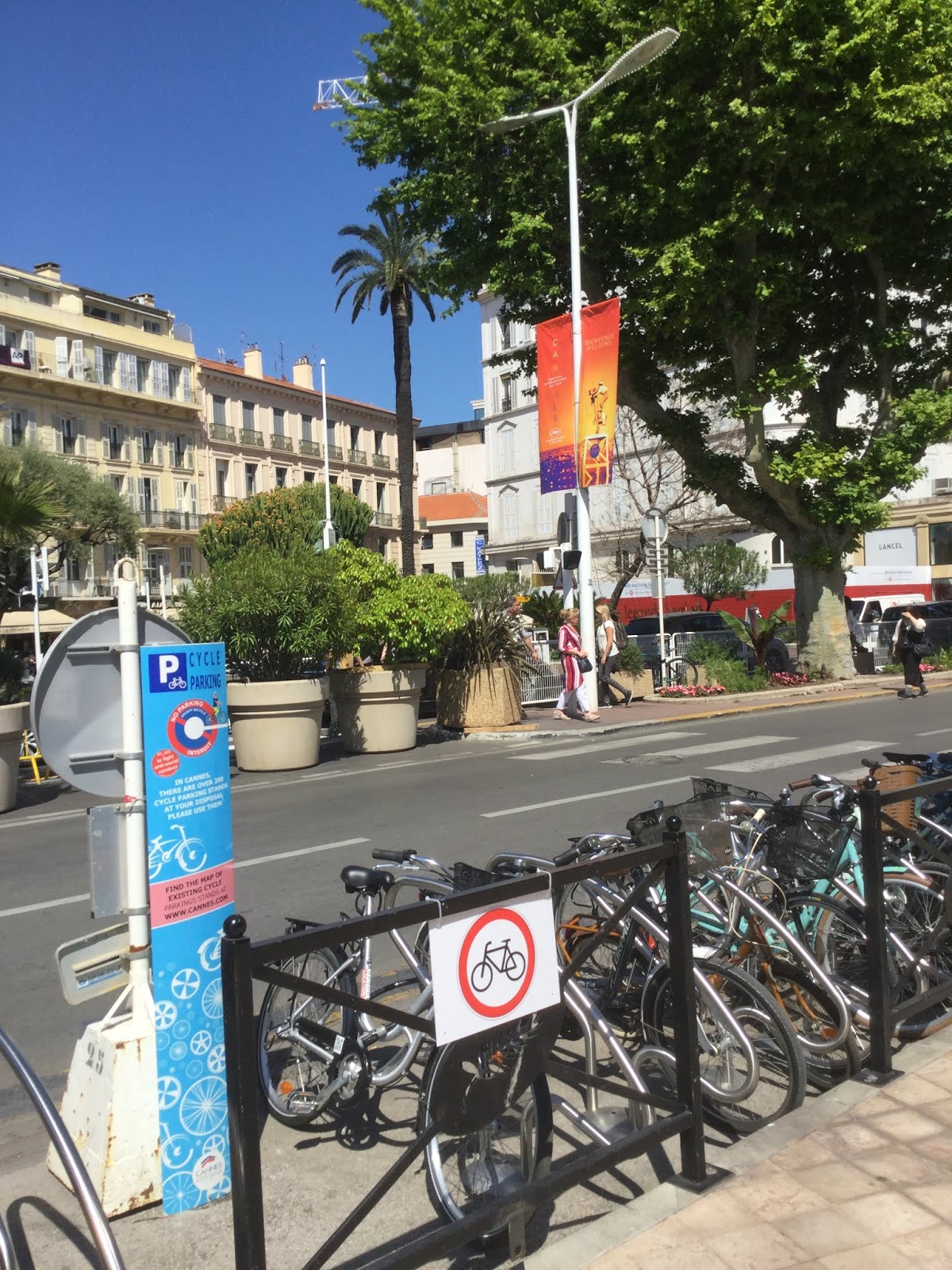
I was the first to park a bike at 8:15 this morning at the new, long-needed bike rack in front of the Debussy. There are 22 arches, enough to accommodate 44 bikes. Cyclists used to lock their bikes to the palm-ornamented barriers in front of the Debussy until “no bike parking” signs went up a couple of years ago, forcing us further away.
I was relieved as I approached the security check for the first time this year at the Palais that there wasn’t a pile of confiscated food and bottles, indicating that they may be more lenient than in the past. I had left my water bottle on my bike and had tried to hide my food for the day in secret pockets in my pack and vest. The guard just gave a quick look into the main pocket of my pack without probing the other smaller zippered compartments. I scampered up the several flights of stairs to the balcony in relief for the first of the 21 films in Competition—Jim Jarmusch’s vampire comedy “The Dead Don’t Die” starring Bill Murray, Adam Driver and Chloe Sivigney. After nothing but subtitled films yesterday I felt a wave of easy familiarity when the film opened with Murray and Driver sitting in the front seat of a police car and they started speaking unaccented English.
Jarmusch provided chuckles aplenty from the very start with his signature understated wit coming from a host of off-beat characters including Steve Buscemi sitting at the counter in a diner wearing a “Make America White Again” hat talking with Danny Glover. The zombies don’t show up for awhile and when they do, the killing is less gruesome than the horror genre usually provides, with the gentle humor continuing to predominate. Tilda Swinton as a wacky Scottish funeral parlor operator in this small one-diner town could have stolen the picture if she’d had a larger role. But as with the picture as a whole, she wasn’t fully developed, making this more of a pleasant ditty of a film, than anything of much significance.
“Queens of the Field” was the first of three French films on my docket for the day. It was one of five films on soccer I spotted in the program, all in the Market other than a documentary on Diego Maradonna with an Out of Competition slot. The Queens are a group of women, many of whom are wives of the men who play soccer for the town team, who have been recruited to replace the men on the team who all have been suspended for their final three games of the season for getting into a fight in a game that resulted in the assault of a referee.
The town team, which had a rich 90-year history, is in danger of being relegated to a lower level, essentially putting it out of existence if it doesn’t gain at least a tie in one of the remaining three games. None of the men in town are in favor of the women playing soccer. Even the coach is initially adamantly opposed to the idea. The wealthy husband of one of the wives goes to extreme measure to sabotage her and the team. Only a couple of the women have any soccer experience. They are decimated in their first game, but then manage to recruit a former National-level player who is out on parole, who makes them competitive. They still have much to overcome. The plot doesn’t lag at any moment as they persevere.
I thought arriving an hour ahead of time for the two o’clock screening of the first Un Certain Regard film at the Debussy, “Bull” from the US, would be plenty of time. I even paused to fill my water bottle, which I was greatly regretting when I saw how long the line was and how slowly it was moving. As it was, I was the very last person to gain entrance to the 2,300-seat theater and was allowed to sit in a prime reserved seat that hadn’t been needed just as the lights dimmed. Evidently the word was out to the merits of this very fine film about a delinquent 14-year old girl living in a rundown neighborhood outside of Houston. Her mother is in prison and is being looked after by her very perturbed grandmother.
The girl wins the favor of her older delinquent friends by inviting them to crash the home of a black neighbor, a former bull rider, who goes away on weekends to work in rodeos in the very dangerous job of distracting bulls after they’ve thrown their riders. They drink his alcohol and pop his pills and have a wild time. When he returns home and finds his house trashed, he knows she is responsible and calls the police. The grandmother begs the guy not to press charges and let her grandchild clean the house. Thus develops a friendship between these two very authentic personalities. This was cinema-verité at its finest, an all-round exceptional film that will receive much attention in the months to come.
I didn’t expect to gain entry to the less than one hundred seat screening room showing “Grand Isle” starring Nicholas Cage, especially after it was given prominence in the day’s “Screen” magazine schedule of Market screenings. But it was less than half full. Cage plays an alcoholic Vietnam vet married to a former lounge singer. They are living in her family’s large home in Louisiana. Cage terrorizes a young man, a former military man himself, who comes to repair his fence, while his wife tries to seduce him. The plot becomes so far-fetched and convoluted that Cage and everyone else who ended up in this fiasco ought to be doing everything in their power to destroy every print or copy of it. The first-time director introduced it saying there would be no credits, as he was putting the final touches on the film. How he ever convinced Cage to submit to this would make a better movie than the movie itself. No one else in the film looked as if they’d ever acted in anything other than community theater. It was a full-on embarrassment and disaster.
I quickly put it behind me with the intensely real, socially-conscious “Battle of the Classes,” a French film about the struggles of a boy to survive in a school outside of Paris where he is the only white. The film opens with his parents talking with a real estate agent about selling their condo in Pairs. The father is a 40-year old drummer in a punk band long past it’s prime, and the mother an accomplished lawyer. The extreme idealist father doesn’t want to sell it for more than the 200,000 euros they paid for it a decade ago, while the agent says they are crazy as it is worth more than twice that and they’ll need all that to afford the house they want to buy for 450,000 euros in the neighborhood the lawyer, who is of Arabic descent, grew up in. She is more of a realist than he, so they do get 399,000 euros for it.
Their values mostly coincide, and they both agree that they don’t want to take their son out of his public school as all the other white parents are doing, putting their children in better private schools not dominated by blacks and Arabs. When their son continues to have a hard time of it, particularly mocked for being an atheist condemned to hell by all his religious classmates, they try to transfer him to another public school by pretending to live in its district. The black woman in charge was a fan of his dad’s punk band and remembers his song about fucking the Pope in the ass and is quite appalled when they try to cheat the system, accusing them of being worse than right-wingers. There is considerable substance to this film as the parents attempt to resolve their son’s predicament.
I was greatly looking forward to my next screening, a return of Kim Ki-Duk, the South Korean provocateur, whose breakout film, “The Isle,” was the most audacious film of 2000, and the first of several startlingly original films. But it has been quite a few years since he has offered a film. And what was playing here was just two screenings, both in theaters of less than 50 seats. Back in his heyday there would have been hundreds lined up to see his next. But this time there were just a handful standing off to the side when I showed up. A sign said “Guests Only.” And that was being adhered to. I hung out a bit hoping the guardian might relent and let the few of us uninvited in if there were empty seats, but there was none of that.
My delay prevented me from getting in to see the special screening of “Easy Rider” in the Buñuel two flights of stairs up. I joined the line, but fell twenty-five people short. That at least allowed me to bike to the Croisette for the final Director’s Fortnight screening of the night—a French surreal black comedy, “Deerskin.”
A goofy guy infatuated with his vintage deerskin jacket with tassles offers people money to let him film them throwing their jackets in the trunk of his car and saying, “I’ll never wear a jacket again,” then drives off with their jackets saying, “I have proof you don’t want your jacket.” He checks into a remote hotel and tells a bartender he is shooting a movie. She says she is an aspiring film editor. She is as much of a schmuck as him and withdraws all her money to help him make the movie he pretends to be shooting after he enlists her to edit it. There are chuckles along the way though this harmless, inconsequential film won’t find an audience beyond the film fest and small art theater circuit.
Tuesday, May 14, 2019
Cannes Day One
I was hoping to camp outside of Cannes just over the summit of the final mountain ridge I had to cross on Saturday night and speed down Sunday morning arriving by nine a.m. to pick up the goodies, but I fell twenty miles short of my goal and didn’t make it until noon. But it didn’t matter, as even though I was able to grab my credentials, the bags weren’t being distributed until the next day, requiring a return visit to the accreditation office. Getting the credentials earlier speeded up the process, but not much.
My pass was printed out by a machine in a kiosk right along the harbor. There was no wait, but I had my first encounter with the ubiquitous ever-zealous festival security that can be a headache when I set down my handlebar bag to pull out my iPad to retrieve the special number I had been sent for my early processing. A guard pounced on me, strongly reprimanding me for having an unattended bag. When he left, the young woman overseeing the operation apologized for his behavior and said she would speak to him about it.
When I finally got the program first thing Monday morning there was the exciting news that there were five screenings that day, an unexpected bonus. Ordinarily the movies didn’t start until the next day. Three of the screenings though were trailers and one was by invitation only. It was just as well that there was only one movie to tempt me, as whatever time I spent watching a movie was time I needed to dissect the program.
The movie was a French comedy that wasn’t scheduled to open until October. It was shown at two p.m., just when I needed a break from reading the synopses of dozens of movies. “Play” was a perfect hors d’oeuvre, just the type of movie I search for in the market that holds up a mirror to French society, giving me added insight into my surroundings for the next couple of months. It was the compilation of twenty-five years of videos that a fourteen year old starred shooting of his life when he was given a video camera. He’d finally decided to try to reduce the hundreds of hours of video he had shot well into his marriage into a movie. He follows his life from an awkward teen into awkward adulthood. It doesn’t begin very auspiciously, but it actually works.
About half the French films I’ll see will have a glimpse of the Eiffel Tower. This one did not but it did refer to it. One of the teenager’s friends boasts to him that a Dutch girl he claims to have seduced when they were on a trip to Barcelona was impressed with the size of his penis and called it the Eiffel Tower.
Having taken time for a movie I fell thirty pages short of reading all 152 pages of the one paragraph descriptions of all the movies before they started playing. I had only come upon one movie on bicycling so far, but three others included a mention of cycling. One referred to a woman killed while riding her bike. Another mentioned kids riding BMXs and the last was an Un Certain Regard film, an American comedy called “The Climb,” that pictured two guys on bikes in the mountains. The actual biking movie was a Spanish animated featured called “Bikes” and it was playing only once and that was today. It would be my fourth movie of the day.
I could have begun the day with a film about Little League baseball, but I opted for a French film starring Marion Cotillard—“Little White Lies.” She is one of a group of ten relatives and friends who surprise a big-time Parisian restaurant owner at his getaway home on the Atlantic coast for his 60th birthday. He’s not happy to see them at all, as he has been estranged from them and is greatly depressed over losing his restaurant, which none of them know about, not even his girl friend. All of them have their torments. There is a lot of arguing over past issues. Cotillard is the most volatile of the lot. The script rampages from one unpleasant scene to another, interrupted by some reconciliation and play, including Cotillard and two others jumping out of a plane and the two gay guys going off on a bike ride on electric-assist fat-tired bikes. This was a consummate French relationship movie that manages a happy ending.
I had a slight breather with my next film, “Abe,” a Brazilian production about a 12-year old boy by the name of Abe whose mother is a Jew and father an Arab. It takes place in New York City. The rival strong-willed relatives both want him to embrace their religion and culture. The Brazilian connection is a black Brazilian who runs a food stand that Abe takes an interest in, as he has a fascination with and talent for cooking. He ends up working for the Brazilian unknown to his parents. There is lots of arguing along with marital strife in this movie too, but it is more heartwarming than heartrending.
It was back to French fare featuring another French icon, Isabelle Huppert, in “Pure as Snow,” directed by the lone director of note among the day’s films—Anne Fontaine. Huppert owns a luxury hotel and is incensed when her boy friend takes an interest in a ravishingly beautiful young woman on her staff, so Huppert arranges for her to disappear. The movie momentarily lapses into a horror movie when the young woman finds herself running for her life in a forest in the mountains and then wakes up in bed with a seedy young man hovering over her. She turns into a nymphomaniac seducing man after man in the small village she turned up in. It looked as if Huppert was just going to have a cameo in the movie, but half an hour later she turns up at this village hoping to finish off the job that the person she hired failed to do. This joins “Elle” as one of the lesser role choices that Huppert has chosen. If this movie had been directed by a man, rather than a woman, it would be savaged by feminists.
I was more than ready for “Bikes” after this. The town of Spokesville is a cyclist’s dream, inhabited solely by bikes, and fully ornamented with bike parts—chains adorning roofs and earrings, arches of handlebars and chainrings, pyramids of freewheels and other adornments. Each bike has a talking face, some with mustaches formed by bike parts that have a bend to them. There is no need for bike racks because bikes, being the sole beings in this town, go in and out of buildings. The tranquility of the town is upset when bankers pushing gas-powered bikes convince just about everyone to convert to putting engines on their bikes. This leads to a rebellion by those unwilling to accept the noise and pollution they create. And good wins out.
I ended the day with two more French films. France’s leading television book critic loses his job when he dares to question that a deceased small-town baker was the author of a best-selling book published after his death in “The Mystery of Henry Pick.” The critic goes to the small town in Brittany where he lived to get to the bottom of the mystery. He goes to its library that has a special room of rejected manuscripts where the book was found the year before. That leads to a local book club and back to Paris with the daughter of the baker. Their arrival in Paris gives the festival’s first grand image of the Eiffel Tower. As with the other three French movies so far, the dialogue is fast and furious and the characters all creditable French prototypes—solid, cinema fare, not necessarily worth seeking out, but enjoyable if one is in the mood.
Friday, May 10, 2019
Pont du Gard
It started as a light drizzle as I broke camp. I put on my booties for the first time and wore my down jacket under my rain jacket with the temperature just 45 degrees. There were a couple of lulls during the day, but late in the afternoon as I was completing my descent back down to lower elevations it came down in near torrents. I had been reconciled to staying in a campground, knowing it would have facilities for me to hang my wet gear, but I was now getting so soaked without the opportunity to dry I knew I would have to find a hotel, something I have never done in sixteen years of cycling in France other than last year in Lyon when I resorted to a train to get from one side of the country to another during The Tour, arriving after dark. I was headed to the large city of Alès with hotels aplenty. I found a small, moderately-priced family-run hotel by the train station. The owners didn’t speak any English, but they couldn’t have been friendlier, even offering to put my wet gear in their drier.
My legs were depleted from three days of strenuous riding in mountainous terrain. They greatly welcomed the minimal strain of the flats. Having reached the south the temperatures were warmer and I was welcomed by arcades of plane trees and vineyards. And alongside the road, just as they had been all the way down from Paris, were dandelions in full flurry. They had just been erupting when I left Chicago. They are one of the lesser known of those New World products that were part of the Columbian Exchange. Corn, tomatoes, potatoes, tobacco, and chocolate get all the attention, but the dandelion may be the most pervasive.
With the color yellow synonymous with The Tour de France, the dandelion doesn’t seem to be regarded as an unwanted weed. With this being the centennial of The Yellow Jersey, introduced at the 1919 Tour, thirteen years after the inaugural Tour, Yellow has added significance this year. A museum in Nice has a special exhibit honoring The Yellow Jersey. That will be my first destination after Cannes.
It is now less than two hundred miles to Cannes on roads I know well. I know where the best camping is and which towns have spigots dispensing free-flowing spring water. It is France at its finest.
Monday, May 6, 2019
Brioude, France
Brioude, population 6,670, is the first of three Ville Étapes on this year’s Tour route that I’ll be able to scout out on my ride to Cannes. It has the honor of hosting the finish of the Bastille Day stage on July 14. It’s City Hall had a giant Yellow Jersey over its entrance announcing the coming of The Tour. Otherwise there were no decorations yet around the small city other than a couple of storefronts who had their windows painted with some scene relating to The Tour. Brioude was a Ville Départ in the 2008 Tour. I was happy to renew my acquaintance with the cobbled narrow streets of its medieval center and to discover the rare amenity of a row of electric outlets outside an auditorium across from the toilette publique. Though my generator hub is helping keep my iPad charged, its always nice to know where auxiliary charging can be found.
Not even ten miles into my ride I had my first spontaneous “Wow” moment when I came upon a giant dragon sculpture in a roundabout. Roundabouts alone are a pleasing amenity, and their art even moreso. Nothing personifies the aesthetic-sense of the French more. Signs preceding towns announcing a vide-grenier (town-wide garage sale) or a blood drive or the circus coming to town are unique to France. I also know I am in France when I come upon gypsy encampments on the outskirts of towns and also stray white vans (portable bordellos) in a pullover by a forest and the stone-walled cemeteries with their water spigots. The occasional smoker reminds me I rarely see one in America anymore. I do not look forward to having to inhale cigarette smoke while waiting in line at Cannes. But there are plenty of other things at Cannes I do greatly look forward to, not the least of which is the World Premier of Quentin Tarantino’s latest—“Once Upon A Time in Hollywood.” My ten-day ride through La France Profonde is cleaning my palette for the twelve days of Big Screen art to come commencing next Tuesday.
My favorite French meal, caussolet, tastes a little better this year after learning from a book I read just before I left, “A Bite-Sized History of France,” that this meaty bean stew is so revered by the French that a law was passed mandating the percentage of meat in the canned version so that manufacturers couldn’t dilute it. That hasn’t prevented them from reducing the larger canned version from 850 grams to 840 grams, but it is reassuring to know they can’t start skimping on the hunks of meat that comprise a quarter of the volume of the can.
The book, which narrated the history of France as it related to food, devoted a chapter to cassoulet tracing its origins to over five hundred years ago. Three nearby towns in the southwest of the country all lay claim to it. The recipe has evolved over the centuries, as the present white bean used in the stew was brought over from the New World. The three or four times a week I end my day with a can of cassoulet in my tent I supplement it with couscous, which also received mention in the book. It too is popular with the French, who eat more than anyone else in Europe.
Neither book paid tribute to The Tour de France or the bicycle despite their strong presence in French culture. I continually receive affirmations of respect and longings to be doing what I’m doing from people I encounter, whether friendly toots from motorists or people warmly engaging me expressing interest in my travels.
Even before I arrived in France an older French man in line with me at O’Hare waiting to check in at the Air France counter front of me asked if I had a gravel bike in my box, and then waxed on about the joy of biking in rural France. One of the movies I watched in flight, “Nobody’s Perfect,” a French comedy starring Catherine Deneuve and Gerard Depardieu, included a scene with a pair of Middle-Aged Men in Lycra (MAMILs) stopping to ask Deneuve directions. I see many of the species out riding on weekends and they are all happy to see me. A large group of them who were stopped along the road all bowed as I passed.
I am especially attuned to the contrast of touring in France compared to the US with my 2,500 mile ride around California a month ago so fresh in my mind. Besides the ease of camping and the positive reaction from motorists here in France there is the dramatic difference in the size of the vehicles. Americans drive tanks compared to the dainty, reasonably-sized vehicles of the French. And for better or worse, the roads of France are litter free, so I’m spared scanning the roadside for things to scavenge, including coins.
Saturday, April 27, 2019
“Riis, Stages of Light and Darkness,” by Bjarne Riis
For a stoic Dane who adamantly didn’t wish to make a spectacle of himself with tears when he finally made his public confession to taking drugs, as had Richard Virenque and Erik Zabel and many others, Bjarne Riis, winner of the 1996 Tour de France, cites many instances of having been brought to tears in his memoir “Riis, Stages of Light and Darkness,” published in Danish in 2010 and then two years later in English. He does manage to hold off the tears in his televised confessional press conference in May of 2007, six years before Lance Armstrong caved in with Oprah, but he does admit to tears before going on stage when his wife wishes him well and almost succumbing to them when asked how it felt to tell those close to him that he had been doping after denying it for years.
He had hoped finally admitting to his drug-taking would give him some peace, but it continued to weigh on him. His team press officer, Brian Nygaard, was a close friend and could sense he didn’t feel fully unburdened even months later. When he expressed concern for his well-being Riis wrote, “I couldn’t hold back my feelings, or the tears any more. ‘It has been hard,’ was all I was able to say before I started crying.” He cried when he told his team at the start of The Tour de France in London six weeks after his confession that he thought it best that he not accompany them during the upcoming three weeks of racing even though he was the man in charge, as he didn’t want to be a distraction with the press continuing to make an issue of his drug-taking and the prevalence of drugs in the sport.
Tears accentuate many of the key moments of his life. His parents divorced when he was young. Riis split his time living with his father and grandmother, rarely seeing his mother, who had gone to live on a commune. When his father would spend time with a girl friend, tears would stream down Riis’ face when he’d have to say goodbye to his father. His father was an amateur racer. Riis earned a new bike from him when he won his first race as an eight year old. He brought his father to tears when he won The Tour de France, and his wife too. Riis speaks of tears at the finish of the 1989 Tour when he rode as a domestique for Laurent Fignon, who lost to Greg LeMond by eight seconds after starting the final stage, a time trial from Versailles to Paris, with a seemingly insurmountable advantage of fifty seconds. Fignon’s devastating loss had Fignon in tears and many of his teammates, but not Riis.
Though he remained immune to tears then and succeeded in suppressing them during his drug confession, he lost the battle when his father died. His father’s death affected him so strongly he didn’t feel as if he could compose himself to give a eulogy. His long-time physiotherapist could tell what a state he was in and offered to give him a treatment. As he prodded his body, Riis let out all his pent-up emotions and sobbed for fifteen minutes. His fifteen-year old son was in the room. Riis could see he was in a state of shock never having seen his seemingly stoical father in such a state. But it opened the door to them to express their feelings with one another.
It wasn’t the first time his son had seen him cry, as there were tears when he and his wife told their two sons they were getting divorced a year after he won The Tour de France. Riis had fallen in love with a Danish handball champion he met at the 1996 Olympics. They had tried to avoid each other after establishing a friendship at those Atlanta Games that never went behind a kiss, but their connection was too deep and genuine to keep them apart. When they reconnected several months later, she as a fellow elite athlete could fully commiserate with Riis’ struggles to maintain his Tour-winning form. The year after his win he dropped to seventh, as his young teammate Jan Ullrich won The Race. He was eleventh the following year in the Festina-marred edition. An elbow-injury forced him to miss the 1999 Tour and led to his retirement.
There are tears sprinkled though the ten plus years the book covers of Riis’ career as the owner and director of a team. Two more were drug-related. Both he and Iván Bssso are tearful when Riis has to dismiss him from his team before the start of the 2006 Tour when Basso was linked to the Puerto blood-doping revelations. The wife of Bo Hamburger, another of his riders, is brought to tears when he tested positive for EPO and was suspended. There were tears of happiness all around for his rider Nicki Sørensen when he won a stage in the 2009 Tour.
Unfortunately the book was written before Peter Sagan joined his team and Oleg Tinkov became the owner, two dynamic personalities who would have further enlivened the book. As it is, it was plenty rich in material. When he entered the pro peloton in 1986 he gave no promise that his career would warrant a book. He was fortunate to land a position on a small Luxembourg team. Despite no wins in three years Fignon recognized in him the qualities of a strong domestique and recruited him to his System U team in 1989. He later praised Riis as “the most loyal rider I’ve ever come across. He’s never tried to ‘steal’ anything from anyone, and never tried to trick anyone. Guys like Bjarne are hard to find in this game.”
Riis finished 95th in his first Tour in 1989, which he comsidered “not bad.” He used the same words to describe his 107th place in 1991 after not finishing in 1990. He began taking EPO in 1993 and saw its immediate effect finishing fifth. Until then he’d relied on cortisone and caffeine, which also elevated his performance, but not to the extent of EPO. His wife was aware of his drug-taking and was accustomed to seeing him give himself injections, but she was leery about EPO and thought that was going too far. At that point Riis limited what he let her know.
Besides the drugs Riis had another secret weapon, an herbal green tea that he would swig before the finish of a race, giving him a quick energy boost like taking a caffeine tablet. Occasionally he would open a teabag and swallow its contents. Once the particles went flying in the wind. George Hincapie noticed and blurted, “What the hell was that Bjarne? Gun powder?”
Another of his ploys was outftiing a bike with a large chain ring that was smaller than normal in the 1996 Tour when he ended Miguel Indurain’s five-year reign. He switched to the bike just before the climactic Huatacom climb so he could trick his adversaries into thinking he was much stronger than them being able to ride in his large chain ring when they were all in their small ring. “I could see it in their eyes,” he wrote. “Each time I attacked, it was in the big ring, while they struggled in their small chainrings. It was that “secret gear” that did it for them.”
He rode the last seven kilometers on his own, winning the stage while wearing the Yellow Jersey that had he assumed seven stages earlier in the Alps. He extended his lead over his 22-year old teammate Ullrich and pretty much secured the win. He described the last few kilometers as being “painful. Very painful.” But as a true cyclist is “let the pain be my friend.” Riis traced his relationship to pain on the bike all the way back to his first race as an eight-year old. He said he could ignore the pain in his legs then simply by thinking about the new bike that was awaiting him if he could beat the five others he was competing against in a time trial. He started last and overtook all of them. Bradley Wiggins recently commented on his podcast that pain is okay, but not suffering.
I’ve been hoping this book would turn up at a library that I’ve dropped in on ever since it came out, but could wait no longer when I noticed the ebook available for $4 on Amazon. It was well worth the wait, though he made no mention of Christian Vande Velde who rode for him for three years from 2005-2007 before joining the inaugural Garmin team. The translation by Ellis Bacon, a noted English cycling journalist, flows effortlessly other than a few jarring Englishisms here and there—bloody and sod-all and rubbish.
Friday, April 12, 2019
Eastern Tennessee
They found a luxurious home built into a hillside on a quiet rural road of pastures and forests and small churches. Ever since their move Janina and I have been eager to visit their new idyll. We had contemplated joining them for Christmas, as we have done over the years, but opted to delay until more amenable weather for outdoor activities. It would have made a nice 1,300-mile bike ride there and back, but we didn’t have the time for such a luxury, so made a drive of it.
We had helped load more than a dozen of Michael’s smaller sculptures, including a cooker and a couple of fountains, that had dotted their yard in Berwyn for their move to Tennessee and were curious to see them in their new habitat. The sculptures hadn’t been fully arranged, as their property is still taking shape as they finish building a studio and plug away at other projects, including restoring the original farmhouse that they plan to convert to a retreat for artists.
Before searching out the area’s Carnegies we devoted Day One of our visit to a rigorous five-hour hike up a rugged steep trail ten miles from their home that brought us to within a few miles of the Appalachia Trail. We didn’t encounter another soul, allowing Wendy’s dog Max to scamper along without leash. As we approached the summit we noticed an article of clothing beside a boulder. It was Max’s sweater that Wendy had removed to sit on when they last hiked the trail three weeks ago. She hadn’t realized she left it behind.
Janina and I would have stopped at the Carnegie in Johnson City, twenty-five miles north of their home, before we arrived, but we missed a turn and didn’t care to double back. I was happy to make a bike ride of it, and luckily I did, as we would have been needlessly delayed trying to find it. I had to ask half a dozen people where it was, including two people at the city hall, before I found someone who knew.
It was a mystery to most, as the Carnegie Library hadn’t been the town library, but rather the library on the grounds of a large complex for disabled veterans. It wasn’t until I dropped in on Johnson City’s library that an older librarian, summoned by a younger, did I find someone who knew of the Carnegie, though she had to resort to the internet to find its precise location. As always, my search allowed me to explore the environs, stopping in at an art gallery of work by veterans and also at the town’s original library that bore a resemblance to a Carnegie. It now served meals to the needy. I was there at lunchtime and was invited to join them when I ducked my head in to see if this could possibly have been the Carnegie even though it bore the name of a judge with a plaque out front honoring him, not Carnegie.
On my return circuit to Michael and Wendy’s I met up with Janina and Wendy at Davey Crockett’s birth place, a state park along the Nolichucky River. It’s campground was nearly half-filled with RVs. The cabin of his birth in 1786 had been replaced by a replica. The small visitor center had a map showing the several places Crockett had lived in Tennessee before his death in 1836 at the Alamo. He served in Congress after he had moved to the far west of the state. When he lost his seat in 1835 after voting against the Indian Relocation Act pushed through by Andrew Jackson, he ventured to Texas and joined up with those living in the territory seeking independence from Mexico. He was a well-known, virtual folk hero even then, but his martyrdom at the Alamo truly elevated him to a larger than life figure. There have been more than twenty films about his life, including four silent films while he was still alive and another with John Wayne playing him.
He is neck-to-neck with Daniel Boone as the most glorified frontiersman. Boone was a Kentuckian who died in 1820. Though they were both painted by the renowned portraitist Chester Harding, they never met. A plaque near his birthplace stated that Crockett was two or three inches taller than the 5’8” Boone, as if that settled the issue of who was pre-eminent.
We could have spent days hanging out with Wendy and Michael and further exploring the region. We’d especially like to join them when they set up Michael’s portable cooker on the Appalachia Trail and offer barbecued chicken and more for all the hikers. It’d be fun, too, to spend a couple of Sundays dropping in on the multitude of small churches that abound in the area to hear their preachers and size up their congregations. Wendy caused a stir when she suggested to the church she chose to join that they put up a sign saying “Welcome to All” with a rainbow on it.
We were afforded a glimpse into the local culture when we dined at a restaurant that had a Wednesday senior catfish special of $6.99. The place was packed. We were so absorbed in our meal we hardly had time to study the many wall hangings and our fellow diners, though Janina had the sense they were all staring at us. We biked the six miles to the restaurant and had nothing but pleasant reactions with what little traffic there was. Wendy is already making a name for herself, being the lone member of her church who bikes to the services. She and Michael will soon be integral members of their community. Janina and I will try to make an annual visit.


