Tuesday, June 5, 2018

Notre Dame des Cyclists


For the first time since 2005 my wanderings around France brought me back to Notre Dame des Cyclists, a chapel that has served as a shrine to cycling since 1959.   I really ought to make it an annual pilgrimage, not only as an homage to all it represents, but also in remembrance of the place where I met Yvon, a fellow devotee of the bike who was making a tour of France on his bike as I was.  We have managed to meet up nearly every year since, whether at his home in Mulhouse or during The Tour or elsewhere.  Yvon often alerts the local media of our friendship and they are delighted to make a story of it.

The Tour de France has been more diligent seeking it out than I have been despite its relative isolation off in the southwest corner of the country, sixty miles north of Pau, eighty miles south of Bordeaux, one hundred miles west of Toulouse, and eighty miles east of Biarritz.  It resides two miles outside of Labastide d’Armagmac, set back from the road behind a small vineyard.  One passes under an arch and proceeds a quarter mile down a dirt road to reach it.  It is open four hours per day from two until six.  

The Tour first visited the chapel in 1984 to commemorate its 25th anniversary.  It returned five years later as a Ville Étape.  It has passed by three times since, the last a year ago.  It was little changed since my previous visit fourteen years ago, just a few more jerseys crammed in amongst the hundreds adorning it’s walls—a veritable who’s who of cycling.  Among the additions were a Cadel Evans Yellow Jersey and others from Andy Schleck and Alberto Contador hanging over a glassed-in trio of Luis Ocaña jerseys, including one of his Yellows from the 1973 Tour.  Ocaña has a special relation to the chapel, as his wife is from the nearby town and their nuptials were performed in the chapel.


Besides the many jerseys and bikes and photographs and miscellaneous artifacts worthy of any museum, there are several stained glass windows commemorating seminal events in cycling lore.  Two of them are the Italian rivals Coppi and Bartoli sharing a water bottle on the Col d’Izoard during the 1952 Tour and Poulidor and Anquetil leaning into each other on the Puy de Dome during the 1961 Tour.  The chapel oozed with history.  It was a genuinely holy place.  The other reverents in attendance spoke in hushed tones of respect and awe as they pointed out one sacred relic after another. 


I was the lone arrival by bike this time even though it was on the first weekend in June when towns all over the country celebrate Fête du Velo with a wide array of bicycling events. Earlier in the day I passed several hundred Lycra clad cyclists strung out for over an hour on a group ride of some sort. I had checked the national website to see if there were any events in my vicinity that I might be able to join, but there weren’t..

I continued east eighty miles through rolling terrain to Grisolles twenty-five miles north of Toulouse on the Garonne River.  It was the home town of Jean Dargissies, a blacksmith who competed in the first three Tours de France.  He had never raced before, but he was a strong young man who thought  nothing of making the twenty-five mile round trip to Montauban on his recently acquired bike.  When he learned that a newspaper in Paris was soliciting riders for a race around the country in 1903, he signed up.  He finished eleventh and returned home a hero.  He finished fourth the following year when six of the top ten riders were disqualified.  He achieved further notoriety when in 1907 he accepted the offer equivalent to the winner’s share from a baron to assist him in riding The Race, thus becoming the first domestique.  There were no time limits in those days, so finishing a stage twelve hours behind everyone else didn’t matter. The baron quit on the fifth of fourteen stages, and Dargissies along with him, never to ride in The Tour again.

Grisolles remembers him with a short street on its outskirts named in his honor.  No one in the City Hall knew of any plaques or monuments to him, though three schools in the surrounding area have been named for him.  His name can also be found on the family tomb in the local cemetery.  I had canvassed two-thirds of the cemetery before I discovered it about half way along the wall separating the old cemetery from the new.  There was nothing bicycling related at the gravesite, but among the objects on the grave was a momento from Lourdes.


Wikipedia mentioned that his bike was in a museum in Montauban.  The tourist office there knew nothing about that and called around to ask. The city has five museums, two of which were possibilities.  Neither had it nor knew anything about it.  Montauban had been a Ville Étape two years ago.  The man who was assisting me thought if the bike were in the city it would have been brought to attention then.  When I cited Wikipedia as my source, he responded with a laugh, saying one can never trust Wikipedia.

Montauban’s museums were all standard local history and art museums that I could forego, no oddities such as the Helicopter Museum in Dax, or the Rugby Museum in Bayonne, or the Bullfighting Museum in Basoms, or the Seaplane Museum in Biscarrosse all advertised on the regional map.  France truly is a country of museums, even turning a chapel into a veritable bicycle museum, one of many around the country.


Saturday, June 2, 2018

Saint-Pée-sur-Nivelle/Espelette Stage Twenty Time Trial


Only seven miles separate Saint-Pée-sur-Nivelle from Espelette, but the remaining riders in The Tour will take a winding twenty-mile route through the hilly Basque country to get from one to the other in the time trial on the final Saturday of The Race.  It is made to order for Chris Froome with an eight per cent half-mile climb out of the starting gate and a few more climbs along the way including one going on for a mile three miles from the stage finish.  The terrain is forested and the road barely a lane wide in some stretches. The riders will be able to fly along on the fresh asphalt.

Both these first time Ville Étapes just north of Spain, seventy miles west of Pau and less than twenty miles from the beaches of Biarritz on the Atlantic, were decked out in Tour regalia.  Many of the stores were brightened with a Tour-related painting on their window.  The number 64 on the pig is the number of the Département (Pays Basque), the final two digits on license plates for people living there.  The country is divided into 96 Dèpartements.  Residents develop a fondness for their number and attach a significance to it.  I should know them all by now.  I know many but I haven’t made the effort to commit them all to memory.  It would be a nice parlor trick to rattle them off.  They are in alphabetical order, making it a little easier than it might otherwise be.  


The larger of the two towns, Saint-Pée with 5,000 inhabitants,  had an old grand city hall.  It’s foyer had a decorated bike and paintings of bicycles and a yellow jersey hanging in a window.  An electronic message over the entry counted down the number of days until the arrival of The Tour.  It was at 58.


Espelette, population 2,000, had put a yellow line across the highway where the finish line would be after a slight climb.


I was two days early for the Fête du Tour, a ride of the stage  sponsored by The Tour de France that many of the Ville Étapes will offer a month before the start of The Race.  As fun as it would be to share the experience with dozens of local riders, as I did one year in Tours along with Florence and Rachid, I didn’t care to linger around for it.  If I hadn’t ridden the Camino de Santiago, whose primary starting point in St.-Jean-Pied-de-Port, less than 25 mikes away, I could have spent two days biking the first of its 500 miles across Spain.  All roads in the region converge on St.-Jean and I had seen quite a few pilgrims converging on it.  Most were older and in pairs and carrying modest-sized backpacks without a tent, relyinv on the numerous hostels and dormitories along the route.  The way was well-marked with shells, the emblem of the route, embedded on the road and on the sides of buildings and on posts.


The spa town of Cambo-les-Bains was nearby, one of many “Bain” towns with natural hot sprigs scattered around the country in the mountainous regions  that have a great allure for the French as a place to go to be pampered or to alleviate their pains.  Their health insurance covers such treatments.  As a tourist area it abounded with tennis courts and golf courses, though none were being used in the cold rainy conditions.  My days in and on the fringe of the Pyrenees were more like being in Brittany than the south of France. The Tour will be venturing into Brittany after the first three stages just south in the Vendée, so this was giving me a taste of such weather.  I have cut my days of riding short ducking into forests when the rain resumes to set up before I’m too dripping wet.  

With the inclement conditions preventing the  biking from pleasing me to the extent I’m accustomed to, I’ve had to resort to expanding my food choices to compensate for the diminished  pleasure of the biking.  Since the biking doesn’t leave me aglow in my tent at the end of the day, I have to resort to food to give me a boost. Rather than being satisfied with my standard rotation of ravioli and cassoulet and lentils with sausage with couscous for dinner, I’ve been adding potato salad and quiche and apple sauce or grape juice or a flavored yogurt I’ve yet to try.  When the day winds down and I’m wet and chilled and I pass a supermarket, I’ll duck in for some extra treat even though I have food for dinner already.  That is when I truly miss Janina, as she could always be counted on to find something to embellish our diet. It was always fun to tag along with her thorough perusal of the many aisles of food.

Usually I want to be in and out as quick as possible going directly to the location of the few items I’ve come for.  One day when I’d exhausted my nuts I had to make two complete circuits of a large  supermarket before I found them stashed amongst the extensive aisles of wines with other snack food.  Bread is often relegated to a far corner amongst non-food items, as store managers know people can’t leave without their daily baguette.


Wednesday, May 30, 2018

Trie-sur-Baise, Ville Départ Stage 18


The main plaza of Trie-sur-Baise was closed to traffic, as it was being repaved and given an all-round facelift in preparation for its role as the starting point of the fourth to the last stage of The Tour in less than two months.  The Yellow Jersey contenderswill be relatively relaxed as they assemble at the starting line, as this will be a stage for the sprinters—a 114-mile flat stage after two days in the Pyrenees with one more day in the mountains the next day followed by a time trial before the final ceremonial stage in Paris.

Shop owners and pedestrians were watching the construction crew give the tired plaza in front of the town cathedral its makeover.  When I commented to one cluster, “Pour le Tour de France?,” they answered with a gleeful chorus of “Oui-oui.”  Shop windows featured bicycles, but there was as yet no bike sculptures or edifices paying tribute to The Tour.  There were a few signs advertising the town’s role as a Ville Étape, but it had yet to begin decorating itself in earnest. 

It didn’t need to for me, as I could close my eyes and visualize its transformation and how thronged it will be, as never before, when The Tour, a circus unlike any other, takes over the town.  It is beyond the imagining of anyone who has not experienced it.  The dozens of electronic media outlets broadcasting the event all over the world with their miles of cables and satellite dishes alone will be unlike anything this town of 1,100 people has ever seen.  If the town’s people can be captivated by a handful of construction workers and their graders, they will be utterly boggled by what is to come.

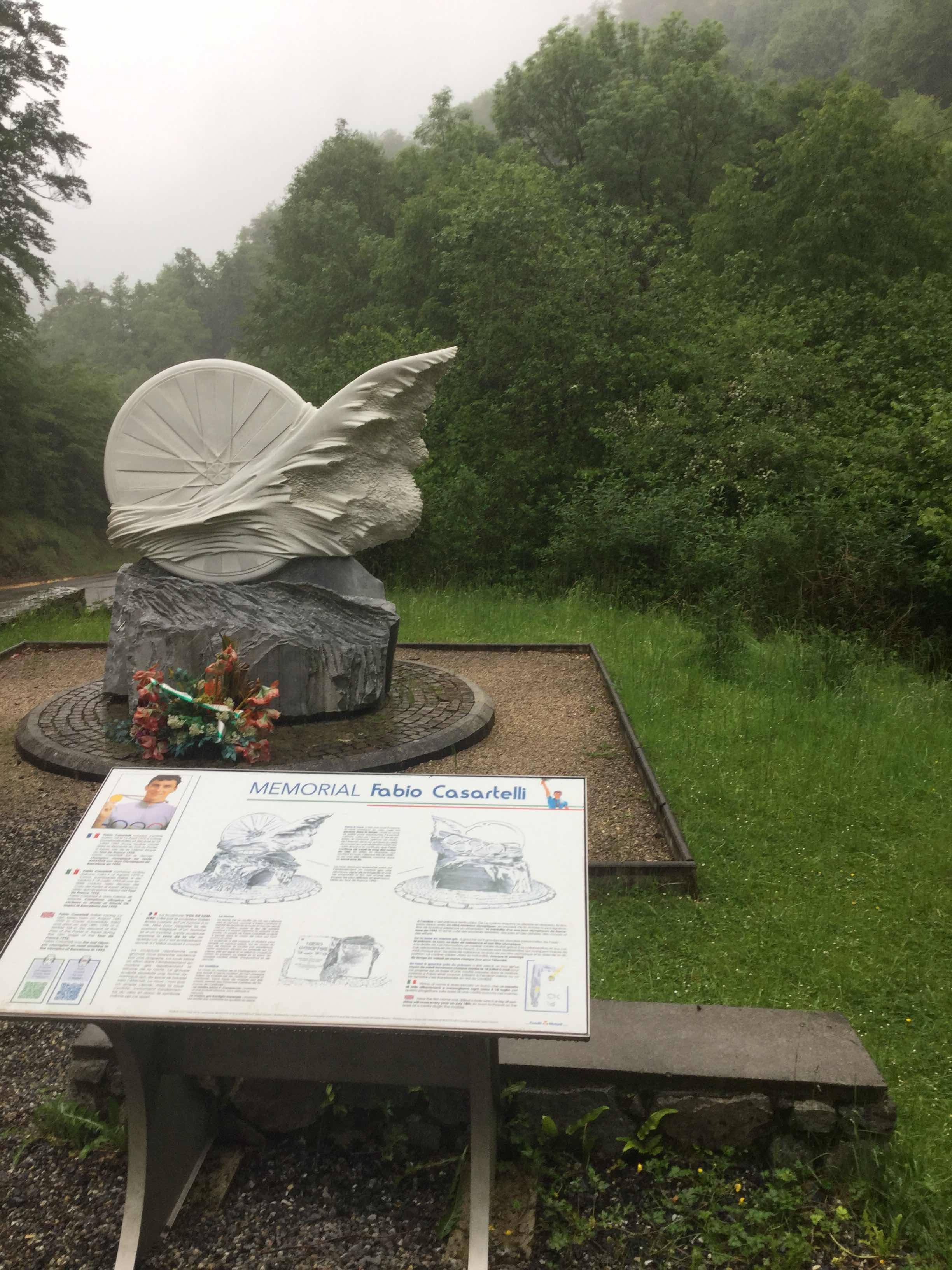
I arrived in Trie-sur-Baise with a healthy dose of Tour fever having just ridden over two of its legendary passes—the Col de Portet-d’Aspet and Col de Menté.  Both had monuments commemorating a seminal Tour event. One of the three deaths of a racer during a Race occurred on the Col de Portet-d’Aspet.  It was the last of the three in 1995 when the Italian Olympic gold medal winner Fabio Casartelli,  riding on Lance Armstrong’s Motorola team, crashed into a wall on the descent back before helmets became mandatory.  There is a small plaque where the crash occurred and a large sculpture in a wide space within sight of it up the road.


Signs warned of a couple stretches on the descent of a seventeen per cent grade.  I was riding in the rain and didn’t need any reminder to be wary.  I was squeezing my brakes so hard and going so slowly on the descent I lost all the warmth I had generated on the climb and was close to shivering.  I gladly dismounted and ran along with my bike trying to hold it back to get the blood flowing and warm up..

The Col de Menté starts immediately after the three-mile, 1,400 foot descent from the summit of the Col de Portet-d’Aspet.  It was seven miles and a 2,500 foot elevation gain to the next summit.  It was after five pm and the rain was coming down hard.  At first it felt good to be climbing and warming up, but I was dreading the long descent in the wet.  After a mile when I came to a shuttered up vacation home with a chain across its driveway I opted to set up my tent behind it alongside a raging creek and tackle the climb with fresh legs and hopefully dry roads the next morning.  The best part of my campsite was an overhang where I could hang my Goretex jacket and soaked shorts and let them drip their moisture off rather than soak my tent, which had moisture aplenty as I set it up and from the rest of my gear.  

The night before I pulled into a campground in a light drizzle before another hard downpour.  I was able to get into my tent before the deluge that time..  I was the only one in a tent, everyone else in camping vans.  The friendly proprietor came to my tent half an hour later with an umbrella to rescue me and bring me to the commons area.  He and his wife had acquired the campground three months earlier and were in that early phase of wanting to go out of their way to please their clients in anyway they could.  They were both school teachers who had dreamed of running a campground.  They had been searching on the internet for campgrounds for sale.  They had fully transformed their life’s, moving from Normandy at the top of France to the Pyrenees at the bottom.  The storm had knocked out WiFi so I read a novel by Zola I had downloaded from Gutenberg.  When I told them I was reading Zola,  they looked at me quizzically, as I didn’t realize the French give the emphasis on the second syllable of his name.  While I was reading they brought me a cup of hot tea.  

They were just twenty miles from Barjac where I was headed in the morning for the Anselm Kiefer sculpture garden.  I was already looking forward to returning to their campground the next year with Janina, as I knew she’d truly win their favor with her French and being a fellow educator.  I was disappointed they didn’t know anything about the Kiefer site, but that was easily explained by their being new to the area.  But it was more disconcerting that the tourist office down the road didn’t know anything about it either.  

I showed the two women tending to the tourist office the Wikipedia page on it.  That baffled them enough for them to do a little searching of their own.  They learned that the Barjac I was looking for was 200 miles away, north of Nimes.  I had actually passed within twenty miles of it on my way to Cannes and would be near it once again in July during The Tour de France for a possible visit then if I’m not pressed for time.  Fortunately I hadn’t gone out of my way to visit this Barjac, as it was on my way to scout out Ville Étapes.  The tourist office just saved me a twenty mile side trip, allowing me to reach the Col de Menté a couple hours earlier than I would have otherwise.

My night in my soaking wet tent on the Col de Menté was the first in these travels where I didn’t have a mint syrup drink to please my pallet.  I hadn’t come upon an open supermarket all day to restock my depleted bottle.  I had to resort to one of my two emergency packs of ramen along with couscous for my dinner.  I passed through the only town large enough to have a supermarket during its 90-minute lunch closure.  It’s tourist office was closed as well, so I couldn’t inquire  about the precise location of a plaque on the Col de Menté to the crash site of Luis Ocaña during the 1971 Tour, one of the most celebrated crashes in Tour history.  

Ocaña was doing the impossible at the time, about to dethrone the two-time Tour winner and seemingly invincible Eddie Merckx.  He had a seven-minute advantage on him thanks to an earlier dramatic eight-minute stage win.  But he crashed on the Col de Menté in a downpour and was knocked out of The Race, allowing Merckx to claim the third of his five Tour victories. Merckx crashed on the same turn but was able to remount and resume riding.  Ocaña had been chasing Merckx and was hit by two or three other riders while he was down, fully incapacitating him. Ocaña did manage to win a Tour in 1973, a year in which Merckx skipped The Race, doing the Vuelta and Giro instead.  Merckx was such a nemesis of Ocaña that he named his dog Merckx so he’d have the pleasure of having a Merckx at his beck and call.

I knew the plaque was on the west side of the Col, but not how far down.  Since I’d be descending myself I could easily miss it.  And I would have if Ocaña hadn’t been painted in large letters on the roadway in front of it.  I had been scanning cliff sides in hair pin turns, but it was hard to give them more than a glance trying to control my speed and watch the road.  At least the road was dry.  It was remarkable how much better my brakes were working in the dry conditions compared to how harrowing it had been in the wet of the day before.


The plaque would have been easy to spot if one were climbing rather than descending, as it was blocked by foliage and indentation to descending riders.  It came a little over two miles after the summit.  

The summit had a small monument to Serge Lapébie, a racer who died at the age of 43 in 1991.  His father, Guy, was a well-known racer who won two gold medals and a silver in cycling events at the 1936 Berlin Olympics and won a stage of The Tour in 1949 and who outlived his son by nineteen years.


After these two long climbs with prolonged grades of ten per cent my thighs were burning the forty miles to Trie-sur-Baise, but I was able to push it up what lesser grades came along a gear or two bigger than I had before, as I could feel my legs strengthening from the considerable amount of climbing I have done since leaving Cannes ten days ago.  I may not have the luxury of altitude-training, as the professionals will before The Tour, but the legs coming around.  Now it’s on to Pau, frequent Ville Étape and the arrivée for the 18th stage.


Sunday, May 27, 2018

Carcassone, Ville Arrivée/Départ


It’s just forty days until the start of The Tour, but neither Carcassone nor Millau, stage fifteen Ville Étapes, had any Tour preparations to give me a jolt of Tour anticipation.  The tourist offices of these mid-size cities, who have hosted The Tour in years past, weren’t even informed as to where the vast Tour village would be erected in their towns, the site of the peloton’s departure and arrival points that would attract thousands on Race Day and would be the focus of the cycling universe for a day. It was disconcerting that the biggest event in these towns this summer, if not the year, wasn’t at the forefront of its attention, as it is in other Ville Étapes.  

I’ll just have to wait until I get to the small town Trie-sur-Baïse, a first time Ville Étape, in a couple of days to get a high octane boost of Tour fervor.  In the mean time I just have to rely on the exploits of Chris Froome at the Giro to raise my anticipation level.  After he accomplishes what had looked impossible and wins the Giro, his third Grand Tour in a row, there will be a greatly heightened level of excitement as he now becomes a heavy favorite to win The Tour and join the elite five-win club of Anquetil, Merckx, Hinault and Indurain, solidifying his status as one of the greats of the sport.  It will make this a historic Tour.  The attention accorded Froome will be at fever pitch.

Despite the lack of any acknowledgement of the coming of The Tour my visits to Millau and Carcassone weren’t without some degree of satisfaction.  They are both historic cities of splendor and character.  Millau sits along the Tarn River where it’s spectacular gorge finally widens enough for a city.  It is framed by high cliff walls that are spanned by a modern iconic bridge, a latter-day Eiffel.  The light posts down the city’s main thoroughfare were adorned with banners for an annual 23-kilometer running race that will take thousands across it, a rare opportunity for those on foot to gaze from its lofty height. The bridge alone makes Millau a must-see.


I passed through Millau on Friday, it’s Market day.  The narrow streets of the centuries-old town center were thronged with the local populace perusing stands selling all manner of food and clothing.  Anyone within a several mile radius of any French town knows it’s a civic duty to come to the weekly Market.  It is a great hive of activity with everyone in a festive mood.  It was hard to push my bike through all the people stopping for a chat.  The conviviality is palpable.

Craig and Onni drive ten miles every Saturday to their nearest Market in Le Vigan.  Craig had to go to Le Vigan the day before Market day to file a report with the police regarding a break-in to a house they look after owned by a Dutch couple who only visit on occasion, but that wasn’t going to prevent him from returning the next day for the Market.  I arrived at Craig and Onni’s home just as Onni was leaving a note on their door informing me they had to meet the police at the house they were looking after.  

Three officers came and they kept Craig and Onni occupied for over two hours as they scanned for fingerprints and other clues, giving me plenty of time to shower and spread out my rain-soaked gear and put my legs up after a strenuous two hundred mile ride from Cannes.  The legs were happy for just a half day of riding after three days of straining up climb after climb. They’d had two weeks of inactivity, just coasting a mile down from the apartment where I was staying during the film festival, with the only effort required of them the mile incline back some time after midnight.  

Craig had  hoped to accompany me the next day at least part of the way to Millau, sixty miles away, but his much-in-demand wall-builder was available to help Craig that day on a staircase he was building in his garden.  He had priority above all else.  Craig’s multi-terraced garden looks more magnificent with each visit, not only the resurrected centuries old walls, but all that he and Onni and their partner Andrè have planted.

Craig had recently learned that a neighbor of his in Notre Dame de la Rouvière had created an extensive mosaic on the walls of the building where he also lives in Nimes and that it had some bicycling elements to it.  That gave me something to search out on my way to NDR.   It was on a narrow street just a few blocks from the Roman Coliseum that is the trademark of Nimes.  The mosaic filled one side of the block-long building and extended partway around the corner on another side.  There were political statements in French, English and Spanish.  One stated, “Where any view of money exists, art can not be carried on, but war only.” Daniel Ellsberg and Andre Gide were among names inscribed. Two bicycle wheels and three cranksets were embedded high up on the long wall.


I didn’t notice that the inaccessible roof of the building had also been taken over by his sculpture, which had a more prominent bicycle flavor.  They can be seen at http://heraultinsolite.blogspot.fr/2015/03/la-maison-dolivier-jullian-nimes.html.  One never knows when one will encounter a manifestation of personal art in France.  In Millau I came upon a three-story house in the old city with colorful adornments.


A couple doors down was a similar outbreak of artistic expression brightening up the dark narrow street.


Carcassone will not only host a finish and the start of a stage, but it will also be a rest day, the second of The Tour, between them.  It will be a most welcome day of rest after two strenuous days on the Massif Central and three murderous days in the Pyrenees ahead. Carcassone will be a great place for a day-off for Tour followers with a couple of World Heritage sites—it’s fortress and the Canal du Midi.  I had a glorious twelve-mile descent down to the Carcassone plain back amongst the vineyards I had left in Nimes.

My next destination as I continue to ready my legs for The Tour and scout out Ville Étapes is a vast sculpture garden outside the village of Barjac in the foothills of the Pyrenees covering more than thirty-five acres created by the German artist Anselm Kiefer.  It was the subject of Sophie Fiennes very worthwhile 2010 documentary “Over Your Cities Grass Will Grow.”  This is also a scouting mission for a possible ride next year with Janina similar to our ride a year ago to all the Andy Goldsworthy sculptures in the opposite direction.  Those were in the shadow of the other great French mountain range—the Alps.  I won’t take Janina via Millau, as spectacular as it is, as that route, especial beyond it, has required an excessive amount of climbing, with one five, six, seven mile climb after another of a couple thousand feet.  It will be much easier to drop down to the Mediterranean, forty miles from Craig and Onni’s, and follow it.  I can’t complain about the difficulty of this route though, as my legs will be the better for it.


Saturday, May 19, 2018

Cannes Day Twelve—The Awards

Every year day by day the suspense builds to the awards ceremony as everyone speculates what films the jury will reward.  The day arrives almost with relief signaling the end of this movie orgy and days of limited sleep.  It is a joy to sit in the plush Debussy Theater one last time and watch the proceedings on the large screen taking place in the Palais next door.  Except this year they decided to restrict the Debussy to the press, even though they didn’t even fill a quarter of the seats.  Ralph and I waited at the entry to the theater along with a couple dozens others hoping they’d let us with Market badges in knowing there were plenty of available seats as they have in the past.  At 7:15 when the ceremony began and we still hadn’t been let in we were apologetically told the “big boss,” whoever that might be, said “no” this year.  

So we had to go over to the Palais complex and stand for an hour with a cluster of others in front of one of the several small televisions scattered around the sprawling complex. The volume wasn’t very loud and whenever someone spoke in English it was drowned out by the simultaneous French translation.  We couldn’t fully appreciate the eloquence of jury president Cate Blanchett’s opening remarks nor the speeches of the award winners nor the openingl harangue by Italian actress Asia Argento that Harvey Weinstein had raped her at Cannes in 1997 when she was 21.  She said it was nice to know that he would never be back.  She should have added he ought to be behind bars. 

Spike Lee was in the audience, indicating that he had been brought back to Cannes for one of the seven awards the jury hands out.  When it came down to the last two and he hadn’t been called to the stage, it looked as if he might have won the Palm d’Or he thought he deserved for “Do the Right Thing” in 1989 but was beaten out by “Sex, Lies and Videotape.”  Once again he was awarded the Grand Prix, but he made no fess about it, just yet.  He had to be thrilled to be given any award for this very average film that just happened to be politically relevant.  In the press conference for the jury afterwards French actress Lea Seydoux said, “fundamentally we knew we had to give it an award,” despite Blanchette emphasizing that at the very outset the jury had agreed not to let politics influence their decisions, just the quality of the films.  It didn’t hurt Lee either that director Ava Duverney was on the jury, as she said that she had always been a strong admirer of Lee and he had been a great influence on her.

Every jury has at least one highly queationable choice.  Other than that, this jury made easily defensible selections, other than not awarding Nuri Bilge Ceylon’s highly ambitious film any award. Some might question it for not giving “Burning,” the Korean film that received the highest score ever from Screen magazine’s panel of critics, any award, but not Ralph or I.  We both cheered that.  Hirokazu Kare-eda’s “Shoplifters” about a Japanese family struggling to get by was a most deserving Palm d’Or winner.  Nadine Labaki’s “Capernaum” about a Lebanese 12-year surviving in Beirut was a perfect Jury winner, though some thought it deserved the Grand Prix that Lee was given or even the Palm d’Or.  That would have been extraordinary if it had, but not without justification.

Pawel Pawlikowski merited best director for “Cold War” following a love affair in and out of Poland for several decades during the Cold War.  Little argument could be made about the best actor and actress awards either—Marcello Fonte as a twerpy kennel operator in the Italian gangster movie “Dogman” and Samal Yesyamova in the Russian film “My Little One” as an illegal immigrant in snowy Moscow frantically trying to find work.  I had seen the film earlier in the day, the only Competition film I had missed.  It was obvious this film would receive some award, especially with a Russian on the jury.  The film is shot in a non-stop snowstorm with sinister snow plows a recurring element.  It was an even more harrowing tale of survivsl with everything stacked against one than the Lebanese film.  Yesyamova has just given birth and escapes out a window of the hospital without her baby since she knows she can’t care for it and has to work even though she is hemorrhaging.  She meets a couple of decent souls in her struggles, but most of those she deals with are predators of some sort.  Not only the character she plays but the role itself had demands beyond comprehension.

The Italian film “Happy as Lazarro” and “Three Faces” from Iran shared the best screenplay, allowing the jury to dispense one more than the usual seven awards, and then went one further by giving Godard a special Palm d’Or as his film defied all norms and couldn’t be compared to any other in the field.  Blanchett said the jury couldn’t stop talking about it, but because it was so unique and unclasifiable, they had to put it in a category of its own.  Blanchett was the star of the press conference, highly articulate and cogent.  Towards the end Duvernay complimented her for her  “exquisite” handling of the jury, drawing out and  paying attention to all eight under her command.  Canadian director Denis Villenenve sat beside her, clearly serving as her chief assistant.  The two of them did the bulk of the talking.  Kristen Stewart didn’t utter a peep nor did several other of the jurors.  It will be available on YouTube, and will be well worth viewing.

Much as I needed to, I wasn’t able to sleep in for once on this day of repeat screenings of all the Competition films, as the film I most wanted to see again, “Summer,” about rock-and-rollers in early 1980 Leningrad, was playing at 8:30. . I joined the long line at eight and was lucky to get in to the 500 seat Soixante, the second largest of the five theaters hosting the repeat screenings.  The Debussy, the largest with 2000 seats, was playing “Cold War,” “Blackkklansmam” and “Shoplifters,” the festival guessing those were the three films people would most want to see.  It was as if they had a foreboding of the jury’s choices.  It was no surprise they programmed “Burning” in one of the smallest theaters.  

I was bowled over once again by the “Pscho Killer” scene in “Summer” and a second show-stopping fantasy scene of a concert when the band on stage and the audience let loose, sending the crew of men in suits monitoring the concert into a frenzy trying to get everyone to contain themselves and threatening them with jail.  Preceding the homage to the Talking Heads, who the band members refer to as “the heads that talk,” the rock and rollers are berated for being a disgrace to the motherland and for singing songs of the enemy.  They reply that the Sex Pistols are working boys and aren’t the enemy and the same for the Beatles.  The film didn’t have a strong enough thread to earn it any awards,  but it remains one of my favorite films of many from this year’s smorgasbord.  I was turned away from both “Shoplifters” and the Godard film later in the day, and was only able to get into to the lesser Japanese film “Asako” before “My Little One.” It was a fantastic time once again, but I am more than ready to return to the bike and exalt myself in a physical manner.

Cannes Day Eleven


Before the Un Certain Regard jury tendered their awards this afternoon in the Debussy theater I was finally able to have a word with juror Julie, director of the Telluride Film Festival, in the lobby preceding her taking the stage with her fellow jurors Benicio Del Toro, Virginia Ledoyen, Annemarie Jacir and Kantemir Balagov.   Usually I share a few screenings with her during the festival, but her jury duties had kept her so busy this was the first we had crossed paths.  She was full of glee over her experience and also over their choices.  I asked if they had to deliberate very long.  She said it went fast as they had been talking about the films they had seen all along and knew one another’s feelings.  She agreed with Ralph and I that Un Certain Regard had an exceptional batch of films this year, the strongest since she has been attending the festival.

Ralph and I were thrilled with their choices, as it means there is a strong likelihood Julie will program several of them for Telluride and we’ll get to see them again.  Their top prize went to the Swedish film “Border” about a facially disfigured border security guard with a gift for spotting smugglers and her friendship with a guy with a similar look and mysterious qualities.  It was easily the boldest, most imaginative film of the festival.  The teenaged boy undergoing a sex change in the Belgian film “Girl” was awarded best actor for his agonizing, sensational performance. “Sofia” won best script.  This story of a young unmarried Moroccan woman who shocks her family and faces prison time when she turns up pregnant may have been the most gripping film of the festival.   Best director went to the Ukrainian film “Donbass” that was the Opening Night film for this category.  I had missed it, but Ralph really liked this film on warfare. They also gave a Special Jury prize to the Brazilian film “The Dead and the Others” for its anthropological portrayal of the life of an indigenous people.

Julie asked what I thought would win the Palm d’Or.  She was hearing that “Cold War,” the Polish film by the director of “Ida,” a Telluride discovery, had a good chance.  I had just seen “ Capharnaüm,” a Lebanese film with the absolutely amazing performance of a twelve-year boy who is fed up with his abusive, indigent parents living on the margins of society and moves into the hovel of an African refugee and her infant son.  His gut-wrenching struggles to survive and care for the infant in a most unfavorable environment were remarkably well-portrayed.  This smaller film could win the favor of the jury simply for its subject matter.  Julie agreed that was a possibility, but she hates it when a jury allows that to dictate their thinking.  

Neither of us had seen the final film due to be screened in a couple of hours, the Turkish film “The Wild Pear Tree” by former Palm d’Or winner Nuri Bilge Ceylan, and knew that was a strong possibility.  Ralph and I feared we wouldn’t be able to see it until after the awards ceremony, as it’s lone screening the next day was at 7:45, just as the awards ceremony would be concluding.  But we lucked out and were allowed into the press screening today when there were plenty of empty seats in the Bazin for this three-hour movie.  We were concerned that we may have been too sleep deprived to do it justice, and that it might have been better to hold off on it until the next day, but it was so well done that it was the only film today that I didn’t nod off in.  If nothing else, it ought to win the award for best script. 

It is a series of long conversations, some going on for ten or fifteen minutes, between a young man just out of college trying to get his novel published while hoping to get a job as a teacher, with a series of people over a few days until a jump ahead of several months to conclude the film.  He still lives at home.  His father teaches grade school and has a gambling addiction. He has no money, even trying to cadge money from his penniless son.  The son hates the town he lives in.  He has a perpetual scowl on his face. His conversations generally begin with an air of amiability, but degenerate into diatribes of bitterness, even with a local novelist he goes to for advice.  This didn’t have the profundity of Ceylan’s Palm d’Or winner “Winter Sleep,” but was still an exceptional film of considerable depth.  It is not a sure winner, but with no clear standouts this year, it will be under consideration.

The Italian film “Happy as Lazarro” might also have some supporters.  Ralph and I finally caught up with  it today after missing it earlier in the festival.  A perpetual smile of benevolence graces the face of Lazarro, a guileless young man who lives in the country and ventures off to the big city.  His purity generally wins him favor from those he encounters.  The film adeptly bridges on the surreal in its commentary on a world of craven selfishness.  

I managed a fourth Competition film today, leaving me with just one more to see tomorrow.  Vanessa Paradis gives a swashbuckling performance as the producer of third-rate gay porn in “Knife and Heart.”  Á knife-wielding killer is murdering people she has worked with eventually derailing her productions.  The police aren’t all that motivated to track the killer down so she follows up on the mysterious clue of a feather left at the murder sites.  This wacky film isn’t meant to be taken too seriously, nor will the jury.  The film begins with a gruesome murder and is the fourth film in Competition to end with a murder (five actually if one includes Spike Lee’s film as it ends with the gruesome footage of the car that ran down a woman in Charlottesville). All this brutality is making the heartwarming Japanese film “Shoplifters” of an offbeat family full of goodwill and consideration more and more palatable as the Palm d’Or.  If it wins, Ralph says it will be the first time in his seven years of attending the festival, going back to the “Tree of Life” year, that his choice will have won.  In the “Tree of Life” year he was rooting for Ceylan’s film “Once Upon a Time in Anatolia.”

I inserted one of the Director’s Fortnight winners into my day—the best European film (though Gaspar Noé’s French film “Climax” won the best overall award, the Italian film “Lucia’s Grace” about a surveyor who becomes haunted by the Virgin Mary trying to make her resist abiding by the wishes of a corrupt developer.  The developer argues that if he did things properly he’d be locked up for being corrupt, so he had no choice in this world of ours.


Friday, May 18, 2018

Cannes Day Ten

Sixty-one films in ten days so far for me and only one “Wow” moment—the three minutes of “Psycho Killer”in the Russian rock-and-roll film “Summer” from Day Three.  There have been better films but none that gave that rare off-the-charts jolt of exhilaratin that a superior film such as last year’s Palm d’Or “The Square” delivered.  There’s still a chance it could come tomorrow with the final film playing in Competition, “The Wild Pear Tree,” by Miri Bilge Ceylon, whose last film won the Palm d’Or.  For the first time in my years of coming to Cannes I don’t have a strong favorite at this point for the top award.

Both of today’s offerings had the possibility of being that masterpiece we’ve all been awaiting by a Cannes regular who has won awards before, though never the top prize.  The first was “Dogman” by Matteo Garrone.  He returns to a territory he knows wells—Italian mobsters.  The dog man of the film is a twerpy guy who runs a small  kennel in a rundown building on the outskirts of a city.  He provides coke and minor services for some small time thugs who don’t much respect him.  They somewhat belligerently toss him a couple of bracelets as his cut for being their driver for a heist.  He is upset that they brag they iced a dog in the house they just robbed, putting it in the freezer.  He returns to the house and lovelingly revives the dog.  One of the mobsters who forces him to do things he doesn’t want to do is fully out of control.  Some of his cohorts think he needs to be eliminated.  The movie has the ring of truth unfolding as a true tale, but lacks the punch of a transcendent film. 

Screen’s board of critics gave “Burning” by Lee Chang-Dong a 3.8, the highest rating of a film ever, exceeding  “Toni Erdmann” from two years ago.  But rarely does the highest rated film win the Palm d’Or.  Erdmann was actually totally ignored by George Miller’s jury.  “Burning’s” score came as a great surprise, as this vanillaish story of another guy searching for a woman he had just developed a crush on, as in yesterday’s “Under the Silver Lake,” failed to connect with either Ralph or I.  We expected three-stars, not fours, across the board.  It had no buzz from those who had seen its early screenings, as the final one of the day at ten pm wasn’t even a third full.  Usually one has to be in line almost an hour early to be sure of getting in.  

The woman who disappears is most charismatic and has two suitors.  One is a dopey guy she knew growing up in their small rural community and meets up again in the big city at her part-time job trying to entice customers into shops with special promotions dancing out front and giving away stuff.   The other guy is a very smooth rich guy with a Porsche who she met on a recent trip to Africa.  The dopey guy, who claims to be a writer, works on his father’s small farm outside the city, is truly in love with her.  The other guy may be just toying with her.  Much is left unstated in the minimalist script that is padded into 148 minutes. I could have left after an hour.  None of the characters are developed enough to care about.  A few clues are given as to their motives, but not with much certainty.  It leaves one with plenty to question, if any of it mattered.

The Un Certain Regard field has several strong contenders for its top prize—“Sofia,” “The Harvesters,” “Border” and “Girl”—so much so that it was almost a relief that today’s two films didn’t further muddle the field.  The German film “In My Room” turned into a post-apocalypse movie when with no explanation everyone has disappeared from the world save one guy.  He’s visiting his dying mother out in the countryside when he awakes one morning and cars are abandoned on the road and stores are empty.  It is as strange and inexplicable to those watching it as it is to him.  He contentedly goes  about living and becoming self-sufficient on a small farm.  He is eventually discovered by a good-looking woman who speaks English and they continue to exist without questioning anything or feeling as if they are under any threat.  This was a genuine ho-hum of a movie that the critics could embrace if they wanted for being so understated.

“The Gentle Indifference of the World” takes its title from Camus.  The two protagonists of this movie from Kazakhstan are both reading Camus.  One is a young woman of intelligence whose father has recently died and is put in the position of having to marry an ogre to pay off his debts.  The other is an unrefined admirer who is a genuinely good guy.  As a stand-alone this might have had some interest, but it doesn’t distinguish itself in any way amongst the many films it is up against.

My other two films for the day were both awardwinners from the Critics Week.  The films in this sidebar generally lack the polish of other invited films, but can shine with their heart and grittiness.  That was true of both “Woman at War” from Iceland and “Sir” from India.  Both center around a woman.  The woman in Iceland is an idealistic middle-aged music teacher who gets around on a bicycle with a large wicker basket on her handlebars.  She has large portraits of Gandhi and Mandela in her apartment.  She is an ardent environmentalist who is knocking down electrical towers to discourage a Chinese company that wishes to further develop power in Iceland with “suicidal” fossil fuels rather than with the more environmentally friendly geothermal power that has been the hallmark of Iceland.  The country is in a state of terror wondering who the sabateur could be.  A Latino touring cyclist equipped with Ortlieb panniers and wearing a Che t-shirt is apprehended several times as a suspect.  The plot has other fresh twists, but not much supporting rhetoric in this quest to “stop the war against the earth.”

In “Sir” a young ambitious maid from rural India has just started working for a young man in Mumbai who has called off his marriage because he is too devoted to his job in his family’s construction business to text his fiancé five times a day as he thinks she desires.  The maid is very sweet and obsequious. The guy recognizes her genuineness compared to the rest around him and takes an affection to her. When the woman who directed this first film introduced it, she said, “It is extremely important that this film be seen and talked about.”  That may be overstating it, but it does deserve to be seen.