Monday, July 3, 2023

Stage Two


I fell just a mile short of the point I hoped to reach on the stage before an officer stepped out on the road and ordered me off the route.  I had been nervously awaiting that moment for better than half an hour, as there had been no cars on the route for that long, just me and a few other cyclists.  Fortunately, that dreaded moment came in a city and I was able to proceed on side roads to the short cut I planned to take to the stage finish in San Sebastián just ten miles away, bypassing the last twenty-five miles of this 130-mile stage, this year’s longest, that looped to the east and back to San Sebastián. 

I had been riding hard for over six hours since seven a.m. with just one break to take on some food.  I began the day halfway up the first of three categorized climbs that awaited me along with a surprise two uncategorized climbs of some significance.  All that climbing put me over five thousand feet for the day, the most so far of these travels.  I had camped in a sloping field not far from a row of camping vans parked right along the road, all with Spanish license plates.  There didn't seem to be any Tour followers from France and Belgium and Holland just yet that will line The Tour route in France. 

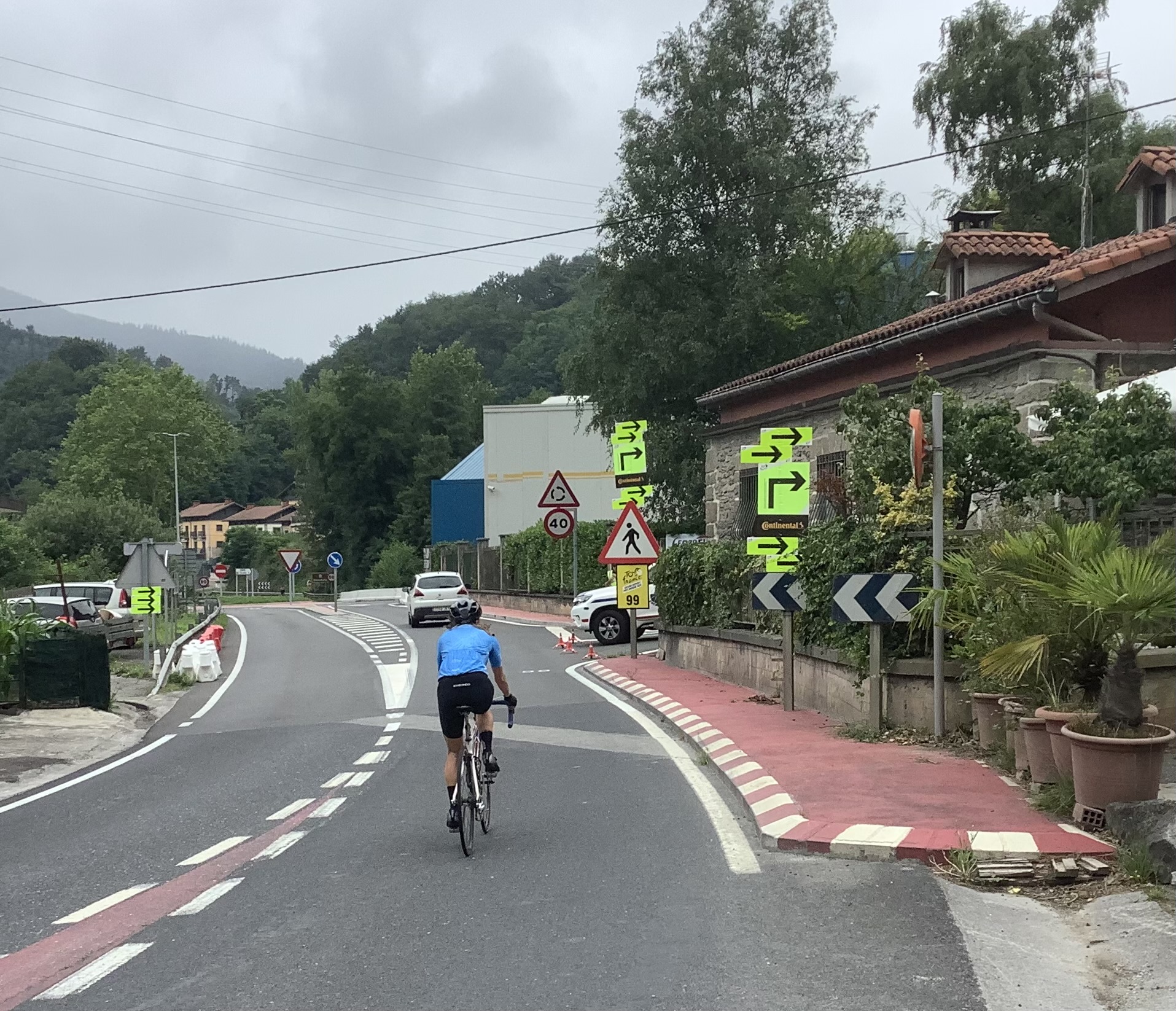
Before long I was sharing the road with cyclists, way more than is customary in France, as many today as I will encounter for the rest of The Tour. The Basque region is a cycling stronghold and legions of them were seizing this opportunity to ride, including quite a few children, some with parents, though the younger set was mostly teens in mini-packs.  Many of the cyclists, and others along the road, greeted me with “au pa,” the local version of “allez.”   I was the lone cyclist with panniers.  None of the other bikes even had a rack.  

Despite the great fervor for cycling, it did not spill over into mounting bike-related decorations, as is the custom in France and generally wherever The Tour ventures.  When the Grand Départ was in Yorkshire bikes painted yellow were everywhere and there were untold variations on the red polka climbers jersey.  There was none of that here other than a pair of mannequins in a roundabout honoring a local cyclist, Joxe Nazabal, who rode in the peloton from 1975 to 1992.  One was decked out in the classic Kas jersey, a legendary Spanish team sponsored by a Basque soft drink company, that Sean Kelly also rode for.  It was the most popular garb of the cyclists on the road.  


I reached San Sebastián with enough spare time to stop in a bar with Wi-Fi and order a plate of tapas and file my Stage One report.  It was a rushed effort though there was much to say.  I was happy to come upon the course markers for the next day’s stage which would be passing through San Sebastián on its way back to France. I was hoping I would find them to guide me through the sprawl to the border twenty miles away.  


I continued to the city center where the stage was ending along the ocean in a most beautiful setting.  I came upon the team buses, all twenty-one parked bumper to bumper awaiting the riders after the finish.  They were parked by a park whose benches had been wrapped in Tour colors.  The area was so thronged with fans I had to walk my bike in my search of the Giant Screen near the finish.  


I followed the mass migration along the ocean side of the finishing straight.  We reached a point that only gave access to VIPs and had to go down a set of steps to the beach to continue.  It was no fun pushing my bike in the sand for a couple hundred feet.  Others with unladen bikes hoisted them on their shoulders for the trek.   Luckily there was a ramp at the other end and I didn’t have to lift my bike up steps.  


We gained the race course at the one hundred meter to go mark.  That was okay, but what wasn’t okay was that the Giant Screen was on the other side of the barriers and beyond the finish line and with its back to us.  There was no way for me to access it.  There was an hour before the peloton would arrive.  I sat in the shade for a spell and had a bite to eat before  meandering along the course hoping to find an English speaker who might have a phone following the day’s action.  I at last overheard some English with an Australian accent.  The guy was holding a phone and not using it entirely to take photos.  After a lead pack of a handful of riders flew past he was able to report moments later the startling news that the French rider Victor Lafey of Cofidis had nipped Van Aert and Pogaçar.  It was the first Tour stage win for Cofidis since 2008, a most embarrassing drought.  


The course markers for Stage Three continued along this finishing straight.  I had to walk a mile through the throngs besides the barriers lining the race course before I could access the road and start riding.  As I followed the route I was looking for course markers guiding me and others mounted facing away from me that had guided the peloton to the finish.  I found one mounted a little high in a roundabout that hadn’t been snagged.  It was within my reach and I quickly undid its metal strap with the pliers on my leatherman tool, claiming the most prized of all Tour souvenirs.  


I was anticipating a most relaxed ride with the course markers leading the way, but it turned into another navigational ordeal when there were gaps in the markers, more than I’ve ever encountered.  It was the worst case of marker thievery I had ever come upon.  Very rarely does anyone prematurely snag a marker, mounted 24 hours before each day’s stage, but this was vandalism on an epic scale.  Defiance of law and order continues to fester among the Basques.  Luckily the larger markers indicating speed bumps and the direction through roundabouts hadn’t been appropriated, but I still had to surmise at times which way to go and rely on other clues, such as hay bales placed in front of obstructions and metal barriers awaiting to be moved to block roads.  

I managed to go astray for a couple miles at one point following clues left over from Stage Two. Fortunately I wasn’t under pressure to get as far down the road as possible as the night before when I rode until 9:30.  I was already less than fifty miles from the stage finish in Bayonne.  The delay might have actually been beneficial, as it prevented me from getting too far up the French coast to where it was packed with seaside homes and resorts and camping would have been an extreme challenge unless I took advantage of the Tour allowance to camp anywhere along the road of the stage the night before.  As it was, I found a pasture to camp in several miles after crossing into France within thirty miles of the stage finish.  I slept well on soft, level ground.


The weather had been so pleasantly cool my three days in Spain, thanks to breezes off the Atlantic, which sometimes brought a refreshing misty drizzle, I didn’t even use half the bottle of mint syrup I’d stocked up on before leaving France.  I’d been going through a liter bottle every three days during my nine-day ride down from Paris.  And it had been so generally overcast I didn’t need to apply sunblock during my time in Spain.

Sunday, July 2, 2023

Stage One


I was right on schedule to reach Bilbao early Friday evening in time to start on the first stage of this year’s Tour with those much-anticipated, hallowed, bright yellow course markers guiding me out of the city and to a place to pitch my tent along the route.  But I was sidetracked as I approached Amoribieta-Etxano, the start of stage three, fifteen miles from Bilbao, when I a forty-year old cyclist offered me lodging for the night.

He spotted me eight miles outside his hometown when he passed me in his car. He  thought I might be following the nearby tentacle of the Camino de Santiago pilgrimage route, which he had completed several times, the latest with his 72-year old father.  He stopped and waved me down to recommend a bicycle path rather than the road I was on.  To make sure I understood his minimal English he spoke into his phone and showed me the translation.  


I thanked him and he wished me well.  Four miles later, as if by magic, he appeared on his bike and truly became a guardian angel, saying the trail grew complicated at that point and he wanted to guide me into his town.  With my minimal Spanish and his better English we were somewhat able to make conversation.  The bicycle path led to the starting point of Stage Three and was just a block from his apartment.  


It was then that he invited me to stay with him.  It was nearly six.  Much as I was looking forward to starting on The Tour route, I was happy to spare my legs the ordeal of a second consecutive evening, after San Sebastián the night before, of navigating a large city at day’s end.  Plus It would be nice to have a relaxing evening and tend to some chores such as charging my three batteries and iPad and Garmin.  It turned out to be a choice well-made. 


Miguel Angel had a first floor apartment with a patio where I could leave my bike.  The bed I would be sleeping on was covered with climbing gear.  Among others things Miguel Angel was an ardent climber and would be going to Nepal in November with his climbing club, hiking into the Everest base camp at 18,000 feet and doing some climbing in the vicinity, though not up Everest, as it wouldn’t be the season for that.  

Cooking as also among his talents as he made a scrumptious Spanish omelet with onions and potatoes that was as hearty as a deep dish pizza.  He apologized that his local bakery was out of a traditional Basque dessert, and that I’d have to settle for a chocolate pastry, no hardship whatsoever. He was the ultimate of hosts, even offering to do laundry.  Our conversation was assisted by speaking into his phone, which provided a written translation.  He said he liked to help people and wondered if I found people mostly good or bad in my travels.  I said the bicycle never fails to generate goodwill.  

His plans for stage one was to join a group of friends on the Category Two climb towards the end of the stage, where he intended to wave the Basque and go crazy as Basque fans do.  It would have been nice to join him, but that would throw out of kilter any possibility of me riding much of the next day’s stage and forcing me to immediately fall behind in my quest to keep up with The Tour.  I needed to start riding the thirty-two miles to the next stage right after Stage One ended.  Even doing that I wasn’t insured of making it to the stage finish before the peloton, especially not knowing how soon the Spanish gendarmes would close down the course.


Stage One started and finished in Bilbao.  My route into the city took me first to the finish line up a kilometer climb into a park. It was good to see which side of the route the Giant Screen was mounted on to make it easier to access when I returned.  The starting point two miles away was fully aswarm with fans three hours before the peloton was due to set out at 12:30.  


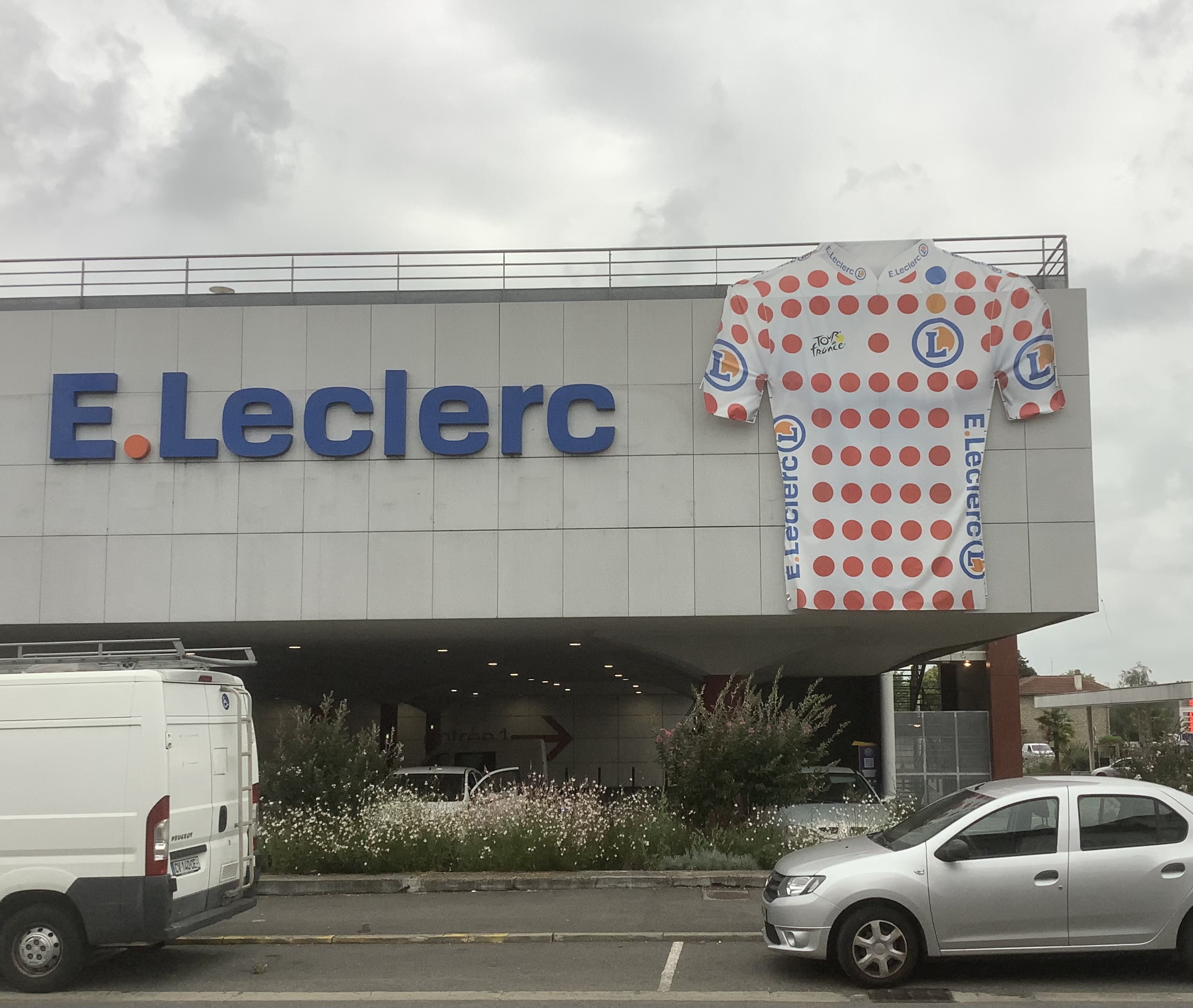
The E. Leclerc supermarket was back sponsoring the climbing competition and giving away hats and jerseys. As usual, it generated a scrum of fans by the van where a young man and young woman were passing them out in between reprimands to be orderly.  I couldn’t help myself and forced myself in to nab a hat.  I’ll no doubt get a jersey or two later, so did not try this time, sparing me of adding it to my cargo it just yet.  


I was fully infected with the delirium of all those gathered for this mega-event.  It continues to be a monumental draw.  Everywhere I looked were people thrilled to be where they were, and I felt the same.  I was almost shaking in disbelief that it could have such an effect.  It was certainly worth the effort of flying over the Atlantic and bicycling over seven hundred miles from Paris.


With a couple of hours before the peloton set out I took a brief tour of the city up and back along the Bilbao River past the otherworldly Guggenheim Museum, considered one of the architectural marvels of recent times.  I also went in search of a couple of battery packs for charging my iPad, as two of the four I brought finally wore out after many years of service.  It was a great relief to find replacements as I would be lost without a functioning iPad.


I opted to watch the peloton set out a kilometer down the course at an intersection where I could make an easy getaway to the Big Screen.  Basque flags were easily the most popular garb of the day. 


The militant separatist fever of years past that regularly inflicted bombings on the region no longer seemed so fervent.  I saw only one example that it still lives.


But Basque pride may be as strong as ever.  Crossing into Spain from France I wasn’t welcomed to Espagne, but rather to Basque Country.  The license plates though all bear an “E” identifying the vehicle’s nationality. 


As I headed to the Big Screen I happened to intersect with the peloton once again still in the neutralized zone before racing commenced outside the city.  It came at an odd point where there were course markers in both directions, as the peloton would be returning to the city on the road it was exiting.


Fans were already gathered along the finishing stretch nearly five hours before the peloton was due.  Sponsors were handing out goodies.  Credit Lyonnaise is once again passing out yellow hats, though of a cycling, rather than baseball, variety.  


I was having second thoughts of sitting around for over four hours after having spent two hours lingering at the start area, so decided to start riding and hope to find a bar with a television to watch the finish.  It was another good choice, as the roads were virtually empty with everyone congregated along The Tour route.  


At 4:30 after completing a five mile climb to a plateau at 1,800 feet where Stage Two would begin I came upon a gas station with a small cafe.  It had no television but the attendant allowed me to use the Wi-Fi.  When I connected the peloton had just crossed the Category Two climb and Mas and Carapaz, two potential podium finishers had crashed.  Mas had to abandon, the first this year, and Carapaz resumed riding but five minutes in arrears.  X-rays revealed fractures in his knee so he is out too.

On the final climb to the finish the British Yates twins riding for rival teams after years as teammates had broken free and were vying for the win. I was sorry I was missing it.  Adam riding as a support rider for Pogaçar nipped his brother with Pogaçar coming in third, a strong testament of his fitness as he had done little racing after breaking his wrist a couple of months ago.  Pinot in fourth brought joy to the French.  He’s retiring after this year and was just a late addition to his team after a strong Giro.  He obviously has plenty left in his legs.  And the Canadien Woods coming in fifth riding for the Israel team takes a little of the taint away of the team not selecting Froome, to his great disappointment.  Neilson Powless, one of six Americans in the race  and the only Native American, was the first over the Category Two climb and claimed the polka dot Jersey.  It’s the second time The American team Education First took the jersey on the first stage.  Taylor Phinney accomplished the feat a few years ago at the German start.  

Friday, June 30, 2023

San Sebastián, Spain


Two of the last three Ville Étapes I scouted in France before crossing into Spain had a strong connection with a Tour luminary from year’s past—Luis Ocana with Mont-de-Marsan and André Darrigade with Dax.

Ocana was a Spanish rider who won the 1973 Tour.  His family moved from Spain to Mont-de-Marsan when he was twelve years old and was where he began his racing career.  He was a rival of Merckx and was so often thwarted by him he named his dog Merckx so he could order him around.  He is one of several Tour winners to take his own life.  The local club he rode for is still going strong and honors his Tour win with a “1973” on its jersey.  The city has just built a velodrome that will have its grand opening the day the Tour comes to town for the stage seven départ and will be anointed the Ocana velodrome.


Dax too will serve as a Ville Départ and will pass by a grand statue of Darrigade in a roundabout a mile-and-a-half from the city center in the small neighboring town where he was born.  Darrigade was considered The Tour’s greatest sprinter until Mark Cavendish came along and surpassed his record of twenty-two sprint wins accumulated in the ‘50s and ‘60s.  He wore the Yellow Jersey for nineteen stages, more than Cavendish, and won the points competition in 1959 and 1961.  His palmares also include a world championship, as does Cavendish’s.


Cavendish has exceeded his wins by twelve and is tied with Merckx for the most career Tour stage wins.  He’s hoping to surpass Merckx this year in his final Tour, as he will be retiring at the end of the year.  The first sprint stage of this year’s race comes the day before the Dax stage on stage three finishing in Bayonne.  It would be fitting for Cavendish to win that stage and set out the next day from the hometown of the Tour’s second most illustrious sprinter.


Darrigade was such a popular French figure that recent French Nobel prize winner for literature, Annie Ernaux, mentions him in “The Years,” a memoir of her youth.  Janina alerted me to this most telling passage, demonstrating the prominence of The Tour in French culture, fully capturing the attention of a young French girl: “July was the Tour de France, which we followed on the radio, cutting photos from the papers (Geminiana, Darrigade and Coppi) and pasting them in albums.”


Besides the statue, Dax has named its sports complex for Darrigade.  His Peugeot bike, complete with toe clips, hung from the ceiling in one of the buildings along with three of his team jerseys.  


He was also featured on one of the eight Tour-related placards mounted  in front of the city hall. Two of them listed the six previous times Dax had served as a Ville Étape and who won the stage and who was wearing the Yellow Jersey at the time. Armstrong was in Yellow on two of the stages in 2000 and 2003.


My final miles in France were along the hectic and overdeveloped coast, not fun cycling at all. It didn’t let up when I crossed into Spain, but I felt I could celebrate, completing my long ride from Paris. I still had nearly one hundred miles to Bilbao and the start of The Tour, but it was as if I had made it. The pressure was off.  I could relax knowing I had a day-and-a-half to make it.  It had been a long hard push putting in seven or eight hours a day on the bike for over a week, usually riding until nine pm to insure I’d arrive for the start.  


My legs were fine largely thanks to a nearly four thousand mile spring ride and some hard rides with the local club.  They even felt as if they were getting stronger as the ride progressed handling the climbs with greater ease than at the start.  The first two or three days of The Tour they’ll actually get a little respite, as I won’t be riding the stages in their entirety, as they wind about and criss cross each other enabling me to reach stage finishes early and sit and watch the action on the Big Screen with dozens of others.

I will greatly welcome the course markers, as getting from the border to the large coastal city San Sebastián, which the peloton will pass through on the second and third stages, was an ordeal having to check my GPS all too often.  I was lucky to come upon a road crew that could direct me once when I reached a superhighway forbidding bikes without offering an alternative as do the French.


Once I got through San Sebastián I got on highway 634 that would be my route for eighty miles to Bilboa and could forgo the GPS.  It was late in the evening when I finally escaped San Sebastián and had the challenge to find a place to camp.  My first two attempts were foiled by soggy ground and thick prickly bushes.  At last I came upon a steep overgrown dirt road that led to a string of power lines.  It was perfect and I had another night of superlative camping.


Wednesday, June 28, 2023

Houilles, France


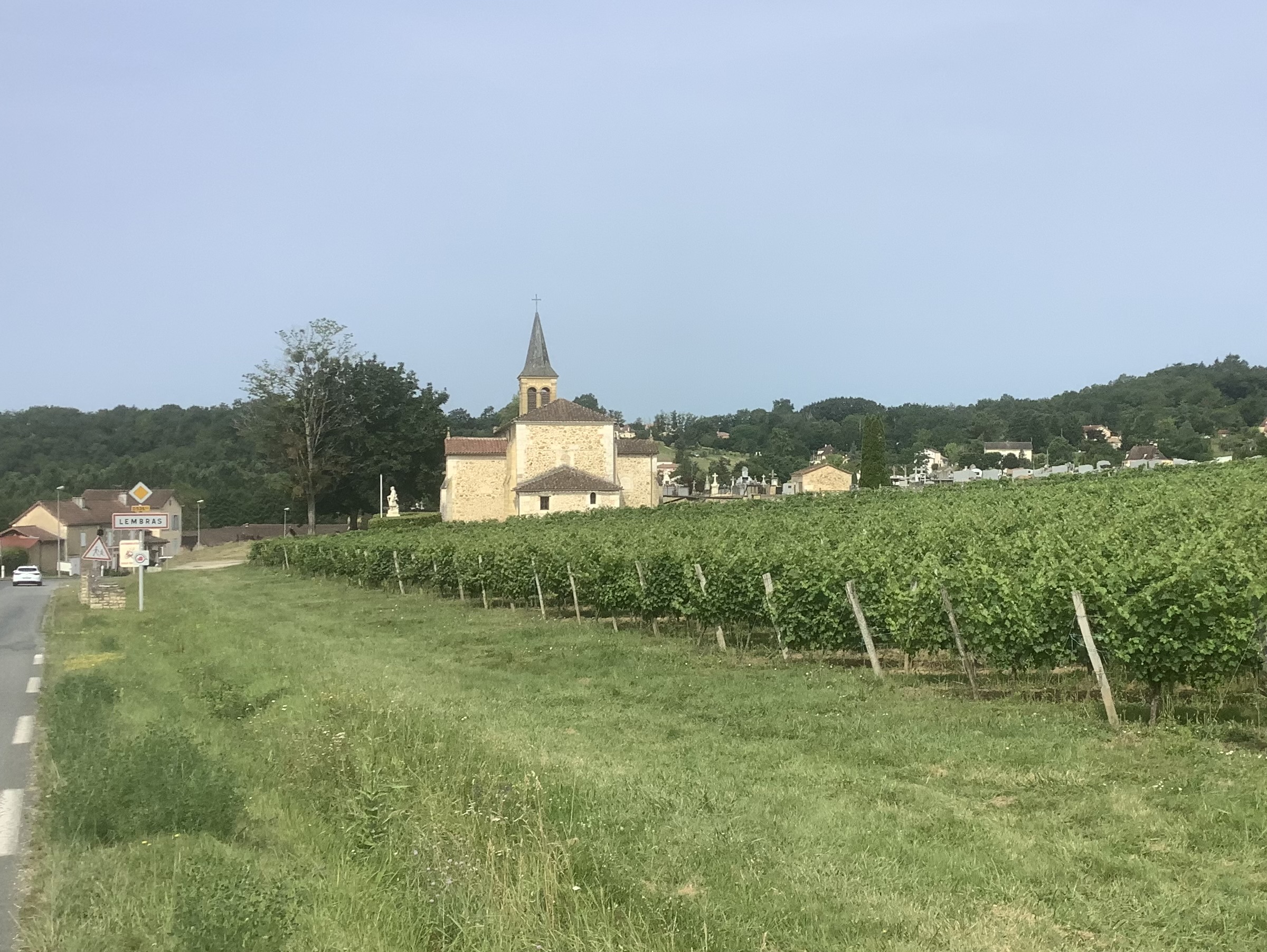
I have penetrated deep enough into France over five hundred miles from Paris to have entered its belt vineyards.  It also includes patches of corn and sunflowers.  


I have not entirely left my pals, the large, round bales of hay, but they are a lot less frequent than they had been.


I have been blessed with a slight tailwind from the north, providing a bit of a push,  but more importantly dropping the temperature ten degrees into the low 80s.  The peloton will be happy that such temperatures are in the forecast for at least the next week. I still welcome whatever shade I may come upon and truly celebrate the arcades of plane trees that go back to Napoleonic times planted for the benefit of his marching troops.  This canopy of trees makes a considerable difference, almost as if I have slipped into an air-conditioned room.


I thought I might start seeing team cars and maybe even some of the caravan vehicles headed to the start, less than three days away, but none yet.  Cyclists have begun to appear in increasing numbers, some in clusters of cyclists and some in pairs, some even bedecked with panniers.  


I was passed halfway up a long climb by a knot of lycraed cyclists riding at a steady clip, not strung out but in tight formation, two and three abreast.  It was quite a contrast to what I experience back home when cycling with others.  When our club rides come to one of the rare climbs on our suburban outings, it becomes a test of who can ride up the fastest and everyone becomes strung out.  Poor Deb, who is not a climber, but is otherwise a strong rider, always lags behind unless I happen to be near the back and can accompany her.  In France she would never be left behind on her own.  When I see groups of cyclists over here the sense of fraternity invariably prevails.  It is the country of Liberté, Equalité and Fraternité.  Rare is it that others push harder than whatever everyone else can maintain.  They wish to stick together.   


I first witnessed this French comradeship in Vietnam when I saw a group of a dozen French riders on a tour riding in a close knit pack, amicably chatting.  If they had been Americans they would have been spread out for a mile or more with the stronger riders wishing to prove it.


Before I reached the grapes and sunflowers I passed through Limoges, the Ville Arrivée for stage eight.  This will be the sixteenth time it has hosted The Tour.  The peloton will be sprinting into the heart of the city, finishing in a small park just a block from the tourist office and several blocks from the train station.  There was no indicator of the finish line there as there had been in Moulins but the city was packed with billboards, large and small, promoting its status as a Ville Étape.


Coincidentally, Limoges was mentioned on an ESPN podcast I had been listening to about Frederic Weiss, a seven foot tall Frenchman who was the first round pick of the New York Knicks in 1999.  He was being remembered as the number one pick in the NBA draft last week was another seven foot tall Frenchman, the highly touted Victor Wembayama, who is considered the best prospect to enter the NBA since LeBron James.  Weiss is from Limoges and still lives there.  He never played in the NBA, preferring to remain in Europe, where he is now a popular basketball commentator.   

I’m surprisingly getting a dose of French as I  listen to podcasts I’ve downloaded  here, as they include commercials relevant to the region. The technology is such that the internet knows where one is and inserts local commercials, even the baseball podcast I listen and many of the cycling podcasts.  The French tend to talk fast, so listening to them at one-and-a-half speed is quite comical and disconcerting, almost enough to make one’s brain explode, as Janina says of speeded up podcasts.  This insertion of French commercials is a recent trend, as I was not subjected to them two years ago.  I have noticed it, as well, when traveling about the U.S., but they aren’t as startling as these.

On day six of these travels Yahoo finally realized I was sending emails from France and found that suspicious, forcing myself to authenticate myself.  I had to have a code sent to my phone, which is a landline back in Chicago.  Fortunately I could still FaceTime, so enlisted the help of Janina to convey the code when it was phoned in.  I had to wait until mid-afternoon, what with the time difference.  Janina wouldn’t have appreciated being woken at two a.m. when I first realized I had lost access to my email at nine in the morning.  On a more positive note I have discovered that most supermarkets now offer Wi-Fi, so I don’t have to seek out MacDonalds or tourist offices, which aren’t as common as supermarkets.  

I’m a day from crossing into Spain.  Nine of my previous seventeen Tours de France have started outside of France, though none in Spain.  This will be just the second time Spain has had the honor of the Grand Départ and that in 1992 in Saint Sebastián, which will be the stage two Ville Arrivée this year.  

Foreign starts have become a tradition after the first in 1954 with Amsterdam.  They are generally a year or two apart, but of late they have been coming back-to-back, including this year after last year’s Départ in Copenhagen.  It’s actually the third time it’s happened, and all during my tenure.  The first time it happened was in 2010 from Rotterdam after starting the previous year in Monaco.  Then in 2014 and 2015 it 
was Leeds in the UK and Utrecht in Holland. 

Next year will be the first time it has had three consecutive foreign starts,  as Italy for the first time will be hosting the Grand Départ in Florence.  Italy will become the eleventh country to have had the honor.  Holland has had the most with six, followed by Belgium with five and Germany with four.  Three countries are at two—England, Spain and Luxembourg.  Four countries have had a solitary Départ—Ireland, Switzerland, Denmark and Monaco. There have been twenty-five foreign starts in the seventy years since the first in 1954.  One can find a year-by-year list of all the Grand Départs beginning with the first in 1903 outside of Paris at Wikipedia, so significant is this event.  Back in the era of the Concord jet there was talk of staring The Tour in Quebec or the US, but that never materialized.


Monday, June 26, 2023

Saint-Leonard-de-Noblat


I made it to the Intermarché supermarket in Guéret with ten minutes to spare before it closed at 12:30, it being a Sunday.  I cut it close, as the terrain had turned hilly and the temperature was already approaching 90 forcing me to take an occasional respite when a patch of shade presented itself along the road.

It wouldn’t have been a disaster if I hadn’t made it in time, as I had reserves of food, but I was eager for some chocolate milk and a loaf of bread.  The limited hours of supermarkets, many closing for lunch for ninety minutes and only being open in the morning on Sundays, if at all, abiding by the spirit of being more employee-friendly than customer-friendly, is one of those features of traveling in France that doesn’t necessarily go in the charms column.  

But as I sat outside the supermarket drinking a liter of cool chocolate milk and eating a sandwich of Camembert cheese, I was rewarded with one of its most highly rated charms when a woman walked by and said “Bon appetite,” a greeting of camarderie that speaks to the French devotion to food that happens no where else.  It is certainly more pleasing than someone slipping my a couple of bills, as happens in the US.


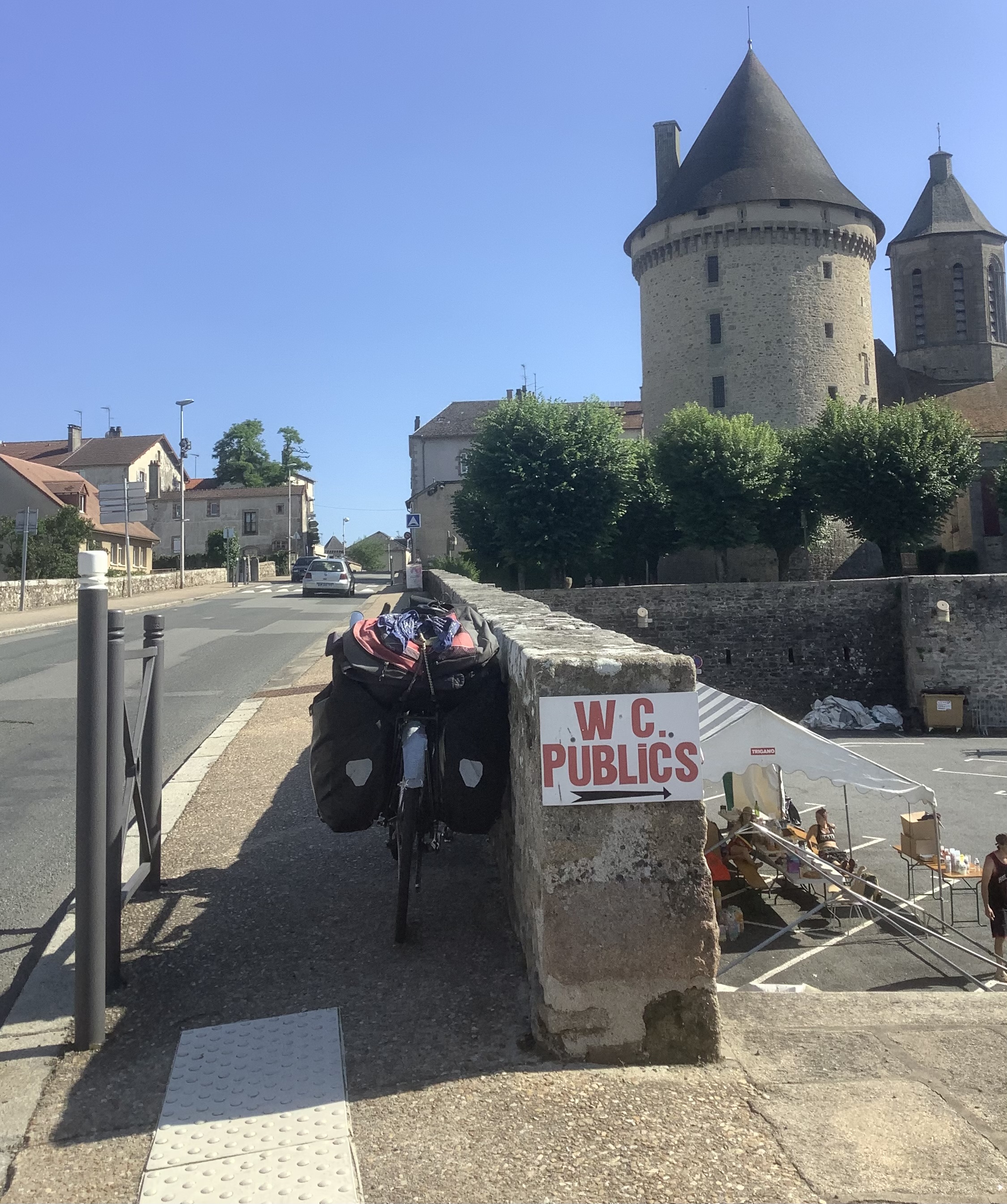
Another of its charms, especially on a hot day, is the availability of water, not only in cemeteries but in public toilets, often indicated by the English term WC.  I welcome the water not only to pour down my throat but on those hot days to pour over my head and to soak my shirt.  I’m ever on alert for water, including early-day manual pumps, though many are no longer operative.


I was chagrined to come upon a cemetery that was still requiring masks as I hadn’t brought one.  I wasn’t sure if the French would approve of a neckerchief.


Fields of giant rolls of hay bring cheer to my soul as well, as they can provide a wonderful alternative to camping in the woods.  They are one of the emblems of rural France, la France profounde, so much so they were featured on a Tour de France poster one year.  Sometimes I’ll roll a couple together to fully shield me from the road, but usually there is a high hedge along the road providing ample privacy.  I stopped a few miles before my goal of eighty miles for the day a couple nights ago to take advantage of such an idyllic setting, partially because I saw another long steep hill ahead and I’d had enough climbing for the day.


I was approaching the hometown of Raymond Poulidor, the much endeared Pou-Pou, fully channeling his spirit, knowing he’d ridden the road I was on countless times.  Saint-Leonard-de-Noblat would be the Ville Départ for the ninth stage that appropriately ends atop the Puy de Dome, as Poulidor had a legendary battle up its road that corkscrews around the volcanic peak with his long-time nemesis Jacques Anquetil in the 1964 Tour.  The two of them grimacing elbow to elbow is one of the iconic photos that defines The Tour.  The Tour hasn’t climb the Puy since 1988, so this will be one of the highlights of this year’s Tour.  That 1964 stage is considered by many to be the greatest in Tour history. 


Saint-Leonard-de-Noblat with a population of 4,400 is rather small for a Ville Étape  without much of a surplus budget, so its Tour decorations were minimal and of a small scale compared to the larger Ville Étapes.  Plain vinyl signs at the two entry points to the town merely announced it would be hosting The Tour.  


Simple wooden cut-outs of figures with upraised arms filled a roundabout and also were mounted atop a ledge.  


A rather tacky yellow jersey was draped over a bull by the plaza where the stage will commence.  Store windows throughout the town paid homage to Poulidor in some manner.  


A street has been named for him, but there is no statue.  I actually happened to be passing through the town in my early days of following The Tour the day the street was christened.  It was the first of many encounters I’ve had with him over the years, as he was a Tour ambassador following The Tour every year until he died in 2019, hanging out in the Ville Départ before each day’s stage and often appearing at the Ville Arrivèe as well.  The road was always peppered with signs of “Merci Pou Pou.”  He was considered the most popular of French riders, more so than the two five-time winners Anquetil and Hinault,  though he never won The Tour, finishing second multiple times. 

Though he won’t have the honor of sending off the peloton in his home town, his grandson, the Dutch rider Mathieu Van der Poel, one of the dominant riders of these times, who did something his grandfather never did, wore the Yellow Jersey, will be participating in this year’s Tour and will be a strong focal point on this stage.


Saturday, June 24, 2023

Moulins, France


As I sat in the jam-packed Atlanta airport awaiting the second leg of my ten-hour flight to Paris, I was struck by the thought that I was going a long way for a bike ride.  It was no ordinary ride, following the Tour de France, but I’d already done it a few times before, seventeen in fact, so I hardly needed to do it again.  

But, oh yes, I did need to do it again.  It was most surely in my blood.  Biking around France in July, tagging along with The Tour, is the ultimate of bike rides.  Biking through the French countryside is second to no place else and to do it when the entire country’s focus is on the bicycle and on The Tour, it is worth any sacrifice, though there was the present morally questionable act of flying in these times of the atmosphere filling with pollutants that may end life as we know it.

My fellow passengers may have had better justification than going for a bike ride for taking to the air, but I did not raise the question with any of them as I closed my eyes upon taking my seat, as it was midnight and I was ready for sleep. Fortunately, Ralph Nader hasn’t gotten Congress to pass a law making it so mandatory for passengers to wear a seat belt, as he did with automobiles,  that an alarm sounds whenever someone doesn’t have their seatbelt fastened, as I noticed through my entire row no one was quick about putting theirs on.  If a beep had sounded when the plane began to roll for all that were unfastened, it would have been mayhem with shouts all round, “who doesn’t have their seat belt fastened.”   

I was surprised upon arrival in Paris the vast majority on my flight went through the transfer portal rather than baggage retrieval.  A goodly number were likely headed to Africa, but it was difficult to surmise about the others.  Charles de Gaulle airport was much quieter than Atlanta, the least busy I’ve ever seen it.  And understaffed.  The French are trying to discourage air travel with all shorter routes within the country that can be reached by train curtailed.

There was no line for getting by passport stamped with so few arriving, but it was an hour before our baggage arrived.  There were only two representatives at the Air France customer service.  In the past each of the eight stations had been staffed.  I stopped to make sure Air France still provided bike boxes for those traveling with a bike, the reason Air France is my choice.  Thankfully it still does, sparing me the major hassle of coming up with a bike for my flight home.

With that weight off my shoulders I could get on my bike and disappear into France.  It was 4:30.  I had better than five hours of light to escape fhe sprawl of Paris and defeat jet lag and find a place to camp.  I was immediately energized as I slipped into the procession of cars leaving the airport.  They were virtually all compacts, not a SUV among them.  What a joy.  Gas going for eight dollars a gallon could be a contributing factor.

As always, I had to adjust my reflexes, as the French like to accelerate fast and dart quickly in front of me making turns or entering the highway.  The rush hour traffic was thick and congested, allowing me to ride past backed up cars at certain points.  And I had the pleasure of one round about after another.  There’s only one anywhere near me in Chicago, five miles away in Brookfield, though it’s not a free-flowing roundabout, as each entry has a stop sign, rather than the standard yield sign, as the locals couldn’t adapt to the ease of slipping in and out without having to come to a halt.

It was thirty miles, mostly west, to Orly Airport before I could head south and out of the metropolitan sprawl into the countryside towards Moulins, two hundred miles away, where I would pick up the Tour route and follow it from there to its starting point in Bilboa, Spain,  a further five hundred miles.  I rode National Highway 7 for a few miles past the airport, then turned off onto a quiet rural road and had a campsite  in a forest in no time.  Camping doesn’t come any easier than in France with its abundance of forests everywhere.

I was well fed by Air France, a dinner shortly after takeoff and breakfast shortly before landing, and had some leftovers, so I didn’t need to eat much and could get to sleep.  The forest was dark enough that the morning light didn’t wake me,  but rather the patter of rain.  I didn’t mind sleeping in.  After eleven hours of sleep the rain had diminished enough to break camp.


The light rain barely wetted my shoes and socks, so I had no complaints.  It wasn’t long before I came to a cemetery and could fill my water bottles and salute Yvon for telling me this secret many years ago when we met at the Chapel des Cyclists.  I often wonder if I would have ever discovered this easy source of water, as cemeteries in the US, which occasionally provide camping for me, don’t offer such an amenity.  I wouldn’t have been drawn to French cemeteries as they are very compact and nothing but hard surface with no grass.  


I am always so happy for the water I express my gratitude by filling whatever receptacles are by spigot, often several, for those venturing to the cemetery to wash the grave of whom ever they are visiting. It has to please the visitors to be able to immediately grab a can and tend to their business. If they’re in the sun, they’ll be heated to make the washing all the easier. It’s a gesture I don’t find repeated, so I have yet to establish a trend, just as I’m not establishing much of a trend of getting people on bikes.


My next noteworthy stop was the supermarket.  Though I wasn’t desperate for food I was eager for a bottle of mint syrup to enliven the water in my water bottle.  Others may be drawn to France for its wine, but for me the greatest drinking pleasure anywhere is this zesty mint drink—menthe á l’eau.  Each sip dazzles my throat and alleviates whatever concerns I may have.  I am happy to take a hit every few minutes as I’m pedaling along.


Along with the sirop de menthe I bought another of my French staples, a pound of couscous, and also half a pound of pâté and a baguette, thoroughly Frenchifying myself.  I was sorry to discover that inflation has not spared France, as everything was at least twenty-five per cent higher than two years ago.  I definitely knew I was in France when a little ways down the road I came upon a car pulled off the road and a man standing in the bushes with his back to the road taking a pipi rustique.  Nowhere else are men so casual about answering nature’s call.


I needed another eleven hours of sleep on night two, but was fine with eight hours the next night, allowing me to arrive in Moulins by mid-morning.  There were signs on the outskirts announcing the arrival of The Tour and banners and flags and billboards all over advertising the Tour, each conveying a jolt of joy that The Tour was nigh.  


It would start a week from today and reach Moulins twelve days later.  It was the first time Moulins had hosted The Tour.  It had been the only prefecture of the ninety-five départements never to have been a Ville Étape, so it is an especially noteworthy event for the town and for The Tour completing the roster of all the prefectures. The town tower was adorned with the three prominent jerseys of the peloton.  And the town hall across the street was similarly adorned.


I will now head west on the roads that the peloton will ride entering Moulins, making a sharp right after it crosses the L’Allier river, then finishing a mile further beside a small park.  


It will be an especially memorable finish, as I will be joined by Florence and Rachid, who will be driving down from Tours for our almost annual rendezvous.  

Friday, June 16, 2023

To Shake the Sleeping Self, A Journey from Oregon to Patagonia, Jedidiah Jenkins


When Jedidiah Jenkins set out to bicycle from Oregon to Patagonia in 2013, as recounted in his best-selling book “To Shake the Sleeping Self,”  he had no bike touring experience and didn’t even own a bike until shortly before he set out.  He’d been inspired by a co-worker who had completed such a trip a few years before, though he doesn’t share any advice his friend may have given him other than he should start telling all his friends he planned on such a trip so he wouldn’t back out.  

He followed that advice, beginning to spread the word among friends three years before he set out that he intended to quit his job as a lawyer and bicycle the length of South America when he turned thirty.  Despite having three years to prepare for it, he didn’t have the sense to train or bother to learn Spanish, dispensing with the language course he purchased after a couple of days.

His trip gets off to a rocky start, managing just twenty-five miles the first day and after several more days bemoaning he hadn’t trained for it. When he reaches Mexico he begins hitchhiking and taking buses.  If nothing else, this book is a strong testimonial to the axiom that if one isn’t fully committed to the bicycle, remaining faithful to it in all circumstances, and starts taking alternate means of transportation when the challenge becomes too much, one is doomed to continually abandoning the bike when adversity presents itself.

Once one buckles to headwinds or boring scenery or too much traffic or fatigue or excessive climbing or heat or any of the many other challenges that is the lot of the touring cyclist, he will be continually beset by the temptation to quit when the going gets tough, disqualifying him from the great sense of accomplishment one feels upon completing one’s trip.  After one long bus trip in Mexico he admits he felt like a cheater, but it hardly altered his behavior.

When he reached Nicaragua he wrote, “I was excited to see Panama, Colombia, Peru, Patagonia.  I was.  But the damn bike.  I wanted to take more buses. To skip the boring parts.  But I also didn’t want to.  I felt the duty of the promise I made to myself and the expectations of all my friends watching.  This trip had become my job.  Hourly, my thoughts transitioned from dread to duty to excitement to anxious.”

His honesty is admirable, but it was most disheartening that this book became a tale of traveling with a bicycle rather than a tale of riding a bicycle. Not only that, he grew tired of camping, one of the greatest features of traveling by bike, and welcomed a hotel whenever he could find one.   Even though he had a companion much of the way, all the time on his bike allowed him much time to reflect on his Christian faith and his church’s regard for his homosexuality, two of the major themes of the book.  He goes round and round about such issues.  He begins the trip thinking Jesus is his savior, but by the end he isn’t sure.

This was no eulogy to the glory of the bicycle nor the glory of traveling by bicycle.  When he reached his ultimate destination of Fitz-Roy mountain in Patagonia, he makes the tragic revelation, “I never got on the bike again.”  The bike failed to win his heart.  When I completed my first big bike tour, coast-to-coast, I didn’t want it to end, as is the common feeling of many.  I turned left when I reached Oregon and continued another thousand miles. Jedidiah chooses to take a bus the final thousand miles to the tip of South America.  When I reached the tip of South America on my ride of the length of the continent I hopped up to Buenos Aires and biked an additional 2,500 miles to Rio da Janeiro and only reluctantly flew home from there, resisting the urge to continue another thousand miles to the Amazon.

He had so little bicycle consciousness, that from beginning to end of the book he refers to suffering a flat tire as “popping a tire.”  Not once does he use the term “flat tire” despite having many.  He began the trip not even knowing how to fix a flat.  Fortunately his companion, Weston, a former New York bicycle messenger, had that expertise. Weston was a last minute addition, much to the relief of his mother, who insisted he find someone to accompany him, fearing for his safety through Mexico.  

Weston didn’t have the financial resources of Jedidiah, and preferred spending money on marijuana rather than lodging.  Jedidiah was continually paying his way when he was short on money, even covering the hefty expense of a week-long boat trip from Panama to Colombia around the Darien Gap.  They have continual friction with “every conversation feeling like a negotiation.”  He didn’t let on to his thousands of instagram followers that Weston was “driving him crazy” as he didn’t want to “damage the perception that Weston and I were on this perfect fantasy trip.”

In some respects the book might be taken as a confession.  He is honest enough to admit early on that he feels lucky to be on this trip and “not stuck at a desk job, but damn, the adventure wears off.  I’m not ready to quit right now or anything.  But it feels good to admit it isn’t one long string of euphoria.”  When he reached Oaxaca, he took a break and flew home for Christmas.  His mother joins him in Ecuador and at the end of his trip.  

His father too, a legendary traveler, meets up with him in Argentina.  His father, Mark, is the Jenkins who achieved fame for his three books about walking across America in the 1980s.  He met his wife in New Orleans and she joined him on his walk.  They divorced when Jedidiah was four, he says in this book, though in his follow-up book, “Like Streams to the Ocean,” he wrote they divorced when he was “five or six.”

That was one of many inconsistencies in the two books.  He admits in his second book, published in 2021, three years after the first, that his first book was “about chasing my dream to be a writer.”   He never acknowledged that was his impetus in his first book.  Rather he wrote, “I went on this bike trip to chase adventure and avoid the assembly line life of routine and expectations.”  The subtitle of his first book was “a quest for a life with no regret.”  In his second book he says he regretted the way he treated his younger brother.

That second book is a collection of essays, or “notes,” as he terms them, on “ego, love, and the things that make us who we are.”  There is bare mention of his bicycle trip, which he alludes to once as having “lived in South America for a year.”  He also refers to that book as a memoir “about my struggle to be a good church kid from Tennessee in a family who loved me but thought being gay was a death sentence” and about the “dismantling of my faith.”

He mentions at one point that he tried to overcome his addiction to coffee, but not his cigarette habit.  His strength of self-reflection allows him to let slip a couple times in both books that he smokes, but without further comment.  As a youth he was obese, 190 pounds at 5’ 8” tall, and not in a “cute teddy bear kind of way,” and drank a six-pack of Dr. Pepper every day.  He has always had a warm personality that wins him friends.  Straight friends would introduce him as being “gay, but not THAT gay.”  

Both books include quite a few movie references.  Movies are such an integral part of his life he downloads them to his computer and watches them in his tent at night, a tent he didn’t acquire until well into South America, preferring the great challenge of trying to find a place to hang a hammock when he camps for much of his trip. He doesn’t explain how he came to the choice of sleeping in a hammock rather than a tent, but it could have been inspired by one of the blogs he read in researching his trip.  Before crossing into Mexico at San Diego into Baja a blog warns of lots of flat tires ahead, so he inadvisably stocks up on an excessive number of “tire tubes,” ten of them, another mistake he admits to. 

His books have found enough of an audience to inspire him to write a third, to be published this November on a five thousand mile trip with his seventy-year old mother retracing some of the walk she undertook with her husband.  I suppose I will read it since I can’t resist books on travel, but not with any eagerness.  He writes well and has a tender, caring soul, but he doesn’t speak to me as a cyclist or traveler.  All too often in his first book my heart sank at his ineptitude, though it did stir my urgings to be off on the bike doing it in a proper fashion.  I can at least thank him for that.