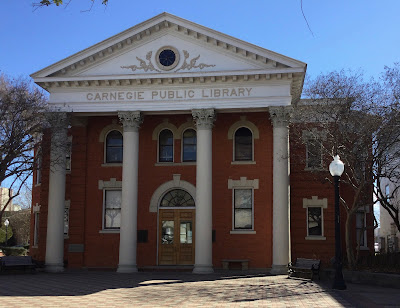
Sunday, April 24, 2022

Onawa, Iowa


 I left Chicago with so much food packed in my panniers, I have been spared the ordeal of grocery shopping yet.  I’ve been gorging on hard-boiled eggs, hummus, bean salads, cheese, cranberry bread, Ramon, canned ravioli, nuts and assorted sweets.  Somehow I’ve managed without chocolate milk, which will be among my first purchases when my stores are exhausted. 


My only expense these first four days has been the five dollar admission fee to the Museum of Danish America in Elk Horn, money well spent.  As the only Danish museum in the US, it pays tribute to all things Danish and has Danish-related artifacts from all over, including Victor Borges first piano that he bought in Denmark as a young man in the late ‘20s.  

Along with the piano were an assortment of videos of his performances on the Ed Sullivan show and before eleven presidents and sessions accompanied by Frank Sinatra and Dean Martin and other luminaries.  He is a Danish icon and was a great favorite of my father.  He was among a dozen Great Danes listed at the entry of the introductory exhibit of the museum along with Hans Christian Andersen, Soren Kierkegaard, Scarlett Johansson and Viggo Mortensen.

I arrived at the museum in the early evening after it closed, so was the first customer the next morning.  It resides on the outskirts of Elk Horn surrounded by cornfields.  With no nearby residences I pitched my tent on the grounds behind an old cabin that had been the home and school house of a Danish immigrant in North Dakota that had been transferred to the museum.  


With the museum not opening until ten it allowed me time to do some early morning meandering about town hoping some house would trigger a memory of it having been where my grandparents had lived and I slept once or twice on family trips to Yellowstone and Colorado many decades ago.  There were quite a few likely candidates, but nothing clicked.  

I stopped by the cemetery to see if my grandparents might have been buried there.  There were two Andrew Christensen’s among the many Christensen’s, but the dates didn’t correspond to my grandfather and neither were accompanied by his wife Mildred.


The town’s early library with a cornerstone of 1950 fitted into a narrow slot between larger buildings on its Main Street and was now a tattoo parlor.  It was mere wisp, especially compared to the Carnegies in Atlantic and Audubon twenty miles to the south and north. The contrast was a strong testimonial to what the generosity of Carnegie could have provided if only Elk Horn had had a citizen or two or women’s group, as was the case with many towns, to rally the town to meet the prerequisites that Carnegie set for a library—providing a centrally located piece of land and passing a bond issue of ten per cent of his grant to maintain it.   The present library is attached to the city hall and has very limited hours, but a most fetching mini-mural.


The attendant at the museum wasn’t a Christensen, rather a Peterson, ending with an “son” rather than the Danish “sen.” She said her mother was Swedish and had married a Dane, who like her had the Petersen surname.  She assumed his version of Petersen, but when they divorced she wanted that “o” back and changed her name to the Swedish version, which her daughter also adopted.

When the museum was initiated in 1983 it was known as the Danish Immigrant Musuem, but in 2013 changed its name to the more inclusive Museum of Danish America. In the latest census one-and-a-half million Americans claimed Danish ancestry, which I was among.  A good many of them, 300,000, immigrated between 1850 and 1920, including my grandparents.  Twenty thousand of them were Mormon converts, as the religion had taken hold in Denmark.  The first language the Book of Mormon was translated into was Danish.

The Danish immigrants had to be overwhelmed by the size of America, as Denmark is the smallest of the Scandinavian countries and is just one-third the size of Iowa. Its present population is five-and-a-half million.  The museum pointed out they are the happiest people among the world’s nations according to many surveys.  Universal health care is one of the reasons and also undoubtedly their close relationship to the bicycle with fifty-five per cent of the population commuting to work and school by bicycle.  The exhibit included a Danish made bicycle, a Principia, that a Danish journalist pedaled across the US in 2012.  But it made no mention of the EPO-tainted Bjarne Riis, the only Dane to win the Tour de France, breaking the five-year run of Indurain in 1996.


A second floor exhibit was devoted to the “Danish Pioneer,” a newspaper established in Omaha in 1872 and continues to be published, though just twenty-six issues a year.  It relocated to Chicago in 1958.  It was originally published in Danish, but English has been its language for quite some time.

I lingered in the museum almost long enough to be able to drop in on the library, which didn’t open until 12:30.  But with the possibility of rain I made the Audubon Carnegie, twenty miles northeast, my library for the day.  It resided in a park facing a statue of its namesake.  


The walkway to its original entrance, now closed, was lined with tile mosaics of Audubon’s bird etchings.  There were several dozen throughout the park.  There was a mural of Audubon at the new entrance to the library in its addition to the rear of the building.  Another mural devoted to Audubon graced the interior of the post office thanks to the WPA in 1942. 


The librarian was one of several people who informed me there was a high wind warning for that afternoon and tomorrow.  It blasted up from the south shortly before I turned west to Onanwa, seventy miles away near the Missouri River.  It was so strong I had to bike in the middle of the lane to prevent myself from being blown off the road.  I was leaning into it so severely I feared scraping my left pedal on the pavement.  Fortunately I was on a county road with little traffic.  When I stopped at a gas station for water a woman apologized for not stopping to offer me a lift, as she saw me swerving all over trying to stay upright.  She said she had a dog in the cabin of her pickup and he wouldn’t take kindly to me.

I passed up an abandoned house that would have provided  refuge from the wind, either inside or as a blockade, as I wanted to get further down the road fearing the conditions could be even worse the next day.  I came upon a cluster of trees and a recessed river bank out of the wind that was just fine.  Still my rain fly flapped against the tent all night regularly waking me.

The wind had calmed a bit in the morning and I didn’t have to battle for each mile.  The wind did pick up after I’d take a break after thirty-two miles, forcing me to lean into its force from the south.  Thirteen miles later after I’d stopped for more food just seven miles from Onawa the wind had become a gale force.  It was impossible to remain upright.  Even walking was a challenge with one gust blowing the bike out of my hands on to its side as I walked along pushing it. 

I kept waiting for a pickup truck to stop and rescue me.  Half a dozen or more passed until one pulled over after I’d been at it for nearly half an hour.  It was a guy from Kansas City pulling a rusty old Volkswagen bus he’d just purchased for $1800 to restore and sell.  When I saw him stopped ahead, I figured the wind was playing havoc with his load, but he was a cyclist himself and knew what impossible conditions I was up against.  We hardly got to talk as it was just six miles to the Carnegie.


My rescuer didn’t know anything of Carnegie libraries, just asking if it was the same Carnegie as Carnegie Hall.  I was hoping Onawa’s Carnegie would have a strong “wow-factor” to impress him, but it was of the restrained dignity faction.  As with Audubon’s, its original dignified entrance had been closed and replaced by a lackluster entrance through the addition, denying one the pleasure of being immediately immersed in the high-ceilinged Carnegie aura.  The Carnegie-experience is always blunted when one has to pass through an ordinary contemporary setting.


But Onawa’s addition had some pleasing features.  One was a pyramid of books.


Another was an Einstein benediction akin to his more famous “I thought of it while I was on my bike.”  This one was, “The only thing that you absolutely have to know is the location of the library.”  I was shocked that I had never come across it before.  It should be inscribed in every library.

By five o’clock when the library closed the gale force winds had somewhat abated and best of all had switched to a southwesterly.  And since I was turning back east and heading a bit north I was in business.  At times I was flying along at twenty miles an hour without pedaling and at other times had to lean into the wind when the road did some winding.  A large bush behind an electrical plant provided a wind block for my tent.


Friday, April 22, 2022

Atlantic, Iowa


Unlike my previous excursions on Amtrak this year (to Little Rock and back from Baton Rouge), I had to share a seat on my latest trip, this one to Omaha.  The train was fully booked and seats were assigned.  It was no hardship, as it wasn’t an over-nighter for me, just nine hours, arriving in Omaha at eleven p.m.


The mask mandate had been lifted and most passengers were revealing their full face.  The conductors though remained masked.  The conductor making the announcements may have been auditioning to host the Oscars.  As we approached the Mississippi, he gave the startling news that we were about to cross the Atlantic Ocean and would be arriving in Cuba shortly.  

At the stations where the train stopped long enough for passengers to step out for a smoke, referred to as “fresh air” and “stretch your legs” breaks, he said that passengers were welcome “to try out some dance moves.”  One of the smokers was excited about our arrival in Omaha, and said, “I’ve never been to Nebraska and I’ve been to thirty-seven of the fifty.”


I too was eager to set foot in Omaha and to take to its streets on my bike.  I’d passed through many a time when taking the California Zephr to and from Colorado, but had never made it my destination.  I would have disembarked in Council Bluffs in Iowa, just across the Missouri River, but the train didn’t stop there.  I’d just have to bike back over the river for the first of seventeen Carnegie libraries awaiting me in the northwest corner of Iowa.  

There are another eighty-one scattered about the state, all of which I’ve visited, many in the fall of 2019, except one on the campus of Upper Iowa University in Fayette in the northeast corner of the state.  I plan to get to all of them on this outing along with a couple dozen more in Nebraska, South Dakota and Minnesota just over the border from Iowa in thIs four corners region, though Nebraska doesn’t quite extend all the way to Minnesota making an official”four corners” as with Colorado, Arizona, New Mexico and Utah.

The highlight of the trip might be a visit to Elk Horn in Iowa.  It doesn’t have a Carnegie, but is the small farming community where my father grew up and is home to the only Danish museum in the US.  It’s six miles north of Interstate 80.  I can vaguely recall visiting my grandparents there in my youth, the last time when I was twelve, nearly sixty years ago.  My strongest memory is the steep hills leading into the town and thinking it would be fun to bike down them.  I’m finally going to get that chance.

The small Amtrak station in Omaha remained open all night, but it was too brightly lit and had no secluded corners and no WiFi, so it offered no temptation to linger until daylight.  Instead I had the pleasure of finding a place to pitch my tent in the midnight hour. I had no worries whatsoever when I set out from the station eager for what would reveal itself as a place to camp, elated that “now the adventure starts,”  fully confident I’d find a nook to pitch my tent. 


There was a patch of wilderness just across a pedestrian and bicyclist bridge to Council Bluffs.  I feared it might be steep terrain, a bluff, so I kept my eyes peeled for what might offer itself on the three mile stretch to the bridge.  There were some possibilities at a construction site and amongst some trees along the train tracks by a vast empty parking lot by a stadium, but I wasn’t so desperate to avail myself of them, and deny myself the pleasure of riding over the Missouri in the dark.


It actually wasn’t all that dark, as the bridge was illuminated with alternating pink and blue spot lights to show off it’s award-winning architecture.  The bridge was completed in 2008 and received the Project of the Year Award from the American Public Works Association.  “Travel and Leisure” magazine named it one of the world’s most spectacular pedestrian bridges.  It is one of the longest at 2,300 feet.  I wasn’t the only one crossing it in the midnight hour, sharing it with another cyclist and a young couple strolling along holding hands.


I was happy to see the wilderness area below the bridge as I entered Iowa was relatively flat, and was relieved that it wasn’t swampy when I ventured into it.  The ground was plenty soft.  I had no concerns of being spotted, as a fog had settled in and was still thick in the morning.  As I pedaled into downtown Council Bluffs and the Carnegie in the morning, four miles away, I kept waiting for the sun to burn off the fog giving me a clear view of the library.  It somewhat dissipated, but not fully until ten, well after my rendezvous with the library.  


Council Bluffs was a significant river front city in the early 1900s, earning it a sizable grant from Carnegie for a much more grand building than those gracing smaller towns, almost too much so.  It was now the Union Pacific Museum, though it retained “Free Public Library” high above its entrance.  


The next Carnegie was in Atlantic, forty-five miles east through quite hilly terrain awaiting to be planted.  Though my legs strained, my spirit soared, delighted to be off pedaling on roads new to me and that I pretty much had to myself. As always, I gloried in being footloose and worry-free and blessed my good fortune, especially after a retired friend who’s finding it a challenge to find things to do with his time had recently told me I was lucky to have a hobby.  Hobby!!!  Riding my bike is no hobby.  It’s my passion, my calling, my purpose, my raison d’etre.  Hobby it is not.  

But I appreciated his sentiments and do indeed consider myself lucky to have something I look forward to doing when I awake every morning.  And so it was too during my years as a bicycle messenger. That was no more of a job than biking is a hobby. As I biked in to the Loop every morning, whether rain or shine, hot or cold, I exalted at being able to ride my bike all day with purpose and at accelerated speeds. The Loop was my playground, and I was as gleeful as a kid at an amusement park as I galavanted about it all day. Hail, hail to the bicycle.


The Carnegie in Atlantic further emphasized the pleasure of being on the bike, as it brought me to another gem of a building.  Its quiet dignity lent stature to this small town and pride to every citizen that their town had such a noble structure full of books.  It still served as a library and identified itself as simply “Carnegie Library.”  Its orignal entrance had been usurped by an addition to its side in 1996.  The elevated area around the entrance was now a fenced-in picnic area.  A table with a fireplace in the background had a display of weather-related books under a “Spring Forcast” sign and a prediction of “One hundred per cent chance of reading.”  


I didn’t have the heart to tell them their “forecast“ was missing a letter. 


Friday, April 8, 2022

“Signs of Life,: A Doctor’s Journey to the Ends of the Earth,” Stephen Fabes

Ten years after he and his younger brother spent five months bicycling the length of Chile when he was nineteen, Stephen Fabes set out on an around the world bicycle tour that lasted six years, recounted in “Signs of Life,” published in 2020, four years after his return to the UK.


There is no denying his intrepid spirit.  He was two years out of medical school when he gave in to his wanderlust once again, a condition that has an actual medical term (dromomania), one of many that he sprinkles throughout his narrative.  Though the book is subtitled, “A doctor’s journey to the ends of the earth,” he writes much more through the lense of a touring cyclist than a physician. It is a travel book through and through, filed in the travel section of Chicago’s main library rather than the bicycling section, where most of such books end up, of which there are quite a few.

Faber mentions several including those of Dervla Murphy and Ian Hibbell and Thomas Stevens.  They are among dozens of books by a wide range of authors from Edward Abbey to Henry Miller listed in his seven-page bibliography.  If there had been an index one would have found Jens Voigt and Heinz Stucke, two noted German cyclists, one a Tour de France racer and the other deemed by Guinness to be the most-traveled cyclist in the world, someone who spent fifty-one uninterrupted years bicycling all over the world before returning home.  Faber stopped by Stucke’s home towards the end of his ride and devotes nine pages to him, more than most countries.  

Mexico earned a mere three paragraphs, though it included one of his many amusing and astute observations.  He wrote that Mexico was a long succession of dusty towns, “where men sat with their t-shirts hoisted, airing their paunches like over-heated cars with the hood up.”  Another of his noteworthy descriptions was personal.  After biking Africa top to bottom at the start of his travels followed by South America bottom to top he was in peak fitness.  He could see it in his legs, where “in a certain light the pattern of veins on my calves had a creepy likeness to Che Guevara’s face.”  

He’s not the first author to see some sort of design in the veins of a cyclist’s leg.  Ned Boulting, another British author, wrote that the veins in the legs of the American racer George Hincapie’s are so prominent that one day they’d be numbered like the switchbacks on L’Alpe d’Huez and given plaques bearing the names of famous domestiques, such as him, who never wore the Yellow Jersey. 

Four years into his travels, as his funds diminished, and he began to rely on ramen noodles more and more, which he said had the nutritional value of talcum powder, he began giving talks to schools and publishing articles.  By the time he wrote his book he had honed his writing skills, though at times he could go a little too deep into his jar of adjectives, particularly when it came to describing sunsets.  Occasionally he’d extract an adjective rarely associated with the setting of the sun—enormous, raucous, extravagant, lingerie-pink, smudge of wine.

The only typographical error I detected in this Simon and Schuster book was sun-related.  He wrote that he generally rode from dusk to dawn, meaning dawn to dusk.  That fit in with his preference for wild-camping, which one puts off until dusk and the cover of night and obliges one to begin cycling in the early light before one might be discovered.  He attaches “rough” and “stealth” to his style of camping along with “wild.” 

He gloried in the camping, writing that it defined his journey as much as the cycling.  His favorite statistic of his travels, more than the 53,568 miles he pedaled, was that he had camped for free just off the road over one thousand nights, as it “reminds me of the capacity for freedom in a world more dependable than I’d ever imagined.”

Most of his campsites were lost to memory, but a handful stood out as “glorious victories: the Jordanian clifftop, the Californian sea cave, the center of a French rond point, the ramparts of a ruined Ottoman castle.”  Unfortunately none of them came up in his narrative and were given a mere belated, bare mention.  If I ever cross paths with the good doctor, the first question I’ll have for him is about that French round-about and what it was thick with that provided adequate cover and also what it was like to have vehicles circling around him through the night.

I’ll also thank him for giving the medical term for the sensation of feeling ants crawling on one’s body—formification.  He didn’t pass through Brazil, where I suffered the condition numerable times.  He experienced it in El Salvador during a quick dash through Central America, where he wrote that he was changing countries more often than underwear. 

One aspect of the touring life he overlooked was the joy of getting a shower.  Those can be seminal moments when one hasn’t had the opportunity for days.  But he or his editors understood that getting a shower becomes a cliche in many cycle touring books, so they elected to purge this book of any mention of showering. Also ending up on the cutting room floor were many of those who had done him good deeds, providing lodging or other acts of kindness, that were a theme of his travels.  He would have liked to have credited all of them, but his editors wouldn’t allow it.  He apologizes to the overlooked in his acknowledgements.  

Nor did he write nearly enough about two of his travel companions, a friend who joined him for eight months during the early part of his travels and through most of Africa, and then his girl friend who joined him for several months starting in Australia and ending in Singapore, when she surprised him with the news that she had had enough and had just bought a one-way ticket to Japan.  

He could have sacrificed the four pages he wrote on leprosy or the five pages devoted to a Calais refuge camp for more of his travel experiences.  But, of course, it was a near impossible task to reduce over two thousand days on the road to a mere four hundred pages.  He easily has enough experiences to mine for another book or two, such as Ted Simon did after the success of his classic “Jupiter’s Travels,” about his around the world motorcycle trip published in 1978.  

India figured prominently in both their books.  It was there that Simon’s motorcycle was anointed “Jupiter.”  Fabes had a similar experience when an Indian policeman told him, “You are like Braveheart in the Mel Gibson movie.”  He could have titled his book “The Travels of Braveheart” if he hadn’t opted for a medical-related title.  

As all such travel books do, this stirred the urge to be back at it and stirred a steady flow of memories, many long-forgotten.  Just as one can lose one’s self when out biking, I’d lose myself flying along reading this book, suddenly realizing an hour or two had passed.  After finishing it I discovered a catalog of many of the articles he’d written at his website stephenfabes.com offering some more fine commentary on the touring life. 


Wednesday, March 9, 2022

Baton Rouge, Louisiana


 As I closed in on Baton Rouge, I came upon an unexpected visitor center in the small town of Grosse Tete where I could confirm that the ferry across the Mississippi in Plaquemine twenty-five miles away was in operation and find out what its hours might be.  No worries, as it had a regular schedule departing every half hour on the hour and half hour.


Then I asked if my information was correct that Baton Rouge didn’t have an Amtrak station. That was true, but I didn’t have to go eighty miles to New Orleans for a train, but could cut that distance by thirty miles by heading to Hammond, due east of Baton  Rouge.  The woman with the answers knew the station was staffed during the day and that it offered baggage service.  And she made a quick check to confirm it offered bike boxes, although it turned out I didn’t need one as the City of New Orleans line will take bikes as is stripped of its baggage.

All the good news made the cycling even more enjoyable on the quiet, perfectly flat roads intertwined with rivers feeding the Mississippi.  It was quite a contrast to the evening before when I spent twenty miles on 190, a four-lane divided Highway heading directly into Baton Rouge.  The final seven miles were on a stretch elevated above swampy terrain.  It had a retaining wall to keep vehicles from plunging into the murk and no shoulder.  

I was lucky it was a Sunday with a minimum of eighteen-wheelers, but only slightly less than bumper-to-bumper traffic speeding into the big city.  It was no place for a bicyclist, but there was no alternative.  As the light waned I wanted to put on my flashing red light, but there was no space along the side of the highway for me to stop.  If I’d had a flat, I’d have to keep riding. 

When the road finally dipped to solid ground and a shoulder reappeared, I dug out my flashing light, and began to look for a place to camp.  It was better than a mile before I came to a patch of solid ground, but with only a thin shelter of trees and within sight of the road.  It was dark enough I had little concern of being spotted, though I knew I’d have to be on my way at first light.


I didn’t need to layer-up in the morning, as after enduring the ice and snow of two winter storms earlier in the trip, I’ve been hit by a heat wave pushing the temperature into the 80s with it staying warm enough through the night that for the first time I didn’t have to start the day with wool socks or long pants or more than a shirt on my back. Suddenly it was summertime. It was nice not to have to stop several times during the day to shed clothes or swap socks as the day warmed up.  

The warmth has brought with It mosquitoes and other bugs in the tent and a genuine craving for ice in my water bottles.  It is a first-rate bummer when the ice dispenser at a fast food restaurant is out of order and one is restricted to a mere cupful from a server behind the counter, almost enough to make me want to cancel my order and go to another of the franchises, as they generally congregate in bunches.  The warmth also means I need to eat the Hershey chocolate bars Ricky gave me in the morning before they’ve turned too soft and gooey to extricate from their packaging. 

Knowing the ferry schedule I timed my arrival for five minutes before departure.  The last two miles through Plaquemine the road was dotted with beaded necklaces as I’ve come upon through most towns in Louisiana, remnants of recent Mardi Gras parades. I had collected enough I didn’t need more, but it was hard to resist scooping them up if any presented themselves at my feet when I stopped at a red light.


There were a dozen cars and a few pickup trucks and a school bus waiting for the ferry, a little less than its capacity.  It took seven minutes to cross the mile width, as recorded by my Garmin cyclometer, of the river.  


It deposited me fifteen miles south of Baton Rouge, a good location, as my friends Bob and Catherine lived on the far south side of the city.  They had moved to a larger, more spacious house from where they had been when Janina and I visited them eight years ago.  Best of all, it had a three-car garage for Bob’s three vintage Corvairs.  It was extremely lucky that Catherine had stumbled upon the house, as even a one-car garage is not so common, with open carports the standard.


Bob had retired from Trader Joe’s just two months ago at the end of 2021 after thirty years as a manager, ten in Baton Rouge after moving from California to get this one started.  He was plenty busy with projects around the house, including restoring a bench he had found along the road and constructing a long, deep vegetable bed where he was determined to finally grow a tomato and also building a new gate on his driveway, as the previous one had been damaged by a hurricane last August.  


It was the first hurricane they had experienced since moving to Louisiana and were lucky that it veered at the last moment and didn’t inflict them with its full fury.  They were still without electricity and telephone service for four days.  As the hurricane bore down on them they weren’t sure what to do.  None of their more hurricane-experienced neighbors were evacuating, as it was just a level three, one less than the worst, so they stuck it out.  Their trees were severely bent by the winds, but none were toppled, unlike others in nearby communities.  Bob and Catherine got a first-hand view of the destruction as they participated with their church in clearage missions with chain saws.

They would have missed the storm had they been in Telluride, where they have worked for the film festival with Janina and I for years, but opted out this year.  Bob was extremely Covid-weary with it falling upon him at Trader Joe’s to deal with customers who declined to wear masks.  Many of them were belligerent, spitting on him and aggressively coughing in his face, forcing him to call the police from time to time.  

He feared more of the same at Telluride, where both he and Catherine had positions of responsibility.  Fortunately it wasn’t an issue at Telluride with all those attending obliging the mask and vaccine protocols.  They greatly missed not being there and look forward to next year with much anticipation.  

We had a lot of catching up to do, not having seen each other since Telluride of 2019, as 2020 had been cancelled.  His daughter, who has joined us at Telluride several times, had just earned her PhD in microbiology and his two sons were doing well too.  Freed of his workload at Trader Joe’s, Bob was looking forward to attending a few track meets at LSU for the first time.  He’d been a miler in his high school and collegiate days, nudging the four-minute barrier as a teen nearly fifty years ago, earning him a scholarship to track powerhouse UCLA.

Spending an evening with the two of them was a fine capper to these travels.  Unfortunately I had to be on my way early to reach Hammond in time for the 2:45 train.  There was a staggering amount of traffic pouring into Baton Rouge as I left with little going my direction at seven a.m. The direct route took me back on 190, but twelve miles out of town, by which point there wasn’t much traffic and with a shoulder that alternated between narrow and wide, even when the highway reduced from four lanes to two.  

The lands weren’t so marshy that the road had to be elevated, so I never lost what elbow room I had with no restraining wall along the road, as had been the case on the other side of Baton Rouge, and could enjoy the final miles of these travels. I passed under Interstate 55 on the outskirts of Hammond.  If I were driving I could have hung a left and driven north for nine hundred miles and come within a mile of Janina’s  house.  The small railroad station had one final plaque that couldn’t resist a reference to the Civil War.


The final fifty miles brought my total to 2,734 for my six weeks on the road.   That averaged out to about one hundred miles per Carnegie, as I made it to twenty-six I had not been to previously, along with three in Texas I visited for a second time.  As always, each has left a lasting impression that made any effort to reach them, even through the snow and ice, worthwhile.    


The tread on my rear tire began wearing thin after 2,500 miles, but held up. It yielded just one late flat when it picked up a wire thread from one of the many tire fragments along the roads.  As always, the bicycle served me well and was a wonderful companion. 


Sunday, March 6, 2022

Jennings, Louisiana


Among other things, this trip is distinguishing itself as “the trip of unexpected hospitality.” For the second time in the past month a motorist pulled over along the road ahead of me in the waning light as I was on the verge of disappearing into the forest and invited me to his home for the night.   This is a rare, rare occurrence that has happened to me just a handful of times in tens of thousands of miles and decades of touring. 

As the previous instance in Oklahoma, an older, somewhat disheveled, guy said he lived nearby and that I was welcome for the night. The guy in Oklahoma validated himself by saying he was a cyclist.  This guy identified himself as a retired cop.  Unlike the guy in Oklahoma he did not have a wife to call to warn of a guest and to set an extra place for dinner.  He said, “We’ll have my place all to ourselves as my wife of thirty-eight years just divorced me.  I’ve got a bunch of canned goods for dinner and we can watch tv.” 

Though I’d been looking forward to another night in the forest, I couldn’t say no to this opportunity and what it might lead to.  He said it was too complicated to explain how to get to his house, so we hoisted my bike into the back of his pickup.  He had a load of clutter, preventing us from pushing it far enough forward to close the gate, so I sat beside it with a firm hold on the frame to keep it from going anywhere.  It was a little further to his place than he had indicated. When we went down a dirt road I was beginning to wonder what I had gotten myself into.  His trailer was at the end of the road with neighbors nearby

He offered me my own room with a king bed, but I’m never one to relinquish my tent.  As I was setting it up, he came out with a huge bulky blanket.  I hardly needed it, but I accepted it as some extra padding to sleep on if nothing else. He said he had a washer and dryer and to bring in all my dirty clothes.  He had spare clothes if I wanted to wash everything.  His hospitality was overwhelming.  He was truly treating me like an honored guest.

When I came in with an armload of clothes for their first authentic wash of the trip after only being washed by hand previously,  he was sprawled on his couch staring up at the TV.  “I’ve only got eight channels,” he said, “but they’re all free.”

When he showed me the shower he said, “Oops.  I took a dump before I left and forgot to flush the toilet.”  Other than a pile of dirty dishes in the sink, all was tidy and clean.  Before I took a shower he told me to pick out a can of something from his cabinet for dinner.  “Have whatever you’d like.  I get $360 in food stamps in a couple of days, so I’m in good shape.  And you can take whatever you’d like when you go.  Take this chocolate. It will be good energy for you.”    I selected  a can of lasagne and when I came out of the shower he had opened it and put it on a plate ready for the microwave. 

We sat on separate couches with the TV on in the background as he lamented the loss of his wife and a lot more.  “She earns $200,000 a year as an administrator at the local hospital,” he said.  “She was upset that I hadn’t worked in two years, but I hardly needed to with all the money she was making.  Plus she didn’t like my drinking.  But I treated her well. I never beat her.  I paid for her college education. We got married when we were sixteen. We had to leave the state to do it.

“I dropped out of high school when I was fifteen and moved out of my parents house because my father treated me like shit. He didn’t just whip me, he beat me.  All the time.  Not once did he ever say he loved me.  And now he wants to evict me from here.  I own the trailer, but he owns the land.  You're the first guest I’ve had in over a year.  I apologize if I’m talking too much, but it’s rare for me to have someone to talk to. My daughter hasn’t spoken to me in two years.  She married a millionaire and lives in Scherveport.”

On and on he went.  It was hard to imagine he had been a cop for twenty years.  He wasn’t drinking but he must have been.  He was smoking by inhaling on a soda can with tobacco, explaining  he couldn’t afford cigarettes.  He had no opinion on the new coach of the LSU football team, hired away from Notre Dame, as he didn’t follow sports other NASCAR.  Nor did he have much to saying about his life as a cop other than he ranged fifty miles in every direction and had to deal with a lot of domestic disputes and had never had to use his gun, though he’d come close. 

He didn’t ask anything about me, just observing that we both could get by on little as I ate my lasagne with a couple of pieces of toast and a glass of milk.  He had no WiFi and didn’t use the internet.  He kept saying he wished I’d sleep inside, but could understand that I liked to sleep in a tent as he did too.  

Several times he reiterated, “Just don’t leave in the morning without saying goodbye.  You can come in and have some breakfast.  I have a bunch of biscuits and sausage.”  After an hour around eight he rolled over on the couch and went to sleep.  I was exhausted myself.  

I warily came back in at seven in the morning fearing he might not remember me.  I hugged the thick blanket close to my chest in case I took a shot. He was propped up on the couch watching TV saying he’d been up since three. He wanted me to eat some breakfast and keep him company, but I knew I’d just have to listen to him repeat laments I’d already heard several times.  I told him I wanted an early start before the predicted wind from the south picked up and blew in my face.  

“At least take the package of biscuits and sausage in the ice box,” he said. “I’m just going to throw them out. And take the can of spaghetti and meatballs in the cupboard and whatever else you’d like.”  I would have liked to have left him a twenty dollar bill, but feared he might take it as an insult.  And if I just left it on the counter he might come after me with it.  He thanked me for my time with him and I thanked him for his great generosity.  He was as welcoming as any Warm Showers host, as if he were a fellow comrade of the bike, though he’d long ago sold his. 

It was seventy miles south to Jennings and it’s Carnegie on the flattest terrain by far of the trip through the Mississippi Delta and into  a strong wind blowing in off the Gulf of Mexico.  There were vast expanses of rice fields providing no windbreak. 


I’d swung by the Carnegie in the sprawling city of Alexandria, twenty miles north, the day before.  It was now a museum with the new library across the street.  The plaque in front of the library took a swipe at the Union army, as many of the southern historical plaques do. It said this library replaced an earlier library burned down by Gen. Nathaniel Banks’ federal troops on May 13, 1864, though the Carnegie wasn’t built until 1907.


The Carnegie in Jennings also had a Civil War related plaque, this one attached to the building beside its entrance.  It was the proclamation of General John A. Logan on May 5, 1868 establishing the first Memorial Day, initially known as Decoration Day,  for citizens to “garland the graves” of those killed in the Civil War with “the choicest flowers of springtime.”  Twice it referred to the war as “the late rebellion.”


It was a fine final Carnegie of these travels, the twenty-ninth.  It was the second with the always pleasing corner, diagonal entrance and also a modest dome.  The circulation desk faced the entrance, allowing a librarian to welcome all those entering.  The two wings were well-illuminated by natural light.  It’s WiFi password was a polite “letmeonplease.”  It was one of those libraries that one didn’t want to leave and with the even stronger than usual feeling of “this is one I have to come back to.”


Now it’s on to Baton Rouge and Bob and Catherine, then New Orleans for Amtrak home.

Friday, March 4, 2022

Leesville, Louisiana


My day got off to a great start when my spreading knife turned up as I was breaking camp.  I had conducted an all-out search for it the night before, but it wasn’t to be found.  I had last used it outside a McDonald’s to make a peanut butter sandwich for later in the day while my devices continued to charge inside.  I remembered taking it inside to give it a wash along with a couple other items, but then couldn’t remember if I slotted it back in my handlebar bag where it normally resides or if I had slipped it into one of my front panniers in an open container for easy access for future use.  


When I couldn’t find it in any of those places I feared it might have fallen out of the hole in the bottom of one of my front panniers, or I may have placed it atop my packs over my rear panniers and forgotten about it.  Turns out I put it in my pants pocket after washing it off and there it still was, which I discovered when I slipped them on in the morning.  It wouldn’t have been a great loss if it had disappeared, as I can spread with my spoon and cut items with my sharp knife.  I was as happy to solve the mystery of where it had gone as I was in finding it.

The day continued to go well, especially when I approached the two-mile bridge and causeway over Lake Livingston and there was no sign prohibiting bikes.  My Apple GPS bike route feature gave a different and longer route around the lake making me fear bikes weren’t allowed on the bridge.  Thankfully the only sign prohibiting anything applied to fishing off the bridge.  If the sign had applied to bikes as well I would have just hitched a ride in one of the steady stream of pick-up trucks that predominated on the road leading to the lake, the second largest in the state with a 450-mile coastline, and like most of them, man-made.  The lake is a reservoir for the drinking water of Houston and Galveston, seventy-five miles south.

The last town before the lake was Point Blank, another of the many unique Texas town names such as Uncertain north of there.   It was originally Blanc Point, named by a Frenchwoman in 1850, but was anglicized a few years later.  On my way to Dallas I passed through the small town of Poetry, which had changed its name too from the mundane Turner’s Point, when a resident proposed the change saying the springtime there was like a poem.


Lake Livingston was surrounded by a vast national forest, signaling a most welcome change in topography, making camping considerably easier and more pleasant than it had been for days and days in the wide open, arid spaces of western and central Texas and a lot of Oklahoma.  I no longer had to be nervous about improvising a place to camp, knowing I could camp virtually at will.  The only detriment to the ease of camping was being tempted by the many small dirt roads that disappeared into the forest with the thought of how nice it would be to just go sit in the forest for a few hours or for the rest of the day.  It would initially be nice, but I’d soon want to be on the bike gliding along the road cloaked by forest.  One of the last towns in Texas was Jasper, which calls itself “The Jewel of the Forest.”


Every time a logging truck road past leaving a thick aroma of pine in its wake I wished they weren’t so fast and I wasn’t so slow so there might be the possibility to ride along in its fragrant draft as I’d managed in third world countries where trucks with such loads labor along not much faster than a cyclist.


The loggers without fail give me a wide berth as do the vast majority of vehicles.  Maybe once every three or four days some belligerent bastard passes at speed a few inches away purposefully giving a fright.  It’s hardly an epidemic, but it is  a higher rate than elsewhere.  I’ve been reminded by Diane Jenks on her Outspoken podcast of a couple incidents in Texas in the past few years of a motorist running down cyclists.  She had been following the case of a sixteen-year old in a pickup who mowed down six of them in a bunch, sending four to the hospital.


The Outspoken podcast isn’t in my regular rotation of podcasts when I’m home.  I catch up with it when I’m on tour, and always think I should try to find time for it otherwise, as she has a wide array of interesting and informative guests.  Jenks is a retired bike shop owner in Cleveland.  Her husband is a frame-builder, so many of her guests are frame-builders from all over the US.  They are generally an eccentric and entertaining lot.  

But she goes far afield of mere frame-builders with authors and representatives of all aspects of cycling—event promotors, representatives of bike organizations all over the US (Adventure Cycling, Ride Illinois), the owner of the Israeli Start-Up cycling team, the editor of Rouleur magazine, the man behind the Horton collection of cycling memorabilia, the Washington D.C. representative of People for Bikes.  Her latest was with Don DiCostanzo, the entrepreneur behind the two hundred stores of the Pedego e-bike chain, a guy who got his start in the automotive business and saw an opportunity with e-transport.  

Without a cycling background or consciousness he was oblivious to the “S” trademark of Specialized, its version of Nike’s swoosh.  He had no idea what a store near him was selling that simply identified itself with that “S.”  He cited that as an example of how insular the bike industry is, as if it is a cosy little club, which prevents it from expanding its numbers.  

He’s been teaching a collegiate marketing class for over five years.  He always asks his students to name a bicycle brand.  Few know anything other than Schwinn with eighty per cent of each class without fail offering it as their choice, a brand whose time is long past.  Huffy comes in second with sixteen per cent, a third-rate quality bike scoffed at by any knowing cyclist.  A few students with cycling knowledge will cite Trek or Cannondale or Specialized, brands that would have much more recognition if cycling weren’t such a minor strand of the culture. 

Jenks spices up her interviews with exclamations of “who knew…how cool is that…you think…true that” and ends each show with the wisest of words, “Remember, there’s always time for a ride,” reason enough to listen to her.


As my time in Texas neared it’s conclusion as I approached Louisiana, marshy terrain and bayous began appearing along the road.  When I crossed into Louisiana on a bridge over the Sabine River, I entered a state of parishes rather than counties.  The welcoming sign to the state gave a nod to its French roots with a bilingual greeting.  The first town twenty-seven miles from the border, Leesville,  was a reminder that one was in the former Confederacy. It would be sixty miles more to the Carnegie in Alexandria, one of two I had yet to get to in the state.  Of the nine in the state, six had been in New Orleans, which I had visited on previous visits.  The other had been razed long ago.  


Wednesday, March 2, 2022

Huntsville, Texas


When I found a quarter along the road, the first of these travels, in the first half hour of the day’s ride, I took it as a sign that it was going to be a good day.  That, of course, goes without saying, as any day spent on the bike is a good day, but since there was an Aldi’s less than a mile away, my first in over a week, I hoped it portended that I was in for a big score.  


But no, there’d been an early morning garbage pickup and the dumpster was empty. I suffered a second disappointment when the McDonald’s across the street was a rare one that only offered drive-through.  I had a blog report to finish off and file, so had to resort to the WiFi at the nearby Walmart where I had some shopping to do—a half gallon of chocolate milk, a handful of ramen, a loaf of bread and a couple of bananas.  

And, I’m sorry to confess, my purchases included a bike tube.  It is almost an indictable offense for a cyclist to make a cycling purchase at Walmart, but since bike shops are virtually extinct except in large cities, I had no choice. I had suffered the second flat of the trip the day before. Both had been patches that had gone bad.  Both tires had six or seven or more patches, some I recognized as from Brasil over two years ago, so I opted to retire the tubes rather than to patch a patch. I still had a spare, but didn’t care for that to be my only one, as it’s very possible to start the day with two flats after pushing my bike through thorny terrain from my campsite.

There was a spot by the vending machines in an aisle to the side of the entrance where I could sit by an electrical outlet, so my turn of bad luck had been reversed along with the store having 700C presta valve tubes in stock.  My only complaint was having to walk the length of the gigantic store to a back restroom to fill my water bottles, as the one up front was being cleaned.


The highlight of the day, in addition to the end-of-the day Carnegie in Franklin, was finding a Wyoming license plate.  It is much more colorful than the bland black-and- white of Texas and is spanned by a background of the Tetons.  It’s the first of Wyoming I’ve found and easily the prize of this trip’s roadside scavenging.  It could have been a wallet I found a few days before, but all the money was gone, containing just a driver’s license and credit cards, which I dropped off at the next police station.


There was no direct route to Franklin from Belton, so I pieced together a series of county and secondary roads, one of which turned into a dirt road for ten miles or so, as I’ve suffered several times in these travels.  This was the least painful of such excursions.  It had a minimum of gravel and washboard, so it was a rather pleasant interlude with no traffic. I was relieved when it turned to pavement well before a bridge over the Brazos River.  If it had remained dirt, I feared the possibility that the bridge might be out and I’d have to make a huge detour to another bridge.


It was less than an hour before dark when I reached Franklin.  The library was closed and it’s WiFi needed a password, so I had to resort to the Dairy Queen next door for water and the internet. Dairy Queen’s are quite ubiquitous in Texas.  Many offer seating, as much or more than the more prominent fast food restaurants, as this one did.  It provided a fine view of the modest-sized Carnegie built in 1914 when frills were discouraged.  It was still a notable brick building with high arched windows and a pressed metal roof that resembled tiles.  It was on a slight rise on a narrow strip of land along a main highway coming into town giving it all the more stature and all the dignity as those with columns and other decorative features.


The Carnegie in Bryan, thirty-one miles south, built in 1903, was another of those early stunners.   It is the oldest still standing Carnegie in the state and is a rare one with a street-level entrance rather than the traditional promenade up a set of steps. A plaque out front credits the efforts of the Mutual Improvement Club, renamed the Women’s Club in 1909,  for having the inspiration of acquiring the library, one of just thirty-one cities in the state with Houston and Dallas having two each.  It would have suffered the fate of twenty other Carnegies in the state if the power-brokers and money-interests had had their way.  


When the new library was built a block away in the ‘70s the building had a succession of tenants, none of whom put anything into its maintenance.  As the building deteriorated, it had a period of several years when it was vacant.  Those who wished to tear it down were happy to see that becoming imminent, salivating at the opportunity to build something new and nondescript on its choice downtown lot across from the local movie theater.   


But a handful of devotees of the library, who had a not-so-common for Texas preservationist rather than development mindset, managed to get it turned into the research and genealogical branch of the library.  It’s interior is as soul-elevating as its exterior and includes two portraits of Carnegie, one the standard and a second painted by a local.  When Janina and I passed through Bryan in 2014 it was a Sunday, so we didn’t have the opportunity of gaining entry. I was happy it was on my way to the next  Carnegie in Alexandria, Louisiana, nearly three hundred miles away, allowing me to get to know it a little better.


It was Election Day in Texas.  The polling places were all obvious from a couple of blocks away by the forest of signs out front, some with human easels.