Monday, June 8, 2020

Marietta, Ohio


It wasn’t until Day Thirteen that someone with a gun and a badge wanted to know what I was about.  I had stopped when the bike path out of Athens ran out and was looking at my GPS device to decide what to do next, whether to continue on the shoulder of the busy four-lane highway 50 to Marietta forty miles away, or to take the slightly shorter secondary road route that would probably inflict me with more climbing.

After deciding on the shorter and more scenic and lesser traffic of the secondary roads I put away my iPad and was about to resume riding when an officer pulled up and asked if I needed any help.  He said he had a bunch of detailed county maps and could recommend a route on lightly traveled roads.  He told me the route I had decided on attracted a lot of motorcyclists and could be treacherous.

That was actually an endorsement. If it attracted motorcyclists that meant it made for a pleasurable ride and it also meant the possibility of finding a neckerchief, as they often blow off the heads of the riders. 

“Motorcyclists never give me a problem,” I told the officer. “They often give me a thumbs up.”

“Not me,” he replied.  “It’s the middle finger.”

The officer told me the route I had chosen had been flooded a week ago just before Amesville.  I told him I was seeking out Carnegie Libraries.  Knowing that I had an interest in libraries, he told me Amesville had a Coonskin Library Museum.  That closed the deal.  Even if it wasn’t open, that was a town I had to visit.  

Before I was on my way the officer said, “I grabbed a couple extra Gatorades this morning.  You're welcome to them, if you’d like.”

I couldn’t say no to that.  In exchange I gave him a black rubber bungee cord I had picked up and was waiting to bequeath to someone who did me a good turn. He said he could use it for his chicken coop. He asked if I had a cell phone so I could give him a call if I had any problems. He was shocked I didn’t have one.  He gave me his card anyway and said to give him a call if I had trouble of any kind.

I was surprised that I didn’t have an encounter with an officer earlier in the day as I roamed the totally desolate Ohio University campus in Athens in search of a Carnegie Library.  It was a virtual ghost town.  Barriers had been placed blocking various routes through the campus and fencing erected to prevent entry elsewhere.  I was enjoying the tranquil collegiate atmosphere, but was nervous about being evicted.  My entry to Athens via a roundabout just before crossing the Hocking River, my first roundabout since Xenia, had given me an initial good taste for the town which only increased.

I had to go around some fenced-off areas on the campus and ride on a sidewalk through a quad before reaching the Carnegie, now Scripps Hall.  It was next to the new library and was on the fringe of the campus.  It had actually been the city's public library before it was replaced and taken over by the university and greatly expanded.  There were no plaques indicating its origins.  It was a bit frayed with its wooden window frames all peeling white paint.


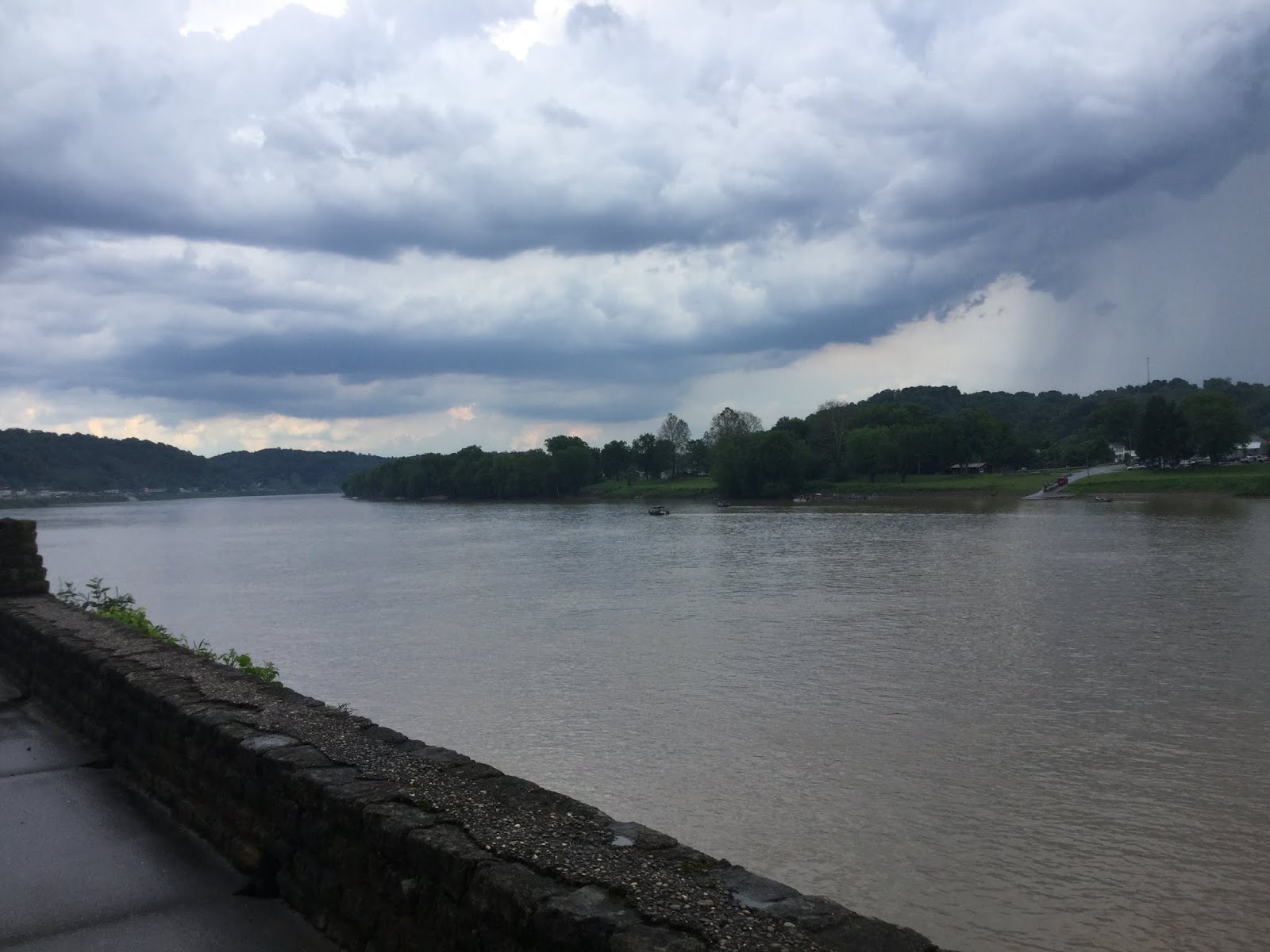
I’d had a steady twenty-five mile climb to Athens from Pomeroy and the Ohio River where I saw a handful of fishermen in the evening hour in a cluster of boats on the West Virginia side of the river. 

The Carnegie in Pomeroy was a block up from the riverside road.  It was now a law office.


The quaint Carnegie in Middleport, just three miles before Pomeroy, still served as a library and had just reopened six days before.  The circulation desk was entirely encased in plastic hung from a network of unfinished two by fours.  It looked like a construction site.  The young librarian said there had only been “five or eight” cases of the virus in the county, but the plastic barrier still made her feel safe.  Rather than a Carnegie portrait there was a portrait of an older woman behind the circulation desk who had been on the library board from 1908 until 1964.


Middleport took its name from being the halfway point between Cincinnati and Pittsburgh.  It was much smaller than Pomeroy, which had a McDonald’s right on the river, maybe the most scenic location of any.  It had a gazebo one could eat under.  It offered walk-in orders, but no seating indoors.  Quite a few were happy to walk in to place their order rather than wait in the long line of cars at the drive-up window.  All those idling cars spewing pollutants were making up for the diminished numbers of cars on the road.

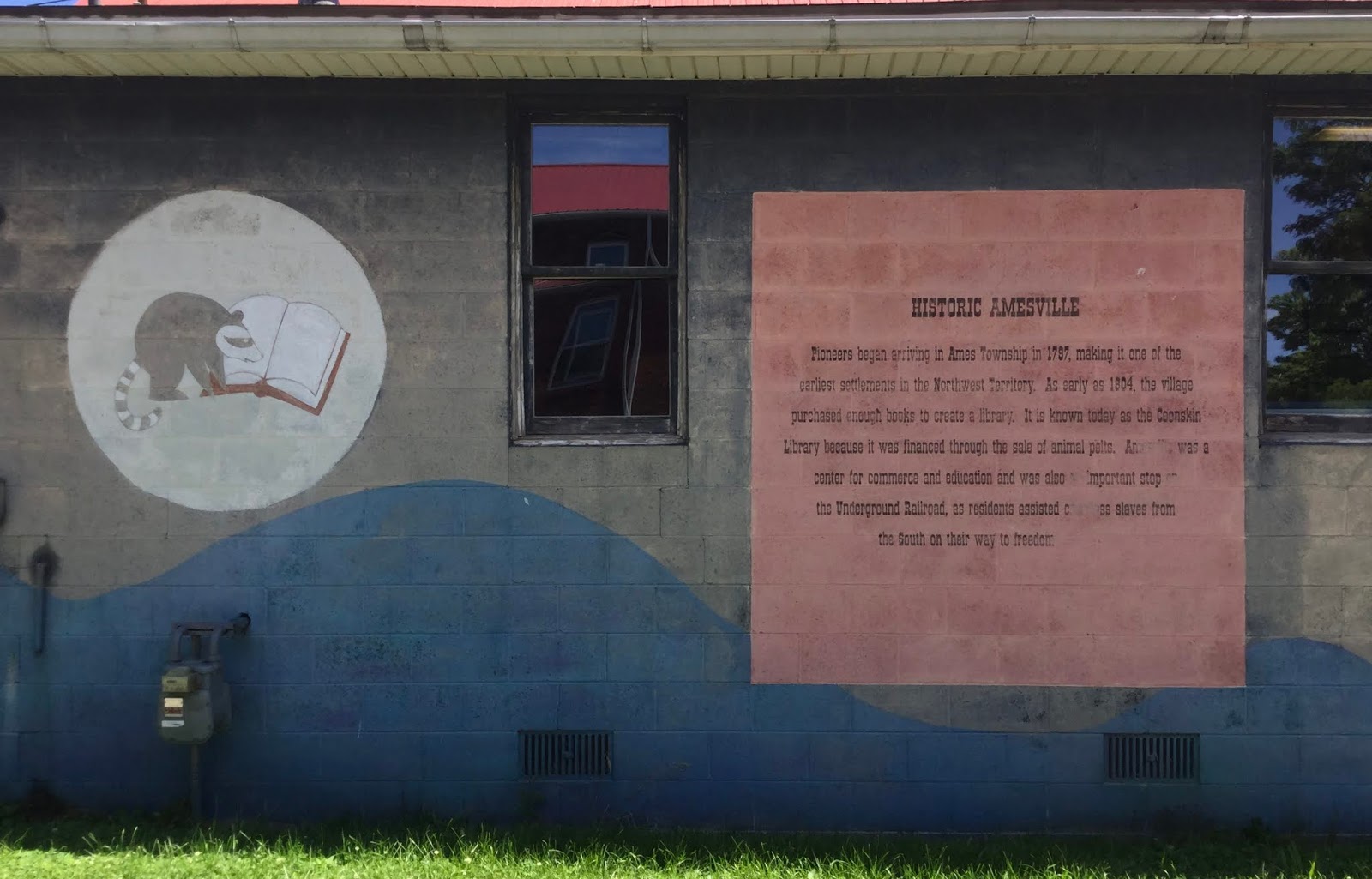
There was no library in Amesville, a town of just 154, but there was a set of lock boxes for locals that books they ordered from the Athens library could be deposited in.


 That was almost as noteworthy as its heritage of establishing a rotating cache of books in 1804 that had largely been funded by the pelts of coons.  A historic marker in the town park recounted the story as did a mural including a coon reading a book.


The forty miles to Marietta were the hilliest of the trip, mostly up and down with rarely a flat interlude.  I was lucky it was ten degrees cooler than the day before with the temperature hovering around 80.  Those two bottles of Gatorade wouldn’t have lasted long if it had been in the 90s.  Instead I only needed one and saved the other for the next day.  The officer was right about the motorcyclists.  There were quite a few but they weren’t a menace at all, always passing wide.  They were a fine sight, especially those with a helmetless, bare-shouldered woman with hair blowing in the wind on the back. And I did find a neckerchief, a black one, still knotted having blown off the head of some rider.  It was my second of the trip, half as many as license plates.

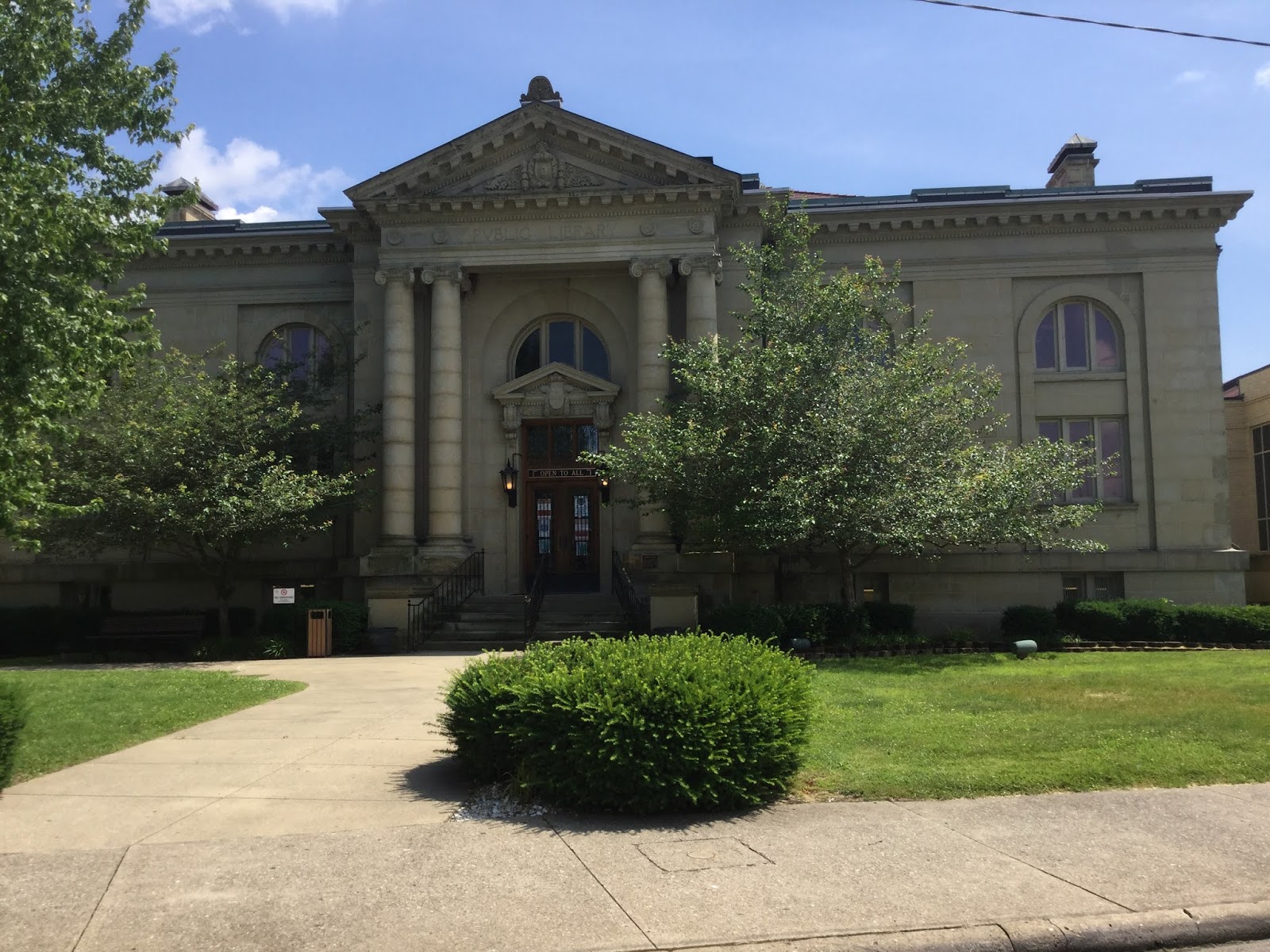
Marietta, back on the Ohio River, offered up a pair of Carnegies, one at the university and the other for the public, both on 5th Street less than a mile apart.  The public library was built on an Indian mound of the Hopewell tribe.  It had reopened but was only allowing one patron at a time.  That didn’t effect me as it was Sunday and not open.


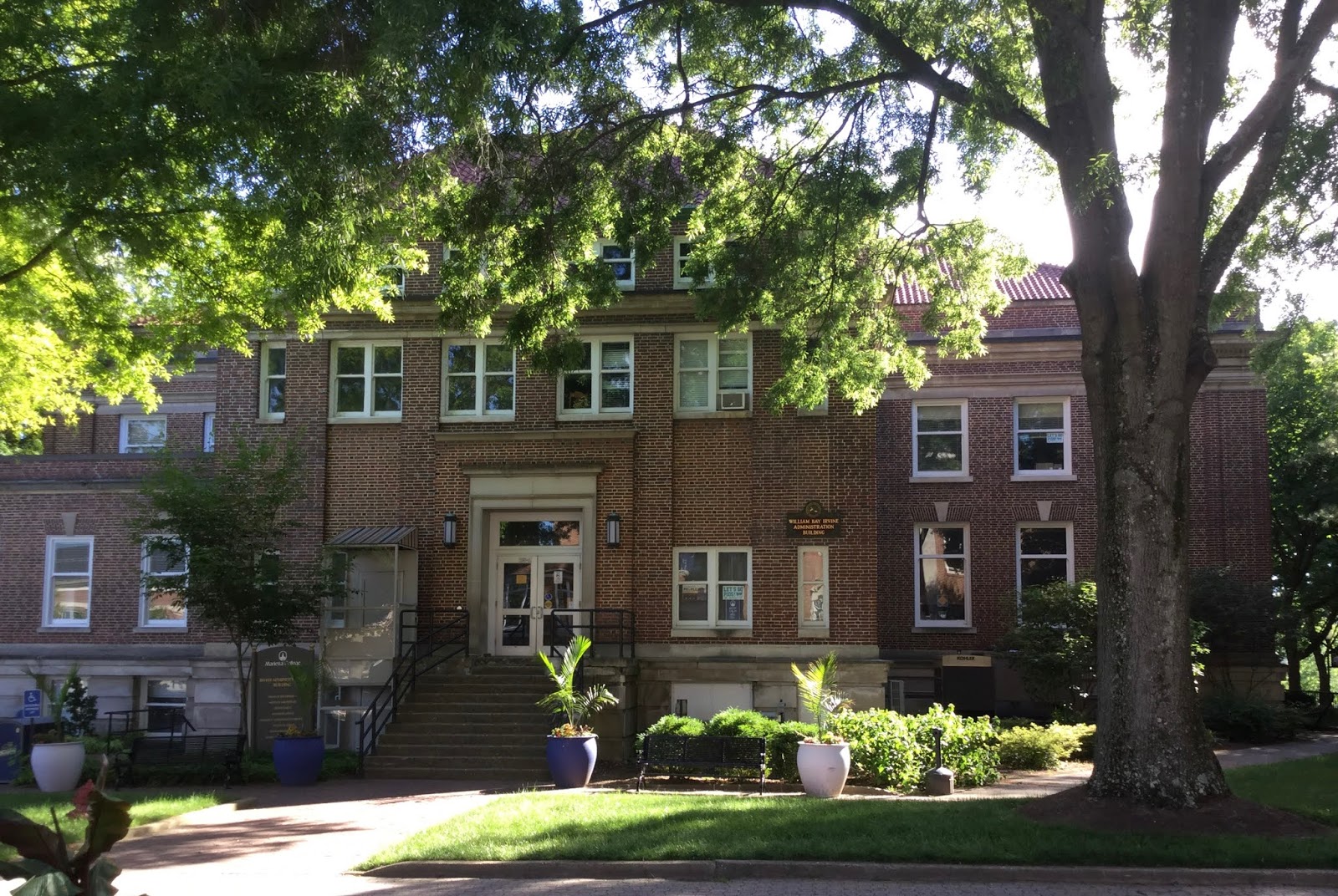
There was an even bigger mound between the two Carnegies that had been turned into a vast noteworthy cemetery where more Revolutionary War officers are buried than in any other.  The Carnegie at Marietta University was now an administration building with the office of the president and others.  

Saturday, June 6, 2020

Gallipolis, Ohio


For sixty miles as I bicycled along the Ohio River Scenic Byway between Ripley and Portsmouth I had glimpses of the Ohio River through the trees, though never long enough to notice any of the barges that ply its waters flowing into the Mississippi. There were campgrounds here and there along the river to my right and inland in Shawnee State Park to my left. But there were even more dilapidated, abandoned barns that were more enticing as a place to pitch my tent, offering the genuine camping experience of peace and solitude plus little threat of the deadly virus.

Not that I have much concern of the virus here.  It’s not much of an issue in these parts.  Rarely does any one tell me of more than a handful of cases in a county or of any deaths.  When I told one young man who was curious about my travels that my Carnegie quest had taken me to South America this past winter, the first time I had mentioned it to anyone during these travels, he stuck out his hand and said, “Congratulations, it sounds like you’ve led an interesting life.”

I hesitated and said, “Is it safe to shake hands around here?”  

“Sure.  I don’t know of anyone who‘s contracted the virus except my aunt and she lives one hundred miles from here.  She thought she had the flu and got tested.  It was the virus, but she was fine in a few days.”

As I repaired a flat tire, my second of the trip just after writing of how I’d been free of flats since Day One, outside a bar in the late afternoon, locals were flocking in convivially greeting each other with no concerns of social distancing.  A few asked if I needed any help with my repair.  One guy told me he had two sisters who were librarians who would be fascinated by my Carnegie odyssey.  Not a one questioned my sanity for wandering the country in these times, nor has anyone else. Nor has anyone expressed alarm at me being an outsider and a possible transmitter.

Unfortunately the Carnegie in Portsmouth wasn’t without concerns and hadn’t  reopened, just providing pickup service.  I had been hoping to be dazzled by its dome as I had been when I visited it in April of 2011.  Instead I had to be content with a mere peek of its interior through the door of this glorious temple of a building. 


I was hoping to ask a librarian how much of an event TOSRV is in Portsmouth.  A pair of murals at the entry to the city celebrated this annual bike ride, the Tour of the Scioto River Valley, that has been going on since 1962.  It is one of the premier cycling events in the country along with the Hilly Hundred in Indiana and the Apple Cider Century in Michigan. 


Portsmouth is the mid-point and overnight spot for this 210-mile ride that starts and ends outside of Columbus.  It was established by Charlie Siple and his son Greg.  Greg went on to be one of the co-founders of Bikecentennial, devising the coast-to-coast trail across the US for the country’s Bicentennial in 1976 that thousands have followed.  The Bikecentennial organization lives on as Adventure Cycling, headquartered in Missoula, Montana.

Father and son are acknowledged on a panel between the the murals at the top of a map of the TOSRV route.  Greg recently retired from Adventure Cycling.  I met him when I ventured to Missoula to visit its Carnegie library and had my photo taken by him for his vast gallery of touring cyclists.  I spent the afternoon at Adventure Cycling reading a rare copy of Ian Hibbel’s book “Into the Remote Places” from 1984.  The bike that Hibbel rode across the Sahara resides at the offices. Siple and his wife June met Hibbel in 1972 in Central America when all three were engaged in rides of the hemisphere.


I left the Ohio River just beyond the sprawl of Portsmouth after a several mile stretch of the most franchises I had been subjected to in days, including a Walmart and the first Aldi’s in over a week, whose dumpster provided a handful of bananas.  I cut inland for the fifty-mile stretch to Gallipolis where I was reunited with the Ohio River.  I camped along a stream infested with mosquitoes.  It was my first chance to test the patching job Janina had done of my tent covering the many quarter-size holes created by the Leaf-Cutter/Scissor ants of Brazil.  She couldn’t cover all the holes, as some were too tiny to deal with, but the mosquitoes didn't find them and the rest of her patching job was a great success.

The Carnegie in Gallipolis resided a block from a large park that overlooks the Ohio River.  The park was dotted with historic signs tracing the history of this prominent river town originally settled by French fleeing their Revolution.  It’s location also made it a pivotal spot during the Civil War.  The stature of the city earned it a little larger than normal grant from Carnegie, funds enough to include a large domed rotunda.   It opened in 1905 and served as the city library until 1978.  It now houses the administrative offices for the school system.  


The new library was open, just the fourth I’ve come upon and the first to require facial covering.  There were signs everywhere warning people to stay six feet from others.  Reunited with the Ohio River I will follow it for twenty miles to Middleport and Pomeroy for their Carnegies and then turn inland to Athens and eventually Columbus.

Thursday, June 4, 2020

Ripley, Ohio


I’ve been camping in some prickly places, but I have managed to avoid puncturing a tire.  I’ve had just one flat so far and that was on Day One fifty miles into the ride in the urban wasteland of Gary a few miles from its Statue of Liberty.  

I took a thorn though to the fore finger of my right hand while clearing branches for my tent two nights ago.  It broke off leaving a fragment deeply embedded beneath the skin.  I spent several minutes trying to puncture the skin with a needle to pop it out, but the skin was too tough, and the thorn too deep and my pain threshold too low to accomplish the operation.  I decided to put it off to the next morning when I could soften the skin with hot water at the next rest room.

It came within ten miles.  After dousing my finger I sat outside off to the side of the service station continuing to probe the skin.  While I was dabbling away a young tow-headed boy approached with his mother.  I was too intent on my operation to realize I was the object of their attentions.  With my head still bowed the boy thrust a dollar bill at me and said, “This is for you.”  After I’d replied with a startled “thanks” his mother reached towards me with three quarters and said, “He wanted you to have this too.”  

I would have liked to have given the boy a sermon on how I was a man of means having an adventure and that his bike could provide him a similar adventure some time in the future, and in fact could take him anywhere as had mine, even to the tip of South America and across Australia and all over the world, but I knew it would fall on deaf ears.  Such words would have denied him and his mother the pleasure of helping the seemingly less fortunate.  A better response would have been to let them return to their car and come after them before they drove off with a five dollar bill to give to the boy as a reward for his good heartedness, but I didn’t think of that soon enough.  

It took a while longer, but I finally extracted the pesky thorn.  It was a great triumph when that black little fragment popped out.  I wasn’t entirely pain free, as I was reminded of the wound on those rare occasions when I had to depress my brake.  But it at least wasn’t the sharp prick of pain as it had been before.

The wind had switched from the north and was now blowing warm air from the south. By noon it was in the 90s and I was looking for an ice cold drink.  In the pre-virus days I would have been hoping for a McDonald’s and it’s one dollar self-serve all-you-can drink machines that also dispensed ice.  But I had yet to come upon a McDonald’s whose seating areas had opened.  Burger Kings in these parts were allowing patrons to come inside and eat, but McDonald’s remained drive through only.  I had ducked inside a Burger King the day before.  Most of its tables had been cleared out and it’s self-serve drink machine had been turned off, but not it’s air-conditioning.

I was desperate enough for an ice cold drink I was willing to avail myself of a McDonald’s  drive-through when I came upon one, even though I would be at the mercy of the amount of ice I got and there’d be no refill.  Before I entered the drive-through line an employee slipped out the front door for her smoke break.  I asked if her store had the dollar offer for any size of soft drink.  She confirmed they did and said rather than having to wait in line she’d go in and get me one.  When I dug out the dollar bill the young boy gave me, she declined it.

There was no shade to sit in and drink, so I went across the street to a service station.  As I sat there savoring the ice cold drink that I’d poured into my thermal water bottle, a guy working road construction wearing a reflective vest asked if he could buy me a cold drink.  I said thanks but I was fine.  

“Are you sure,” he persisted.  “There’s lots of two for ones in there.”

“If that’s the case, I’d be happy with anything.“

A couple minutes later he presented me with two twenty-ounce bottles of coke and put two dollars in my hand and said, “Get yourself something at McDonald’s.”

Before I was on my way a delivery man came over and handed me three boxes of cookies saying, “Here you go man.  I’ve got some extras you can have.”

The heat had amped up people’s generosity. I’d never experienced such a surge of goodwill.   These were the first offerings I’d had in a week since the first two ninety degree days.  And it didn’t stop.  An hour later when I took a break outside a small cafe a forty-year old guy surprised me with a twenty dollar bill.  Not five minutes later a similar guy handed me two fives and two ones.  I felt as if I were some celebrity raising money for a cause.  Or maybe someone had attached a “Homeless vet” sign to my bike.  This was getting serious.  I’d have to start setting these offering aside to donate to Adventure Cycling.  This corona virus had certainly softened hearts.  

But all these encounters had been quick in-and-outs.  Not a single one of these generous souls had lingered for a even a perfunctory “where are you going/where are you coming from,” wishing to minimize their contact with this creature who they thought had fallen on hard times, as if any more time with it would make them feel even more pity and make them want to do more.  But woe unto me to criticize them in any manner.  I greatly appreciated their sentiments, misdirected as they may have been.

I was skirting Cincinnati, as back in November of 2015 I gathered its eight still standing Carnegie branch libraries, all but one of which still functioned as libraries.  On my approach to Cincinnati from Xenia I stopped in Miamisburg for its Carnegie, now the Carnegie Center. It was set a good distance back from the road in a large park with a small fountain between it and the road.  It was constructed of red brick, some of which had been intricately placed in bands. The new library was off to the side.


I was happy to escape the increasing amount of traffic approaching Cincinnati and took advantage of a serene bike path along the Great Miami River that took me most of the way to Middleton and it’s Carnegie.  It was a sad site, all boarded-up and in great disrepair with vines growing up its walls and the roof collapsing.  It had once been a grand edifice with a side entrance to a “Lecture Room.”.  Down the steps to another side entrance a mattress betrayed a homeless encampment.


It was seventy-five miles to the next Carnegie on my list in Ripley down on the Ohio River.  On the way I passed the stately Carnegie in Lebanon that I dropped in on in April of 2011.  It is a rare one with a diagonal corner entrance.  A sign in the entry stated it was closed due to the virus.


Twelve miles before Ripley my route took me through Georgetown, just as had my ride in South America earlier in the year, where I ended up in Guyana’s Georgetown for its Carnegie.  There was no Carnegie in this Georgetown, just a sign announcing that it was the boyhood home of Ulysses S. Grant.  This came as a surprise, as Galena, Illinois claims Grant for its own, though he didn’t make it his home until 1860 at the age of 38.

As I approached the Carnegie in Ripley I spotted a thrilling sign out front saying it was open.  It was into its third week of being open.  It had only minimal restrictions—no more than ten people at a time and just one person at a time in its elevator.  Plastic barriers had been hung around the two check out desks, one in the original library and the other in its addition.  There was no one in the library when I arrived other than three librarians, all wearing masks.  It offered a most welcome refuge from the heat for a couple of hours.


Now it’s on to Gallipolis over one hundred miles away, following the Ohio River for half the distance to Portsmouth, whose domed Carnegie I visited in 2011.  Then I’ll leave the river and cut through hilly country, where I’ll truly be getting away from it all.  It ought to be the best cycling yet.

Tuesday, June 2, 2020

Xenia, Ohio


 It’s unfortunate that Harmony Korrine didn’t film his notorious debut feature, “Gummo,” that 1997 masterpiece that packed Facets for every one of its screenings during its one week run, in Xenia, where it was set, rather than in Korrine’s home town of Nashville, as if he had, he could have featured Xenia’s long-vacant and eerily spectacular Carnegie library.  His delinquent, glue-sniffing, bike-riding teens could have had a grand time romping in and around it.  Korrine would have been pleased to flash on its prominent “Free to the People” chiseled above the entry.

I almost thought I was in a Korrine movie when I passed a handful of raggedy demonstrators galavanting a couple blocks away from the library holding “Black Lives Matter” signs and others with a Korrine edge—“From Slave to Criminal” and “Stop Killing Us.”  It was the first evidence I had come upon of the demonstrations that had rocked the country over the weekend.  They must have been extreme, as the media was proclaiming they were the angriest and most out-of-control since the ‘60s.  

I had no idea what was going on other than an email from a friend in New Jersey that Chicago and elsewhere had been convulsed by rioting over the murder of a black man in Minneapolis by a police officer.  Once again I was glad to be off on the bike, divorced from the cacophony and tumult.  I couldn’t tell if signs I saw posted in front of churches reading “Fear Less, Love More” and “Do not be afraid, God is with you” had just been erected in response to this latest spasm or if they had been there awhile relating to the hysteria over the corona virus.  The most dominant sign though out in rural Ohio has been “Pray to end abortion” in the front yards of many homes.  

I thought I was returning to normal the day before when I had the great pleasure of coming upon a Carnegie that had reopened with no stipulations other than that those who had had “fever, dry cough and sneezing, headaches, chills, or difficulty breathing in the past fourteen days to please come back and see us another time.”  It was in the small town of Rockford.  Unfortunately, it was Sunday and the library was not open.  


But as I’ve experienced in the past in small town America, the door was ajar and I could walk right in.  I dashed back to my bike and grabbed the charger for my iPad and slipped in.  I gave a friendly smile to the Carnegie portrait off to the side above a wall of books and settled in on the floor beside one of the rare electric sockets in this century old building.  I almost hoped a police officer would come barging in, wondering if he’d have gun drawn.  I would be happy to explain my quest, but I continued my streak so far on this trip of not yet having to hand over my driver’s license to a leery officer of the law.

This was my first opportunity to do some charging in a library.  Usually that is my main source along with what juice I can conjure from my generator hub.  I have had to be a little more inventive with libraries and restaurants closed.  I’ve been taking advantage of outlets outside Dollar Stores and service stations. About one in three will have one.  When I was getting desperate I asked at one Dollar Store if I could use an outlet I noticed inside beside the row of shopping carts.  The cashier hesitated for a moment then replied, “Okay, but we’re not reliable for its missing,” as if her spellcheck had gone haywire. 

It was forty miles due south from Rockford to the next Carnegie in Greenville.  I glided along past the recently planted fields with a refreshingly cool tailwind.  After starting this trip with back-to-back sweltering ninety degrees days, a shift of the wind from the north has brought almost fall-like seventy degree temperatures that have dipped into the fifties at night.  I haven’t had to buy a cold drink, other than chocolate milk, since those first two days, nor be worried about having all my water bottles full in the evening.  On day two I found a cyclist’s water bottle along the road, an item I couldn’t resist scavenging even though I had four with me.  A fifth was hardly necessary, but I added it to my reserves for a little extra peace of mind.

The Carnegie in Greenville was a palace of a building with additions to its sides that nicely blended in, making it the most exemplary of the first ten of these travels.  It too carried that welcome of “Free to the People,” a reminder that libraries weren’t necessarily free in the early 1900s.  Greeenville is a much larger town than Rockford and wasn’t prepared to let its masses back in.  At least it’s WiFi was still operating, which someone else was taking advantage of.


I camped in another forest just outside of Greenville, then proceeded thirty-five miles to the mini-metropolis of Dayton, the sixth largest city in Ohio with 140,000 inhabitants.  Carnegie had provided two branch libraries, but only one remained, on the east side of the city.  In the center of the quiet city, which betrayed no evidence of the chaos convulsing the land, a tall building had a quote from Rita Rae Brown that could be seen from blocks away, that proclaimed, “When I got my library card, that was when my life began.”  I circled around the building, assuming it to be the main library, only to discover it was the administration center for the library system.


A couple miles further the Carnegie I had come for sat in a park all to itself in a residential neighborhood.  It was no longer a library, but now the quarters for a development company.  


Xenia was fifteen miles to the east of Dayton.  I took advantage of a well-used bike path most of the way. And on the way out of town I passed through a rare roundabout, reminding me that if it weren’t for the virus I’d presently be in France, roundabout heaven.  If Korrine had filmed “Gummo” in the region he could have included another Carnegie Library just three miles outside of Xenia on the campus of Wilberforce University, the first black college in the US, founded by the Methodists in 1856 and named for the British abolishionist William Wilberforce. Ohio can also boast the first white college in the US to admit blacks, Oberlin, which also has a Carnegie Library.  Wilberforce’s Carnegie now serves as the administration offices for the nearby National African-American Museum and Cultural Center.


Halfway between Xenia and Wilberforce is a national monument, the home of Charles Young.  He was born a slave in 1864 and went on to be the third black graduate of West Point in 1889 and last until 1936, a startling 47-year gap without a black graduate  Through much of his career he was the highest ranking black in the US Army and was the first black National Park superintendent.

Also in the vicinity, six miles down the road in Cedarvillle was another Carnegie Library on the campus of the Baptist Cedarville University.  It is now the Carnegie Center for the Visual Arts.


Sunday, May 31, 2020

Delphos, Ohio


Once I reached the first Ohio Carnegie on my agenda in Wauseon they started coming every twenty-five miles or so.  With none open so far I plop down at the entry of each for a spell using its WiFi, provided it doesn’t require a password.  Wauseon actually offered its password (bookemdano).  The WiFi was strong enough I could sit on a nearby bench.  

It was a rare Carnegie with an entrance at sidewalk  level.  Most have several steps (symbolically ascending to knowledge). The two-story building had a glassy addition to its side.  It was providing curbside pickups, but I arrived after its hours of operation so couldn’t have a word with a librarian or a glimpse of the interior.

My time at each library firmly implants an image of its majesty, which I carry as I pedal to the next and then is replaced by the latest, though not for good, as any can pop up at any time, always giving me a wave of pleasure.

My approach to the next Carnegie in Maumee took me through several blocks of homes, several of which had signs out front saying “A Hero Lives Here.”  I’d been seeing “Heroes Work Here” banners in front of care facilities and hospitals and food processing plants, but these were the first to identify where heroes lived.  It might have been that Maumee was a larger town than most and had a greater percentage of heroes, as it was on the fringe of the metropolis of Toledo. I was spared going into Toledo as I had visited its three Carnegies on a previous trip when I gathered all those in Cleveland and then along Lake Erie to Toledo.


Maumee’s Carnegie sat in a sprawling park.  It had had a couple of extensive additions, totally blocking its original entrance, putting the new one on the opposite side of the complex by its large parking lot.  A sign by the bike racks advertised “WiFi Zone.”  I was the only one taking advantage of it, but two cars pulled up while I was there to pick up books.  The books were placed just inside the entrance on a table, so there didn’t need to be any human contact in the transaction.  


The library was a block from the large Maumee River, which flows into Lake Erie.  I was able to follow it for fifty miles to the Carnegie in Defiance, easily the best cycling of the trip on a lightly traveled secondary road.  I passed through Napoleon and was able to drop by its classic Carnegie, which I had previously visited in April of 2014.  It is well-maintained and unmarred by additions.  “Carnegie Library” is chiseled into its facade, though it no longer serves as a library, rather storage for the new nearby library.


I had my best campsite of the trip in a forest along the river.  I’ve been in a forest every night so far, but all previously had been within range of habitations with the danger that a dog might sniff me out and in such tight bushy quarters that I didn’t have room to raise my tent and shake out what debris had gathered in it when I took it down in the morning. I severely gashed my shin on a fallen log I hadn’t seen at one such campsite saturating my sock with blood.  I’m still smarting from the wound.  This was the first campsite without deer making their presence known with their snorting version of a growl.  

I was able to fill my water bottles at a park area along the river.  As at the Walmarts, the drinking fountains were turned off, but the rest rooms were open, though a sign in front of them warned, “For emergency use.  Not recommended for general use.”  There was hot water as well as cold in the rest rooms, and a soap dispenser, so I could thwart the virus.

The Defiance Carnegie was right on the banks of the Maumee at its confluence with the Auglaize overlooking the remains of Fort Defiance, built in 1794 during the Indian wars in the region.   It took its name from the general who built it, Anthony Wayne, who proclaimed, “I defy the English, Indians and all the devils of hell to take it.”

The Tudor Revival building with a red sandstone facade was flanked with jarringly modern additions.  But two large trees somewhat obscured them and the grandeur of the original so dominated the additions, they could easily be ignored.  Still I couldn’t wipe them from my mind’s eye as I cycled on to Paulding for its Carnegie.


The Paulding Carnegie was the first of these travels with a plaque out front tracing its history as the first Carnegie to serve an entire county, earning four times the usual $10,000 grant for small towns.  


As so often happens, the plaque bungled the numbers of Carnegies, both world wide and in the US.  The actual numbers are 1,679  in the US and 2,509 world wide.  The plaque was way off with  1,946 and 2,811.  


One of the memories I carried on to the next Carnegie in Delphos was of a guy cutting the grass at the library on a riding mower flying the American flag.


I had to verify I had the right address for the Carnegie in Delphos as the library at 309 West Second Street bore no resemblance whatsoever to a Carnegie.  But the address was correct, as this was another of those Carnegies that had been totally swallowed up by its additions. Only the backside revealed the original brick of the building.  The additions had no character and were bland standard fare.  A neighbor at his barbecue said that when the library was redone a statue of a soldier on a pedestal that had been out front was also removed and transplanted to another park.


Along with all the images of Carnegies I have been transporting, I’ve also been lugging a heavy heart.  Two faithful readers of this blog since it’s inception have passed since my return from Brazil, Charlie in Everett, Washington and Robin in St. Louis, though not from the virus.  They were friends and supporters for decades who often replied to my writing. I am at a loss knowing that I won’t be hearing from them during these or any of my travels to come.  

Friday, May 29, 2020

LaGrange, Indiana


It’s been over two months since I set foot in a library, quite a disruption to my routine as when I’m Stateside visiting a library is nearly a daily occurrence.  I wasn’t expecting to find an open library quite yet when I set out to Ohio to round up the 53 of its 103 still standing Carnegies (eleven have been razed) that I have yet to get to, but I needed to expand my riding beyond the bounds of my vicinity and wanted to start adding to my Carnegie collection whether I could enter them or not.  

I had been checking on the status of some of them to see if any had possibly reopened.  None had, but some had begun offering curbside pickups, which might allow me a peek inside.  Though it would be a disappointment not to gain entry to the libraries and give them a wander and sit for a spell, I am accustomed to reaching Carnegies on Sundays or other times when they aren’t open, so that was not a reason to be deterred.  Their exteriors were their most prominent features.  I could be plenty pleased with that.  But most importantly I wanted to be biking and camping, as these quests allow.


My eagerness was more than rewarded when 150 miles into my ride across the top of Indiana to Ohio I discovered an open library in LaGrange in the heart of Amish country. It was a Carnegie that I had previously visited, and was only stopping at to renew acquaintances, not expecting anything more.  But lo and behold, it had reopened, albeit with considerable restrictions.  

Visits were limited to twenty minutes and children under twelve were not allowed in.  Patrons had to observe the six-foot social distancing protocol and were encouraged to wear masks, but not required, though staff was.  I’m not sure what filled me with the greatest joy, returning to a Carnegie or simply being in a library after having gone so long without.  I was almost giddy with glee at this unexpected pleasure being amongst stacks of books and absorbing the aura of this temple. I had no concerns about overstaying my twenty minutes as I had arrived near closing time and could only duck in and out.

All across Indiana at every gas station and grocery store I had stopped at, not a one mandated masks.  All had signs about being careful and many had added plexiglass shields at the gas register.  One store warned, “Please do not enter if you have a fever or a cough.”  A sign at the entry to a Walmart advised, “Face coverings are recommended while you shop.”  Not too many shoppers were obliging, though all employees were.  The greatest hardship was it’s pair of drinking fountains having been turned off, forcing me to fill my bottles in it’s restroom, which only dispensed hot water.  It’s was over 90 outside, so it didn’t take the bottles long to cool to the outdoor temperature.

Not a single restaurant, fast-food or otherwise, provided other than takeout service, so I was relegated to taking my rests and eating breaks outside Dollar Stores or service stations.  I saw a couple sitting at a table inside a Taco Bell and hoped it might have opened so I could take advantage of its air-conditioning, but it was a manager conducting an interview.  She was nice enough to let me fill my water bottle with ice and cold water from the self-serve soft drink dispenser.

These trying times have brought out more than usual courtesy and decency among those I have encountered.  As I sat outside a 7-11 drinking a super Big Gulp and eating a peanut butter sandwich a guy thrust a dollar bill into my hand.  At another store a scrawny young man in a singlet with two little girls in tow asked, “Could you use a couple of bucks?” He hadn’t dug them out of his pocket yet, so I could decline his offer.  A driver of an 18-wheeler who had just made a delivery at a Dollar Store saw me sitting along the side of the building in the shade reading a book. He asked what I was reading and then asked if I was okay.  I told him I was fine and was heading to Harrison Lake State Park to meet a friend.  

Though I had no new Carnegies to search out on my ride across Indiana, as there isn’t a one in the state that I haven’t visited, I did have a couple of those eight-foot tall Statue of Liberty replicas that the Boy Scouts made available to communities in 1950 to celebrate its fortieth birthday to search out.  Only about two hundred communities took advantage of the offer, but they are to be found in 39 states and  four territories.  


Ohio is one of the few states without one, but there were two across the top of Indiana for me to add to my collection.  The first was in Gary.  I had to do a little searching to find it, as Wikipedia was wrong with its location.  It wasn’t in front of the city hall, but rather across the street and on the other side of Broadway on the corner of a large empty lot gazing upon City Hall.  More prominent was a mural of the Jackson Five, who grew up in Gary, a couple blocks away more in the center of the city.


The next Statue came in South Bend  in front of its courthouse.


It bore the identical plaque as the one in South Bend, though with a different year, a year later than Gary’s, as the program went on for two years.  It is a surprise that there are only two hundred of these Statues scattered around the country. I would have thought there’d be as many as Carnegie libraries, 1,679, presuming that most Boy Scout troops would have been administered by citizens with connections to civic leaders who would have wanted to acknowledge the Boy Scouts and have such an icon of a statue.


But this was the McCarthy era and this may have been a divisive issue in some communities.  It is so long ago google doesn’t offer up much on the program.  But I will continue to seek these statues out as these iconic figures stir the emotions.  I’m just sorry I wasn’t aware of them when I was in the Philippines, as there is one there.

I had been hoping to meet up with Rick from Lansing on Saturday at Harrison Lake State Park just south of the border with Michigan.  It would have been a ninety-mile ride down for him.  But he became concerned about encountering people not as concerned about the virus as he is, and decided it best to stay home.

I don’t know whether I am brave or foolhardy or simply rational to be venturing out into the corona virus world.  Janina accuses me of being a Viking and not being risk-adverse.   I may be of Danish heritage, but I’m inclined to the Swedish approach to this virus.  I will be careful, but not paralyzed by anxiety.  I prefer to hope for the best rather than fearing the worst.

I was somewhat concerned about the feasibility of touring in these times.  I feared some dictum might have been issued to law enforcement officials to detain transients and place them in confinement as some of Chicago’s homeless have been in a motel near where I live in Countryside.  

But a report from a touring cyclist who recently completed a coast-to-coast ride without any interference removed my doubts.  A motorcyclist friend encountered the cyclist in Texas in mid-March half-way to reaching his grandfather in Florida after starting out in the Bay Area.  It was just before staying-in-place became the norm.  My friend told the cyclist he knew someone who had just bicycled the length of Brazil.  The cyclist said, “You know George?  I’ve been reading his blog for years.  This is my first tour thanks to him.”

My friend told him he ought to email me.  When he never did I emailed him to ask how it was going out there.  Here is his encouraging reply:

Dear George,

Yes! Since meeting Keller in Presidio I have had a wonderful trip across the South. My goal was my grandfather's house in Ocala, Florida, where I landed last week. Along the way I took a detour up into the Ozarks and then down through rural Mississippi and Alabama. 

For the most part, folks have been wary of the virus but the atmosphere hasn't been too tense. Campgrounds all closed, but I had already realized that a solo forest spot is a much better option. Dining in a restaurant had been an extravagant choice to begin with. The rural police have always passed me with nothing more than a friendly wave.

At the start of my trip, folks would sometimes stop and offer me water or food or even invite me to stay in their trailer; I think this has been the biggest loss. Still, in southern Alabama when a woman looking for a horse heard that I was biking from California to see my grandfather in Florida she told me that I touched her soul and got out of her car and tearfully hugged me. It is wonderful to experience not only the joy of riding a bike but what it can inspire in others.

I've decided to continue on with my tour. Today, emerging from the Everglades into the edges of the Miami urban sprawl, I had my first taste of what life has been like for my friends back in the Bay Area and, no doubt, in Chicago and all major cities. I had felt more comfortable with the panthers and black bears and invasive pythons so tonight I am back in the Glades. In a few days I will begin to head up the Atlantic to visit my uncles in Virginia.

I must mention how floored I was to receive your note. I imagine that it was how a Catholic would feel receiving an email from the Pope. I am absolutely certain that I would not be out on my bike now had I not discovered your blog well over a decade ago. It was like a thunderbolt from Zeus himself; I read every entry, agog, with a map on the other monitor as my mind reeled that this was possible.

After Virginia I hope to continue northwards and perhaps loop back towards California. If I am extraordinarily lucky, we will cross paths, but no matter what the sheer happiness of a day on the bike will shine through me. Thank you so much for achieving true bicycle enlightenment and sharing it with the world.

All the best,

Chris

If I were to have a tombstone, I might want a sentence or two of this to grace it. Such sentiments convey a semblance of assurance that the life I have chosen, or that has chosen me, has not been a futile gesture. 


Saturday, May 2, 2020

The Nine Cycle Touring Books of Steven Herrick


Under normal circumstances I’d presently be in the midst of my annual six hundred mile pilgrimage to Cannes, cycling down from Paris.  Thanks to the pandemic, for the first time since 2004, I’m at home in May with no Cannes Film Festival nor Tour de France in my immediate future.  I would have been setting out in fine shape with over 5,000 miles in my legs after my traverse of Brasil earlier this year riding from Uruguay to the Guianas.

Though that was over two months ago, I’ve maintained my conditioning with daily forays gathering rocks, twenty-five pounds or more at a time carried in a milk crate on the back of my bike.  We’re turning our yard in a Goldsworthy rock garden. I have a number of gathering spots, mostly near rivers.  This is a hotspot of limestone, attested to by a giant quarry.  It defines the area to the extent that a sprawling shopping center with multiple stores, including a Walmart and Target and Petsmart, is known as The Quarry.

It’s been a fun project, adding to the many rocks we’d accumulated over the years, truly embellishing our surroundings.  In between these outings I have continued to vicariously escape my semi-confinement reading about being off to other places  Prime among them has been a vein of nine cycle touring books by Australian Steven Herrick, six of which included excursions through France.

Herrick was 53 when he commenced his touring career in 2012, two years after he had taken up cycling when he realized he needed to lose weight.  After several thousand miles of bicycling around his mountainous neighborhood, he had become “a confirmed cycling nutter,” and decided to head off to France to ride a popular cycling route along the Loire River and then capping his trip riding some of the storied Tour de France climbs in the Alps.

Since he was a writer, having written nearly twenty children’s books, he turned his journal into a book, “Baguettes and Bicycles,” and then returned to Europe the next six years for another ride and another book.  He brought his wife along for the next ride from Bordeaux into the Pyrenees, and she accompanied him on all the rest.  They range all over Europe, but France is their favorite country, so every trip except one includes a foray there.  The lone exception is their ride along the Danube, his third trip, recounted in “Bratwurst and Bicycles.”

They commence “Cycling North,” book number five, in Marseilles and continue to the fjords of Norway.  They followed that with “Cycling South,” starting in the highlands of Scotland and ending up in the islands of the Mediterranean including Sicily.  They couldn’t have been happier when they crossed into France from England, escaping the chips dominated cuisine.

Every book comes with the disclaimer, “Cycling is just an interlude between meals,” which Herrick attributes to his wife.  The books are extremely heavy on what they eat.  By his third book, and in nearly every subsequent one, he feels the need to defend his emphasis on eating and his style of touring, staying in hotels and eating in restaurants, which comes under criticism from the more hardcore touring cyclists who camp and eat food of their own preparation. He claims admiration for those willing to rough it, “more power to them,” is his repeated commendation, but sleeping in a “flimsy tent” and eating “noodles or pasta” is not for him.  He likes ending his day with a shower and beer and a long, leisurely meal “eating his fill“ and maintains it is a fine way to get to know a country, as if camping does not offer a similar opportunity.

It is a shame he never gave camping a try, as their environment and the people he would have met in campgrounds would have given him a much greater insight into the countries he bicycled through and much more interesting material to write about than all the food he ate.  Camping further emphasizes the freedom and independence that are the essence of traveling by bicycle, especially if one wild camps in forests and fields.  One is fully unshackled when one’s itinerary isn't dictated by sanctioned places to stay, and having to end one’s day prematurely when the cycling is too good to stop simply because there is no hotel or campground up ahead.  The self-sufficient cyclist can keep riding to his heart’s delight.  But eating, not biking, has a greater appeal to the Herricks.  They are appalled when they meet a pair of cyclists along the Danube heading to Turkey averaging 100 kilometers a day.  “How do they see anything,”  is their response, as if one can’t see anything from a bicycle seat.  Imagine if they met someone doing 100 miles a day.

By his eighth book, the first of two on touring in Japan, he’d become so sensitive to readers taking him to task for his dependence on hotels, he brags that his success as a writer of children’s books has allowed him to be able to afford to stay in comfortable accommodations, and adds, “I’m so indulgent I even travel with my wife.  Shoot me now.”

In all his books he regularly gives the cost of meals and hotels and frequently says they are a bargain compared to Australia.  A favorite phrase of his is to ironically add “princely sum” to the cost of something, as if it was next to nothing.   He is cost conscious enough though to be delighted when the WIFI doesn’t work at a hotel, because it invariably means he’ll get a free breakfast out of it.

His first few trips were on a bike he called Craig, in honor of the weight loss program Jenny Craig.  The children’s writer in him fully anthropomorphizes Craig.  He talks to it and gives it pats of encouragement and is concerned about its sleeping arrangements when it is forced to overnight in a garage. His wife’s first bike goes by Jenny.  He checks on the two of them in a garage one night and notices Craig’s handlebar is touching Jenny’s seat and observes, “She doesn’t seem to mind.”  Another night when they are cooped up with a bunch of other bikes he fears Craig has kept them up late bragging about the extent of his travels, something perhaps his owner is prone to do, as he mentions from time to time that people he meets are impressed by how far he has ridden and mountains he has climbed.

He develops the personality of Craig more than his wife other than to say she is beautiful and is a belly dancing teacher.  Her profession merits some commentary, but he offers not a single anecdote, unlike his references to his own career as a writer of children’s books and his occasional public appearances.  She is a mere ornament and rarely mentioned.  He does give her credit in book number six for introducing him to the term for a gathering of flamingos.  It is a “flamboyance.”  That must have sent him to an anthology of similar terms for other animals as in his later two books on Japan he drops in the term “murder of crows” with no explanation.

As far as his mechanical skills go, he admits it is a struggle to assemble his bike at the start of a tour, writing, “As a bicycle mechanic, I make a great poet.”  Once when he got a flat near a bicycle shop, he turned over the operation to the shop, though he otherwise manages on the road.  Before he climbed Mont Ventoux on his first trip he acknowledged he had to be capable of repairing a flat, writing, “What would I do? Cry?”  He is so ecstatic about conquering Ventoux, when he calls his wife back in Australia to tell her he is near tears.

Though he seems to know something of the Tour de France and racing, he makes no mention of the Australian icons Cadel Evans or Phil Anderson.  He doesn’t appreciate that each of the twenty-one switchbacks on L’Alpe d’Huez are named for a winner of the stage, thinking its “cheesy.”  He misspells the Alpe as Alpe de Huez in “Cycling North.”  That can be passed off as a typo, but not his comment that Tour climbs are rated from category six to HC (for Beyond Category), as the categories begin at four, not six.  Much more egregious is his assertion two books later in “Boulangeries and Bicycles” that climbs are rated from one to five with one being the easiest.  One is the hardest and they begin at four not five.

He is wrong too on one of the most famous incidents of Tour lore that he recounts in “Bordeaux and Bicycles.”  He states Eugene Christophe was disqualified from the 1913 Tour for allowing a young man to operate the bellows as he repaired his fork which he broke descending the Tourmalet.  It was a seven-year old boy who operated the bellows, and Christophe wasn’t kicked out of the race for the unauthorized assist.  He was penalized ten minutes, later reduced to three, which hardly mattered as he spent three hours completing the repair.  It is such a storied event that there is a plaque on the old stone building where it took place, and it was re-enacted on the 50th anniversary of the event with Christophe and the boy.

Since these are all self-published books it is explainable that such slips come through.  Another was spelling Johnny Hallyday, as “Halliday.” The books are far from typo-free.  They are dotted with a recurrent typo of  “a” before words beginning with a vowel (a old road, a elderly Dutch couple) and “an” preceding words beginning with a consonant (an steady, an poorly designed).  It is perplexing that these haven’t been corrected in the ebook versions I was reading.

One has to question his credibility as a touring cyclist when even by book seven he’s still lamenting there is no such thing as waterproof clothing. He’s not paying attention, as they are out there, such as the Arcteryx jacket that for years has kept me perfectly dry in typhoons and monsoons and day-long rains.

Herrick’s last two books on cycling in Japan, with the second beginning in South Korea, offer no explanation on why he moved on from Europe.  He did mention that he’d also cycled in Thailand and was at work on a book of that trip. The two Asia books were much shorter than his European books, just eighty pages.  I was fortunate to be able to read all nine of these for free thanks to a trial offer of kindle unlimited, which allows one to read as many books as one can for $9.99 a month.  Unfortunately, the majority of kindle unlimited books are of the self-published variety and doesn’t include many mainstream titles.   One can read any of  Herrick’s books for between $2.99 and $5.79.  He’s obviously found a market to keep cranking them out.

Though none of his books offer much more than the cycling journals one can find at Crazyguyonabike.com, they at least have the polish of a professional writer.  I kept reading them as they do give a glimmer of  that sensation of being out on the road.  If nothing else, he can be commended for being a strong advocate of cycle touring, affirming there is no better way to travel. And he is right too that there is no better place to tour than France.