Monday, June 17, 2019

Valenciennes, France

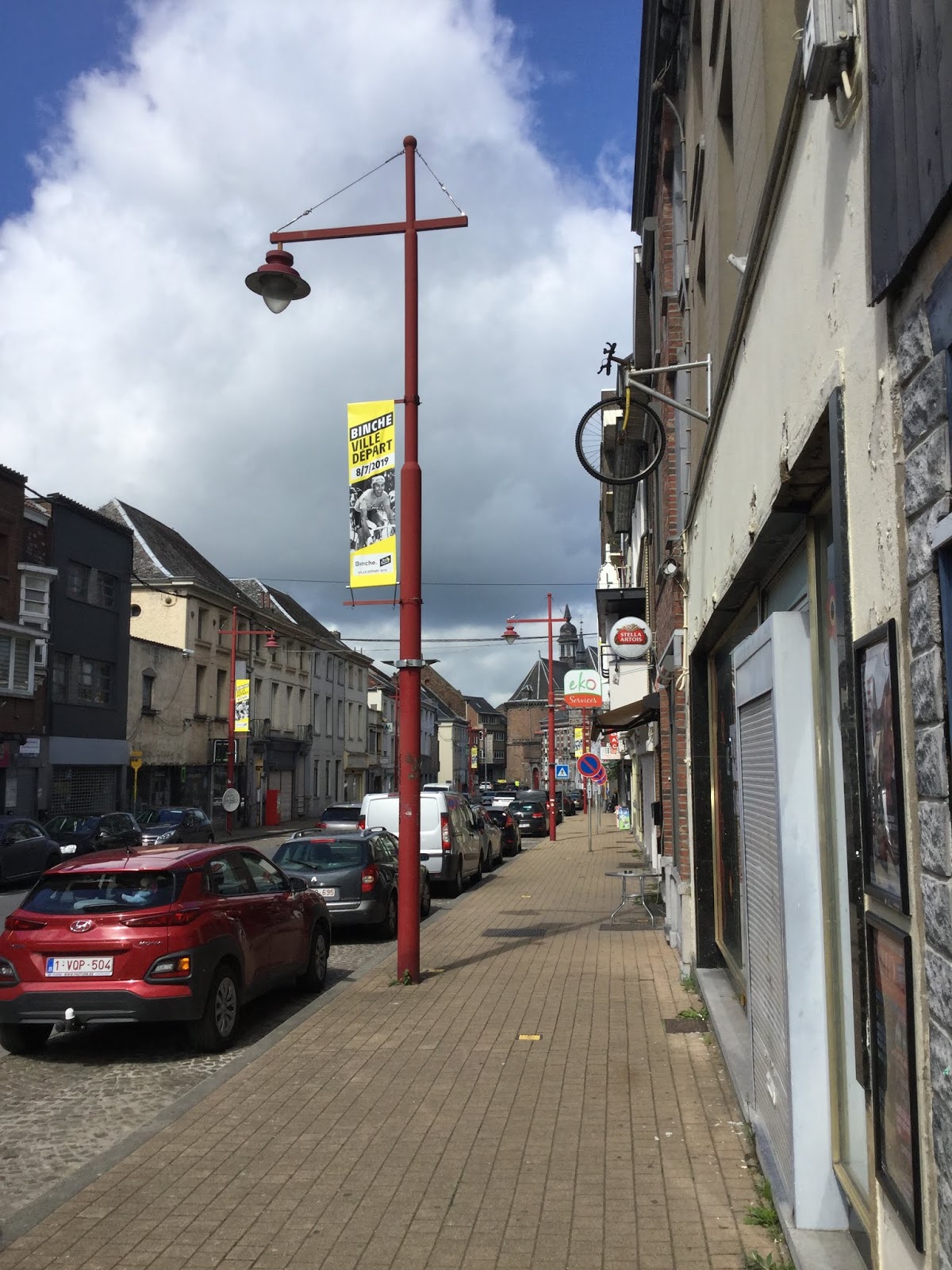
The theater in the main plaza of Binche, Belgium, start of Stage Three of this year’s Tour adorned with photos of a young Eddie Merckx.

At the opposite end of the plaza.


The street where  the peloton will commence the stage.


A few blocks from the stage start.


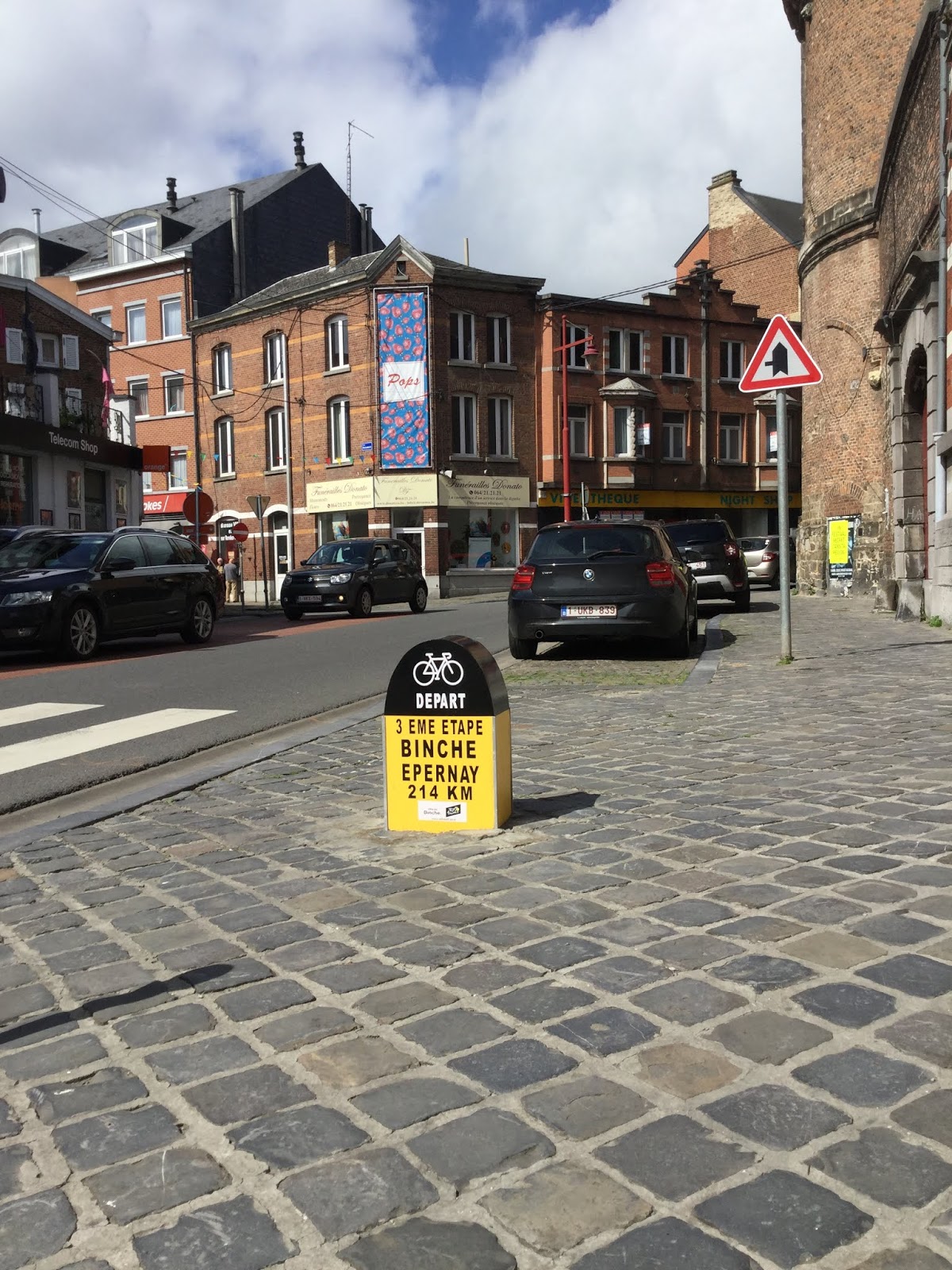
The starting point of the stage.


Planters in front of the town theater.


The first roundabout in Belgium, six miles from the stage start.


Another airborne cyclist further down the route in France.


A gathering point in the town plaza in Valenciennes for World Cup fans.


On my daily wander through the supermarket gathering my provisions for the day I am occasionally drawn to the snacks aisle for a package of peanut puffs.  It is rarely premeditated.  I have passed it off an impulse-buy until I heard the sports physiologist Dr. Allen Lim, who is an authority on cycling, give a fascinating dissertation on sweating on the Cycling Tips podcast a couple of days ago.  He said that when one is dehydrated and low on sodium one is drawn to salt.  The body knows, he said.  


He recommends sports drinks to keep one in balance.  Gatorade was the first in 1965.  Now there is a vast array to choose from.  He asserts that drinking water isn’t enough when one is dehydrated, that it can actually be harmful as it will further exacerbate the imbalance between sodium and water in one’s system.  There are salty compounds one can add to one’s water for a quick fix that are so salty they’d be repugnant if one weren’t dehydrated.  One’s taste buds don’t cringe at excessive salt when the body is craving it.  The instructions on one additive state to keep drinking it until it tastes salty, as it won’t seem salty when one’s body is short of salt. 


Lim gave as an example a friend’s restaurant in Boulder.  In the summer diners often complained that its food was too salty.  The head chef discovered that his chefs working in the heat were semi-dehydrated and when they tasted sauces they were preparing they seemed to need more salt according to their usual taste test. When the head chef mandated his chefs keep hydrated with sports drinks, keeping their salt levels in balance, diners stopped complaining of too much salt.


Lim’s commentary will have me keep a stock of salty snacks in reserve, at least until I come upon the next Decathlon sporting goods store where I can get a container of a powdered sports drink for the hot days ahead.  Sweating hasn’t been an issue of late, as it’s been cool and overcast as I reach Northeast France and close in on Belgium. I was happy for some sun yesterday so I could give my sleeping bag and sleeping pad a blast of sunshine to remove their dampness and also to eliminate a possible infestation of bugs.  


I awoke with a rash of bites such as I have never experienced before on the soft untanned skin of my inner thighs and abdomen and the underside of my arms.  I have no idea what feasted on me during the night.  I’ve had a few of the usual mosquito bites and ticks attaching themselves to me, which are just a minor nuisance, but these weren’t from them.  I’ve learned to be careful to brush off any of my gear I may have placed on the ground before putting them into the tent, less bugs, particularly spiders, have attached themselves.  But something in the forest I camped in penetrated my defenses and has had me itching all day.


At least I could thrill to the preparations that Binche, just seven miles into Belgium, has made for its hosting of The Tour’s third stage departure three weeks from today.  I followed the route the peloton will take due south from Binche to Reims and on to Épernay though small towns.  The terrain through fields of wheat was mostly flat, broken by a few sizeable hills.  


Shortly after crossing the unmarked border into Belgium a roundabout in front of a McDonald’s gave the first evidence I was in Belgium with its flag planted in its center and surrounded by cutouts of The Tour Jerseys.  The main street through Binche where the peloton commence its day was lined with banners of Eddie Merckx.  An oversized version of the same photo of the young Merckx adorned the theater in the city’s main plaza.  In front were planters of flowers with yellow wheels and yellow frames.  An aloft giant bicycle had been erected at the opposite end of the plaza.  It was a stunning site.   A lengthy mural of cyclists had been mounted several blocks down the route from a post that marked the official starting point.  They all added to the building excitement of Binche’s historic day of hosting The Tour for the first time.


Rather than penetrating deeper into Belgium to Brussels thirty-four miles away, the site of the first two stages, one a team time-trial, I returned to France for a couple of day’s before my full immersion into Belgium wandering all over visiting its many cycling shrines.   I wanted to drop in on Valenciennes, the smallest of the nine cities in France hosting the Women’s World Cup. The others are Paris, Lyon, Le Havre, Montpellier, Reims, Nice, Grenoble and Rennes. It was the only one that hadn’t been a Ville Étape during my fifteen years of following The Tour de France. The second of the six games to be played there had been played the day before.  


I was hoping there might be a giant screen in the town plaza showing the USA-Chile game being played in Paris. The square did have an enclosure for fans to gather, but there was no screen showing games being played elsewhere.  France is one of the favorites to win, along with the US.  Hopefully the fervor will gather as the tournament gathers momentum and I’ll have an opportunity to watch France in the championship game as I did last year in a huge stadium after Stage Nine of The Tour when the men’s team won the championship. Far better to have sports to preoccupy one’s attention than current events. 

Friday, June 14, 2019

Reims, Ville Départ Stage Four


A monument in Bar-le-Duc to Pierre and Ernest Michaux, who in 1861 added pedals to the forerunner of the bike.


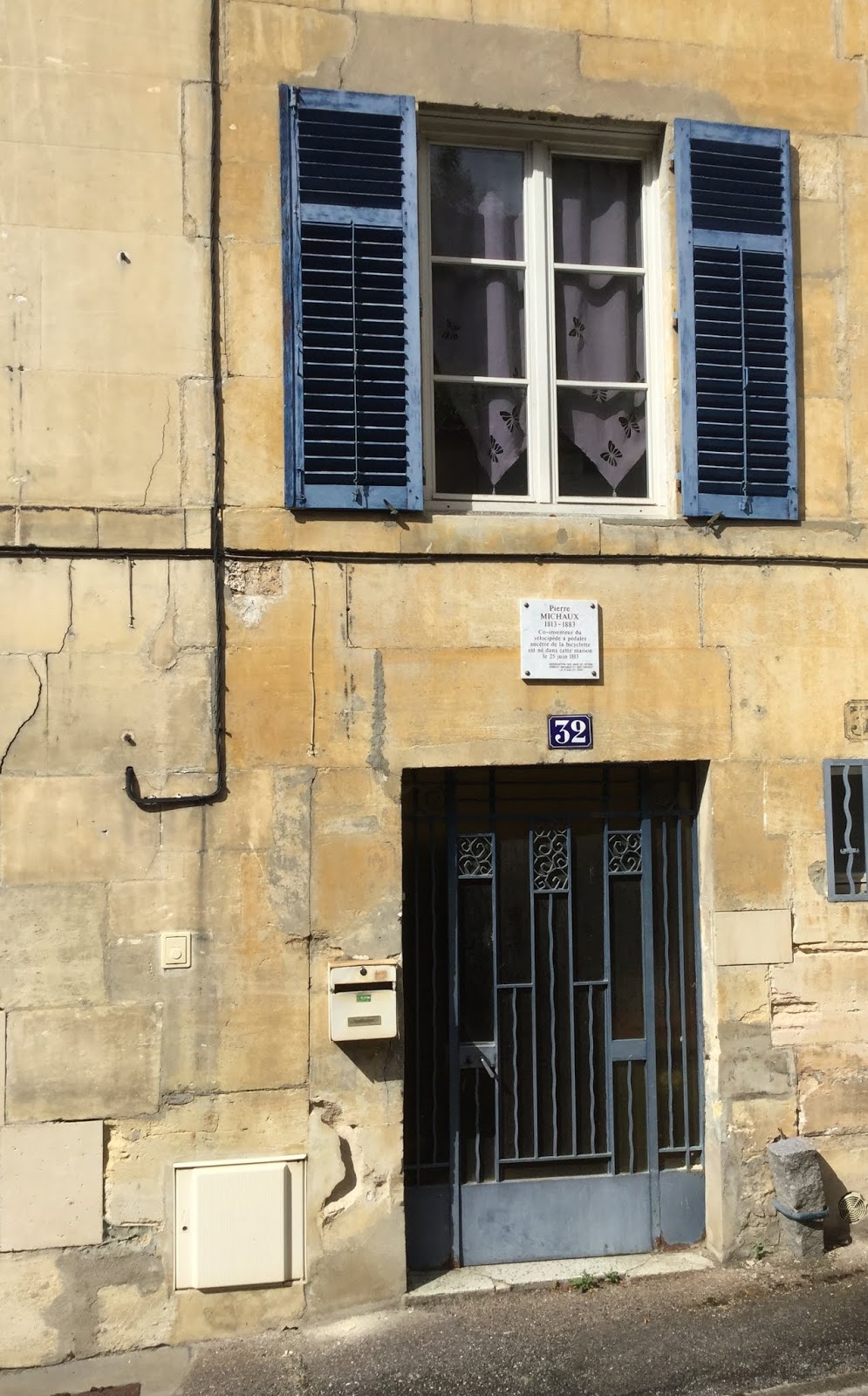
The house where Pierre Michaux was born in 1813 in Bar-le-Duc.


A replica of the Michaux invention in the Bar-le-Duc tourist office.

Early Tour decorations along the road.


Photos of seminal Tour events in front of Épernay’s City Hall.


Posts.j along The Tour route through Épernay wrapped in Tour colors.


The final roundabout before the finish in Épernay.


The Carnegie Library in Reims, the only one in France.


One is never far from some historic site in France nor far either from a site with some cycling significance.  Halfway between Nancy and Épernay, the Ville Arrivées for the third and fourth stages of The Tour, Bar-le-Duc offered up a magnificent monument from 1894 to honor Pierre and Ernest Michaux, the father and son blacksmiths who in 1861 had the stroke of genius to add pedals to the two-wheeled draisienne, the forerunner of the bicycle, elevating it to a viable means of transport.  The pedals attached to the front wheel allowed one to generate much more speed than the scooter-effect of simply pushing one’s self along.

Pierre was born in Bar-le-Duc in 1813. There is a plaque on the home of his birth up a steep hill half a mile from his monument in the center of the town.  He moved to Paris as a teen and worked on carriages until he created that miracle machine that changed history and that everyone had to have. He established the first bicycle factory employing 300 workers. They produced 200 of velocipedes a day.  The tourist office in Bar-le-Duc had a replica of his invention.

Many of the towns along The Tour route already had mounted painted bikes and arrangements of wheels that would be the envy of any sculptor or florist.  Every year residents along The Tour route affirm once again that there are no bounds of creativity when it comes to expressing one’s affection for the bicycle and The Tour.

The affluent wine-town Épernay, the stage three Ville Arrivée, the first in France after one and two in Belgium, allocated funds for an array of dazzling decorations.  Among them were fifteen eye-catching photos along the sidewalk in front of its City Hall of seminal events in Tour lore—Coppi on L’Alpe d’Huez in 1952 (its first inclusion in The Tour), Thevenet on Pra Loup in 1975 defeating the seemingly unconquerable Merckx, Ocaña’s crash in the Pyrenees in 1971, Anquetil and Poulidor sharing a podium and others of Bobet, Hinault, LeMond, Indurain, Thomas, Evans, and Voeckler in Yellow.  Passersby couldn’t help but stop and gaze upon these storied figures in the heat of action.

The peloton will be flying past them on their way to the finish a mile away up a steep final climb that will thwart the sprinters.  Posts along the route had been wrapped in the colors emblematic of The Tour.  A roundabout where the riders will make a hard right before their ascent was adorned with a giant wicker basket that had a band of yellow wheels around it, the first stunningly original creation I’ve come upon this year.

A steep climb of over a mile in the otherwise flat terrain separated Épernay from Reims, the next Ville Étape fifteen miles away.  Reims, like Nancy, is among the larger cities in France with a population of nearly 200,000.  It has such a varied and vital array of happenings it had nothing on display as of yet Tour-related.   The city is always bustling with tourists attracted by its spectacular World Heritage cathedral where for centuries the French kings were crowned.  A statue of Joan of Arc faces it, as she came to Reims in 1429 to tell Charles VII that the voice of God had instructed her to lead French forces to repel the English.

Just a couple blocks from the cathedral is the lone Carnegie Library in France, erected after WWI to replace the one that had been destroyed during the war.  A bust of Carnegie stands in the walkway to its entry.  I spent an hour sitting at a desk reading until the library closed at one for lunch.

Reims is one of the nine cities in France hosting matches in the women’s World Cup that just started.  A few clusters of fans waving their country’s flags added to the ambiance of this most pleasant of cities. 

Tuesday, June 11, 2019

Saint-Dié-des-Vosges


The route the peloton will take out of Saint-Dié-des Vosges.


A bridge the peloton will cross in Saint-Dié-des-Vosges.


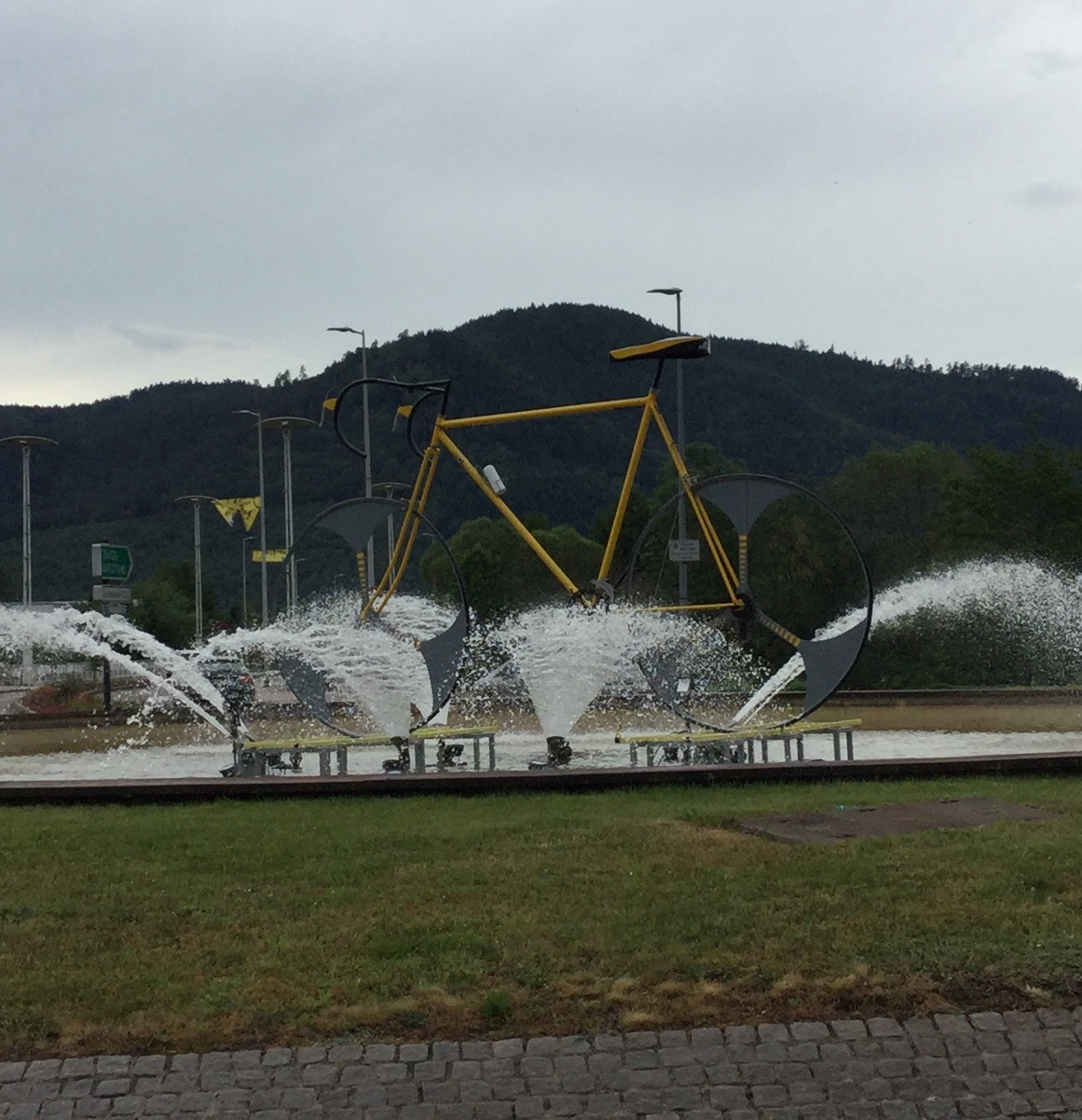
A giant bike in a roundabout outside Saint-Dié-des-Vosges.


One of many posters in Colmar promoting the coming of The Tour.


The countdown to the coming of The Tour in Mulhouse.


A memorial to René Pottier at the summit of the Ballon d’Alsace for being the first to cross it in the 1905 Tour de France.


A monument to those killed defusing land-mines at the summit of the Ballon d’Alsace.


A tribute to the Rubic’s Cube in a roundabout in Dombasle-sur-Meurthe 

I had to dig into my emergency rations when I was caught by a surprise French holiday on Monday and all the supermarkets were closed.  It was the Pentecost.  It comes 50 days after Easter Sunday, so the date varies from year to year.  Luckily I still had six slices of bread for what peanut butter and honey I had left, as well as a pack of Ramon and a couple packs of instant oatmeal as well as some Madeleines and two canisters of apple sauce.  I’ve switched from one large heavy glass jar of apple sauce to a four-pack of 125-gram containers in much lighter plastic.  I had to dig deep into my panniers to find them, not sure if I had any left.  Usually I have some couscous and corn flakes, two of my staples,  but they had both run out the day before. 

I almost had to resort to a McDonald’s, as there was one on the outskirts of Saint-Dié-des-Vosges, Ville Départ for stage five.  The journalists following The Tour are always happy when a Ville Étape has a McDonald’s, as it is a source for WiFi.  I feel the same, though slightly less so this year, as for the first time it is blocking blog sites with the explanation that its content could be suspect. 
Along with the the Yellow Arches, Saint-Dié-des-Vosges abounded with Yellow Bikes.  They were everywhere—all over this town of 20,000 and along the road leading into it, in roundabouts, and mounted high on pedestals.  The main boulevard the peloton will depart on was an arcade of large banners declaring “C’est Notre Tour” with the “O” a bicycle wheel. A bridge the peloton will cross was fully decorated with wooden cutouts of the jerseys and a rider on a bike.  

The town expressed its enthusiasm about the coming of The Tour as every town should.   All eyes of the cycling world will be upon it as it launches the first meaningful stage of The Tour with its first dose of genuine climbing, a pair of category two climbs in the Vosges on the way to Colmar.  It will give the riders a taste of what is to come on the next day’s killer stage to La Planche des Belle Filles with four category one climbs.

Colmar hadn’t done anything significant to promote The Tour, just mounting a bunch of perfunctory posters, that had least had an original rendition of a cyclist with a labyrinth of lines.  Colmar was aswarm with tourists, many of them Asian, wandering the old cobbled streets of this German-flavored city.


The Ville Départ for the next stage, the even larger city of Mulhouse with a population of over 100,000, only had a large box, similar to the one in Belfort, with a digital countdown to Tour Day and a list of Tour-related events leading up to it, mounted in front of the city’s cathedral.  I am regularly drawn to Mulhouse as it is the home of my fellow cycling fanatic Yvon. Unfortunately it was in Belgium, so I’ll have to wait until The Tour for our annual reunion.

As I have in the past I came into Mulhouse over the Col du Ballon d’Alsace, a category one climb the peloton will tackle on stage six on the way to La Planche des Belle Filles.  It is noteworthy for being the first significant climb introduced to The Tour in its third edition in 1905.  The first two routes crossed an equally high climb, the Col de Republique outside of St. Étienne, but the grade wasn’t as steep as the seven per cent of the Ballon d’Alsace.
 Henri Desgrange hyped the Ballon wondering if any of the riders would be able to get over it on their one-speed bikes in the pre-derailleur era without having to get off and walk.  René Pottier managed it.  He was the first over, but the effort took so much out of him, he abandoned The Race. He was first over again the next year and went on to win The Race. A plaque at the summit acknowledges his feat.  He was the first of several Tour winners to commit suicide.  He hung himself in 1907 when he discovered his wife had taken a lover while he was winning that 1906 Tour.
Also at the summit is a monument to those who defuse land mines.  It is called “L’Homme Projeté” (The Propelled Man) showing a man sent airborne by an exploded mine. Among the spectators was a guy wearing a red-dotted hat that had been dispensed by The Tour de France caravan. 
On the descent into Mulhouse, about thirty miles away, I could hear the sound of metal on metal coming from my front wheel as I braked.  The steep descents of the past couple of days had worn down my front brake pads.  The rear were fine, as I’d needed to replace them on the way to Cannes.  As always, I began the trip with four spare brake pads along with three spare tubes and spare brake and derailleur cables and chain and the requisite tools, adding a few pounds to my load.  The new pads should get me through this tour and a couple more, but to be safe, I’ll pick up one set of spares at the next Decathlon I come upon.


Saturday, June 8, 2019

La Planche des Belle Filles


A week after taking on the Galibier I found myself tackling an even tougher climb, La Planche des Belle Filles in the Vosges.  It will be the finish for the sixth stage of this year’s Tour, and if form holds true whoever is in Yellow after this killer climb will win The Race, as has been the case the three other times it has been a stage finish.

The first time was in 2012 when Bradley Wiggins became the first Brit to win The Tour.  He didn’t win that stage, though he was wearing the Yellow Jersey. His teammate Christopher Froome, more of a climbing specialist, won it in somewhat humiliating fashion, looking over his shoulder to see if Wiggins could keep up with him, as he was supposed to be leading him up the climb.  Two years later Vincenzo Nibali was first up the climb while wearing Yellow and maintained it to Paris.  The last time the climb made an appearance was in 2017, Froome’s fourth Tour win.  I’ve been on the scene for all of them,  but had never had the time or energy to make that final climb to the finish of the stage, so was glad to finally have the opportunity to experience it.

The climb peaks out at only 3,766 feet at a minor ski resort,  but the grades are much steeper than the Galibier, starting at 10.5 per cent, steeper even than the opening ramp  up L’Alpe d’Huez, and finishing off with a stretch of  22 per cent.  This forest-encased climb took an all-out, leg-busting effort.


I was riding along with a couple thousand others, all wearing Lycra astride light weight racing bikes with a number on their bike for this group event.  Friends of the participants were scattered along the route with a mob at the finish under an arch where all the registered riders were handed a medal.  I’m not sure where they started, probably somewhere in Belfort, a city of 50,000, fifteen miles from the steepest final three-and-a-half miles.  It was a gradual climb all the way.  Once the road turned nasty many were sprawled along the road or were reduced to walking.   

Those who had some energy to spare gave me a thumbs up or a gasped endorsement of “Super” or “C’est bien” or “Chapeau” or a few other of the accolades the French disperse including that most unique to them, a simple “Respect.”  That goes in a country where philosophical intercourse is inbred, where alongside “People” type magazines in the supermarket are magazines of philosophy. One encounters a greater degree of intellect and humanity than elsewhere.  It is a country that provides pianos in train stations for people to play and has television shows in prime time Friday nights with pundits discussing books.  Respect is something the French are looking to grant and when they offer it they mean it.  To be the recipient is always touching.

Even with grades nearly double those of the Galibier, I was feeling stronger than I had a week ago.  I wasn’t passing anybody, other than those off their bikes, but I maintained a good steady pace and got up that 22 per cent grade, though with a little tacking.  I’d managed the 18 per cent finish on Flèche Wallon a few years ago, so knew it was within my capabilities on a loaded bike.  My legs are coming around.  Now I need to start increasing my mileage, as I have kept it under 75 miles a day so far since this block of training started two weeks ago.  It’s four weeks until The Tour starts.  I’m confident I’ll be ready for those day-long stints of one hundred miles and more.

The steeper stretches had me standing on the pedals.  I had just been listening to Bobby Julich’s daily podcast during the Tour of California.  He had been commenting that when one stands on the pedals, their heart rate goes up as a whole new set of muscles are recruited for the effort.  He was right about that, but it was still within a tolerable range.

Julich is new to the VeloNews podcast.  He has a vast store of anecdotes and great breadth of knowledge, having finished third in the 1998 Tour de France as well as winning Paris-Nice and an Olympic medal.  He now works as a personal coach after stints coaching for Sky and CSC and was continually dispensing insightful advice and observations on what the riders were doing, right and wrong.

He mentioned that former World Record holder and Yellow Jersey wearer Chris Boardman was the most considerate roommate he ever had.  When he got up at night to take a leak, he tried not to disturb him, so sat on the toilet to diminish the sound of his urine.  He now lives eight minutes from George Hincapie in South Carolina and rides regularly with him and Christian Vande Velde, who feature in his recollections.

If he continues to podcast during The Tour, that will be another podcast I’ll have to listen to after every stage along with those of Armstrong and Wiggins and the Warren brothers and one by the BBC and Cycling Tips and the grandfather of them all, The Telegraph with a trio of first-rate  British journalists (Moore/Friebe/Birnie) with contributions from an Italian and French journalist.  They all add great luster and insight into the racing and complete my full immersion into The Race.


I got my first dose of more than faint Tour fervor in Chalon-sur-Saône, the stage seven Ville Arrivée, the day after La Planche des Belle Filles.  The city of 47,000 had decorations everywhere.  It’s city hall was adorned with a banner across it and two more wrapped around columns. A digital clock counted down the days.  The vast plaza in front of it was adorned with bikes painted green and white.  Throughout the city strings of mini-flags of Tour jerseys hung over the route the peloton will follow to its finish along the Saône River.  And bike sculptures turned up here and there.  I was happy to drift around the city soaking it all in.  This is what I come to France for.

All that Belfort, where the stage would start, had to show for itself was a mini-monument with a digital clock at the stage start by the city’s enclosed market.  I was a week late to Belfort for its Fête du Tour ride, which Mâcon was having this weekend.  I was riding hard to reach Belfort to arrive before its tourist office closed to find out if there was a ride the next day.  Rather than riding out of the sprawling city to find a place to camp I took advantage of its municipal campground, not wanting to overcook my legs knowing La Planche awaited me.

That was a good choice, as I arrived at the campground at the same time as a French cyclist, so we were able to share a campsite.  He had left his home town along the Mediterranean west of Montpellier and was headed to Copenhagen.  Ten years ago, he and his wife had spent six months bicycling around South America on a tandem, starting in Buenos Aires, looping over to Lima via Tierra del Fuego and Patagonia, a route I knew well.  He’d been able to take off for so long as he’d lost his job during the economic downturn and with no work available in his field decided to take a dream bike trip.  He’d recently retired and could take another long ride while his wife continued to work.

I’d had a most sociable day, as earlier I’d met a couple from Idaho riding Surleys with disc brakes who’d flown into Barcelona and were headed to the Ukraine.  They didn’t have a return ticket, as they didn’t know when or where they would end up, but knew they could get a cheap flight home on Norwegian Air.  They too were of the older set and veteran touring cyclists.  Their favorite trip had been through Scandinavia into the Arctic to the Nordcap, the northernmost point in Europe in Norway.  They generally camped wild.  The Frenchman did occasionally, but preferred camping with amenities. All would have made agreeable traveling companions if we’d been going in the same direction.   

The cycling has been as sensational as ever, no rain other than a couple of nights while camping, sunny, warm days and roads with little traffic, especially in the Vosges, among the reasons I told Jerome McDonnell that France was my favorite place to cycle.  The interview has drawn a considerable number of readers to the blog, some who even sought out my post on the first Carnegie library in Texas I visited that I mentioned in the interview.  It’s more about a dog who gave chase and the rare ornery librarian who oversaw the library, but still emphasizes its grandeur.  It can be found here:

http://georgethecyclist.blogspot.com/2005/11/comanche-texas.html


Wednesday, June 5, 2019

Mâcon, Ville Départ Stage Eight


I have listened to Jerome McDonnell’s mid-day, hour-long Worldview show on Chicago’s NPR station ever since he took over the helm from Sondra Gair in 1994, so when he emailed me a couple days ago with an invitation to be a guest on his annual bicycle show I had no hesitancy in saying yes. He interviews guests from war torn nations all over the world.  Making a connection with a wayward cyclist from a campground in France didn’t concern him in the least.

He is an adept, most personable interviewer and a devotee of the bicycle, commuting nine miles every day via bicycle.  I knew I would be in good hands with this Chicago institution. He said he had been following my blog for years and knew the extent of my travels and interest in Carnegie libraries and considered me “one of the world’s greatest cyclists.”  I wouldn’t say such a thing, though when one looks at everywhere my bicycle has taken me the past forty years, it is an assumption one might make.

We arranged to check in with each other a couple hours before airtime to confirm we had an adequate connection.  He has learned that Apple’s FaceTime is most reliable and so it was. He suggested we tape the interview right there, but I was along the road in a strong wind and more background noise than there would be at the municipal campground five miles away in the city of Mâcon that had been my destination, knowing that it would have WiFi to ensure the quality of our connection.

The only question he asked me before the interview was if was all right to mention my age.  Certainly.  It wasn’t part of his introduction, just something he slipped in later on towards the end of our twenty-minute conversation.  I’ve always wondered how he preps for his show with the wide array of subjects and guests that he covers.  He certainly did a thorough job knowing what questions to ask me.

One can give it a listen at https://www.wbez.org/shows/worldview/wbez-enters-the-ring-again-for-2019s-bike-to-work-week/b3fb8b1b-7853-4ae2-9638-e0334ad71abaI conclude the show.  I tried to anticipate what he might ask.  I thought one of his questions might be if I had a favorite Carnegie library among the more than 700 I have  been to so far, but he had run out of time when the subject of Carnegies came up.  We went too long as it was, as I noticed he edited a few minutes out of some of my long-winded responses.  

There was much I was hoping to squeeze into our conversation, prominent among them the story of the tiny town of Merom in Indiana, the smallest community with a population of just 500 to receive a Carnegie grant, the usual $10,000 and among the last in 1916. The message board outside Merom’s library read in bold capital letters, “WELCOME GEORGE CHRISTENSEN.”  Coming upon that was almost as much of a thrill as being on Worldview.  The librarian at the Vincennes Carnegie had alerted the Merom librarian that I was headed her way and in typical small-town America hospitality aimed to please.

If there had been time to recount the seventy miles I had ridden before our interview I would have told him of having visited the grave of Roger Pingeon, the 1967 winner of The Tour de France, who also won the Tour of Spain in 1969 and finished second to Eddie Merckx in the 1969 Tour, the first of his five wins that The Tour is commemorating this year with its Grand Départ in Brussels.

Pingeon was buried in his hometown of Beaupont twenty miles from Mâcon.  He died two years ago and this was the first time I had been in the vicinity since his death.  As I was searching for his grave I vividly recalled the fond memories of my wanderings around cemeteries looking for the graves of other Tour winners—Anquetil, Bobet, Fignon, Coppi, Pantani, Robic, Garins, Petit-Breton, Lapize and a few others.  When I’m in Belgium in a couple of weeks, I hope to add a handful more to the list.

Beaupont’s cemetery was one of the smaller ones I’d been to.  I guessed right in perusing the right side of the cemetery first.  His grave was two-thirds of the way down and at the far right side.  The outline of France with a cyclist etched in the middle on his tombstone caught my eye before the name. All the flowers on the grave somewhat obscured an additional plaque of the young Pingeon in a Yellow Jersey.  The same photo adorned a small billboard beside the City Hall a couple blocks away.

Beaupont was the quintessential French small town.  It has a population of just 500, but had a small, grand cathedral, a prominent City Hall to be proud of, a WWI memorial, a cemetery and most important of all, a bakery.  It is always a debate as to who is the most important resident—the baker providing everyone with their daily baguette or the mayor trying to keep everyone happy.  

The sizeable city of Mâcon along the La Saône River will be hosting the start of the 8th stage of The Tour.   Tour banners adorned all the light fixtures on the two-mile route out to the municipal campground on the outskirts of the city.  A fixture was mounted at the starting point of the stage along the riverside boulevard with a digital readout counting down the days until The Tour’s arrival—39.  A billboard in front of the City Hall advertised a ride for the locals this Saturday celebrating The Tour (La Fête du Tour), an event many of the Ville Étapes put on.  With luck there might be a similar ride in Belfort, where I could be Saturday as I enter the Jura mountains. 

Sunday, June 2, 2019

The Galibier


As I approached the Col du Galibier a sign warned that it was closed.  My heart sank, as that would greatly alter my plans, effectively denying me access to a couple of Ville Étapes I wanted to visit, and force me to go through the large city of Grenoble, which I would prefer not to do.  I held out hope that the snow on the road might not be too deep and still passable by bike.  Just before the start of the climb at the summit of the Col du Lautaret was a restaurant that would know.  

A trickle of cyclists had passed me as I finished off the 21-mile 4,304 foot Lautaret climb.  As I neared it’s summit I could saw the happy sight of a string of cyclists inching their way up the Galibier.  That was no guarantee that they could get over it, but a good sign.  A bartender confirmed that cyclists were managing it, but that there was still a danger of avalanches and that it was possible that there could have been some during the night that blocked the road.  No cyclists were coming back, so that was further encouragement.  

I paused to eat and rest my legs before the final five-and-a-half mile effort to 8,668 feet, the sixth highest pass in the Alps.  A barrier blocked the road, though it was easy enough to get around.  The legs felt surprisingly good on day seven after two weeks of atrophy at Cannes. I remained in my lowest gear and luxuriated in the absolute silence with the absence of motorized vehicles other than the occasional battery-assisted bike.  The still heightened the roar of the few fast-rushing streams along the way and gave a distinct clink to the water dripping off the walls of snow lining the road.  

My thought returned to my previous rides over the Galibier.  The last was in 2011 when it was a summit finish in The Tour de France for the first and only time. It commemorated the 100th anniversary of its first inclusion in The Tour, the first year the Alps were attempted by the riders in its ninth edition.  They had managed the Pyrenees the year before, even though one rider, Octave Lapize, famously called The Tour organizers “Assassins” for inflicting the brutal mountains on them. 

In 2011 I reached the Galibier the night before the peloton and camped half-way up it.  That was lucky, as the next morning the road was blocked to cyclists, letting me have the road to the top all to myself.  I didn’t remain there as it was too cold and the large screen television had been parked at the start of the climb, so I returned to it to watch the day’s dramatic action highlighted by a long successful breakaway by Andy Schleck with Cadel Evans chasing after him to preserve his chances of winning The Race the next day in a time trial in Grenoble, which he did.  Thomas Voeckler also was heroic clinging to the Yellow Jersey one last day, making it his second ten-day stint in Yellow, bringing great joy to the French.  There was still some graffiti on the road from fans who must have used some high-quality paint—“Cadel” and “Andy and Frank” (the Schleck brothers) and “Leopard” (their team). 

Shortly before the summit the large monument to Henri Desgrange, Tour founder and director for its first 33 years, was surrounded by deep snow.  The Galibier was his favorite Col.  In his typical hyperbolic prose he called all the others “gnat’s piss.”   I was disappointed to see the large wooden doors to the tunnel shortening the climb were closed, so it was another kilometer of an even steeper grade to get over this beast of a climb.  The summit wasn’t as congested as Everest is these days, but there was a wait to get a photo of the summit sign.  

The air was still and no one was in a rush to leave, soaking in the spectacular views in all directions, one all the way to Italy.  Less than a kilometer down the other side the road was blocked by snow about half the length of a football field.  But there was a path through it.  Others were able to carry their lightweight racing bikes through.  I was the first to put down tire tracks.  I had to stop several times afterward on the descent to wipe my rims dry as my brakes weren't nearly as effective as they needed to be when wet.  I was fully prepared to plow into a snowbank if I became a “runaway cyclist” as I came perilously close to. 

Two-and-a-half miles from the summit I came upon a monument to Marco Pantani mounted at the bend in the road where he attacked Jan Ullrich on the fifteenth stage of the 1998 Tour going on to win the stage and taking the Yellow Jersey from Ullrich, which he did not relinquish.  He had won the Giro the month before, the last rider to win both in the same year.  

It was another eight miles to the ski town of Valloire, which will be the Ville Arrivée for the 18th stage of this year’s Tour.  It was virtually deserted early in the ski off-season before the hiking season opens and the Col du Galibier reopens.  There were at least banners on light poles and a large banner across the street by the closed tourist office and church promoting the coming of The Tour.

The road out of the village took me by boarded up multi-storied condo buildings. It was three miles up to the summit of the Col du Télégraphe and then another ten-mile descent to the valley floor.  I had the option to turn right along the river L’Arc to the Ville Étape Tignes or left to the Ville Étape Saint-Jean-de-Maurienne.  I really had no choice as Tignes was via the Col de l’Iseran, which is even higher than the Galibier and was truly impassable.

A roundabout before Saint-Jean had been taken over by a small cluster of Yellow Vests with a sign berating Macron and his wife Brigette.  No one seemed to be paying them any mind with toots of encouragement or disagreement.  A roundabout in Saint-Jean had a giant Opinel knife, as this is where these iconic wooden-handled, folding knifes are manufactured, fifteen million a year.  There’s even a free Opinel museum in the city center not far from the City Hall, which had a wooden Yellow Jersey celebrating the coming of The Tour.  Unfortunately it is closed on Sundays, so I’ll have to wait to see it another time.

It was late in the day, so I was happy to take advantage of the town’s unpretentious campground without a swimming pool, just providing the essential necessities, including a morning baguette if one wished.  My worn muscles welcomed a hot shower after a demanding day over three of France’s most notorious climbs.  I was glad this was pre-Tour and I needn't be in a rush to get going the next morning.