Wednesday, March 7, 2018

Along the Mauritania Border


Rather than trying to slip into Mauritania for two or three days and subjecting myself to its treacherous roads and nerve-racking border officials, I simply rode along its border for a hundred miles, stopping in at three border crossing sites across the Senegal River--one over a dam and the other two by ferry.

It was a relief to be approaching a border without having to worry about going through all the rigmarole, but I still couldn't help but feel a little tension, especially at the main crossing at Rosso with its swarm of hustlers and touts and money-changers.  Several jogged alongside me telling me I had passed the office where I needed to get my passport stamped.  None wanted to accept that I had simply come to give this ferry crossing a look.  

A primitive, small barge provided the transport. It wouldn't take much for an overloaded truck to capsize it. I didn't mind at all that I wouldn't be boarding it.  If I had decided to venture into Mauritania I would have chosen the dam.  It's a bit out of the way off the main highway, but said to have a minimum of hassle.


The river was rarely visible from the road that somewhat paralleled it.  The terrain alternated between barren desert and stretches where there was decent soil and irrigation had turned it productive.  There was sugar cane, rice, ochre, onions, melons and more.  One night I was able to camp on a path between rice paddies, but another night I was caught in a stretch of emptiness and ducked into a walled in compound of farm equipment when I noticed a security guard sitting at the entrance.  I assumed he was there for the night.  He was happy to let me pitch my tent inside.


Now that I'm shoulder to shoulder with the Sahara, the air has turned browner than ever with the wind stirring up the sand of this vast, ever-increasing desert the size of the continental US.  There were occssional irrigation canals where people went for water and could take a swim.  At one a cluster of women frantically waved at me as I passed.  I was surprised so see that several were topless and seemed to be beckoning.  None objected to being photographed.


No more baobabs, though I did have a glass of its juice specially prepared for me.  As I was sitting in the shade of a tree beside a village cemetery a young man, who introduced himself as Alieu, sauntered by and asked if I needed anything.  He had grown up in The Gambia so his English was fluent.  He had recently returned to the village of his grandfather and father, who were both buried in the cemetery, to farm their parcel of land.  He had been trying to make a go of it as a fisherman in St. Louis, but that is a tough life with lots of competition, so was glad to give the farming a try.  He resorted to the Internet regularly when he had questions of what to do.  I asked if there were any baobabs in the vicinity.  There weren't.  Next I asked if he liked baobab juice.  He said he did and said if I'd like some there was someone in the village who made it.  

He had already invited me to come hang out at his home in this heat for the next few hours as he would until five o'clock, when he would return to his fields.  I was actually getting ready to be on my way when he had stopped by.  I told him the breeze I created as I biked made the heat not so bad.  I would ride an hour then cool off in the shade for a spell and was just fine.  This sun though was intense.  The Brazilian cyclists said their solar panels had never worked so well as during their time in Mauritania.
 
I had my day planned out and didn't care to linger too long, but couldn't resist the opportunity for a freshly made glass of baobab juice.  It was a tough slog through the sand to his village on the other side of the road.  We joined a cluster of folk who were laying on rugs in the shade of a three-sided shelter.  A young boy brought me a glass of cold water.  


When I asked if I could take a picture of everyone, Alieu said in their culture the men and women sit separately, so that meant two photos of the group.  Alieu is in the middle.


I asked if I could watch the preparation of the baobab juice.  Alieu said it would take a while and it was best if I just waited with the others in the shade.  After a few minutes a woman brought me a soft pad and pillow, which I declined.  Alieu said his friend beside us had a bad shoulder and wondered if I knew any remedies for it.  I showed him an exercise I used when I had a broken collarbone and my shoulder stiffened up--bending over and letting the stiff arm dangle and then slowly rotating it like a butter churn.  Shortly after that a woman presented me with some x-rays of her son's withered arm.  Alieu said everyone assumed I was a doctor, as volunteer doctors are the only whites they have contact with.

Half an hour later Alieu said it would still be a while before the juice was ready.  I was  headed to check out the ferry in Dagan, just six miles away, and then would return to St. Louis.  I told Alieu that maybe I should continue on my way and come back in an hour or so.  He thought that was a good idea.  I was delayed though by a flat tire and more rough sandy roads through Dagan to the dormant ferry, just a pirogue that could take individuals across the river.  There was no immigration office.

Alieu and a dozen others were still under the shelter when I returned an hour later than I thought I would.  They had awaited my return for the final touches of the juice, a prolonged hearty stir and addition of sugar.  During the procedure Alieu excused himself to go pray at the nearby mosque, accompanied by the other men, while the women remained.


When the juice was completed they let me sample it to see if I would like any more sugar.  It was plenty sweet, enough so that I asked for it to be diluted with more water, which would add to the volume of the  bottle they were sending me off with.  It was the fourth or fifth time I had had the juice.  All were divine, but this was extra special. Before I was on my way we went on line and became Facebook friends.  Alieu said it was important for the Sengelese to be hospitable and was happy to have had the opportunity.  Someone the day before had also invited me to his home "to show how we live" but there haven't been as many examples of this as I was told there would be, probably because my French isn't fluent enough.


Sunday, March 4, 2018

St. Louis, Senegal


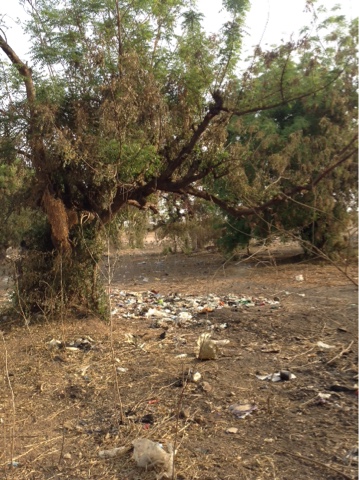
The vegetation grew increasingly sparse with the baobabs few and far between and the soil more and more sandy as I closed in on Mauritania and the Sahara.  But the litter became even more spectacular thanks to the quantity of traffic along this main road and the regular dots of civilization and the steady winds bringing it to congregating points.


With the abundance of litter strewn far and wide attracting my attention I hardly missed the baobabs.  But the kids shouting out "taubab" with the emphasis on "bab" as I passed kept the spirit of the baobabs alive.  It is a somewhat cheery term for whites in these parts, in contrast to the rather harsh "mzungu" of East Africa and the downright austere "blanco" of Guinea-Bissau.


West Africa might be the land-based equivalent of the huge gathering point in the Pacific for oceanic garbage.  It is hard to imagine so much could be generated just in this region.  Somehow the winds must bring it here from all over.

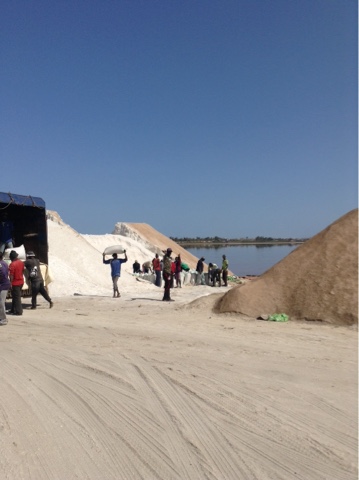
I took a slight detour after I left Dakar to Lac Rose, twenty miles outside the city along the coast.  It is an attraction due to its sometimes pink-hued waters due to red algae and its heavy salt concentration, ten times that of the ocean.  It is also noteworthy having been the finishing point for the almost mythical Paris-Dakar race.


The race was last run to Dakar in 2007 after security threats in Mauritania caused its cancellation in 2008. It had such appeal, peaking in 2005 with 688 competitors, it is still run (by the same organization that conducts The Tour de France) in South America through the desert terrain of Argentina and Chile.


At one end of the four-mile long lake by the large parking lot where the race used to end a handful of touts descended on me trying to recruit me to a hotel or a boat ride or to buy some souvenirs.  They don't get much business with no direct, easy way to reach the lake, though it does provide a welcome antidote of tranquility to the mayhem of Dakar and has a handful of hotels.

Salt production seems to provide more revenue than tourism.


There were several clusters of workers raking and sacking and loading the salt.


After biking several miles along the sandy dirt road hugging the shore of the lake I headed back to the main road for eight or nine miles on sandy roads that had me pushing my bike in equal measures to riding it, giving me a taste what it would be like to ride across the unpaved roads of the Sahara.  When I met a couple of Brazilians who'd just ridden down from Morocco across Mauritania, who said the roads of Mauritania were dreadful, requiring a considerable amount of pushing their bikes through the sand, Mauritania lost its allure for me.  I had a further taste of pushing my bike through the sand the two nights I camped on my way to St. Louis.  Unlike further inland on my ride to Mali, where I was able to ride on the hard dirt when I left the road to camp, it was a tough slog pushing my bike through the sand trying to get to a tree before a car came along.


At least the road was in tip top shape, recently repaved.  There were no broken down trucks awaiting repairs unlike all the other roads I've ridden in Senegal and Mali, just the carcasses of cows and donkeys and the occssional car.


St. Louis is on an island reached by crossing a bridge whose arches were designed by Gustave Eiffel.


Eiffel architecture turns up all over.  I saw a prefabricated church of his creation in South America, but missed out last year on a fireplace he designed in Madagascar.  This bridge was actually intended for the Danube, but when that project fell through, it ended up here in Senegal in 1897.


After crossing the bridge I crossed a second to the sister island of St. Louis, a much longer and narrower island defending it from the winds and ravages of the Atlantic where there was a hotel with a campground just off the beach.  I was thrilled to discover three cyclists who had come down from Morocco and Mauritania--two thirty-year old Brazilians and a twenty-year old Belgian, fresh out of high school on his first tour.  They had met in Morocco and had ridden together since.  They were relieved to cross into Senegal and its smooth roads after the nightmare of Mauritania, not just the horrible roads, but all the police checks and the ban on wild camping, having to pitch their tents at a police check every night.  

With the extra abundance of garbage along the road I had collected a load more of colorful and distinctive fabric fragments for Janina that needed washing.  A thirty-year old Australia woman who'd been on the road for six years was also doing her wash.  She was highly impressed by my project and found the fabrics most appealing.  I told her Janina knew what I was doing and had encouraged me, but like those t-shirts "My parents went to Sydney (or wherever) and all they brought me was this lousy t-shirt," there is always the danger Janina will say, "You spent a month-and-a-half in Africa and all you brought me was a bunch of rags you found along the road."

After doing my wash I had time for an initial exploration of the main island of St. Louis and its old colonial architecture that has earned it World Heritage status.  All the glory of the two-storied, balconied buildings that lined a few of its streets was long gone and further dampened by the dirt and sand on the streets, but compared to the utterly lackluster present-day construction they do stand out and warrant some recognition.


But the old city is relatively quiet, almost semi-abandoned compared to the nearby thickly populated shanty towns that are more characteristic of Senegal.


I'll continue my explorations tomorrow and see if I can verify that Mauritania issues visas at the border and whether I wish to give it a dabble before having to be back in Dakar in a week for my flight home. 


Friday, March 2, 2018

The Ziguinchor-Dakar Ferry


I had several prolonged spells of nervous suspense as I awaited the departure of the overnight sixteen-hour ferry from Ziguinchor to Dakar. The first was whether I would even be aboard.  I had originally booked a ticket for the Sunday ferry, but when I spent less time in Guineau-Bissau than I anticipated, I tried to change my ticket to the Thursday ferry on the Monday before its departure.  I was told all the cabins had been booked, but I could have a chair, without however being refunded the difference in the cost. 

The ticket sellers were taken aback that I was agreeable to that. They said there was a good possibility that there would be a cancellation, but I would have to leave my ticket with them so they could change it when it happened.  That seemed a little risky, but I had no reason to think it was a scam, so I left my ticket and headed off to Cap Skirring for a couple of days.  I was told to return to the ticket office at ten a.m. on Thursday, three hours before the ferry was due to depart.

I was back in Ziguinchor by nine a.m. after camping nine miles out of town in a palm grove.  Rather than heading straight to the ferry terminal, I bought a bag of baobab juice to pour over my remaining cornflakes and plopped down in the shoddy town park for some breakfast.  Rare was it to find a town park let alone a bench, so even though it was as unkempt as an unmade bed, it provided a nice refuge from the general hubbub.


When I arrived at the ferry terminal a little before ten it was already aswarm with passengers lined up to board and another mob in front of the ticket office.  I regretted not coming directly to the ferry at nine.  It looked like I was doomed to the Sunday ferry.  I went to the front of the line outside the ticket office to see if I could catch the eye of the ticket-seller who I'd left my ticket with.  She was blocked by a cluster of customers and a pair of security guards at the door.  The guards took my name and added it to a list of nine others and was told to take a seat until I was called.  Not a single name was called for ten minutes.  It was looking worse and worse.

Then at 10:15 one of the guards suddenly had a handful of tickets and was calling out names.  I joined the crowd around him to peer at the names on the tickets in case he had trouble pronouncing my name.  As he fanned them out I could see my name on one of them.  I was saved.  I wanted to go inside and give the ticket agent a hug of thanks, but that wasn't possible.  I had already been informed that I would have to check my bike and not roll it on to the ferry as I ordinarily do and was even able to do on the Queen Mary this past summer.  I couldn't stop making comparisons to that most orderly of processes and this semi-chaos.  I was a bit leery about leaving my gear on my bike, but had been told I had no choice and that it would be safe.  

I did take off the two front panniers and transferred my more valuable items to them and carried them on to the ferry.  Except when I boarded I was told that since I was in a cabin with eight there was no room for luggage and I would have to check it.  If I had opted for the more expensive four or two person cabins, I could have brought them on.  The guy checking was distracted by my panniers so didn't notice the pack I had on my back with my food and water and extra clothes, so I was at least able to smuggle that aboard.  The same thing had happened at the security check.  The guard looked through my panniers, but not the pack on my back.  He asked if I had a lighter.  There was a big pile they had confiscated.

There were a handful of French tourists among the passengers but none in my cabin.  I was assigned an upper bunk by the window.  There was one older couple and five single guys in our tight little cabin.  There was a shower down the hall, a tiny restaurant and a bar.  There were three levels where one could sit outdoors--one unshaded on the upper level, a slightly shaded alcove at the stern with the bar and then below it a narrow rim with no seating.  Most people crowded on the middle level.


The best viewing was on top, if one could tolerate the sun.


I was aboard by eleven.  After making a circuit of the boat I noticed my bike parked behind the ferry off to the side on the other side of a barrier from four motorcycles and another bike.  I stood at the railing for two hours waiting for it to come aboard.  When it was brought aboard I was going to run below and ask if I could reattach my front panniers, so at least all my gear would be in one place. When it hadn't budged fifteen minutes before one I went down below and asked about my panniers.  They said I could put them on the bike.  When I tried to bring the bike back with me I was waved off, but at least I had asserted the presence of my bike so it wouldn't be forgotten.  

 At one o'clock, our supposed departure time, the attendants began driving cars onto the ferry, just ten of them.  It was encouraging to see there were so few and no trucks.  The predecessor of this ferry had sunk at sea over a decade ago, partially because it had been overloaded.  It was a major disaster with all aboard perishing.  Unlike the train from Dakar to Bamako that had been discontinued after a succession of accidents with fatalities, the ferry was allowed to live on.  I had been told there was a memorial to the victims at the dock, but no one there knew anything about it.  

It was a relief to see my bike wheeled aboard, the last of the vehicles.  Our first three hours were down the Casamance River before we reached the Atlantic and headed north to Dakar.  Lush green vegetation lined the river and continued as far as the eye could see.


Before we reached the ocean we stopped at a small village and took on a few more passengers.  It had been calm going, but once we went out into the open sea a little after five the ship went into a slight roll.  So much for sitting on the deck for me.  I needed to lay down.  I don't know if the seas calmed as I was quickly asleep and was pretty much out until we arrived at Dakar thirteen hours later.  I was only aware of my legs soaking up the rest.  I heard a brief spurt of light snoring, but it didn't amount to much.  I was sorry to miss the sunset out over the ocean, but I was also happy for this much needed sleep.

It was dark when we arrived in Dakar.  Passengers were allowed to linger on board until it began getting light at seven.  When I exited the ship at 6:45 I saw my bike just ahead with all panniers and gear attached--a most happy site.  I kept remembering the friend who flew to Cuba with his bike and had it stolen from the airport before he had a chance to ride it.  I had been in a momentary panic before I boarded the ferry when I was ushered to a window further away than I realized to pay for my bike and left behind my two panniers.  There was a cluster of people milling about in the chaos of the terminal any of whom could have grabbed my unattended panniers sitting in a corner near my bike.  In Cuba that most likely would  have disappeared.  Here my concerns were unfounded.

The ferry docked at the same dock as the ferry I had taken to Île de Gorée, so I knew the way to the hotel I had stayed at when I arrived.  I wasn't going to check in, but I wanted to check to see if it still had my bike box.  I wasn't able to lay eyes on it, but I was assured it was in a safe place.  That didn't leave me fully placated, but all my ferry anxieties were a waste of energy, so I will try not to worry much in the next ten days before I return for it.  In the meantime I'm off to the northern extremity of Senegal after just being at its southern.  It's 170 miles to the UNESCO World Heritage city St. Louis, West Africa's first French settlement, and the border with Mauritania.  It is cooler, in fact cool enough upon arrival in Dakar to need a wind-breaker, at least in the early morning hour.


Monday, February 26, 2018

Cap Skirring, Senegal


After a month of wallowing in the litter of West Africa, I have become so accustomed to it that it is no longer an affront to my senses.  Rather than being incensed and outraged by the carpets of litter through towns, I have come to accept it, so much so that I approach a town with anticipation, eager to see what variations on litter it will offer.  I no longer regard the windswept hodgepodge of plastic bags and all else as an eyesore, but as decoration, an art form of a sort.  Its wide array of colors and forms and haphazard arrangement can be dazzling.  If a photographer of renown were to artfully shoot them and hang the photos on the hallowed walls of MOMA or some other museum of note, it could be hailed as a great discovery.  


The art world would be abuzz at the beauty and texture of the arrangements.  Pollack could do no better. 


It may be garbage, but I gaze upon its clusters not with repugnance, but with respect and wonder.  They elevate rather than deflate my spirit.  I have become like everyone else dropping my litter on the ground wherever I might be, happy to make a contribution, letting the winds place it where it chooses.  Some of the most eye-catching arrangements are in the thicker weeds with plastic bags adorning trees and bushes. It's not litter, it's art.  Towns can be proud of their creations.  


The palettes of garbage are occssionally embellished with goats or pigs nuzzling through the refuse and rearranging it.


Unlike the huge mounds of city dumps off in their own quarter, these are an actual part of the landscape and a town's daily life.


It is everywhere. wherever one might look.  It can be found on every street and road in some form or another.  Hopefully, I won't become so accustomed to it that I will take it for granted and it will lose its splendor.


Though I have come to appreciate the profusion of garbage, I am not so enamored with the ramshackle gauntlet of run-down tiny shops that define and line the main street through every town I pass through.  There is little to distinguish one town from another.  No one seems to care about giving their town any distinction or attraction.  Senegal and Mali may have been French colonies, but they gained none of the French desire to beautify their towns with flowers and sculptures and town halls of distinction. 

In France every village seems to be vying for recognition as a "Beaux Ville," as attentive to its appearance as the average French woman with her makeup and attire.  Every town is a gem.  In comparison it's hard not to regard every African town a slum.  Maybe with more time I can come to recognize them as something more.  I'm told litter didn't use to be such a scourge, that people would find some use for every scrap.  Maybe the prevalence of garbage is an initial step to beautification.

The remote fishing village of Cap Skirring, near the border with Guinea-Bissau, that is being transformed into a resort complete with a Club Med, adorned its roundabout with a pair of sculptures.  


No effort though had been made to add any allure to its main street nor to tidy up the heart of its beach where the fishermen bring in their catch.  It was a vast network of dilapidated shacks dominated by the stench of rotting fish. I had taken a 45-mile side trip from Ziguinchor to give the beaches of Cap Skirring, considered the best in Sengal, a look and take a rest day while I awaited the twice-a-week ferry from Ziguinchor to Dakar.  As I searched for a place to camp, I was terrorized by a squadron of tourists rampaging on ATVs.  

I was tempted to turn around and head back to Ziguinchor.  But I found a bungalow complex on the outskirts of town that offered camping space.  It wasn't on the beach, but it offered the quiet that I sought and a clothes line for my wash. I had asked a handful of people, including a long-haired French guy who had lived in Cap Skirring for years, if they knew of a place that offered camping.  None did, though they offered suggestions on where I might try.  The French guy put in a call to a friend who might let me pitch my tent on his property, but he wasn't answering.  But persistence once again paid off.

Among those staying in the bungalows was a French couple who had been coming to Cap Skirring for twenty years staying at the same place.  I was the first person who had ever camped there during their time. Camping is simply not part of the local culture, and travelers inclined to camp aren't drawn to Cap Skirring or aren't traveling with the capacity to do it.  Shockingly one can fly into this small town directly from Pairs.  There is a twice-weekly Club Med flight.  Cap Skirring was actually a Club Med discovery and is responsible for its becoming known.  The French couple said the town was more popular when they first started coming.  It's presently in decline.  It still attracts sex tourists, almost as many women as men.  The French couple acknowledged a local woman becoming a prostitute could give her the means to open a boutique, but the men who engage in the trade are much greedier, hoping to get enough money to buy a car or more.  They lose their work ethic.  There is a shortage of men who are willing to do hard work.  The area used to abound in rice paddies, but it is now difficult to find people willing to engage in such work.

As in The Gambia not many of the tourists were drawn to the beach.  There were as many bovines as people on the sand.


I had opted the night before to camp rather than stay at a hotel with a young pony-tailed Swiss guy who I had met at the Sukuta campground.  We were both happy to see a familiar face when we encountered each other late in the day in the town of Oussouye, seventeen miles before Cap Skirring.  He said he was the only guest at an auberge several blocks away.  It was tempting to have a sociable evening, but I had my heart set on camping among the palm trees that had taken over the countryside as I approached the ocean, giving a hint of paradise.  And as I sat in my tent eating and reading in complete and utter silence gazing up at the palm trees around me, I was happy to have another genuine African experience of my own.


Sunday, February 25, 2018

Bissau, Guinea-Bissau


Among the wealth of advice that Reinhardt, the German who has been driving cars to Africa to sell for years, gave me was to acquire my visa for Guinea-Bissau at its consulate in Ziguinchor, Senegal twelve miles north of the border, rather than at its embassy in The Gambia.  He said it would be quicker and cheaper.  I was beginning to wish though that I had gotten it over with while I was in The Gambia as I struggled to find the consulate.  The first person I asked, a motorcycle taxi driver, sent me a mile-and-a-half down the road, either not understanding my question or simply being ill-informed.  The next person I asked knew its general vicinity back from where I had come and even volunteered to drive me there, but not knowing how long it would take to get the visa, I didn't care to keep him waiting to take me back to my bike.  

As I've experienced all too often here, my search for the consulate turned into a most aggravating ordeal, as I had to ask another half dozen people, who all headed me in the general direction of the consulate without knowing its precise location.  I could have easily tracked down The Guinea-Bissau embassy in The Gambia, as it was marked on my GPS device,and if I had, by the time I finally found the consulate in Ziguinchor, I would have already crossed the border into Guinea-Bissau.  Anyway, once I found the small consulate off on a side dirt road, it was an easy matter of getting the visa and all was well.

At least the border crossing was accomplished with a minimum of fuss, just as I managed leaving The Gambia the day before returning to Senegal for a brief spell.  My passport is filling with Sengal entry and exit stamps and I have two more to come.  It was even an easy matter of changing my remaining dilisas to CFAs, which was also the currency of Guinea-Bissau, as it had been in Senegal and Mali.

Crossing into the souther segment of Senegal, known as Casamance, was like crossing into another country with its lush, tropical vegetation, a stark contrast to the semi-desert of the rest of the country, one of the reasons there is a separatist movement there that at times has resorted to violence.  It has presently calmed down, but there is enough of a residue of the rebel mentality for one to be wary of banditry.  Reinhardt advised that I be careful about camping, so when I came upon a campement, rustic accommodations catering to locals, outside a small town, I decided to take advantage of it even though more than an hour of light remained.  


They don't necessarily provide camping, but this one allowed me to set up my tent under a very shady mango tree  after considerable raking to clear a flat spot, not having had anyone camp there in quite a spell.  The preferred stay is in one of three large oval huts divided into four or five rooms each with toilets and showers in another hut.  It was perfect for me, though there was no electricity until after dark and the mosquitoes were pesky enough to find their way into my tent.  I had to arise a couple of times during the night and turn on my headlamp and go on a killing spree to eliminate the few who had penetrated my defenses.  It is staggering how loud a buzz such a slight wisp of protoplasm can make.  When I camp in the bush away from human contact the mosquitoes have not been an issue.  They weren't a particulate nuisance at the Sukuta campground, but after dark a mosquito or two would make its presence known.

The vegetation became even more tropical in Guinea-Bissau with palm trees along the road and orchards of mango and apple trees. The lightly traveled road to the capital was narrow and unlined, like a secondary road, with patches of potholes when the road dipped to pass through dry river beds that would overflow during the rainy season.  


Signs were in Portuguese, as Guinea-Bissau is one of two countries in West Africa that were colonized by Portugal, the other the Cape Verde Islands.   People along the road well know it is unlikely visitors speak Portuguese so they would great me with "Hello" followed by "ca va?" combining English and French.  The small villages seemed no different than any others I had been passing through the past month.  There would be small tables with a handful of oranges or tomatoes for sale and with luck bananas or flour balls.  No ice balls though.  Guinea-Bissau, along with Mali and The Gambia, is among the twenty poorest countries in the world. West Africa is the poorest region in the world with nine of its eighteen countries in that bottom twenty.  

It is obvious from the minimal offerings and basic, somewhat primitive, dwellings, that these people are just scraping by, leading simple lives that might be termed lives of deprivation.  Since they do have a sense of the rest of the world out there, they surely understand they don't have as much as most.  How they accept this, someone such as me just passing through wouldn't know.  If their underlying attitude is reflected by the children who ask for money, they can't be fully accepting of their lot.  I frequently recall the comment of a Kenyan when I biked around Lake Victoria a few years ago.  When it took me two trips to haul all my gear from my second floor hotel room, after my second load he said, "You white people are given so much."

I thought I might spend a day hanging out in Bissau, the capital of Guinea-Bissau, but it had no allure, not even its ocean front and port.  It could be the world"s most run-down, bedraggled capital.  Most of the side streets, even those leading to the port, are dirt and rocky, most treacherous to bike.  At least there's not much traffic.  The old colonial buildings all look like they could collapse if there was a shudder of an earthquake.  I was the only guest at Lonely Planet's endorsed pension, just as I had been in Dakar.  West Africa is not much of a draw.


Thursday, February 22, 2018

An Interlude at the Sukuta Campground


After ten days and over 800 miles of unrelenting cycling since Bamako, pushing it day by day to meet various deadlines—to reach a town with a hotel before dark or a border before closing time or wifi on Valentine's Day—I was ready not only for a rest, but also recovery time, when I came to the Atlantic resorts of The Gambia.  I didn't stay at a resort, but rather the lone campground among them.  It was easily the most fascinating place around, packed with veteran travelers of African who could hold forth for hours on their years of adventures all over the continent.

It had ten slots for campers and twice that many lodge-style rooms for rent in its walled in compound down a sandy dirt road a mile from the ocean.  It was filled, but the German owner found space  for me in the lone slot without a car, just a couple of tents of Germans who had driven down and sold their car.   They were leaving the next day and shared a bounty of food they had driven down with and hadn't finished off--pâté, pumpernickel bread, crackers, jam, soup, pineapple juice, a can of peaches and more.  I dove right in, as I had a lot of eating to catch up on.

All the campers had heavy-duty vehicles with a pair of spare tires and plenty of accessories, including shovels and ladders, anticipating as many eventualities as they could.  They had all crossed the Sahara to get this far.  They were a hardy and enthusiastic lot.  A Spanish guy had ridden his motorcycle around the circumference of the continent a year ago--an epic nine-month journey.  His wife joined him in Cape Town for a couple months, but was happy they were driving this year.  The three Germans, who had each driven a car and sold it, had been running such an operation for over twenty years--a car a year to subsidize a couple months getaway to Africa.  They used to be able to drive the Sahara through Algeria and on to Timbucktu, but that is an era of the past.  They had all great advice and contacts on the road ahead to look up.  There was literally no shutting them up once they got going.  I didn't mind in the least, except when I needed to get some food in me or get off my feet if they ambushed me when I was on foot.

My first afternoon I took a nap and might have slept straight through the night if I hadn't been jolted awake after a couple of hours by a barking fit of a dog outside our compound.  None of this crowd were beach people, nor I, but I still felt obligated to give it a look.  It went on for miles and miles uninterrupted by any privatizations.  None of the long string of hotels were overly deluxe nor had encroached upon the beach with seating or bungalows.  My glimpses just revealed a handful of people walking the beach, not laying upon it.


The campground with its plethora of trees providing shade and capturing the cool breeze off the ocean keeping the temperature in the 80s was oasis enough.  I still spent most of my three days there exploring the coastline.  I went as far north as I could, fifteen miles to the capital of Benjul on the wide Gambia River where one had to take a ferry to continue further.  And I also went a dozen miles south down the coast to an Arts Village.

I was delighted to find a woman at the turn in from the paved road to the campground with a large pot of spaghetti that the locals ate in a baguette.  I could stop and fill my Tupperware bowl whenever necessary.  Almost as good, though no bargain, was a bakery a mile away catering to the tourists that sold hearty meat and cheese and vegetable pies and also waffles along with a wide assortment of cupcakes and breads.  The greatest discovery though was a grocery store that sold Gambian peanut butter fortified with baobab fruit powder.  I was familiar with the taste of baobab as I finally made my introduction to baobab juice--a smooth, creamy white drink laced with sugar.  It was a nectar of the gods.

Among my projects, along with swapping my front and rear tires, was to get a haircut to make it easier for the heat to release from my head.  The white-haired owner of the campground had a nice shaggy haircut as I prefer but he said couldn't share his barber, as it was his wife.  In my meanderings I saw a few hair salons trying to look high-end.  My preference was unprentious.  I knew I had it when a came upon the “Look Good Barbing Salon.”


The barber was finishing up a very talkative guy who had worked for Sky in London and MacDonald's in Sweden, but was now back in his home country working for a hotel.  He helped explain to the barber, who only spoke a little English, that I only wanted a trim.  He was accustomed to leaving just a stubble.  He only had an electric trimmer, so had to go in search of scissors.  What he came back with were so dull they could barely cut my super-thin hair, so he used my plenty sharp tiny scissors I use on my facial hair.  He was ultra concerned about taking off too much, as his previous fluent client had told him to only take off "the tips."  But he eventually grew braver and went beyond the tips and gave me a nice tidy trim unlike any of the many samples of haircuts hanging on his wall.  He asked permission to use his clippers on my neck and then used it to even off the rest of the cut.  He was as fastidious as any barber who has put scissors to my mane.  


It had been eight months since Janina had lopped off my hair in France. When I sped off on my bike it was refreshing to feel the cooling rush of air on the back of my neck for the first time in a while.  On the way back from the barber I paused to take a stroll through Monkey Park, a mile-and-a-half stretch of thick forest along the coast in the middle of the cluster of hotels.  It is home to two breeds of several hundred monkeys who are tame enough to take peanuts from the hands of children.


They saunter along and lay about on the same trails that visitors follow, paying their human intruders much less attention than the children who come running at me in villages hoping for a handout.


They were remarkably blasé and photogenic, much like the snow monkeys of Japan.


At last I'd had an animal experience other than goats and donkeys in Africa.  The continent may be synonymous with wild game, but humans have encroached on so much of their habitat, it is only found in isolated pockets.

On either side of the park for miles was unbridled development and a cesspool of billboards advertising all manner of things for sale and accommodations for rent.  On some stretches there was a mini-billboard on every lamppost.


The traffic was equally noxious, dominated by a steady stream of pesky yellow taxis. Three miles down the coast from the campgrounds the congestion thinned out and The Gambia returned to being The Gambia.  A pair of baobabs with bird nests came at a point of non-development.


A little further the fishing village of Tanji were an even more distinct departure from the westernization of The Gambia.  This was as far from the tourists as the moon.


Boats were unloaded of their hauls without docking.


Contents were hauled in buckets and wheelbarrows and put on tables or in piles.


A few miles further down the coast, an artist had created a small domain of his work that he called the Tunbung Art Village.  It was several huts with murals on the outside and paintings on the inside under a canopy of trees with all sorts of dangling objects--car doors and bottles and records and staple guns and bicycle wheels and more.


It was in relative isolation down a sandy dirt road that was even less bikeable than the road to the campground..


There was nothing baobab related, as there had been at the truly remarkable collection of art on Gorée Island off of Dakar, but it still provided a welcome respite from the hubbub of the tourist mania further north.  There was some development down this way, people offering places to stay, that would appeal to those looking for a Gambia experience and not just an escape from winter.  I was taking a liking to the campground culture and the various escapes I found from the resort development, but the road beckoned, so it is now back to Senegal and on to Guinea-Bissau.


Monday, February 19, 2018

Sukuta, The Gambia


The frozen bags of fruit juice were my salvation as I pedalled 250 miles across The Gambia on an undulating, twisty road in oppressive 90-degree heat. Even at 9:30 in the morning before it had heated up I could not resist these tasty treats.  They didn't come as often as I'd like, sometimes not for several towns and as much as twenty miles, so I didn't pass up a one.

I didn't flinch when an enterprising young woman demanded ten dollars (twenty cents), double the normal price. I laughed and said "five," to which she agreed, realizing I knew the going rate.  But if she hadn't budged, I would have gladly paid whatever she wanted.

She was definitely the exception as a price-goucher.  People have generally been the opposite, tossing in an extra banana or flour ball or even ice ball.  One woman brought me a bowl of rice and bowl of sauce fresh from her kitchen  as I sat on the porch of her shop drinking a bottle of cold water I had bought from her.  When I reached into my pocket, she waived her arms saying, "no, no."  One of the young girls selling ice balls gave me two extra as I sat beside her breaking up the one I had bought to put in my water bottle.

I'm not sure how much of it is simple generosity or possibly feeling sorry for me riding in such heat, that I must be truly impoverished, too poor to afford a bus.  When I asked a young girl the price of a stew she was selling, she said, "Five dollars, if you have the money."  I had presented her with my bowl, somewhat similar to raggedy young boys who hang about with bowls looking for offerings.  I'm rather raggedy myself and she and others may take me as an older version of such ragamuffins. 

As I sat under a tree in the countryside a young girl passing on her bike asked if I was tired.  Shade is a precious commodity.  People are often clustered under large trees in the villages sprawled on matts.  A couple of donkeys, who couldn't find a tree, hugged a wall and its sliver of shade.


During the climax of the heat in the afternoon I am able to take advantage of village water pumps, as during most times of the day they are a hive of women and sometimes boys filling all manner of water containers.  I can slip in on such occasions and fill a water bottle, but I can't intercede to do any wash. When no one is using them I can get enough water to wash clothes and splash some water on me.  Invariably a young boy will leave his shady spot and pump for me.  Once as I was finishing up washing some clothes I was reprimanded by an older woman for doing my wash near the pump.  She spoke no English, just pointed where I had dumped my dirty water, shook her head giving me a dirty look and held her nose.  It's doubtlessly not the first time I have violated some taboo.

Despite taking longer and more frequent breaks in such heat, I still manage to put in six hours or so a day on the bike.  The first and last couple hours of each day are fine for riding.  The northeasterly winds have persisted, though not as strongly as in Senegal and Mali or carrying as much dust and sand, but they have given me an assist other than when the road turned north on its windy way to the coast. The riding has been a little easier without any speed pumps.  There were at least two in every village I passed through in Senegal and Mali, entering and leaving, and then several extra if the village was a bigger one.  

The Gambians slow of their own accord in villages, partially thanks to a greater number of police checks, only two of which halted me, one out of friendliness and curiosity, the other by a rare young woman solider being too serious about her job, even wanting to see what was in my panniers.  I opened one and pulled out my vest, which was on top, and that was enough for her.  Motorists, however, aren't overly respectful of cyclists.  They seem to regard them as a nuisance and rarely swing wide when passing, generally holding their line and passing unnecessarily close as if the cyclist isn't there. There was hardly an instance of that in Senegal and Mali.  Could be there are so few cyclists there, drivers don't mind giving them extra space, and it becomes a bother here.

Though the price of food is comparable to Senegal and Mali, there is a slight degree of more affluence in The Gambia. I see aluminum cans along the road.  Homes and shops are more substantial,  constructed mostly of brick rather than wooden slats.  And many more people can afford a bicycle. 

With its small size The Gambia has one of the highest population densities in Africa.  I was concerned that might make it a challenge to camp.  Two of my four nights I was caught in a stretch of small towns  forcing me to be a bit creative, but two of the other nights I had idyllic isolated campsites with no concerns of being stumbled upon.  One was just riddled with the thorniest bushes I have encountered.  My tires survived, but my calves and ankles were lacerated. 

Now that I have reached the Atlantic side of The Gambia, I can take a day of rest and indulge in my first dose of African beach culture.  Then it will be further south back to Senegal and on into Guinea-Bissau before I take the 16-hour ferry from Ziguinchor back to Dakar.