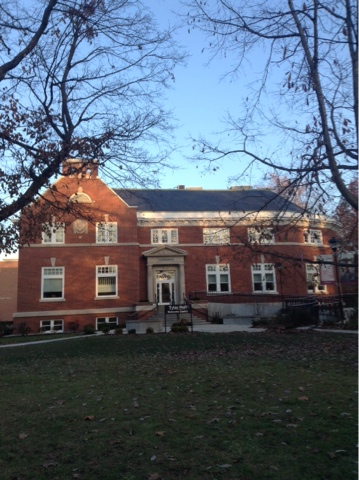
Thursday, November 12, 2015

Oxford, Ohio


Its not so easy to pull myself from the toasty warmth of my down sleeping bag when the temperature isn't much above freezing, even when there is a Carnegie awaiting me just down the road.  I can be happy though for the frost that dusts the vegetation surrounding my tent.  If it were a wet dew I'd soak my shoes pushing my bike back to the road, and I'd have the lamentable lot of wet, cold feet for an hour or more.

I may be starting my days chilled, but the pedalling soon has me warmed up and shedding layers and glorying in being on the bike. I'm a physical being meant to be outdoors and active, not cooped up in some cubicle of a cell. When I eventually shed my corporeal form I can take up a sedentary existence or whatever lays beyond.  

The worst of bicycling this time of the year isn't so much the cold, but rather the shortness of the days, abbreviating my time on the bike.  Dark comes much too early.  Its nice though to spend more than the ten or twelve hours at my campsites that is my usual time in the warmer months when I'm biking until dark and then off early in the cool of the morning.  Each campsite is a jewel that deserves more appreciation and time than I give them.  I'm always too eager to begin pedaling than to linger in camp watching the sun brighten the landscape and giving a full examination of the spot that was my refuge for the night, whether it be surrounded by trees or beside a field of corn.  The best I can do is leave some fertilizer. 

I was able to linger outside the Union City Carnegie on one of its benches and revel in the marvelous setting, as I arrived a few minutes before it opened at eleven.   It had a block all to itself, set back from the street with a vast green lawn before it.  If I had spotted this regal edifice in France I would have guessed it was a residence of royalty.  It was an amazingly distinguished-looking building for such a small, out-of-the-way town. After being subjected to the antiseptic sameness of the last few libraries that had replaced Carnegies, sitting in the cozy warmth of this historic building felt like putting my feet into a pair of beloved, well-worn shoes.


At Winchester it was back to the modern mundane in an attachment to its Carnegie that was an abomination.  The Carnegie was closed off from the addition and only used for meetings.  The entry to the new library hugged the backside of the old building.  It was all enclosed.  Those who enter could go to one side into the new library, or, if they didn't know better, such as me, climb a few steps to the old library.  If one went up those steps, he'd be thwarted by a sign that announced "Closed."  Most additions find a way to incorporate the original library and let it continue to fulfill its purpose.  Not here unfortunately. At least the front side of the true library maintained its gallant dignity of a century ago, though somewhat blighted by the wings behind it that were part of what is now the library.


The city of Richmond did not need the beneficence of Carnegie for a library, but there was a Carnegie in the city on the campus of Earlham College.  It was in the middle of the campus and was now its Welcome Center and administrative offices.  The school appreciated its significance, spending $5.6 million dollars renovating it in 2012.


The tenth and final Carnegie on my route through Indiana came in Liberty.  It faced the town's central plaza and fully functioned as it was intended.  Unfortunately it was closed for Veteran's Day so I couldn't soak up its ambiance.


Not too far across the border into Ohio I came to Oxford and Miami University, one of eight colleges in the state with a Carnegie-funded libary, more than any other state except Pennsyvania with nine.  The domed building now fittingly housed the Architecture Department.  It was the most prominent of a row of red-brick buildings that faced out onto a vast quad.  I was the only one among the streams of students on a bike.  If I were on a crusade to promote the bike, I would have given up long ago. My only crusade, foolish or not, is to get in a bike ride as often as I can. 


Decatur, Indiana

I've  been criss-crossing Indiana for years from top to bottom and side to side at the outset of bicycle tours and also upon their completion.  I vary my routes through the state as much as possible.  Lately its been dependent on Carnegie libraries I have yet to visit. Since the state is so thickly freckled with them, its not difficult to piece together a series of roads I have never ridden in my quest to see them all.  

Carnegie funded 167 libraries in the state, by far the most of any state.  California is second with 144, then Ohio with 114 and Illinois 111.  Only two other states had more than 100--New York 110, of which 66 were in the Five Boroughs, and Iowa with 108. I have visited well over half of those in Indiana and Illinois, but still have hundreds of miles of pleasurable riding in the years to come before my bike has taken me to them all.

I'll have the thrill of laying eyes on ten more in the Hoosier state that have eluded me on my present ride to Georgia.  Last November my route took me through the heart of Indiana, including Indianapolis, to Louisville for its nine Carnegies.  This year I'll go further east before heading south so I can pass through Cincinnati for its nine Carnegies.  Only four cities have more--Cleveland and Baltimore with 14, Philadelphia with 26 and New York City. I'll have a fine day getting to know Cinncinati through its Carnegies, just as I did in Louisvile last year and also Denver two months ago.  

I've already cut across Indiana to the Ohio border.  Rather than crossing into Ohio, I'll stick to the Indiana side of the border for four more Carnegies in addition to the six I've already visited.  Two were small town libraries modestly constructed of red brick and four were small city libraries majestically constructed of Indiana's trademark limestone.  All were magnificent.  Which was moreso is dependent upon the eye of the beholder.

I had to take a small, county road the last few miles to reach Monterey.  Its Carnegie had an uncharacteristically large number for its address--6260 E. Main.  Generally the street number of a Carnegie is no higher than 200, what with numbering systems for towns usually emanating from the town center, and Carnegie's stipulation that the library be no more than a block or two from the center.  It was no surprise the library was on Main Street, as that is by far the most common street for a Carnegie.  There are thirty-five Main Street Carnegies in Indiana.  The next most popular street address in the state is Washintgton with six.  There are three Walnut and three High Streets.  The towns with High Streets must have had an English influence, as High is what the English call their Main Street.


Monterey was barely large enough to have a town center, but its Carnegie was just a block from it in a residential neighborhood.  Its street numbers started from Highway 35 nearly ten miles away.  The building was identitied as "Library" over its front entrance.   Above its side entrance was the greeting, "Your window to the world."  What its interpretation of the world was I do not know,  as the library closed at one on Saturdays and it was later than that.

I ventured off onto another small country road to reach Roann and its Carnegie.  Like Monterey, it was so small there were no signs for its library.  I was looking for Chippewa Road but missed it, as I was distracted by a sign for a covered bridge and didn't notice it was on Chippewa.  After I passed through the town without spotting Chippewa, I doubled back and asked directions from someone who was cleaning out his garage.  Along Chippewa were a couple of antique stores catering to the crowd attracted by covered bridges. The library resided in a nice open space.  A plaque gave notice that it was on the National Registry of Historic Places.  This despite the addition to the back providing access for the handicapped.

  
There were no signs either in the city of Wabash for its Carnegie, but I knew  it was just off the main thoroughfare through the city.  There was no missing this grand limestone building with a green dome peaking above it. It was further distinguished by a large limestone addition and "Carnegie Library" chiseled into its front and rear facades.   Its original entrance framed by four columns had been barricaded and now resembled a porch.  A four-sided clock tower with Carnegie etched on all four faces was erected in 2009 in the name of Elizabeth Pearson, a benefactor of the library.  It resided near the summit of Hill Street, making it all the more regal.


The Carnegie in the similarly sized city of Huntington, twenty miles down the road, was vacant and had fallen into neglect.  This once proud chateau of a building was still adorned with "City Free Library" on its facade, though in its latest incarnation had served as an administration building for the local  school system.


All through Huntington I had been following signs with a quail on them to the Dan Quayle Museum of the 44th Vice President of the United States under George Bush the first.  It was just a block beyond the Carnegie and in much finer standing than the former library.


As I exited Huntington I came upon my first supermarket of the day.  I had gone all day without a chocolate milk.  It was a little late in the day for it, but it was a need I had to fulfill.  With day-time highs in the low fifties and night-time lows near freezing I bought a half gallon carton so I would be good for the next two days.  It didn't cost much more than the pints that the Dollar Stores only offered.  I also stocked up on honey and baked beans.  Along with bread and ramen and other reserves, I was set for the night,  but couldn't resist going around back to give the dumpster a look.  

Right on top was a bag of fried chicken from its deli department and several containers of dips and containers of chopped fruit.  A little deeper I found bread and several half gallon jugs of apple juice and packages of chocolate chip cookies.  If Tim had been accompanying me in his car, as he did last year, we would have had food for days.  I only had space for one loaf of bread, one juice, one dip, one package of cookies, one container of fruit and three pieces of chicken.  I had no regrets over not going to the dumpster first, as I got food I needed inside as well.  

My panniers were bulging from this bounty.  I  couldn't fully fasten them, but that was okay, as I would be camping soon.  It was near dark.  Within a few minutes I came upon an Army Corps of Engineers lake surrounded by woods.  There was a picnic area on one side of the road and a barrier blocking the entrance to a boat launch on the other.  I went around the barrier and disappeared into the woods. An hour later, as I was still feasting on the chicken mixed in with ramen and dip, I heard the rustle of leaves from some critter no doubt as excited about the chicken as I was.  I banged my metal water bottle with my knife and it scurried away.  I later scattered the chicken bones a good ways from my tent.  They were gone in the morning.

It was less than two hours the next morning to the next Carnegie in Blufton.  It now provided office space for the local government.  A sign out front advertised flu shots.  The new sprawling library, complete with an electronic message board, was right across the street.


Decatur's Carnegie was now a courthouse, desecrated with a shed of an entrance tacked on to its front. The new lackluster library was right next door.  It had been built in 1979 at a cost of $730,000.  The much more magnifcent Carnegie was built for less than $15,000 in 1905. The first librarian was paid $35 a month.  It had a painting in its lobby of the Carnegie as it was, showing the "Carnegie Library" on its facade, now covered with "Adams County Superior Court."


As is frequently the case, Decatur's library had a sculpture out front of a child reading a book.  This one was entitled "It must be a good book."


Tuesday, November 10, 2015

Yard Art Across America


I've noticed a growing trend of yard art, subtle and grandiose, in my recent travels out in rural America.  Americans have long had a propensity for decorating their yards at Christmas and Halloween, and even Easter, so much so it might be termed part of our cultural heritage.  It has almost become a craze among some communities, and a compeition only as Americans can make it.  Whether it is an urge for self-expression or a clamour for attention, the "art," tacky as it can often be, ought not be too severely condemned.  It is more often an enhancement than a blight and can be credited for leading to a higher and more varied form of art.

Yard decorations have begun to evolve beyond mere pink flamingoes and ceramic deer.  More and more home owners are putting up original creations.  Whether its an over-sized wooden woodpecker on the side of one's garage or a scattering of tributes to Mickey Mouse, they all deserve commendation.


There have always been the eccentrics who have devoted their lifes to filling their property with a wild array of concoctions and ornaments.  Now they are being joined by common everyday citizens who have a bent for some fun and creativity, adorning their yards with oddities they have some connection to.

I have been enjoying a regular dose on my present ride down to Columbus, Georgia to attend the annual vigil outside of Fort Benning in remembrance of the Jesuit priests who were murdered in El Salvador  nearly thirty years ago.  I biked the eight hundred miles from Chicago last November for the occasion and enjoyed basking in the great passion and energy of the thousands of activists from all over the country in attendance.  I knew I  couldn't stay away.  Unfortunately, I'm not accompanied again by Tim, but will be joining up at the event with Dwight, a long-time friend of equal stature who I have shared many an adventure, including another one in Georgia for the 1996 Olympics.

My first four days on the road across Indiana have been marked by Carnegie libraries and yard art.  I hadn't even left Illinois when I came upon a permanent pallet in a farmyard featuring pumpkins and bike wheels.


Bikes have been a common adornment.


I'm not always sure if the bikes are meant to be an art-ful display, but I accept them as such.


I can't say what this rural resident meant by his display of bikes, but they were a statement of some sort.


The property with the woodpecker south of Huntington, Indiana had a scattering of art with a throne looking out upon them.


I have been particularly attuned to these creations, as Janina and I have been inspired by this same spirit sweeping the land.  Since I moved in with her after my return from Telluride, we have mounted a bicycle on the roof of her house and decorated another out front near a Goldsworthy cairn Janina constructed.  Its just the beginning.  I've been extra diligent collecting bungee cords on this trip, no matter what shape they are in, for something we don't know yet. Janina will figure out something.


Her yard is increasingly filled with cairns varying from four or five rocks stacked on top of one another to caverns of dozens, some as high as four feet.  And we're only just getting started.


Another version of yard art sweeping the land are colorfully decorated "little free libraries" for trading books.  


According to the website that sells them, there are over 30,000 scattered about the country.  One can find them by entering a zip code on the website.  Janina and I haven't joined that fraternity, but we regularly stock five of them within several miles of her home.  When we recently visited friends in Bloomington, Indiana, we brought along books for its littlefreelibraries.  There was a significantly higher quallity of books in the academic community compared to Janina's suburbia.  We came back with an Orhan Pamuk novel, a study of Malcom X, a novel by Jiimmy Carter, a book on the humility of the founding fathers and not surprisingly, a biography of Bobby Knight.  No Kurt Vonnegut though, born in Indianapolis, where we visited the superb Kurt Vonnegut Library with his typewriter and paintings and rejection letters along with all of his books.

The yard art also spills over to libraries.  Many have sculptures relating to reading out front.  


I try not to let the many forms of art along the way be a distraction from my Carnegie-quest, but rather another feature of it.  You'll have to wait for all the libraries in the next post.


Thursday, November 5, 2015

"Reckless, The Life and Times of Luis Ocaña," by AlasdairFotheringham--Another Merckx Biography

The career of Luis Ocaña was so intertwined with that of Eddy Merckx, Alasdair Fotheringham's recent biography on the Spanish Tour de France winner, "Reckless, The Life and Times of Luis Ocaña," is almost as much about Merckx as it is about Ocaña.

More than half of the book is devoted to their Tour de France battles in the early '70s.  They were born just eight days apart with Merckx being the junior, but Merckx's career took off much faster than did that of Ocaña.  They first raced against one another in 1968 at the Giro d'Italia, when Merckx was already a dominant force and Ocaña was somewhat of an unknown.  Merckx won the race, his first Grand Tour victory, while Ocana finished 34th.  They both rode The Tour de France for the first time in 1969.  Merckx won it while Ocaña lasted only eight stages.  Ocaña improved to 31st the next year as Merckx won again.  

But in 1971, Ocaña was able to challenge Merckx full throttle unlike anyone else at the time.  He gave him one of the worst defeats of his career on the Orcieres-Merlette stage in the Alps, winning by an unimaginable eight minutes and forty-two seconds.  He was poised to claim The Race title and topple Merckx from his throne, but he crashed several days later in the rain in the Pyrenees and had to abandon. He couldn't descend as well as Merckx and gave into his predisposition to recklessness as he chased after the Cannibal on a treacherous descent and wiped out and then was hit by two following riders.  Fotheringham maintains that his reckless streak was what defined him, thus the title of the book.  It was  what made him great, but also undid him, on and off the bike.

Ocaña's lone Tour win came in 1973 when Merckx skipped The Tour after winning it the previous four years.  Ocaña won The Race in convincing Merckxian fashion by over fifteen minutes over future Tour winner Bernard Thevenet, claiming six stages along the way.  But without Merckx in the field nor the Italian great Felice Gimondi, it was known as "The Tour of Absences," and Ocaña's victory was somewhat tainted.  Ocaña, though, would have none of it, and said that if Merckx had been there he would have made him suffer.

Fotheringham interviewed Merckx for the book, but not Ocaña, as he died in 1994 from a self-inflicted gunshot wound at the age of forty-eight, sixteen years after he retired from racing, distraught over his ill-health and struggling finances.  But he does interview his wife of twenty-seven years.  She feared her husband would do harm to himself and called his doctor to come and tend to him shortly before he shot himself.  Fotherringham cites his brother William's biography of Merckx several times and also that of Daniel Friebe. The emphasis on Merckx is reflected on the cover of the book, quoting Merckx as saying Ocaña was his "most dangerous rival."  Fotheringham also references many of the other books written about Ocaña, including his autobiography and another with the title "Merckx-Ocaña: Duel at the Summit."

What made Ocaña dangerous in the eyes of Merckx was his recklessness.  He was a rare cyclist who dared to attack him and with abandon. Usually it was to no avail, but he made Merckx wary.  When he humiliated Merckx in the 1971 Tour with his dramatic win on the Orcieres-Merlette stage, considered one of the most memorable stages in Tour history, Merckx responded the next day with an all-out attack with his teammates from the very start.  That too is a legendary stage.  Merckx was only able to gain back two minutes, but he pushed the pace so hard the racers arrived at the finish in Marseilles much earlier than anticipated and before many of the dignitaries had gathered.  The mayor of Marseilles was so incensed he didn't allow The Tour to return to Marseilles for several decades.

Ocaña was driven by an obsession to defeat Merckx.  He renamed his dog Merckx so he could have the command of at least one Merckx.  He took special delight in ordering Merckx to lie at his feet.  When he met the Queen of Belgium, he told her he was going to make Merckx eat his bike.  He told others he wanted to destroy him.  He attacked him many a time, but was only able to claim victory over him five times, two of which were time trials.

As prone as Ocaña was to impulsive and unpredictable behavior, Fotheringham doesn't cite a single instance of Ocaña being brought to tears, whether in defeat or victory, as is common in the peloton.  To contain such emotions was part of his heritage.  He said he only saw his carpenter father cry once--when he presented him with the Spanish national championship jersey for the 1968 time trial.  

Ocaña had an early career decision whether to declare himself Spanish or French.  His family moved to France when he was twelve. He was educated in France and married a French woman and spent most of his life in France.  His wife said he was clearly Spanish in character, but overall was more French than Spanish.  He rode for a Spanish team early in his career.  When he switched to the French Bic team of the pen company in 1970 for more money, he was lambasted by the Spanish press.  One writer said he would pay for it with "tears of blood."

Fotheringham's previous book on an earlier Spanish Tour de France winner, Federico Bahamontes, was also light on the mention of tears, in contrast to most cycling books.  He clearly understands the significance of tears though, as he uses the tears of Gimondo, after a snowy stage in the 1968 Giro, to demonstrate the severity of the conditions and to elevate Merckx's triumph on the stage.  Gimondo struggled and apologized to the nation afterwards in tears on television.

No cycling book is complete either without the intrusion of drugs.  Fotheringham attributes a  teammate as saying Ocaña was a very heavy user of "medication," though he only tested positive once --for pemoline, an amphetamine, in the 1976 Tour when his career was in decline.  He didn't deny taking the drug, but  said he was no more guilty than anyone else. Four others also failed the drug test in that Tour, but none were kicked out of The Race or given any kind of suspension.  They were all sanctioned with the standard penalty in effect then--a mere ten minutes added to their time.

Fotheringham offers other examples that the times have changed considerably in the decades since Merckx and Ocaña.  Teams during The Tour were often housed in dormitories.  The money they earned was also paltry compared to now.  Early in the 1971 Tour on a day when the riders had to ride three stages in one day, they went on strike in the first sector in protest that the prize money had not been increased since 1963.

Fotheringham inserts many such choice insights into the world of cycling, making this a valuable contribution to understanding not only Ocaña and his rivalry with Merckx but the sport in general.  Whether he next writes on another Spanish Tour winner or some other aspect of cycling, it will be a book to look forward to.  Hopefully he'll try to match the output of his brother, though he has a was to catch up.  With only two he is eight behind.


Friday, October 23, 2015

"Gironimo! Riding the Very Terrible 1914 Tour of Italy" by Tim Moore

Tim Moore regards himself as a travel-writing humorist.  Each of the five blurbs he selected to put on the back cover of his latest book ("Gironimo! Riding the Very Terrible 1914 Tour of Italy") emphasizes how funny it is, one even describing it as "laugh-out-loud."  It is debatable whether his endeavor to cycle the 2,000 miles of that 1914 race on a one-speed bike from that era with wooden rims wearing garb of the time is comical or ridiculous.  What isn't debatable is that it was a struggle, not only for him but for those who accomplished it, as only eight of the eighty-one starters finished the race, the highest attrition rate of any of the trio of three-week Grand Tours held in France, Spain and Italy over the past century.

Reliving this race was a great idea for a book and for an escapade, such as Moore is known for.  He wrote a similar book about The Tour de France, "French Revolutions," in which he rode the route of the 2000 Tour.  He was a novice cyclist at the time who didn't bother to train for the effort to make his struggles all the more emphatic and laughable.  He walked up most of the mountain passes.  The book just marginally captured the flavor of The Race, as he rode the route a month before the racers did without the roads thronged with fans or the towns decorated with bicycles and banners and the newspapers full of articles on every aspect of The Race.   The response of the French public to The Tour is as much a part of The Race as is the route and the racers.  

It was a book for neophytes, not aficionados, and the same can be said of "Gironimo!"  Too bad the other cycle-writing Moore, Richard, who wrote the brilliant "Slaying the Badger," didn't write this book.  Richard has a deep knowledge and love for the sport and would have made this a much more informed commentary on the lore of the sport and its participants.  His several books on cycling are all packed with telling detail that this book lacks.  Tim, the other Moore, did plenty of research, including regular referrals to an Italian book from 1972 about the 1914 Giro, but he is more concerned about mirth and his efforts, than truly penetrating to the essence of the Giro and what the experience was actually like for those who competed in it.  

There is no denying that he has a much deeper understanding and interest in bicycle racing than when he undertook his Tour de France ride.  For one, he knew enough to train for this ride.  It consisted mostly of riding a stationary bike while he watched the broadcast of various races. The commentary from those broadcasts was deeply embedded in his subconscious.  He frequently hears the voices of Phil Liggett and Paul Sherwen as he rides along, and confesses he doesn't think he could have finished the ride without them.  He is inspired to keep battling a vicious wind as he imagines Sherwen describing his efforts: "Moore's got the race-face on and he's pumping those two big pistons he calls legs." 

He finds encouragement too from the wisdom of Paul de Vive, an early-day French cycling enthusiast who was the first to advocate bicycle touring.  He agrees with de Vive that cycling is "a wonderful tonic," but adds that, "There is no point in denying that sometimes its shit." "The shit" is what he prefers to dwell upon, not only in this book, but in his previous one. 

His research is impeccable enough that I only caught one minor factual error.  He wrote that Eugene Christophe broke his fork in the Pyrenees in 1912.  It was actually 1913.  But he doesn't make the error that many books do of the time penalty he was assessed for accepting the assistance of a young boy to operate a bellows as he repairs it. He plays it safe by writing he was penalized rather than giving the exact amount--ten minutes reduced to three.

Moore spent thirty-two days riding the eight stages of this Giro.  They averaged 250 miles each.  It took him five days to ride the first stage in which 37 of the 81 starters dropped out.  By the end he was determined to ride the final stage in three days.  His pain and suffering is the main thrust of his story.  He walks up many a climb, though not if there are others around.  He's not sure if he wants to give a friendly driver who encouraged him on one steep climb to keep pedaling "a tearful hug" when he meets him at the summit or to "punch his lights out" for prolonging his suffering.  Tears figure in at another summit during a few day stretch when he was joined by a much stronger friend on a contemporary bike.  His friend reaches the summit well before he does.  When Moore joins him, he douses himself with water from a spring, hoping his friend can't distinguish it from his "tears of relief."  When he weeps on another hill he explains that "riding a bike up a big hill makes heroes of us all."

Tears receive a frequent mention, not only his own, but those of others.  The great Italian cyclist, Costante Girardengo, the first to be anointed "campionissimo" ( champion of champions), competed in the race as a 21-year old.  He won the third stage, but was so depleted by the effort that he abandoned the race twenty-two miles into the fifth stage, "sobbing apologies for letting everyone down."  Moore goes back to the first Tour de France in 1903 to add emphasis to what a horrific ordeal bicycle racing can be.  He quotes its winner, Maurice Gann, as lamenting that he "cried all the way from Lyon to Marseille" on its second of six stages.  The winner of the 1914 Giro, Alfonso Calzolari, cries as well, though in a different manner. As an 85-year old recounting the race to the author of the book Moore uses as his chief source, he says that he "cried like a baby" over accusations that he cheated.

Moore chooses to ride a dinosaur of a bike so he can suffer as the racers suffered and refers to the ordeal of the 1914 Giro as a "solar fireball of suffering."  He strains his literary muscles to such an extent when describing his suffering that it must have wearied them to the point of exhaustion bordering on pain and suffering.  He endures "slow-roasted suffering."  His legs were "blasted in shiny pain."  On another occasion they "glowed with pain." He is distracted by "blinding pulses of neat pain."  He seeks "majorly suffering" such as Sean Kelly describes when he comments on races.  This was the first Giro since the inaugural race in 1909, six years after the first Tour de France, to be decided by time rather than points.  Moore calls that "the sour cherry on top of the pain-cake," as a rider couldn't build up a cushion from points and take it easy on a stage.  They had to ride every stage hard.

By stage five he's able to put his mind on "auto-pilot oblivion," enabling him to go "whole hours without asking aloud whose stupid bloody idea this was."  The book is packed with British lingo.  The b-words run rampant--bloody, blokes, bollack, bin, bitters, bodge, buggery, boot, buttocks.  His favorite b-word though is the French bidon for water bottle.  He mounts his handlebars with a pair of vintage metal bidons, and there is a photo to show them.  The book is scattered with photos of the author and his bike and his gear, including a photo of his laundry in a hotel sink.

He makes mention of his Tour de France ride from time to time.  He sees many more "proper road cyclists" in Italy than he did in France, in fact more in one hour on the outskirts of Turin than in his entire circuit of France.  The Italians are also more lively.  Many react with great glee at his ancient bike and his get-up, complete with goggles.  He regularly encounters prostitutes along the road, a subject that didn't come up in his previous book.  Two on a sofa propose a mènage a trois. In Rome’s "tart belt" a completely naked women beckons him from the shadows.  

He learned from his French ride that a definitive article preceding a mountain, such as Le Ventoux or L'Alpe d'Huez, is a warning of a sort, giving the mountain an added measure of respect.  The Italians refer to their most intimidating mountains in a similar manner, letting him know he’d have to summon a little extra effort.  Such observations do show he has a sharp and attentive eye, lending a good amount of merit to this book. My tastes would have been much better served though if Moore had placed more focus on informing than tickling and had concentrated more on racing than masquerading as a racer.  


Monday, October 5, 2015

Headwinds Across Illinois

Gusting winds were blowing me all over the road and sometimes off it for 160 miles on my home stretch run across Illinois from the Mississippi River to Chicago.  My water bottles weren't transparent, so I couldn't claim to have white caps in them, as did "Des Moines Register" columnist John Karras, co-founder of RAGBRAI, on one of his rides across Iowa, but I wouldn't have doubted if there were. If someone had stopped to offer me a ride, as happened in Nebraska in much milder conditions, I might have accepted, not only to be spared the danger and the strain of the conditions, but also because I had ridden this highway a couple times before.

A grizzled old-timer in a beat-up pickup truck did stop with an offer--not of a ride but rather of a five dollar bill.  It was a few miles past Mendota at about my halfway point across the state.  "I spent a couple years on the road myself," he said.  "I know what its like out there.  Here take this.  There's a McDonald's a couple miles up the road.  Have yourself a cup of coffee and something to eat. You're lucky to be passing through, as things aren't so good here.  Two of our three factories are closed up.  Lots of people are out of work and a good many of those who aren't have to drive a long ways to their jobs in other towns.  I'm glad to be retired." 

He wasn't the only kindly soul who wasn't particularly well-off who thought I might be a victim of these hard times and short on funds. The day before outside of Davenport I stopped to ask a bedraggled older fellow, who from a distance appeared to be a touring cyclist, for a cycling-friendly bridge over the Mississippi.  The bags adorning his bike were actually filled with aluminum cans and he was stopped along the road gathering more.   He said he lived in a tent in the nearby woods. After he gave me directions to the Centennial Bridge, I asked him if there was a grocery store up ahead.  "Do you need some money?" he asked.  "I could give you some."  

I felt as if I should have been the one doing the offering.  I'd pick up a pair of vise grips a few miles back.  "Could you use this?," I asked.

"That's in pretty good condition," he said.  "How much do you want for it?"

"No, no, take it," I said.  "I was just rescuing it from the road and looking for someone to give it to."  Then I pulled out a couple of bungee cords and offered him those too.  "No thanks," he said. "I find plenty of those myself."  

It was late in the day.  He advised me not to try to bushwhack in downtown Davenport as there were some unsavory characters there.  He is caught by dark on occasion in the city and has to be careful where he sleeps.   "I sleep sitting up so I can make a quick eacape," he said.  "There are punks who like to come along and give you a boot."  

I was sorry I was pressed for time, otherwise I would have asked if I could share his campsite in the woods. I knew he could keep me up late with his tales.  Though he might not have been monetarily rich, I could tell he'd led a life rich in experience.  He had not an iota of resentment or despair.  He was a survivor who was doing just fine.

I had to ride on a narrow sidewalk across the bridge and could only take quick glances at the river below as I tried to hold my line in the strong wind. I had visited the Carnegie in Moline a couple years ago, so I could head right out of town.  I crossed the Rock River before its confluence with the Mississippi and passed through the town of Milan.  A car dealership had a banner out front that might have been inspired by Huck Finn.


A llittle further, as dark fell, I camped along the Quad City International Airport, my first non-cornfield campsite in days.  The wind ruffled my tent all night. I had to wear an extra layer to stay warm in my sleeping bag.   In the morning several formations of geese passd overhead on their way south.  There wasn't a Carnegie Library along the route that I hadn't visited.  My stops were minimal.  I just grinded away into the strong wind between seven and eleven miles per hour depending on what the wind and terrrain allowed.  With 1,500 miles in my legs from Telluride, they were strong enough to put in close to eight hours of effort in the less than twelve hours of light at my disposal.  There was no relaxing or gliding in these conditions.  

Struggle though it was, it was satisfying to be out in these less than optimal conditions and persevering, watching the farmers in their huge combines harvesting their corn and appreciating a few early Halloween decorations.  One farmhouse just east of Walnut was populated by an army of nearly a hundred ghoulish characters, some hanging from trees.  One guarded the mail box.


Another supervised the sale of road kill.


The sun was setting.  I didn't want to camp too near this band of characters.  A few miles down the road I found a high and thick field of unharvested corn that provided enough of a windbreak that I thought the wind might have calmed down during the night.  But when I emerged from my tent I could see the nearby wind-turbines were still spinning and pointing in the wrong direction. On I pushed.  I had 90 miles to Janina's. I really wanted to make it this day even if I had I to push on into the dark. I knew once I got to the urban sprawl the wind would be somewhat blunted.  

I was within twenty miles when the last of the sun's light was gone.  I had turned on to 75th Street from highway 34.  It had a nice wide shoulder.  I'd never come in this way before and didn't know if the shoulder would hold up all the way to my turn on to Plainfield.  Before I could find out the air turned misty and my glasses became dewy.  My limited visibility became even more limited.  I survived for six miles riding with great caution.  I wasn't tired, but this was becoming a bit too stressful and perilous.  I had passed up several forests already, wondering if it was a mistake.  When I came to another, better judgement prevailed and I turned in.  At the speed I was going it would be at least two more hours of riding in the dark, sweating out each revolution of the pedals.  Rather than feeling defeated, I felt happy to have one last night in my tent.  It made my arrival at Janina's the next morning all the more joyous.  Though I was reveling in the completion of another great journey, I was already looking forward to being back on the road next month for a ride to Fort Benning in Georgia once again for the vigil honoring the six Jesuits priests and their housekeeper and her daughter murdered in El Salvador twenty-six years ago.


Friday, October 2, 2015

West Liberty, Iowa


When I saw a set of bike sculptures in front of the Carnegie Library in West Liberty, I thought maybe they had been put up by someone anticipating my arrival. It wasn't likely, as the last two Carnegies on my route were no longer libraries, so no one within the last one hundred miles could have alerted West Liberty to me and my quest, as happened in Indiana last spring.

My first question for the librarian, rather than "Do I need a password for your WIFI?," was, "What's the significance of the bike sculptures out front?"  Several of the librarians had ridden RAGBRAI this past July as a fund raiser for the library and the sculptures brought attention to their endeavor.  They raised over $5000 from pledges and also the sale of T-shirts. There was one on display on the circulation desk along with a photo of the four librarians and a city councilman who participated in the ride.


I figured the library would have at least a couple of the several books written about RAGBRAI.  None were on display, so I asked where the 700 section was.  "We no longer use the Dewey Decimal System," I was told.  "We file things by subject.  I'll show you where our bike books are."

Not all were grouped together, as personal accounts were in the biography section.  There were two about people who had ridden coast-to-coast, one of which I had read, but curiously none on RAGBRAI, especially since the librarian I  was talking to had ridden RAGBRAI five times and was the inspiration for the others to do it. She had also just read the recently published "Gironimo!" on the 1914 Giro d'Italia that I am eager to read.  There was enough local bike interest for the library's copy to be checked out.  She was aware of my friend Greg Borzo's 2013 book laden with photos on the history of RAGBRAI, but hadn't acquired it.  She checked the holdings of other Iowa libraries and could find only one that had a copy of it.  

She wasn't all that surprised, as she explained that RAGBRAI isn't as popular within the state as out-of-staters might think, as many Iowans are turned off by some of the rowdiness associated with it.  There are those who ride it once and say they'll never do it again.  I asked if she knew my friend Kathy, who has ridden it many times with a schnauzer.  "Of course, everybody knows her," she said.  "She's so popular that she charges people to take her photo with her dog and gives the money to a charity, an animal shelter."

I hadn't noticed Carnegie's portrait and asked if they had one.  It was high above the elevator facing the library's new entrance.  The library had been expanded in 2001, extending it off to the left without it appearing to be an addition.


To the right of the original entrance there was a cabinet with books for trade.  


It was a replica of such cabinets known as "Little Free Lbraries" offered by http://littlefreelibrary.org.  They sell kits ranging from $150 to $1000. Janina has several neighbors out in LaGrange with such contraptions in front of their homes.  This was built by a local craftsman.  He had made six of them, all of different designs.  They were scattered around town in parks and other public places.  The library stocks them with discards and donated books.  The librarian acknowledged that not everyone trades a book for a book as is encouraged, so sometimes their stocks begin to wane, but she was just happy that people were availing themselves of the books.  They used to have extra "Oprah" books to spread around, as for a couple year period early in her program they would receive a monthly batch of twelve hard-back copies of her latest selection.  She also had strong words of commendation for Bill Gates.  He had made it possible for her libary and countless others to join the Internet age.  Without his generosity they would not have been able to afford computers.  She felt almost as much goodwill towards him as she did for Carnegie.

Our conversation went on for so long talking of books and bikes, my legs began to tire and I had to apologize that I needed to sit. I had been pushing into a strong head wind the past three days, partially thanks to hurricane Joaquim brewing in the Caribbean, blasting a cold wind out of the east.  I had wanted to make it back to Chicago by the end of the month to help my roommate clear out of our apartment, as our landlord had sold our building to a developer and we were being evicted.  I had moved out most of my stuff before I left for Telluride, but had left a few minor items behind, mostly posters and pictures.  Debbie had gained permission from the new landlord to leave such things in the basement through the weekend as long as everything was out of our apartment.  I was sorry the winds were preventing me from helping her complete her move.

I had extended my mileage a bit by swinging up to the college town and state capital, Iowa City, for its Carnegie.  It had been a dandy, but had been converted into five apartments catering to students. It had lost its luster and wasn't particularly well-maintained.  The grounds around it were strewn with cigarette butts.  It was on the fringe of the campus, across the street from the new large glassy library.  A large number of students were wearing Iowa sweatshirts in the chilly fifty degree temperature, that had me in tights for the first time on this trip.


I had to push directly into the northeast wind for over fifty miles from the previous Carnegie in Sigourney.  It was in the process of being converted into a residence even though it still had a canopy with "Library" on it over its entrance.  The new library on the outskirts of the town had little more character than a warehouse.  The librarian spoke with great nostalgia for what a fine place it had been to spend her days.


West Liberty would be the last of my Carnegies in Iowa, as the one in Davenport, where I would cross the Mississippi back into Illinois, had been demolished.  That left me with an even dozen in Iowa, two more than on my crossing two years ago.  That leaves me with seventy-six more to track down in the state.  There had been 108, but ten are no more.