Showing posts sorted by relevance for query course marker for. Sort by date Show all posts

Tuesday, September 6, 2022

A Tour de France Course Marker for Greg LeMond


The Telluride Film Festival  is the rare film festival that does not announce its schedule in advance, so I didn’t know until the day before the festival started when the schedule was released that a documentary centered on Greg LeMond’s 1989 win of the Tour de France was to play and that LeMond was to be in attendance.  That may have been the most exciting revelation in the thirty years I have been attending the festival, anchoring it’s shipping department for a four-week paid vacation in the spectacular San Juan mountains.  Well knowing the intimacy of the festival I knew I would have the opportunity to meet Greg, a heroic figure who had granted me much happiness during the height of his career, and that had me hopping with delight.


Luckily the first screening of the film, “The Last Rider,” was on the first day of the festival, so I didn’t  have to endure the anticipation of seeing LeMond and his film too deep into the four-day festival.  It would be my second screening on its opening Friday night at 8:45 p.m. in the 60-seat Backlot Theater in the town library.  

By sheer luck I had brought along from Chicago a Tour de France course marker as a gift for a friend from Los Angeles who was an ardent Tour fan.  It was to be a surprise for her.  I had yet to see her, so it remained in my possession and I could offer it to LeMond or maybe have him autograph it for her if he didn’t want it.  I had a similar experience with Christian Vande Velde.  I presented a Tour course marker to him for an autograph when he made an appearance at a Chicago bike shop, not so much for his autograph but out of curiosity to see his reaction to the marker. 

I didn’t know how aware riders were of these bright yellow signs with a black arrow on them pointing the direction at intersections since they were led by a phalanx of motorcycles and hardly needed them to guide the way as they served me when I was riding the Tour route preceding the peloton. I learned from Christian that the riders are fully cognizant of them and regard them as much of a holy relic as fans do.  They are the ultimate souvenir for the fans and the riders, especially since they are not for sale, but must be scavenged after the peloton has passed. Christian has been delighted to accept a handful of them from me over the years.  I wondered if Greg would have a similar reaction. 

He was late arriving at the theater, and I wasn’t even sure if the husky, white-haired masked gentleman was Greg, as he wasn’t accompanied by an entourage, though he did have a blue lanyard around his neck worn by guests of the festival.  I had been waiting in the lobby after claiming a second row seat.  He proceeded into the theater and took one of two seats in the  fourth row that had evidently been reserved for him at the far end from the aisle, as if he wished to be anonymous.  

I went to my seat and dug the course marker out of my backpack and discreetly held it at waist level pointed in his direction.  It immediately caught his attention.  His eyes lit up and he gave me a thumbs up. Hooray, it was him and the marker meant something to him. I sat down to await the introduction of the film.  The director of the film, Alex Holmes, whose previous film was the much acclaimed “Maiden” about a group of women who competed in an around-the-world sailing race, introduced the film.  He told us we were the first audience to see the film and nodded towards Greg and his wife, who had joined him, and said they were seeing it for the first time too.  He didn’t say anything about a Q&A afterwards, so I could ambush Greg when he rose from his seat and came to the aisle.

I couldn’t fully concentrate on the film knowing that when it ended I’d have the chance to meet this three-time winner of The Tour and have a bit of a chat.  The first half of the movie charted LeMond’s career from a youth to  becoming a Tour rider, finishing second to his teammate Bernard Hinault in 1985 and then winning it himself in 1986 in a most agonizing battle with Hinault, who seemingly reneged on his promise to help Greg win after Greg sacrificed himself to help Hinault win in 1985, his fifth Tour title, tying him with Jacques Anquetil and Eddie Merckx for the most ever.  Greg felt betrayed by Hinault and could hardly enjoy his victory, the first by an American.  He didn’t even want to attend the team victory party, putting in just a token appearance.  

Several months after his win he was shot by his brother-in-law in a hunting accident and was lucky to survive.  It took him three years to regain his form.  He was ready to quit the sport when he attempted his first Grand Tour after his shooting riding the Giro in 1989. He struggled mercilessly.  But by the end of the three-week race he had a strong time trial giving him a modicum of confidence going into the Tour de France shortly afterwards.

Fignon won that Giro and was a strong favorite to win The Tour.  He and LeMond traded the Yellow Jersey throughout the race.  It culminated with a time trial from Versailles to the Champs Élysées.  Fignon had a seemingly insurmountable fifty second cushion, but Greg pulled out a miraculous effort defeating Fignon by fifty-eight seconds, winning The Tour by eight seconds, the closest ever.  Fans of the sport know the LeMond story well, but it was still exhilarating to watch it unfold, especially accompanied throughout the movie by commentary from Greg and his wife.

The movie ended with hearty applause.  It was several minutes before I could speak to Greg as others around him engaged him in conversation as he headed in my direction.  With course marker cradled in my arm I said, ‘I didn’t notice any of these in the film.  Did you have something similar to this in your day?”

“Yes we did, I know them well.”

“Do you have any? This is for you if you’d like.”

‘I’d love to have one, but are you sure you want to give it up?”


“I have a few, as I’ve ridden the Tour route as a touring cyclist nearly every year since 2004 when Lance was going for his sixth win and always bring back a few to give to friends, including my favorite bike shop in Chicago, and Christian Vande Velde, a fellow Chicagoan, who I’ve given several to over the years.  He’s always happy for another.”

He wanted to know more about my Tour experience, asking where I camped and how many miles I did and if I shared the experience with others. When I told him I enjoyed that first Tour experience so much that I’d returned for sixteen more, he exclaimed, “That’s more than I’ve ridden.”  He well knew the pleasure of cycling in France and expressed the desire to experience France and The Tour in a similar manner.  

I said the festival director had mentioned that Greg might lead a ride to his final screening in one of the two outdoor theaters on the last day of the festival on Monday.  He said he didn’t know anything about that and that he hadn’t ridden his bike in two months after being diagnosed with leukemia In June. He said he was feeling much better than he had been, as he had started on a new medication.  He looked as if he was in the best of health and was as buoyant and upbeat as could be.  He betrayed no hint of being in ill health in any way. 

Several times more as we talked, while he clutched the course marker, he reiterated, “Are you sure you want to give this to me?”  I assured him that it was an honor to share it with him.  I knew others wanted to have a word or two with him, so after my friend Ralph, who has ridden a few stages of the Tour with me over the years, and is a staff photographer for the festival, posed a photo of us in front of the screen, I stepped aside and let others have the pleasure of time with him.  He seemed to be in no hurry and was as affable as could be.

I had much more to say to him, so I returned the following day for his next screening.  He and his wife and director were half an hour early this time lingering in the lobby.  As I approached them Kathy immediately greeted me with, “That sure was nice of you to give us the course marker.  We really appreciate it.  We already have a spot picked out for it over a doorway.”  

That was music to my ears.  I told them I had a Tour experience that related to Greg.  During my second Tour, which was consumed by Lance mania drawing thousands of Americans to the Tour, an older French cyclist, who wasn’t so enamored with the throngs of Americans new to the sport taking over the Tour, asked me if I’d heard of LeMond.  At first I thought he meant the French newspaper, but then realized he was a typical Frenchman who thought Americans had no appreciation for the past and he was actually referring to Greg.  Rather than taking insult that I wouldn’t know of LeMond, I replied with gusto, “Of course I know LeMond! He won the Tour three times, just like Bobet.”

“You know Bobet,” he replied in shock. “He was my childhood hero.  No one remembers him.”

Having won the Frenchman’s favor he invited me to his home to watch the end of that day’s stage.  I couldn’t take him up on it, as I needed to keep riding to get further down the course to keep up with the peloton. As Greg quizzed me more about my Tour experiences, I told him he could read my daily Tour posts with lots of pictures of course markers and fans along the road and Tour decorations on my blog.  He could find it by simply googling “George the Cyclist.” I said I would turn up, just above George Hincapie.

Kathy chimed in, “As it should be.”

Greg pulled out his phone and immediately googled “George the Cyclist” and there I was.

“You must have two million followers,” he said.

“Not that many,” I replied, “but quite a few around the world.”

I told him that I had emailed Christian to tell him that Greg had joined the fraternity of cyclists who have received a course marker from me. Christian replied, saying I was fortunate to meet Greg and his wife too, adding that she had midwestern roots and that he liked her a lot.  That was no surprise, as she was as easy-going and charming as her husband.

I told them how much I enjoyed Richard Moore’s highly-detailed book “Slaying the Badger” about LeMond’s 1986 win and wondered how much time Moore spent interviewing him.  “Only about an hour, isn’t that right Kathy?,” he replied.

 “Wow’s all.  I figured he must have spent a couple of days with you going through all the twists and turns of that race.”

“No that was it.  You know he died a little while ago.”

“Yes, that was a great tragedy. I’ve met him a couolof times during the Tour.  He was as nice a guy as you.”

In my brief time with them I could clearly see they were warm and caring and kindly folk, just like Christian, who has gone out of his way to acknowledge me a number of times during the Tour, even once breaking from his teammates to greet me during the opening ceremony in Liege as each team slowly rode a route through the city past thousands of fans after they had been introduced on a stage in the city center.

It was a gesture that seemed in character for Greg too, who couldn’t have been more humble and considerate, and like Christian deflecting attention from himself. I greatly look forward to crossing paths with him again, maybe even riding together in France. 


An addendum from a cycling friend and journalist who rode a three-speed coast-to-coast decades ago and holds Greg in the highest of esteem.  He sent me a copy of the note he had written to Greg while he was in the hospital recovering from having been shot.


Thursday, October 1, 2009

A Tour de France Course Marker for Christian VDV


Its been a long time since I asked anyone for their autograph, not since I was a kid, but when I learned that Tour de France stalwart, fellow Chicagoan Christian Vande Velde, who had finished 4th in The Tour earlier that year, would be attending a customer appreciation night at a local bicycle shop last December, I couldn't resist taking a Tour de France course marker that I had scavenged from The Race route for him to autograph. 

Those course markers are a hallowed object to anyone who has followed The Tour, as I have done the past six years. His autograph would make it even more hallowed. But I wasn't so much interested in Christian's autograph as I was to see his reaction to the course-marker. I wondered if Christian would recognize it, as the riders don't need to pay attention to the markers, led as they are by a brigade of motorcycles along a route lined with fans most of the way. The course markers, though, are hard to miss--a black arrow on a day-glow yellow background with the Tour de France logo in a corner. They can be seen from half a mile away. 

 Christian didn't discernibly light up at the site of the marker, as I always do when I spot one as I'm bicycling the route ahead of the peloton, sometimes the evening before, but he did acknowledge that he was most familiar with what it was and handled it with genuine respect, as if it were a holy relic, as he autographed it. I later regretted that I didn't ask him if he had one himself, wondering if it would be as prized a souvenir to an actual Tour rider as to those of us who follow the route. If he didn't have one, I would love to have the assignment of nabbing one for him. 

 As luck would have it, I encountered him seven months later in Monaco at The Tour start, as he and his Garmin teammates were setting out on a training ride. They pulled up alongside me as I sat astride my fully loaded bicycle at a stop light. I quickly blurted, "Hey Christian, remember me, you autographed a course marker for me last December." 

 "I do," he said, "You sure do get around." 

 "Do you have a course marker yourself? If you don't, I could get you one." 

 "That would be great," he said. And then the light changed and off they sped. 

 This was my sixth Tour and at every one I have gathered a handful of markers to share with friends. There are probably a couple hundred of them scattered along each day's route at intersections and round-abouts. They are put up the day before each stage and the Tour fans give them their utmost respect, leaving them in place until the peloton passes. Then they are fair game and disappear fast. They are attached to light poles and road signs with a wire strip that is twisted so tightly that one needs pliers or wire cutters to free them. I generally garner mine out in isolated rural areas where there aren't too many fans. The past couple of years I didn't intend to harvest any more, but when I come upon one that has yet to be plundered, I can't resist, knowing that it will thrill another friend back home. I was happy to know that the next one I found would end up in the hands of Christian. 

 It wasn't until the third stage that I had the opportunity to nab one of those sacred signs. It was just beyond the town of Les-Baux-de-Provence, about 25 miles before the city of Arles, that I pounced on a marker before any one else. I could have sought out the Garmin team bus and presented it to Christian the next day before the team time trial in Montpellier, but I preferred to wait until we both returned to Chicago when we would be less harried. A friend who knows Christian's dad conveyed the message that I had a marker for him and would be glad to take it out to his house. I mentioned I was a bicycle messenger, so was accustomed to making deliveries, and that I was also preparing for a two-month bicycle tour of China, so needed to get in some extra training miles. 

Christian emailed me giving me his address. We arranged to meet when he returned from Interbike in Las Vegas. It was a fairly strenuous 30-mile ride into the wind through Chicago's southwest side and then through a series of suburbs to the distant suburb of Lemont where Christian grew up and continues to call home. Christian lives in a gated community around a golf course. A security guard called to announce my arrival. It was a few blocks further to Christian's house. When I came around a bend, I spotted him standing in his driveway awaiting me wearing a Garmin baseball hat. He greeted me with a broad grin, as if I were a lifelong friend, and asked, "How was your ride? I hope the wind wasn't too bad." 

 He led me into his house through his garage, past half a dozen bikes hanging from a wall. I didn't notice any golf clubs. I asked if he'd taken his clubs to Las Vegas. Even though he played on his high school team and has a brother who is quite an accomplished golfer, he said he hardly plays any more. "When I was in high school I spent a lot of time on the course, playing and caddying. I also worked on a crew that planted the trees on this course. It was hard work. My dad said he hoped it would inspire me to get a good job . But I just wanted to be a bike racer." 

 And that he has, one of the best in the world for the past decade. Not only has he finished in the top ten at the past two Tours, he's one of only two Americans to wear the pink jersey of the leader of the Giro d'Italia and is a two-time Olympian. He hopes for his third in London in 2012. "I'd like to make that my final race," he said. He rode the first of his seven Tours de France as a 22-year old in 1999 as a teammate of Lance, the year Lance won it for the first time. The sign at the Lemont city limits announced itself as the home of the 2001 state champion high school marching band. I told Christian the sign ought to mention him. If this were France or Italy or Spain or Belgium, it certainly would. He admitted that would be nice, but he also likes being able to go out in public without being recognized, something that isn't so easy to do in Europe where cyclists are superstars and receive tons of attention from the press. 

 As Christian plopped down the three course markers I had brought, one for him and another for his dad, also a two-time cycling Olympian and his sister, a former Olympic cycling hopeful, he thanked me again for bringing them out. I told him it was a pleasure, that I am happy to spread them around. 

"This was my sixth Tour," I said, "I always bring back a handful for friends. A couple of friends have them in their office windows in the Loop, and I've given some to my favorite bike shops in the city. I even gave one to the Antler Guy at The Tour this year. He'd never gotten one. I'm sure you know him." 

 "Yeah. We used to not like him, as he'd only cheer for the Discovery guys, but now he has a Tyler Farrah outfit and cheers for us as well." 

 "I met him the day he unveiled it this year. He said he and Tyler are fellow Washingtonians." 

 "I didn't know that. I figured he was from Texas." 

 "I did too with that Texas longhorn football uniform he wears for Lance. But he's actually from Seattle and works for Boeing. He's a fairly normal guy. When I met him he was out of uniform and I had no idea who he was until he told me." 

 "He's a pretty tall guy, isn't he?" 

 "That's right. About 6'2". He's got a long stride so he can keep up with you guys." 

As we chatted, Christian hopped up on his kitchen counter, as if he were in training abiding by the racer’s axiom to never stand when one could sit and not to sit when one can lie down, even though his season had ended three weeks before when he broke a couple of bones in his hand at the Tour of Missouri, a race he had won the year before. He had ridden the Apple Cider Century, a long-time touring event in Michigan, the day before, and he said the bones were still hurting. "I'm going to have to see the doctor again if they don't feel better soon," he said. 

 The world championship bike race had taken place the day before in Switzerland, a race Christian has competed in representing the U.S. I asked if he had seen the two-hour coverage of it on the Universal Sports station. He said he missed it since he was in Michigan, but that he had Tivoed it to watch later. He said it must have been a hard race for everyone to be so spent that they couldn't stay with Cadel Evans when he attacked near the race's conclusion. 

 "You would have been on his wheel, wouldn't you?" I said. 
 "I would have," he said with a smile. 

 Christian is known as one of the nicest guys in the peloton. He was certainly proving it. He was in no hurry to get me on my way. We leisurely chatted away as if we were pals of long standing. I was wearing a Bouygues Telecom jersey of one of the French Tour de France teams. It was a souvenir I had gotten near the summit of Mont Ventoux on race day. It was so windy and cold up there that fans were besieging the van that was distributing them, desperate for an extra layer of clothes. Christian commented that he heard the Caisse d'Epargne team had been giving away jerseys as well. I'd gotten one of those, too, earlier in the race. Christian was surprising me with the fan minutia he was aware of that I figured the racers would be oblivious to. 

 Christian took me down to his basement and rummaged in a closet, then presented me with a couple of Garmin jerseys and a pair of tights and the team's trademark blue argyle socks. There was a large box just outside the closet with dozens of Cliff Bars "Take whatever you'd like," he offered. "There's way more there than I need." 

 I was so boggled by his generosity I didn't know what to say. I was hoping I just might come home with a Garmin water bottle. I'd even brought along a couple of extras I'd scavenged from other teams--Cofidis and Telekom--to trade. Rather than gushing my thanks I kept talking cycling. 

 "I was surprised Chris Horner wasn't at the world championships," I said. 

 "He's still recovering from a broken hand too," Christian said. "I saw him at Las Vegas." 

 "I read somewhere he was going to be riding the upcoming Tour of Lombardy, so I figured he had to be back in Europe ." 

 "That's still two weeks away. He'll be ready by then." 

 "Has he signed with anyone for next year yet?" 

 "No. I'd love to have him as a teammate. He's an exceptional tactician. He's going to make a great team director.”  

"I thought for sure he'd have signed with Lance by now." 

 "Lance wants him, but Lance is like a CEO trying to get the best deal he can. Chris will probably end up with him." 

 I had many more topics to bring up, but Christian kept diverting the conversation to me. He wanted to know about my bicycle messengering and touring and where I'd grown up. He told me I ought to follow the Giro some year. He asked how many miles I ride a year. I told him, "About 10,000 miles touring and another five or six thousand messengering and getting around." 

"That's what I do," he said. 

 "Yes, but your miles are at a high intensity. You guys really push it. The effort you put out is just incredible. I go all out as a messenger, but I know I don't dig as deep as you do. I have no illusions in the least that my cycling compares to what you do. You have my utmost respect.”  

Christian wondered what climbs I had done in this year's Tour. I bypassed the Pyrenees after riding the first five stages, but I did several of those in the Vosges and the Alps along with Mont Ventoux. "That climb just before the Colombiere, the Col de Romme," I commented, "Might have been the worst. Its first couple of kilometers were brutal." 

 Christian agreed, saying that it came as a surprise to even him as it was the first time it had been included in The Tour. 

 "Isn't that where Sastre tried to attack like he did on L'Alpe d'Huez the year before, but it was too much for him?" I asked. 

 "That's right. He had a rough Tour. Its a shame because he's a really nice guy." 

 "Did you know his 17th place finish was the second worst of a defending Tour champion?" 

 "I didn't know that. Was Pereiro's the worst?" 

 "No, it was some guy in the '30s who finished 31st." 

 Christian mentioned he was off to London later in the week to attend the wedding of his teammate David Millar. Then he'll be going out to California for a charity ride from San Francisco to San Diego. We slipped out to the garage after an hour or so of talking biking like American sports fans talk baseball or football. After we shook hands and said our goodbyes we kept talking for another ten minutes. There was always one last thing. Christian said he was eagerly awaiting the announcement of next year's Tour route, just a few weeks away. Me too. 

 As I rode the thirty miles back home, even if I hadn't had the wind at my back, I would have been flying. All the way I kept replaying our conversation and thinking of countless other things I would have liked to have asked him. I was curious about his philosophy of tossing empty water bottles during a race. Did he do it randomly or did he look for a worthy recipient? I never saw his trophy room nor asked if he had a place of honor for his course marker. I had a whole series of questions regarding his team director Jonathon Vaughters and yellow wrist bands and his greatest thrills in the sport, as well as his dad's career, which included an appearance in "Breaking Away" as one of the villainous Team Cinzano riders. But most of all my thought was preoccupied with looking forward to next year's Tour. I would save those argyle socks until then. I know they'll have me flying up the climbs faster than I ever have.

Wednesday, July 14, 2010

Gap, Ville Arrivée

Friends: Its Bastille Day. Who will explode next? Yesterday it was Evans. The stage before it was Lance. It could be anybody in this heat and another day in the Alps. It doesn't look as if it will be Schleck or Contador, the two at the top of the standings who are beginning to distance themselves from the field.

In the era of Lance's dominance, everyone was racing for second place. This year the race is for third, while Schleck and Contador battle it out for first. They went at it yesterday hammer and tong up the Col de Madeleine but neither could drop the other. It was another spectacular day of racing with racers strung out for miles trying to survive the heat and the fifteen-mile climb.

Evans looked like the most miserable man on the planet as he fell further and further behind, losing eight minutes and plummeting from first to eighteenth place. When he's struggling, no face shows more anguish than his. It looked as if he could burst into a torrent of tears at any moment. He may well have when he crossed the finish line, falling into the arms of his teammate who had accompanied him on the climb. They held each other helmet to helmet, still on their bikes, for a good minute or more--another poignant portrayal of the extraordinary emotional involvement of these racers, exulting tremendously in triumph and falling apart in defeat.

Wiggins, another favorite for the podium, lost five minutes, and now is sixteenth overall, seven minutes down. His Garmin teammate from last year, Ryder Hesjedal, finished just ahead of him and sits twelfth overall, a minute-and-a-half up on Wiggins. It will be a great triumph for the Garmin team to have Hesjedal finish ahead of Wiggins, who defected from Garmin for a huge salary from the English Sky team despite a year left on his contract.

I rode a few miles today on a category-two climb with a British family decked out in Sky uniforms. Mother and eight-year old daughter were on a tandem and father on his own bike. They were the first English fans I've met this year. They were typical English fans--well-informed and passionate. I had expected to be meeting many more of them with Cavendish and Wiggins major contenders, but there have been few to be seen. They had attended the English road race championships three weeks ago and had their picture taken by the Sky PR person for the team web-page wearing their Sky uniforms.

I camped last night just before the start of the five-mile category-two climb 27 miles from Gap. It's the second time this year that I've begun my day with a category-two climb. They're not as demanding as the category-ones,but significantly more so than the category threes. They frequently have grades as steep as the category ones, just not as long. They are not the best way to start the day.

I popped a few of the caffeinated gel tablets a Power Bar van had given me on an earlier stage. It is one of several sponsors that precedes the caravan by a couple of hours, along with a quartet of Nestles trucks giving out coffee. Its the first time I have resorted to caffeine this year. I have a few tablets of caffeine energy powder to put in my water bottle if necessary, but my legs have been holding up just fine.

I could have skipped the climb by staying on National Highway 85 yesterday evening after watching the last two hours of the day's stage in the town of Corps, giving me a 15 mile shorter and easier ride into Gap, but I was curious to see how packed the road would be with overnighting campers and to give the mountain scenery a gander off on the smaller roads the peloton would be riding. There hasn't seemed to be as many people following The Tour this year in campers, and last night was further confirmation. Despite the strain, having to climb an extra three thousand feet, I was rewarded by picture postcard mountain scenery and a quiet, cool campsite at nearly four thousand feet elevation. And it allowed me the encounter with the English family and also later a trio of Canadians.

It was the first day of The Tour for the Canadians, just the sort of people I love to encounter. They had just flown in with their bikes and rented a van. They hope to follow The Race for the next week. They were in ecstasy, especially with the performance of Hesjedal. One of the three pulled out a camera every minute or so as they rode along for another shot of the scenery and his comrades.

Getting an early start on the stage two days ago out of Cambery allowed me to arrive in Gap six hours ahead of the peloton. I was lucky to find this Internet cafe open on Bastille Day. I arrived so early the jumbo television screen had yet to be erected at the finish line, my destination once I send this off, so I'm not sure which side of the course I need to return to. It can be complicated to get from one side to the other with barriers for blocks and blocks if I guess wrong.

I struggled to find The Tour route out of Cambery, as I was half a day ahead of the course marker crew. I managed to get 25 miles into the course that evening. I expected to encounter the course marker crew sometime that morning going about their business. It was a hot and sticky night in the tent, so I stopped at the first town water spigot I came upon after five miles to splash some water on me and to wash some clothes and my Tupperware bowl.

When I resumed riding, just ahead was a yellow course marker, just put in place. I was simultaneously thrilled to now have the way marked for me, but also disappointed that I had missed the crew in action. It wasn't even nine a.m. I didn't expect them to catch up to me for at least another hour. They certainly got an early start.

Only twice before in my years of following The Tour have I been just ahead of them, with the chance to catch them, missing them both times. I was primed today, with my camera ready for a photo of their van stacked with markers and also a shot of the device they use to wrap the metal band that holds the marker in place and can't be removed by hand, one of the reasons I am able to collect them and others can't since I have a pair of pliers among my tools.

I have already collected five of them this year, my usual quota. I usually keep them wrapped in my purple towel on the back of my bike, but it is useful at times to have one on display on top, authenticating me as a Tour follower. It came in handy one evening when Vincent and I were looking for water. We stopped by the City Hall in a small town, knowing there is frequently a toilet or a water spigot available for public use. I couldn't spot either.

The door to the town hall was open and just inside was a group of people around a conference table. One man saw me circling about and came out to query me. I said I was looking for "un fontaine pour un peu de l'eau." He saw the course market on the back of my bike and realized I was following The Tour, which would be passing by the next day. He said he had some water and disappeared back inside, without taking my water bottle. A minute later he emerged with four half-liter Vittel bottles of cold water, the same bottles that the caravan passes out.

I have yet to scavenge a team water bottle yet though, as of the nine stages so far, only once have I been stationed along the Tour course when the peloton passed and then followed along after them. That one time was on Stage Seven in mountainous terrain with lots of other spectators scavenging after the racers had passed. With it so hot, the riders are tossing bottles left and right. I have targeted a couple of stages before the Pyrenees in the next few days where I will be caught mid-stage and will be able to ride the course after the riders. I always come back with as many water bottles as course markers. All it takes its one good isolated stretch and I could more than meet my quota.

I am looking forward to a fireworks display tonight. A small town a mile from where I was camping launched theirs last night, visible through the mesh of my tent.

Later, George

Thursday, December 22, 2011

A Garbage Bag for Christian


For the fourth holiday season in a row Christian Vande Velde made a magnificent Christmas present to his hometown fans of Chicago--a free public appearance talking about his career and life in the peloton.

I haven't missed a one and have been greatly enriched by each. I've reciprocated his Christmas spirit with a gift for him of some Tour de France souvenir from that year's Race that I figured would have a special meaning for him. My first offering was a course marker, a relic that is a prized item for anyone who has been a part of The Tour, whether as a rider or a follower. He was so thrilled by it, I asked him if he'd like another. He said absolutely, so that was a repeat gift one year. Another year my gift was a Tour edition of "L'Equipe," the French daily sports newspaper, with a photo filling its first page of he and Lance battling it out in the mountains. That also put a large smile of delight on his face.

I could have brought him another course marker this year, but I thought I'd surprise him with something different--one of the official green Tour plastic garbage bags that line The Tour route. When I presented him with a course marker the first time, I wasn't sure whether he as a rider would be cognizant of them, as he certainly didn't need them to find his way, as the peloton is led by an armada of gendarmes on motorcycles. But he was well aware of them as their bright day glow background are hard to miss, especially when they come in pairs or trios pointed at an angle warning of a sharp turn ahead.

I was curious if he'd be aware of the garbage bags, as they aren't mounted high like the course markers and are generally hidden from the racers by the throngs of fans lining the course. They are hung on barriers or attached to trees or posts at waist level. But Christian has surprised me over the years by being aware of aspects of The Tour that I suspected would only matter to fans.

I presented the bag to him folded with The Tour logo facing out, and asked, "Do you know what this is?" hoping he'd instantly recognize it by its distinctive soft green color, and reward me with an exclamation of delight as he has in the past. But I stumped him, even as I unfolded it further to reveal what it was. After I explained it to him, he playfully chided me saying, "What's with a garbage bag? Where's my course marker."


"You don't have too many?" I asked.

"Hell no," he replied.

"Okay, next year I'll be sure to bring you some more course markers."

Before I could feel too bad, he held the bag up and showed it to his sister, standing off to the side and said, "Look at this. An official Tour garbage bag. Isn't that cool?"

Then he asked, "Do you know about the garbage disposal zone along The Tour route for the riders?"

"Yes, it's just before the feed zone. Do the riders actually take advantage of it?"

"We sure do. Every one's emptying out their pockets of wrappers and unused energy bars before they load up with more food. You should hang out there. You're always so skinny, you could use the food.

I was standing with my friend Elizabeth, who brought along several bicycling calenders of her photographs for him to autograph. They are a fund raiser for the annual world wide Ride of Silence the third Wednesday of May every year in memory of those killed while riding a bicycle. Elizabeth spearheads the Chicago edition that attracts several hundred riders. Christian wasn't aware of the event, but he turned instantly serious at the mention of the subject. He's known his share of racers who've died over the years, including one in the Tour of Italy this past year in a horrific crash. Christian crashed five times in this year's Tour alone, and is well aware of the dangers of the sport, as are all the racers. He says he has a German teammate who rides with a small block of wood that he taps at any thought of death or close call.


There were only about forty of us on hand for this year's event at the Garmin Store on Chicago's glamour shopping street, Michigan Avenue, the stretch known as the Magnificent Mile. A cold drizzle discouraged all but the most hardy of cyclists of coming by bike. The Garmin representative who introduced Christian asked, "How many people bicycled here?" Only three of us raised our hands. Then he asked, "Who came the furthest?" A guy sitting in front of me spoke up first and said, "I came a mile." My friend Craig said, "I came three miles." When the Garmin rep turned his eyes on me, the only other one to have raised his hand, I said, "I live in Wicker Park, about five miles away." Christian immediately piped up, "That's no surprise. No one bikes further than George."

Christian began by saying how much he enjoys this annual gathering with his fans and being able to spend some of the year in his home town with family and friends, since he spends so much of the year traveling all over the world to race. When he asked for questions there was a hesitancy in his audience, who seemed awed by his presence, allowing me to dive right in.

"Are you back from Hawaii?," I asked.

"No, I didn't go out there this year. My teammate, Ryder Hesjedal, who I always stay with, got married to a girl from Missouri and wasn't there, so I did my December training in San Diego instead."

"Did Ryder still have his camp for paying customers?"

"He did, but I wasn't a part of it this year."

Our informal exchange wasn't enough to give anyone else the courage to raise a hand or speak up so I simply continued, as I could have all night. "Tell us about your team time trial win at this year's Tour. When you were here a year ago you predicted you'd win it."

"I did?"

"Yes, remember I asked if you would assume the yellow jersey afterwards, as you had in the Giro a few years before with the pink jersey after Garmin won that team time trial, and you said it would probably be one of your sprinters and you were right about that too."

"The win was one of the biggest thrills of my career. I broke into tears in the team bus afterwards. I kept remembering how far our team had come in the four years I had been with it and all the effort we put into building the team. It was quite emotional for all of us."

He continued on saying how proud he was of how well Garmin did in the Tour with two other stage victories and defending the yellow jersey for a week and winning the competition for the best team. They put a lot of effort into winning the team victory, which is determined by the times of the first three riders for each team on each stage. Garmin had three strong climbers, Christian, Hesjedal and Tom Danielson. Christian said they had to be very vigilant on certain stages not letting three riders from other teams get too far up the road. "It upset some riders that we were trying so hard for the team victory," Christian said. "Stuart O'Grady chirped at me once, 'Haven't you guys won enough. You ought to give the rest of us something.' But that's not the way it goes"

At last some else spoke up asking, "What language do riders chirp in."

"When I first started riding in Europe in 1998," Christian said, "It seemed that there were more Italians in the peloton than anyone else and that was the dominant language. Now there are lots of English riders with us Americans and the Australians and English and all the Dutchies speaking English and Belgians and a lot of Germans, so you hear more English than anything else"

The next question came from a young man up front who wanted to know,"Did you dig deeper on your team time trail or the Vail Pass time trial at the Colorado race?"

"At Vail, by far. I was standing on my pedals the last three kilometers. I was 17 seconds behind Levi at the mid-point check point and I made up all but half a second of that by the summit. I held the record for the climb for about a minute, until he finished."

Christian had also finished second in the opening prologue of the week-long race that attracted crowds of Tour de France proportions and finished second overall, his best achievement of the year, ending his season on a fine, fine note tht seems to have him inspired to do even better next year.

"What's your favorite race to watch and which is your favorite race to participate in," another asked.

"I love watching the Tour of Flanders. I've raced in it a bunch of times, but I never want to race it again. I'm happy to just load up with snacks and sit and watch it from start to finish on television. And my favorite races to ride are the Tour of California and the recent Colorado race."

Christian went on to say he wouldn't be riding the Tour of California in 2012 though, as he'll be riding the Giro in Italy instead, indicating how serious he is about doing well in this year's Tour de France, as the three-week Giro is much better preparation than the week-long California race. Some years the Giro course is too demanding, as last year, which left Contador weakened for The Tour despite dominating the Giro. But the Giro course this year isn't the killer it has been.

A young man wondered what Christian's thoughts were about collegiate bicycle racing. "I'm all for it," he said. "I didn't have that opportunity and so didn't go to college, as I wanted to pursue the bike racing. That's an experience I missed and I'm not sure if I'll be able to do it after I retire."

Then he mentioned that he went riding earlier in the day with Bo Jackson, the Heisman trophy winner who was a star in both football and baseball, a man who was able to get a good education and also pursue his athletic career.

"How was Bo on the bike?" I interjected, drawing a laugh from the audience.

"Not so good," Christian said. "He weighs about 280 pounds. We were riding on a trail and his bike was sinking into the ground."

A woman said, "I don't know that much about the sport and can't understand how everyone on a team can sacrifice for one rider who gets all the glory."

Christian explained that its hard on some teams with individuals who don't get along so well, but at Garmin he enjoys a great camaraderie and respect with his teammates. "We're all like brothers. We're together so much, sharing hotel rooms and eating breakfast and dinner together, we become very close. I was very happy to sacrifice for Thor at this year's Tour when he was in the yellow jersey and I know he'd be happy to do the same for me. We'll miss him. He was just offered too much money by the BMC team to turn it down. They're printing money over there."

The Garmin rep cut off the questions after half an hour so everyone could go down stairs and line up for an autographed photo from Christian and a one-on-one exchange. No one passed up on the opportunity. If this had been Europe or Colorado or California there would have been several hundred people drooling at this chance. Though I would have loved to have seen such a mob here, I couldn't be overly disappointed that there were only a handful of us, allowing for a truly intimate and relaxed interchange with one of the sport's significant riders. Its a little over six months until The Tour starts in Liege, Belgium at the end of June. It can't come soon enough.

For more photos of the Garmin event see http://flic.kr/s/aHsjxz19Qp

To read about Christian's two previous Garmin appearances, see these posts:


Friday, July 3, 2009

Monaco

Friends: A mountain ridge rises steeply behind the small principality of Monaco and the harbor its built around, so the twenty teams gathered here for The Tour have only two viable choices for training rides if they wish to spare their legs of the steep, demanding mountain routes. They can either ride west along the coast towards Nice or east to Italy, just six miles away.

As I bicycled in from Italy yesterday morning about half the teams had chosen Italy as their training destination for the day. The route in that direction included several miles of Saturday's opening ten-mile time trial. It begins with a steep climb from the harbor for almost half of the course, rated as a category four climb, and then a descent back to its starting point.

One of the teams that passed me was Astana. As they passed I heard Levi Leipheimer ask, "Are you going to use a 21?" Then I heard the voice of Lance reply, "Probably." They were referring to the size of the largest ring on their cluster. The steeper the climb, the more teeth they would want. Twenty-one is more than usual. Lance and Levi are the only two Americans and native English speakers on the nine-man Tour roster. Chris Horner should have been among them but he was tragically left off the roster even though he has been a dominant force in the two tours he has ridden this year, the Tour of the Basque Country and the Giro.

Unfortunately, he crashed out of both of them, though that's not the reason he didn't make The Tour team. It was the usual--politics. One roster spot had to go to a Kasthatan rider, as a consortium of Kasthathan companies sponsors the team. There went one spot that Horner could have filled and another went to a Spanish rider. Since Albert Contador is the de facto team leader, he pressed to have an extra Spanish rider on the team, whose loyalty he couldn't question, even though Horner served him brilliantly and most faithfully in the Tour of the Basque Country. Contador feared Horner would work for Lance and not for him. Astana appears to be a team divided. Only Lance and Levi wore yellow wrist bands at the team presentation. It shouldn't be as ugly as the Lemond/Hinault rift in 1986, but it will be a factor.

When the Belgian Quick Step team passed me on my ride into Monaco I looked closely to see if Tom Boonen was among them. He recently tested positive for cocaine, just as he did last year. Tour officials wouldn't let him race last year and are trying to keep him out of this year's race as well, even though he is one of the most popular and best riders in the world and his use of cocaine was for recreational use, not to enhance his performance, at least on his bike. His team has taken the case to a Court of Sports Arbitration. I thought I saw Boonen in the Belgian national champion's jersey as the team passed, but I couldn't be sure, as he has several teammates who bear a resemblance to him, especially when they're all wearing helmets and riding at speed. I had to wait until the team presentations that night to discover he wasn't on the roster.

When the French AGR2 team passed, I overheard one of the riders comment, "Skippy." Skippy is a notorious Australian who has followed the Tour since 1998 by bike and car. He too has a white beard and is as skinny as I. When I saw Skippy later that day, hanging around, as he usually does, in the area where all twenty of the team mechanics are stationed working on bikes, just around the corner from the starting line, I told him about it. He said he'd have to talk to those AGR2 guys, as they well knew that I wasn't him, as he doesn't ride with panniers, and he's always decked out in Lycra, unlike me. He said they were just having some fun amongst themselves.

Skippy said he had his picture taken with Lance the night before at his hotel and Lance gave him a bunch of yellow wrist bands to pass out as he rides the course. The yellow wrist bands are a little more evident than they have been the past couple of years. George Hincapie is back wearing one, even though he is riding for the rival Columbia team. Prince Albert was wearing one at the team presentation last night too. He was a part of the festivities, giving a welcoming speech.

Three sets of grandstands with a seating capacity of 6,500, left over from May's Grand Prix auto race, facing out towards the harbor and the stage where the presentation took place, were packed. The roadway in front of the stands was also thronged with spectators getting an up close look at the caravan of sponsors as they passed and the team riders after their introduction, also heading out for a short spin. The ceremony went on for over two hours. The Astana team was the second to last of the twenty teams introduced, just before the new Cervelo team, the team last year's winner, Carlos Sastre, now rides for. When Lance and his teammates arrived there was a mad scramble of photographers as if there had been a shift in the earth.

Lance looked very relaxed. One or two riders per team were asked a question or two after their team introduction. Lance, of course, was one of them. He was just one of four to be interviewed in English-- Christian Vande Velde, Mark Cavendish and Cadel Evans were the others. Most were conducted in French, though there were also some in Italian, German and Spanish.

The interviewer commented to Lance that in the past he always arrived with supreme confidence. He wondered what he was feeling this year. Lance said that since it had been four years since he last raced The Tour he wasn't sure what to expect, but that he knew come Saturday he would have "a heck of a lot of nerves."

Lance has actually been back racing for nearly a year, ever since last fall's Leadville 100 mountain bike race in Colorado. Rather than saying that he's missed the last three Tours, he prefers to exaggerate it a bit, saying its been four years since he last raced The Tour. That's not entirely wrong, but still a slight clouding of the facts. He's not exactly looking for sympathy or building a case for not doing as well as he has in the past, though to a degree he is.

Lance was greeted with a resounding cheer beyond what anyone else received, though The Tour organization hasn't been hyping his return in the least. Contador didn't look so comfortable. He wore a look of nervous, flighty, edginess like the birds that he is so fond of. The opening time trial will be a quick revelation of how strong each is on a most demanding course, but it won't be until stage seven when the race reaches the Pyrenees that the true test of who is the strongest and the man to be supported by all the team will begin to become evident.

I had two prime objectives to take care of before The Race started--replacing my tires, as they had 3,500 miles on them, and sending off some books and unnecessary clothes to lighten my load. I expected it to be a snap to find my preferred Continental Touring tires in one of the many Italian bike shops well-stocked with quality gear as I proceeded along the Riviera before returning to France. So I put off my search until my last day in Italy.

I was drastically mistaken. I was told time after time that a shop only carried Michelin tires, as Continentals were too expensive, or if they did have Continentals, only in sizes thinner than the 700 X 28s I was looking for. I stopped at more than a dozen shops and was resigned to wait until I got to Monaco to hope to find them. But at nearly seven p.m., at the last town before France, I stopped at a shop only because it was on my side of the road. It was a rare shop without bikes out front nor expensive wheels hanging from the ceiling and accessories lining the walls. It was filled with mostly used bikes, many children's. Glancing in I could see that the proprietor was sitting on a chair reading a book, not busy at a work stand or dealing with customers as at every other shop I had stopped at.

"This is a waste of time," I thought, but I was in need of a slight rest and I am always curious to peek in on any bike shop. The guy spoke no English, but I had written down what I wanted on a piece of paper. Shockingly, he didn't scornfully shake his head and send me on my way. Rather he took my slip of paper and disappeared into the back of his shop. After several minutes he returned with exactly what I was looking for, a veritable miracle.

I had stumbled upon the Joe Hall of the Riviera. His back room and basement were packed with obscure parts. I could imagine him going home that night and telling his wife that he sold those Continental 28s that he bought three years ago that no one else wanted. After I replaced my tires, I asked if I could wash my hands. That's when I got to go back into his inner sanctum. He led me to a deep and wide sink, then grabbed a tube of hand cleaner and squeezed out a couple of dabs for each of my palms.

I was equally lucky with finding a small post office in Menton, the first French town across the border, with a friendly post mistress who didn't have many customers. She gave me a box to send five pounds worth of gear home in.

My next challenge when I arrived in Monaco was to find a place to camp. I noticed a cave tunneled into the cliff side of the time trial route that offered a potential refuge. The route was already lined with barricades, but there was a slight gap nearby that my bike and I could slip through. The cave lost its allure when I discovered it was filled with toilet tissue and empty beer bottles and other refuse. I asked at the tourist office if there were was a spot for people with RVs following The Tour to park for the night as there frequently is along The Tour route. There were two such locations about a mile from the harbor by the heliport. I went out there and found them not yet full. One even had a portable mobile installation with six showers. That couldn't have been better. I had asked Skippy if he had found a place to camp. He hadn't and was simply sleeping in his car.

This morning as I was biking to a grocery store, Skippy biked up from behind me and patted me on the back. When I looked over I noticed the Garmin team was with him. Skippy called out, "Hey Christian, meet one of your fellow countrymen." Oddly enough I had met him last December at a Chicago bicycle shop Christmas party.

"Hey, Christian," I said. "Remember me? You signed a course marker for me last Christmas."

"Oh yeah," he said, "You sure do get around."

"I meant to ask you back then if you had a course marker yourself."

"No."

"I'll grab one for you, if you'd like."

"That would be great," he said.

So now I have a mission for a potential podium winner. Christian finished fourth last year, moving up one spot after the Austrian Bernard Kohl lost his third place finish when one of his urine samples tested positive for EPO after The Tour was over. Christian winters in his hometown Chicago suburb of Lemont, so if I don't get a course marker to him before the race is over, I can deliver it to him back in Chicago, maybe in exchange for a Garmin water bottle, one of the few I don't have.

Hanging around the team mechanics, I noticed the mechanics tossing used water bottles to fans off the bikes the riders had ridden that day. The riders have such a germ-phobia, they don't reuse their bottles or even take the trouble to wash them. I unwittingly ended up with a Cofidis water bottle, one I already have. I'll save it for trading purposes or to toss to a fan along the road.

There were teams of Livestrong/Nike representatives walking around selling wrist bands and giving away packets of three yellow chalk sticks for scribbling on the road. That is a new novelty item.

Friday, today, is a rest day and tomorrow the three week Grand Boucle commences.

Later, George

Sunday, July 18, 2021

Stage Twenty-One


Thanks to getting into Paris late last night and not this afternoon after my missed train fiasco, I was able to bike out to  Chatou, today’s Ville Départ, ten miles from Ralph’s apartment in Montparnesse, upping my total of Ville Étapes for this year to twenty-one of the thirty-nine, with three of them both a Ville Arrivée and a Ville Départ.  I managed to ride some of all but four stages—the first, two in the Alps and one in the Pyrenees. 

It was an excellent  tour and Tour.  As Lachlan Morton said upon completing his private Tour de France, only a select few are capable of riding THE Tour de France, but anyone “could buy a bike and put some bags on it and go tour France and there’s no one who can stop you.”  That is if you’re not trying to follow The Tour, as one never knows when the gendarmes might intercede.

Ralph and I were denied riding today’s course shortly after we had completed the seven kilometer neutralized zone and set out from the Kilometer Zero marker, where a line of cyclists waited to have their picture taken, including Ralph, just as there was in Chatou at the electronic countdown sign to Tour Day.


Granted, we had gotten a late start having searched out two Air France offices in the city first hoping to learn if I would need an additional Covid test to go along with my vaccination to fly home on Wednesday.  But, as we feared, neither were open on Sunday, so I will remain in suspense until tomorrow.  It was more than an hour before the caravan was set to take over the course, but that was early enough to declare it off-limits.  We continued on taking parallel roads, as there was an abundance of in the urban sprawl. 

We returned to the course after several miles, hoping that it might be open after that earlier closed sector, but that was not to be.  It was near the lone category climb on the route, so we decided to walk our bikes along the course to that point.  When we reached the three-kilometer climb there was a stretch without gendarmes so we followed others who had resumed riding until shortly before the summit where there were gendarmes and where we intended to await the caravan.  

The crowd was much sparser than out in rural France, but there were still a good many lining the road, including a Swedish guy who was drawn to us by our English.  He greeted us with, “You guys must have come a long ways to be here.”  We couldn’t guess his accent, as it is rare to meet a Swede at The Tour.  He was married to a French woman and had lived in Paris for twenty-six years. He didn’t often seek out The Tour.  He was here this year to treat his young son and his friends to the spectacle.  

Ralph and I didn’t care to be stranded at this point for the next two hours until the peloton came by, wanting to get back to Paris in time to see Cavendish break Merckx’s record on the Champs Élysées.  The Swede told us we could take a nearby dirt road for a mile or so and it would put us on roads that could get us back to Paris.

We opted to stop just before Versailles and watch the peloton pass there.  They toodled past at what cyclingnews called a “club-run pace,” just twenty-miles per hour somewhat spread out with just limited drafting.  When I’m riding at twenty miles per hour with the Downer’s  Grove Cycling Club, I’m close to my limit.  Pogacar was in casual conversation with a rival as he went by.  The pace was so relaxed the course marker crew was able to keep up and grab all the course markers before the fans could.  We were disappointed, as we were set to pounce on two just up the road. 


We joined quite a few cyclists on the road just after the peloton and all the support vehicles went by and followed the route into the city to within a couple blocks of Ralph’s apartment.  We were surprised to see a marker the crew had missed.  When we swooped in on it we had to pass on it too, as it was nailed in, rather than tied with wire.  The nails are hard to remove and generally damage the marker.  It was indication that the crew wasn’t intent on removing all evidence of The Tour, but rather that it wanted to recycle the markers.

Several miles later we came upon another that was tied to a metal pole.  It was on the far side of a roundabout that was out of the way of the pickup crew, so we were able to nab it.  Ralph was monitoring the peloton’s eight transits of the Champs to see whether we had time to make it to his apartment to see the conclusion or if we’d need to stop in a bar to watch it.  At 7:07 the peloton had seventeen kilometers and two laps to go. We were within two miles of Ralph’s apartment so it was going to be close.  It was close enough that we had to bypass another course marker left behind.

After we scampered up the flight of stairs to Ralph’s apartment and turned on the television, the left-hand corner of the TV flashed 2.7 kilometers to go.  Cavendish’s lead-out train wasn’t in command, as it had been in his previous wins, but after the peloton rounded the final bend and headed into the  straightaway with less than a kilometer to the finish he was seven riders back on the wheel of Van Aert, a good one to be on. 

A side view betrayed a pained and uncertain look. It told all, as Cavendish didn’t have enough in his legs to fly past everyone as he had four previous times this Tour.  Not only was he beaten by Van Aert,  but Phillipsen too, who he had tamed four times in the Tour of Turkey earlier in the season announcing to the world he had regained his form after three years of struggle.

Van Aert could be pleased he preserved his fellow Belgian Merckx’s joint record with Cavendish for most Tour wins, but even more so that he almost become the second focal point of The Tour behind Pogacar with his three dramatic stage wins—over Ventoux, in a time trial and in the final, glamour sprint stage. Cavendish couldn’t have looked more disconsolate.  The world of cycling had expected today to be his coronation as King of Tour wins. 

He was clearly worn out and simply didn’t have the legs.  His team too did not dominate the sprint and pull him to the line.  This could be his last chance.  He’s not likely to have such a weak sprint field next year, nor is it likely that he’ll have as good form as he did early in The Tour.  Still four wins this Tour and thirty-four for his career should be greatly celebrated.  It’s a shame he had to end The Tour on a sour note, even as winner of the Green Jersey.  

After all the post-Race replays and podium presentations Ralph and I went bsck out to see if anyone had nabbed that last marker, just a mile away.  They had not, so now Ralph has one for each of his windows.


Cavendish has long been Ralph’s hero, so the additional course marker did a little to salve his hurt. 


Friday, July 4, 2014

Riding the Stage One Route a Day Early

I officially began my ride of the 2014 Tour route at seven p.m Thursday night while the team presentations were going on at the ten thousand-seat First Direct Arena in Leeds. It was a rare indoors event requiring a ticket, with prices ranging from fifty to ninety pounds, an outrage for the people's sport, especially for one following The Tour for less than five pounds a day.

Usually, this ceremony is held outdoors in a large public space for free.  On the two occasions in my eleven years of following The Tour when it has been a closed event requiring a ticket, it has been shown for free on a large screen somewhere else in the city.  Not this time.  The masses were only obliged by being able to catch a glimpse of the riders as they made a promenade on their bikes through the city before entering the arena, quite a contrast to the Grand Départ in London in 2007 when the team presentations were conducted in Trafalgar Square and attracted thousands.  It was a spectacular, all-inclusive event.

The parade route in Leeds was packed with many fans holding yellow "Go Froomy!" signs. Most were clearly bikies wearing a bike t-shirt of some sort or a cycling jersey.  Cofidis was the first team to pass at 6:30, the nine-riders led by a local on a bike and followed by a team car.  They were helmet-less and rode at a crawl pace wearing sneakers rather than cycling shoes.  The crowd surprisingly did not respond to them with even polite applause, and so it was with each successive team as they passed in five-minute intervals, evidently saving all their enthusiasm for Froome and his Sky team, who would be the last to enter the arena.  

If this had been France or Belgium or Holland, other recent Grand Dèparts, every rider would have been greeted with richly deserved applause, not only for achieving the pinnacle in their sport but also in appreciation for the supreme effort each would be giving in the three-week ordeal they were about to embark upon.  The riders would have responded to the cheers with smiles and waves, and we would all have felt a warm camaraderie.  Instead, they rode past the taciturn crowds with blank, if not glum, expressions.   Half an hour of this was enough for me. If Christian hadn't retired last year, I would have certainly waited for the Garmin team and been able to get a greeting in, but when Alberto Contador didn't even attract a reaction when he rode by with his Tinkoff-Saxo teammates, I took my leave, eager to start riding the route.


It was nice though to get a close look at Contador, in the middle of his teammates and just behind the helmet of the delighted civilian, who had the honor of riding along with the team. Froome may be the defending champion, but Contador can almost be considered the favorite.  He's been riding with a renewed vigor after struggling last year and finishing fourth, losing his podium spot on the penultimate stage in the Alps.  He has extra inspiration, as Froome snubbed him on that stage when Contador asked him to not push it on the final climb, so he could keep his third place.  Froome needlessly attacked and Contador blew up, a forlorn figure even passed by a charged-up Andrew Talansky of Garmin, just as Contador used to pass up others and is now doing once again this year. 

Froome has had only nineteen racing days this year battling illness and injury, while Contador has been dominating and is ranked number one in the world.  Still, he is somewhat considered an underdog by the public.  I'll be rooting for him, if only as retribution to Sky for not selecting Wiggins.  Its a grave injustice that this former Tour champion, and still one of the best riders in the world, is not riding in The Tour.  He would a strong asset to Sky, if only on the flats when the team needs to chase down a breakaway.  He's as good as any rider in the world for this role, not to mention his climbing prowess.  Sky's director doesn't fully trust Wiggins not to sabotage Froome, plus he knows he would be a media distraction. Those are viable reasons to keep him off the roster, but still the team would be much stronger and more dangerous with him.  His absence proves their is little room for sentiment or loyalty in the sport, just as David Millar of Garmin can attest to, being left off his team's roster despite being a founding member of the team and multiple stage winner.

It would have been nice to linger and  witness the eruption of cheers for Froome, but that was more than an hour away and I was eager to get riding, hoping to knock off at least twenty miles of the 118 miles of the first stage that evening.  I hoped to close within one hundred miles of the finish in Harrogate, so I could reach the city the next day, as I feared the stage route might be closed off to all traffic, even bicyclists, on the day of the race.  There were signs everywhere saying the roads the race course would follow would be closed on the day of the race, unlike the French who post signs giving the exact hour, two hours before the peloton is due, when the roads will be closed. I knew from 2007 that the English go overboard in closing down the roads early.

If I had any doubts of this, they were emphatically confirmed an hour after I set out when I was halted on the route and told I couldn't precede.  It was shockingly still in the neutral zone of the course, even before the racing would commence.  It was a prolonged neutral zone of over ten miles through the city and then out to Harewood House, a historic royal quarters bigger than Buckingham Palace, with vast grounds where tents were being erected for VIPs.  I didn't realize this neutral zone was so long.  Rarely is it more than two or three miles.  I began to be concerned as I proceeded out of Leeds up a long climb when the course markers continued to have the black checkerboard below them indicating neutral zone.


It had been a fabulous surprise to see them already in place.  The thrill of spotting a course marker up ahead never wears off.  Three weeks of those little perks will keep my spirits in the stratosphere.  Usually they aren't erected until the day before the stage.  I knew they had just been put up, as they weren't there when I went to the arena at five. Evidently someone wisely realized there would be too much traffic in the morning to safely do it, so got an evening start. 

When the course markers directed me through the narrow entrance to the grounds, I feared that maybe the course markers were directing people to a special event there that night after the team presentations.  But two guys just leaving confirmed that this was the actual race course.  Then a little further I was halted by three burly security guards.  This was by far my earliest and most ignominious eviction from the race course.  "I've come all the way from America to ride the route.  Can't you let me slip through," I pleaded.  But there was no reasoning with these guys.  I had to backtrack and circle around to regain the route and was denied seeing the Harewood House.

After my wonderful start with the course markers already miraculously in place to guide me, my start was being ruined, first by the neutral zone going on for so long, miles that aren't included in the official distance of the stage, and now suffering what I hate most, being told that I can't continue riding on the course.  Every time in the past it had been on race day and I knew that moment of eviction was approaching.  This had come out of nowhere.  So much for getting within one hundred miles of Harrogate.  I still rode twenty miles and had the joy of seeing the pair of course makers one on top of the other that marks the official start of each stage. 


Earlier in the day I had seen another marker in the heart of Leeds that also announced the start of The Race, where the peloton will begin its ceremonial ride through the city and then out to where I was unceremoniously halted.  There was a continual procession of people having their photograph taken on it.


It was just one of many Tour tributes in the city.  The city hall was decked out in banners.


Statues were garbed in yellow.


Behind another was the city's premier hotel adorned with yellow bikes.


The race route almost didn't need course markers, as it was also well marked by yellow bikes, though not always at crucial intersections.


Not far from where I camped was mounted a procession of white bikes, evidently by someone who was unaware of ghost bikes.  They were an unsettling sight, knowing that in many places they are a memorial for a cyclist who had died at the spot.


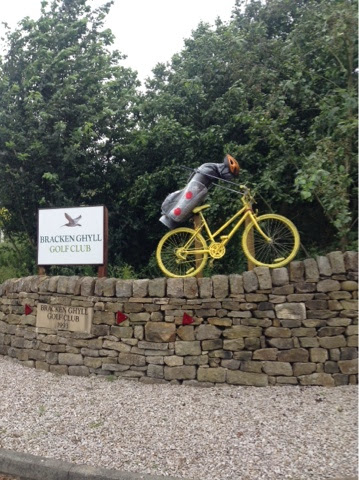
Businesses along the way erected bikes relating to their business including an osteopath putting a skeleton on a bike 


and a golf course transforming a golf bag into a bike rider.


This was day one of full Tour mode, riding until after nine pm and then being back at it nearly ten hours later.  After an hour or so on the road the next morning I began to be joined by other cyclists.  It wasn't long before they began coming in surges with mini-pelotons of twenty or more, many with matching uniforms.  It didn't compare to the huge tide on L'Alpe d'Huez on race day, but it was a flood of hundreds and hundreds giving the first stage a ride the day before the pros had at it.  No one I asked knew for sure whether cyclists would be able to ride the course the day of the race.  They definitely knew cars would be prohibited.  Some thought cyclists might be allowed, but also knew it would only be a short spell.

The route headed north into sheep country.  Their pastures were bounded by rock fences.  For some stretches the road was barely wide enough for cars to pass, and only if they came to a near halt.  The rock piled walls would be most treacherous for the peloton.  


In France such objects would be protected by bales of hay.  There wasn't room enough or hay for that.  It was beautiful cycling, so much so that the Yorkshire officials behind bringing The Tour to the area had mounted permanent official signs designating the route for all time as a Tour stage for cyclists to come ride.


It was virtually an all male contingency riding the course.   They were all riding hard as if in training, a distinct contrast to their French counterparts, who don't push it and are more interested in camaraderie and an enjoyable ride.  It was easily 99% guys and of those 99.9% had nothing more on their bikes than a water bottle or maybe two.  I was the lone touring cyclist, and elicited quite an array of English-oriented comments such as I've never heard before--"You're doing some work there," "Do you have any more bags?," "You've got a big load there.  You're a brave man," "Good effort,"  "Cheers," "Hi there."  There were a few with a French flavor--"Chapeau, my friend," "Domestique."  But not a single one slowed for a chat.  The only person I passed all day was a woman on the steep descent of the first of the three categorized climbs on the stage.  It was drizzling and it was dangerous.


I too was braking, while others flew by.  I commented to her as I slowly went by her, "I agree. This isn't a place to go fast."

"I don't like this at all," she replied with a strong quiver in her voice.  And later, back on the flats when she overtook me, she commented, "You and I were the only sane ones on that descent."

It was still raining and looked like it could for the rest of the day when I came to an intersection where I could turn right rather than left and lop off a loop saving me twenty-seven miles.  Those could be crucial in my making it to the ferry in Dover by Monday night.  It also altered my plans of watching the stage on the big screen.  Instead of hanging out in Harrogate all day waiting for the peloton to arrive while watching all the action on the big screen, I could head sixteen miles south to the stage start in Leeds and watch all the action there.  From Leeds it is some 250 miles to the ferry in Dover.  If I'm to keep up with the peloton I'll have to cover that distance by Monday night in a little over forty-eight hours.  I'll knock off some of those miles Saturday evening after the stage finish.  And I will enjoy every one of them.