Wednesday, October 18, 2023

Rumford, Maine


I spent little more than twenty-four hours in New Hampshire cutting across the northern neck of the state, long enough to gather three Carnegies, but not long enough to encounter any presidential hopefuls, though it may be a little early for them.  There were campaign signs to be seen, but all for local elections.


Someone did point out an opera house in Littleton that had been the site of many a debate between those on the presidential trail.  Littleton was the first town on my trail of Carnegies.  It was a quite lively town that had made a recent list of the twelve most quintessential towns in New England.  There were two movie theaters on its Main Street, one of which was playing the Taylor Swift movie.  A church on the street had a full-fledged, help-yourself food pantry.


The Carnegie was also on the Main Street on a slight rise. A plaque out front described it as “an eclectic blend of Georgian and neoclassical styles with decoration of a richness rare for a structure of its size.”  There was no entry as it was closed for the week to replace its carpeting.  While I gazed upon it a fifty-year old guy stopped to ask about my travels and added he’d had a few long tours himself. “Coast-to-coast?” I asked.

“Yes, seven times,” he replied.  “I used to work for a touring company out of Indianapolis and led rides.  On one it rained twice, once for twenty-three days and the other for sixteen.”

Another of his long rides was in Russia in 1991, when it had yet to be westernized with McDonald’s and all.  The roads were bad and the food and accommodations left a lot to be desired.  His group camped as well as stayed in hotels.  When they returned to the US they made the mistake to check the box on their custom forms that they had stayed on farms on occasion and had their bikes impounded for thirty days.


I could only look upon the next Carnegie in Whitefield too, as it wasn’t open on Mondays.  That was extra bad news as I was in need of an electrical outlet to charge.  I had gone all of Sunday without charging, only spending a handful of minutes inside, first at a Dollar Store and then at Ian Boswell’s house.  I was counting on plopping down an hour or so at either the Littleton or Whitefield libraries to catch up.  Whitefield was much smaller and quieter than Littleton and didn’t offer a cafe, so I had to push on hoping what charge I was gaining from my generator hub could keep my iPad alive.


The terrain was hillier than Vermont and the foliage more colorful, but a lot less touristy.  Maybe the threat of moose kept them away.  A sign warned of the many fatalities of those who had plowed into one.  


When it became clear I wasn’t going to make it to the next Carnegie in Berlin in time for some charging I hoped a motel might turn up, as I also had wet shoes and socks that needed drying.  None did so I kept alive my streak of every night in my tent. I was at least able to take advantage of an outlet at a rest area to gain enough juice to use my iPad without worries of draining in the tent that night.  The rest room was the only time I set foot inside all day, a not unworthy accomplishment.


I arrived at the Berlin Carnegie  too early to end my fast of not settimg foot inside a building. Its exterior had some extra adornments, so its interior could have been special too.  The exterior was accompanied by an Oldenburg-inspired over-sized book giving the library’s hours. 


The terrain flattened considerably when I entered Maine, some of it along rivers.  The first Carnegie came in Rumford on the Androssgoggan River.  An addition to its rear had large windows looking down upon the river.  A large sign on the door prohibited food and drink and there were similar signs on all the tables.  I had to be discreet taking an occasional handful of gorp, as I couldn’t sit without fueling.


I keep checking the weather in Nova Scotia.  It’s been very similar to what I’ve been experiencing so far, daily highs in the fifties and night time lows in the forties. I’ve had rain nearly every day, so what rain awaits me there isn’t too daunting so long as it’s no more than the drizzles I’ve mostly been inflicted with.

I won’t reach Canada for five days, as Maine is much larger than Vermont and New Hampshire, and I have seven more Carnegies to get to with one stretch of 155 miles between two of them.  The rain puts a dent into my riding time and also the shortening days.  Heading east adds to the shortness at the end of the day.  I’d been able to ride until nearly seven at the start of these travels.  Now dark is closing in by six.  At least it’s not as cold as last year’s fall ride, when I encountered snow in Canada north of Minnesota.  It’s been no colder than the low forties so far here.

Monday, October 16, 2023

Peachem, Vermont


I was delighted that my exit route from Vermont took me through the small town of Peachem, less than ten miles from New Hampshire, as it is the present home of Ian Boswell, former Tour de France rider and now one of the premier gravel riders in the world having won Unbound in Emporia, Kansas last year.  He also hosts a podcast, Breakfast with Bos, that I haven’t missed since he launched it during the 2018 Tour with his friend Marshall, who was following The Tour in his car.  

The two of them would record a chat every morning before each stage, recounting their previous day, Ian in the thick of the race and Marshall trying to follow it.  Ian is also a regular on the British podcast The Cycling Podcast and has joined the podcast crew the past two years in France to cover The Tour.  Though I’d never met Ian, I knew him well enough to consider him a friend.  I was hoping I could track him down in Peachem and thank him for the many hours of listening pleasure he had brought me.  Getting to meet him could well be one of the highlights of these travels.


I was on target to arrive in Peachem in the middle of the afternoon, but an excessive amount of climbing, some on dirt roads, delayed my arrival until 5:30, less than an hour before dark.  I felt reluctant to intrude on him at the dinner hour and was resigned to just gaining acquaintance with his out-of-the-way small town.  When I arrived at the main intersection across from its library and by a small inn, I paused at a stop sign wondering if I’d see anyone out and about.  There wasn’t a soul to be seen in this quiet town of 700 residents.  


Before I could even consider ducking into the inn to ask if Ian might live nearby an older guy on a mountain bike wearing a bright orange Arc’Teryx jacket appeared beside me as if he had been sent by a higher authority and asked where I was headed.  I told him Nova Scotia, then asked if he might know Ian.  He said he knew him well, and that he lived just down the road.  It was a little more complicated than that, as he needed to show me on my GPS his precise location two miles away on dirt roads in farm country.  He affirmed that Ian was as nice a guy as he comes across on his podcast, and it would be no imposition to drop in on him.  “Just say Greg sent you,” he said.

His isolated house with accompanying barn was just where Greg said it would be.  There was no indication that it was the residence of a world-class cyclist other than a bicycle wheel with a garland of flowers hanging on a wall to the left of the porch.  Ian’s wife Gretchen, who turns up on his podcast from time to time describing their breakfast that day, answered the door.  I apologized for coming by but said I just happened to be biking through and their friend Greg encouraged me to stop by to say hello and tell Ian how much I enjoyed his podcast.  She said he was in office and would get him.  A skinny, much taller, guy than I expected emerged, greeting me with his distinctive gentle voice and offered his hand.  


I told him I hadn’t missed a podcast and wondered if he had ever snagged a Tour course marker in the past two years when he’d been covering it as a journalist.  He said he hadn’t, as he was always ahead of the race, and it was, of course, taboo to grab one until the peloton had passed.  I told him I’d followed The Tour a few times as a touring cyclist and always brought home a few markers that I shared with friends and that I’d even given Greg LeMond one a year ago.  Ian said he’d love to have one and that I knew where to send it.

I told him I was from Chicago and had become friends with Christian Vande Velde and had given him a few markers over the years.  I added that I enjoyed his interview of Christian on his podcast this past year.  Ian immediately replied that he made a faux pas when he introduced Christian as having ridden The Tour “five or seven times,” as Christian corrected him to say he’d ridden it eleven times and had been back ten more times covering the race for NBC.   I was actually going to ask Ian about that, and was impressed that it had made such an impression on him, as it was a nagging embarrassment, that he brought it up himself.  Ian only rode it once, as his road career was curtailed due to concussion issues.  Few riders have done it in double figures, not even Eddie Merckx.

Ian had once used the term “Frenched” on one of his podcasts, the only time I’d heard it.  I knew all too well what it meant, as I feel as if I’m Frenched by over-zealous gendarmes prematurely ordering me off The Tour course.  Ian said it is a common term among American racers living in France coming up against the French bureaucracy and restaurants closing early and other inconveniences.  

His latest podcast was with Lucy Charles-Barclay and her husband.  She is one of the premier female triathletes in the world, finishing second four times at the premier event in Hawaii.  Her husband is a former triathlete who now devotes himself to his wife’s career.  They live in London and have to do a lot of training indoors in what they call their “pain cave.”  With the two of them sweating away in there for hours at a time day after day Ian asked the pertinent question that only a fellow athlete with a “pain cave” of his own would ask—what kind of smell did it have.  They said they have wooden floors and their “pain cave” has no detectable odor.  I congratulated Ian on the imaginative question.  He replied that Lucy had just won the triathlon in Hawaii this weekend, which she said would be the highlight of her career.

I could have talked and talked as I once did when I visited Christian at his house delivering a couple of course markers, but I didn’t want Ian to feel obligated to invite me for dinner or to pitch my tent on his property, so I said I needed to get going as I was hoping to make it to New Hampshire before dark.  As he led me back to my bike I asked if he flew in and out of Burlington for his extensive travels.  Usually he does, as it’s just an hour and fifteen minutes away, but he resorts to Boston from time to time as well. As he bid me farewell, he said he’d be looking for me at The Tour next year.  He’s as anxious as I am to see its route, which will be announced in a week or so.  We know it will start in Italy and end in Nice, not in Paris for the first time ever, so as not to conflict with the Olympics.  

Greg, who provided me the directions to Ian, wasn’t the only person to come to my assistance this day.  A couple hours earlier a white-haired lady was awaiting me at the top of a climb with a bottle of water and an orange.  She wanted to tell me about a rails-to-trails path up ahead and query me about my travels.  She was aghast that I had bicycled from Rochester, seven hundred miles away and that I was headed to Nova Scotia. I told her nothing of my previous travels, just that I was seeking out Carnegie libraries and the last one I had visited was in Northfield at Norwich College, though it was now Chaplin Hall housing the art and architecture department.  It faced a large quad surrounded by red brick buildings with none of the ornamentation of the Carnegie.


After a few minutes the woman introduced herself as George and asked my name.  After a few more minutes of conversation beside her car she excused herself and said she wanted to give me something more.  She ducked into the front seat and returned with another tangerine and a banana and several pieces of chocolate and $3.50 for a slice of pizza or something she said, while apologizing that was all she had to offer.  I didn’t know it at the time, but it is money I can earmark for the course marker I’ll be sending Ian. 


Vermont was living up to its reputation for friendliness.  It was no wonder that the roads on Saturday and Sunday were clogged with motorists from neighboring states.  Traffic was backed up for two miles just inching along into Stowe.  More than half the license plates were from out-of-state, one from as far as California and another from Utah, a Backroads van of the bicycle touring company with three bikes atop it.  Fortunately there was a wide shoulder so I could fly by them all. 


Traffic had been equally thick for miles between Burlington and Morristown, where I ventured for its classic Carnegie, complete with a plaque describing its architecture in detail.  


The small town, like most I’d passed through, had small shops catering to tourists.  Besides the signs advertising maple syrup, shops were packed with knickknacks of all sorts.


An Art Park (myearthwork.com) was among the attractions in the area on the road from the north into Stowe, a ski town that was the epicenter of it all.  The Art Park was full of Andy Goldsworthy inspired constructions of rocks.


The town was bulging with people, including a wedding party, despite the cold, dank weather.  A little sunlight would have enhanced the fall foliage, but it was still a pleasure to behold.


Saturday, October 14, 2023

Burlington, Vermont


The cycling gods must pay attention to my blog.  Less than an hour after my last post lamenting I’d passed through New York once again without finding a license plate along the road they provided me with one and then another when I opted to return to the state and bike up the west side of Lake George to Ticonderoga for its Carnegie rather than sticking to the Vermont side and then taking a ferry across the lake.  Five miles after the first came another, and then a few miles later a New Jersey plate as well.  It was my biggest license plate bonanza ever.  That brings my total of states to twenty-seven. The gods will truly be benevolent if they provide me with a green beauty from Vermont in the relatively few miles I’ll be biking across the state and the same for New Hampshire.


The gods were looking after me too when I left Ticonderoga at sunset, providing me with a campsite a mile out of this town that attracts recreational tourists, big enough to have a Walmart.  With dark coming on I had a debate with myself whether to sacrifice a few precious minutes of daylight to stop at the Walmart, the first I had come upon in these travels, for a jug of chocolate milk.  I knew it would be a risk to spend several minutes venturing around its labyrinth of aisles, but I couldn’t help myself so strong was my hankering for chocolate milk.  The gods didn’t take kindly to my decision, as the only chocolate milk on the shelves was in gallon containers, which I didn’t have space for.


I had the option of camping behind an abandoned store next to the Walmart or take my chances and head out of town.  There hadn’t been much sprawl entering Ticonderoga, a town of 5,000, nor was there much on the way out, so I was rewarded with another fine campsite in a small forest besides a field under cultivation.  

It left me fifty miles south of Burlington, where a Warmshowers host awaited me.  I decided to avail myself of this service since I had to take the time to search out supplies—a tire and an improvement on my sleeping bag.  It was rated to 25 degrees, but had barely been keeping me warm when the temperature dipped below fifty, as had been the case since the first two days of these travels.  I’d needed a sweater and sometimes a vest and leggings to stay warm. Evidently the loft of my bag had degenerated and no longer retained so much warmth.

Burlington had an REI, so I knew I could find an adequate upgrade.  My Warmshowers hosts, however, recommended the Outdoor Gear Exchange that dealt in used as well as new gear and was just a mile from their home and a couple blocks from the Carnegie Library.  It was a huge store packed with customers and incredible deals.  I left with a new Marmot bag for $130 rated to twenty degrees and a tire for $20.  Inflation seemed to have yet come to Burlington, as a motel on the outskirts advertised a rate of $48.50.


The store was in a several block long pedestrian mall in the heart of the city that was a hive of activity, contributing to the appeal of this city of 44,000 people, the largest in Vermont and the smallest largest city in the fifty states. The store was in a former Woolworth’s, commemorated with a plaque.  It was the largest Woolworth’s in New England and had been in fixture in Burlington at this downtown location for one hundred years until Woolworth’s closed down in 1997.  Its lunch counter is fondly remembered by many.


Learning of the store was just one of many of the great benefits of availing myself of Warmshowers, the first time I’ve done so in the US, after superlative experiences in Abu Dhabi and Brazil and Turkey and Madagascar.  It was thanks to a Warmshowers host in Madagascar that I still have my present touring bike, as he rescued it from the airport when Turkish Air wouldn’t let me fly home with it and sent it later.  


Carmen and Dave were as wonderful as any of my hosts.  Dave had been touring longer than me, getting his start in 1975 when he lived in Cincinnati.  Carmen was a native Vermonter and could remember when Bernie Sanders was elected mayor of Burlington in 1991.  She was a youth and couldn’t understand why an uncle was so upset, not knowing what it meant to be a socialist.  Dave is an ardent sailor as well as cyclist.  He hauls his sailboat to nearby Lake Champlain on a trailer he attaches to his bike.  And they are avid salsa dancers, driving ninety-five miles regularly to Montreal to dance.

They warned me to keep a close eye on my bike, as there had been a glut of bicycle thievery from a growing homeless population.  Ever since a hotel near their home had started housing the homeless, cars left on the street in their neighborhood had been broken into.  There was a cluster of homeless outside the Carnegie.  I was relieved I had stripped my bike of all its gear when I ventured over to it.


The library had had a large addition to its side.  The Carnegie portion was now the children’s section.  Carmen mentioned they’d had a guest a few years ago who had also come to see the Carnegie, but it was so long ago and they have had so many guests, she couldn’t remember who it was or how to contact him.  They’d had many fine guests over the years, but some clunkers as well, including one guy who spent all day sitting on their couch drinking beer while he awaited a package he’d had mailed to their address.  


We sat around the dining room table well into the night reminiscing about our travels and discussing life in Vermont. Dave and I both had early-day TC panniers and still have a pair in our archives.  I’d read on a plaque that Vermont was the first state admitted to the union after the first thirteen.  Carmen said that is something all Vermonters know.  It came in 1791, fifteen years after the initial thirteen.  The flag with fourteen stars lasted only a year, as Kentucky followed in 1792.  New Hampshire was one of the original thirteen.  Vermont had been part of New York, then broke off to become a republic of its own, before seeking statehood.  


I was eager to put my new sleeping bag to use as I slept in their backyard not far from a huge cluster of rhubarb.  I could immediately feel the warmth it retained of my body.  I dared not zip it up.  No worries now of needing extra layers as I sleep.  I left my old bag with Carmen and Dave who may save it for other guests in need.  They have occasional guests from New York City who arrive by train late in the evening and are short of gear.  They have a regular guest from Germany who leaves a bike with them.  As many guests as they have had, they have never stayed with another Warmshowers host in their travels, preferring their independence as I generally do, not wanting to make arrangements ahead of time.  But I will certainly be happy to take advantage of this great network again.

Thursday, October 12, 2023

Fair Haven, Vermont


It’s been one idyllic campsite in the forest after another this past week, though none more Idyllic than two nights ago in the heart of the Adirondacks in a veritable wilderness.  Though the vast park contains quite a few towns and villages containing 132,000 residents, including the town of Lake George with a couple dozen motels including one with a marquee of “Stay Here, Hike There,” there are vast patches of nothing but trees and lakes and rivers.  There are some ten thousand lakes and over thirty thousand miles of rivers and streams.  I could have been in the UP or northern Minnesota or Wisconsin, except this at times felt even more isolated.


For better than three hours I had a twenty mile stretch on a dirt road virtually to myself.  It was slow going, as the road was mostly climbing and descending.  I didn’t climb much over two thousand feet though there were four thousand foot peaks here and there, forty-six in all scattered about the park. Climb all of them and one can claim memberships in the 46ers.   Colorado has a similar clan for those who climb all fifty-eight of its fourteen thousand foot peaks, known as the 14ers.


Signs of “hidden driveways” warned of pockets of habitations.  And “no trespassing signs” gave indication of private holdings.  Carved bears were a common site as well, as bears are among the fifty-three species of mammals in the park along with moose and coyotes and bobcats.  All I encountered were deer and the occasional carcass of a possum.


My best roadside find through the park, and of my first week on the road, was a heavy-duty vest that may come in handy in the days to come.  I begin every day with the thought “What am I going to find today?” as the road invariably offers up something.  Much of what I find I disperse, such as golf balls and tools and bungee chords.  I was able to leave two golf balls on the lost-and-found table of a library.


I’d been hoping for a license plate to add to my collection of close to half of the states and several countries.  I’d been shutout three years ago when I biked some four hundred miles in the western end of New York.  And I had no better luck this time.  I thought I was certain to find one when I saw a trailer along the road with an array of plates, a sure-fire promise of one ahead. But no.  I’ll just hope to find one in the days to come as I cross Vermont and New Hampshire and Maine on my way to Nova Scotia, as I often find plates from states other than the state I’m biking in.

No neckerchiefs yet either, though I’ve certainly no need.  My biggest bounty has been quarters, five of them in eight days.  Usually I’m lucky to find one a week.  Could be another indication of inflation—quarters are no longer worth the bother to stoop to pick up.  Two of the five came at a McDonald’s pay-window, truly indicating that a customer couldn’t be bothered to open their car door and reach down for a botched handover of change.  I usually just spot pennies and an occasional nickel or dime at fast food pay-windows.  Quarters are a significant step up and reflection of these times where wealth is measured now in billions rather than millions.

What could have been my greatest find along the road was a bicycle leaning against a post with a sign of “Free.”  It was a high quality Jamis.  It is a sad, sad reflection on these times that it wasn’t immediately grabbed.   But no great surprise as I’ve seen more stray quarters on the ground than people on bikes.  I can count just four—two young boys on BMX bikes carrying fishing poles and two separate teens in the large town of Watertown.  People just can’t give up their cars as they continue to commit ecocide.

Though my campsites have generally been far enough from the road to be undisturbed by traffic, I was awoken one morning by the hurried clopping of hooves of a horse in a region where signs warned of horse-drawn carriages.  I had an even odder wake-up when I camped across the road from Fort Drum—a bugler sounding reveille.

I’ve had deer rustling near my tent on several occasions and have been on alert for otherworldly beings, since it was north of the Finger Lakes that the angel Moroni communed with Joseph Smith.  I actually passed a church with a message board reading “There are angels among us.” I thought it might be Mormon, but it was of another denomination.  It did remind me to be on alert.


I see ghosts here and there among all the Halloween decorations, though the vast majority feature skeletons, some gigantic and others just heaps of bones.


October is certainly the time of pumpkins and skeletons.  Some people put quite a bit of effort into their decorations.  They are more entertaining than those of Christmas.


It’s always nice to cross into another state, so I could feel all the excitement and anticipation of Vermont from fifty miles away.  The border wasn’t a waterway or mountain ridge.  It came just before Fair Haven, where the first of the state’s five Carnegies awaited me.  


With its front door boarded up I feared it might be closed down, but it was just to ensure patrons entered in the addition to the back.  It shared a parking lot with a Dollar General.  I can’t report on its interior as its limited hours didn’t include any on Thursdays.  I was forced to go to a McDonald’s a mile away for the internet.  It was the first of these travels where someone stopped by for a chat, not unexpected as the first billboard I came upon in Vermont advertised a service station saying “Gas stations are friendly in Vermont too.”


Tuesday, October 10, 2023

Theresa, New York


If I were relying on mini-solar panels, as I have done in the past, to keep my iPad charged I’d be out of luck, as I’ve had virtually no sun the past four days with a heavy overcast and lots of rain.  With no sun to dry my gear I had to rely on a slight breeze to dry my tent yesterday afternoon, allowing me to slip into a somewhat dry tent for the first time in four days. 

It was only by a stroke of good fortune that I didn’t have to resort to solar once again on this trip, as I inadvertently left home without my generator hub, neglecting to swap the non-generator hub front wheel I had used on my Surly when in Telluride.  Luckily I discovered this gross oversight when I stopped at a post office four miles from home to send off a package and realized I didn’t have to disconnect the wire to my hub as I ordinarily have to do when I detach my handlebar bar with all my valuables when I leave my bike.  At least I was still conditioned to do that. 

If I hadn’t discovered my oversight until I got to the train station I would have been quite disappointed, as I wouldn’t have had the time to return the eighteen miles to retrieve it.  My solar panels are nowhere near as effective as the generator hub.  It would have meant a lot more time finding and sitting by electrical outlets charging, rather than riding as I’d prefer to be doing.


I feared I may have jinxed myself, as I had been reading Nicolas Bouvier’s seminal travel book “The Way of the World” published in 1963 before I left.  During his time in Iran he mentioned that Persian caravan drivers had a saying, “First stage, short stage,” because invariably those setting out on a long caravan through the deserts would remember shortly after they had set out that they forget something important and would have to turn back to get it, usually no further than a farsang, four miles, the exact distance I had gone when I realized I had forgotten my wheel with the generator hub. When I read that I felt happy that I had never forgotten something of importance before setting out on any of my many journeys and couldn’t really imagine doing so as I have so much experience in packing, even having a short “don’t forget” list.

Bouvier’s memoir was a most literate rendering of his eighteen months driving from Europe to India through Turkey, Iran and Afghanistan with a friend departing in June of 1953, lingering in places to write and lecture.  He stirred many memories of my time biking through Turkey and India and elsewhere.  His frequent mentions of smoking, his own, and of those he encountered,  revived smoking-related memories that somewhat defined my travels in various countries.  In Morocco I was regularly besieged by shepherds spotting me in the distance, who would run to the road shouting “un cigarette, un cigarette,” taking me to be French.  China was just the opposite.  I was there just as a large proportion of the population was emerging from poverty.  Men were regularly offering me a cigarette, as a sign of welcome and generosity.

In Chile a cigarette may have saved my life, or at least injury.  I was biking in the dark while deep into Patagonia closing in on the Straits of Magellan when the days were very short with winter coming on.  A full moon was imminent and I was slowly gliding along following a white line on the edge of the road in the pitch dark awaiting the bright illumination that would come with the moon.  All of a sudden a tiny orange glow appeared a few feet in front of me from the drag on a cigarette of someone else trudging towards me  in the dark.  If not for that cigarette I would have plowed into him and who knows what would have become of us.

Bouvier also wrote a book on traveling in Japan.  Surprisingly he doesn’t once mention Mount Fuji nor the snow monkeys in a nearby national park that were the two highlights of my time in Japan.  Among my strongest memories of Japan is all the girly magazines I’d see along the road.  Road side scavenging has been on my mind with Israel at the top of the news.  I was warned when I cycled there not to pick up any debris along the road as there was the possibility it could be booby-trapped.  The Israelis were always on guard.  I biked along the Gaza border and through the towns that were recently attacked, knowing that at any time a bomb might be lobbed over from Gaza.

One such memory leads to another as I cycle along when not tuned in to a podcast.  It is nice to have such a wealth.  I never know what will be triggered or what memory will follow the one presently possessing me.  I could spend several minutes reliving my time in Iceland or pay it just a quick visit before moving on to Madagascar or Oman.  I never know.  

As always, it is nice to be collecting more.  After three Carnegies on Saturday I have gathered just one a day the following two days, both in small towns and both maintaining an outward appearance not much changed from when they were built over a century ago.  Each was a small gem that I was happy to add to my bank of memories.


Fulton’s Carnegie had a scenic location along the Oswego River reminding me of others that had a similar privilege.  It was graced with the usual unostentatious adornments that are frequent distinguishing features of these libraries.


It was seventy miles north to the seventh and final of the New York Carnegies on this leg of these travels.  It came in the tiny town of Theresa not far from Canada and the St. Lawrence Seaway.  It was a basic square brick building without adornment, but in its simplicity as dignified as any Carnegie.

If I hadn't been delayed by three weeks in setting out on these travels I would have ventured over to Canada from Theresa for five nearby Carnegies to the west and south of Ottawa,  but with the days getting colder and shorter I must forego that loop and head east to Vermont one hundred and fifty miles away over the northern hump of New York and the Adirondacks.  No Carnegies for three days until I reach Fair Haven then head north to Burlington for another.


Sunday, October 8, 2023

Canastota, New York


I was soaking wet from two hours of drizzle at the end of the day and with the rain not relenting I was reconciled to a motel even though it was just Day Two of these travels. GPS showed the Sleepy Hollow Motel a few miles past Auburn which I was passing through as sunset closed in.  I made it before the sun reached the horizon, but I feared the motel might be closed down with but two run-down cars at either end of its parking lot.  No, there was a non-neon sign in the office window stating “Open.”  

There were only two cars because of the inclement weather, as the motel catered to tourists visiting the Finger Lakes, and charged accordingly—$150.  Itinerant travelers such as me wouldn’t be attracted to such a place with a rate twice what I was willing to pay.  I may have been wet, but at least I wasn’t overly chilled, as it was still seventy degrees from an autumn heat-wave that had had the temperature in the eighties before the rain moved in.  I felt I’d been given a reprieve and could spend the night in my tent rather than some sterile domicile.

Within two miles I came upon a dirt road into a state forest.  I didn’t have to go far before I found a bit of a clearing under a patch of trees that provided a semblance of a canopy blunting the rain, allowing me to erect my abode for the night before many raindrops had penetrated. Once inside I quickly shed my wet shorts and jacket and shoes and socks and could feel myself instantly warming.  My gear wasn’t going to dry much, but it didn’t matter, as the forecast called for a morning rain.  Even if I’d been in a motel and got everything dry, it would all soon be wet all over again.

The rain recommenced shortly after I began riding.  The rain signaled a weather system that brought the temperatures closer to normal for this time of year, just fifty-nine degrees, which turned out to be the high for the day.  The rain was supposed to stop around noon, so when I came to a library at ten, five miles before the big city of Syracuse, I seized the opportunity to dry out a bit and make my entry into the urban sprawl on dry roads.  Unfortunately, weather.com got it wrong, as the rain refused to move on.  The website kept revising the forecast, pushing back the end of the rain until one, then two.  I didn’t care to wait, knowing that I’d have the chance to dry as I rode along when the rain passed.  

Plus I was eager to see the pair of Carnegies awaiting me in Syracuse.  The first was at the University.  I’ve always associated Syracuse with its university, as its football and basketball teams have frequently distinguished themselves.  Nearby Cornell at the bottom of one of the Finger Lakes doesn’t take its name from the city where it resides, Ithaca.  Dartmouth is the same.  So it felt a little strange entering Syracuse the city before reaching Syracuse the university.


The Carnegie was just past the basketball arena.  It looked out upon the wide expanse of a quad and was easily the most dignified building on campus.  It is just one of two of the better than one hundred academic libraries that Carnegie funded that still serves as a library.  There is a new general library, as the Carnegie now serves as the mathematics, technology and sciences library. The day before I had been to the former Carnegie Library at Wells College in Aurora on Lake Cayuga that now is Cleveland Hall serving as classrooms for the language department.  It blended in with all the other buildings on the campus on a hill overlooking the lake.


The trees around the lake were offering a variety of colors with their leaves changing, but the show was dampened with a heavy overcast that leaked an occasional shower.  I sought refuge for a couple of hours earlier in the day in the non-Carnegie Geneva Library that had a lot of character, beginning with signs out front asking “To Read or Not to Read.  What a silly question.”  


Inside was a Little Free Library type of box offering canned goods.  I’ve already come across quite a bit of sharing of food going on in these parts from food pantries and churches offering free lunches and so forth.  


As with the Syracuse University Library, the public library Carnegie funded for the city of Syracuse stands out from all the other buildings around, including the cathedral and the city hall across from it.  It still retains that aura that beckons and promises treasures within even though it no longer serves as a library.  It now provides office space for several county agencies.

With it still raining I had no desire to meander around the nearby campus or urban center or even venture to an Apple Store in a mall four miles away to figure out why my iPad has rejected Safari forcing me to switch to Chrome to access the internet.  I didn’t care to do any extra miles in the cold rain and needed to exert myself at a hearty pace on the open road to ward off the cold.  If there had been a football game this Saturday I would have been drawn to the stadium, where Charlie Eckhardt once played and I might find statues of Jim Brown and Ernie Davis, two stalwarts of its football team from over sixty years ago, one considered the greatest player ever and the other the first Black to win the Heisman Trophy in 1961.

It was past two now and the rain showed no signs of relenting.  It was fifteen miles to the next Carnegie in Canastota.  If a cheap motel offered itself, it would be hard to resist.  About half way there I suffered a flat tire.  The sole consolation was that it  occurred in front of a house with a porch where I could seek refuge.  No one was home so I wasn’t invited in to warm up.  My hands were so cold I could barely pry the bungee chords off my rear load and struggled to unbuckle my pannier to access my tire irons and spare tubes.  I had to stick my hands under my shirt against my skin for a minute or so before my fingers could function.  


The Carnegie in Canastota was a dandy, and unmarred by an addition.  There was no going inside as it’s Saturday hours were just eleven until two.  It wasn’t until 4:30 that the rain stopped, two hours before sunset, enough time for me to somewhat dry other than my shoes and socks.  It was my third night in a row in a forest down a dirt road that didn’t require forcing myself through brush, which is somewhat of a concern here as this region is a hotbed of ticks, where Lyme disease first presented itself.  The all-day rain made it somewhat of a survival day but the forecast called for clear, but cold, sailing the next few days.  I looked forward to dry roads and dry shoes as I dined on ramen enhanced by sweet yams from a dented can compliments of Aldi along with some sour cream.  Dessert of apple donuts was also provided by Aldi.


Friday, October 6, 2023

Finger Lakes, New York


My fall bike tour last year took me through Rochester, Minnesota.  This year’s commenced in Rochester, New York, a city with a strong bicycle connection, as it is the home town of Susan B. Anthony, an ardent proponent of the bicycle along with being a suffragette.  A mural two blocks from her home, now a museum, features her proclamation that the bicycle did more to emancipate women than anything else. 

She fully recognized its power to give freedom and self-reliance, two of its prime qualities that apply to all and  that have made it my religion.  Every tour I take, whether in Africa or France or the States, is a testament to freedom and self-reliance.  I have traveled all over the world not needing hotels or any other means of transportation other than the flight or train that may have delivered me to my starting point. 

I am always happy for the opportunity to travel by Amtrak, especially when it’s on a line that doesn’t require one to box their bike and just lets cyclists hand it up to the baggage car after having stripped it of its panniers.  I was given priority treatment at Chicago’s Union Station, allowed to be the first to board the 9:30 p.m. train to New York, wheeling my bike to the head of the line led by an attentive attendant.  I took a seat in the back of the car in front of a space where I hoped to put down my sleeping bag, but unfortunately it filled with luggage, so I didn’t have the best of sleep, sharing a seat with a hefty young guy who couldn’t pronounce the name of the city he was going to.  He had to spell it out when the conductor asked him his destination.  “S-c-h…”.

“Oh, Schenectady,” the conductor said.  “It took me several trips before I could pronounce it too.  I used the trick of ‘connect-with-me’ to remember how to say it.”

An older lady sitting in front of us was upset there wouldn’t be a smoke stop all night, and, in fact,  not until Schenectady, an hour-and-a-half after Rochester.  “That’s an outrage,” she said.  “I’m the widow of a Vietnam vet and I need to smoke.  Sorry. I’m from Brooklyn and I have a bit of an attitude.”

The conductor explained there’s usually a smoke stop in Buffalo, but the platform was under construction and the train had to make three short stops there for the coach and the sleeping and baggage cars, none long enough for smokers to fulfill their habit.
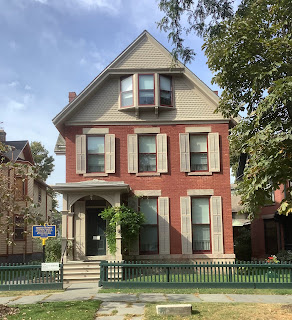


I was as disappointed as the smoker that the Anthony museum in Rochester didn’t have her bike, unlike the Women’s Christian Temperance Union museum in Evanston that honors Francis Willard, another suffragette and cyclist who wrote a book in 1895 titled “How I Learned to Ride the Bicycle.”  Her bicycle from the 1890s is on prominent display.  She was born in a small town outside of Rochester in 1839, nineteen years after Anthony,  before moving to Evanston in 1858 with her family.


The Anthony Museum, a mile from the train station, didn’t open until eleven.  My overnight train arrived at ten, so I dropped by the library first.  It wasn’t a Carnegie, though It was inspired by his largess, funded by a local industrialist in 1911.  It was a huge hulk of a building thanks to a $400,000 grant, but lacked the grace and majesty of a Carnegie.  An addition was built across the street seventy years later funded by Bausch and Lombe, one of three prominent companies that got their starts in Rochester along with Kodak and Xerox.  Among the inspiring phrases chiseled into the facade of the new concrete and glassy library was “Failure is Impossible,” one of Anthony’s famous sayings.

It came in one of her later speeches before her death in 1906, fourteen years before women gained the right to vote in the US.  She did vote once in 1872 when she and fourteen other women forced the issue claiming the recently passed 14th Amendment gave them the right.  The Supreme Court later ruled against her interpretation.  Utah had actually given women the right to vote, but had to rescind the right to become a state.


I also stopped by the sprawling George Eastman museum in the film pioneer’s mansion.  It contains one of the largest collection of photographs in the world along with an archive of 28,000 films. One is immediately greeted in the parking by a stunning replica of an eighteen-by-sixty foot photograph of llamas grazing at Machu Picchu that had once graced New York’s Grand Central Station.  It was one of 574 such photographs in a series entitled Colorama that ran from 1950 to 1990 with a different one mounted every four weeks by Kodak promoting color photography and travel.

Adjoining the museum is a movie theater that has a continual retrospective showing a different film five times a week, Tuesdays through Saturdays.  “Wanda” from 1970 had played the night before.  The Film Center in Chicago just included it in a series of “One and Dones” of great films that were the sole work of a director.

The first Carnegie of these travels was fifty-miles southeast in Penn Yan, nestled among the Finger Lakes.  Traffic was heavier than I would have liked it, only thinning out the final ten miles when agriculture began to take over from all the residences and businesses.    New York is one of six states with more than one hundred Carnegie Libraries, but sixty-six of them are branch libraries in the Five Boroughs.  There were only forty-four constructed outside of the city.  Four have been razed.  

I visited thirteen in June of 2016, most with Chris, who joined me for a spell on his ride somewhat tracing the circumference of the US during Covid.  I’m not sure if I’ll get to all twenty-seven of the others scattered around the state on this trip, as I’m sticking to the northern portion of the state before heading over to New Hampshire, Vermont and Maine and Nova Scotia.  I could finish off the state afterwards unless I stick to the Atlantic seaboard and seek warmer temperatures.


The Penn Yan Carnegie has a large addition greatly dwarfing the original modest two-columned library, whose entrance is no longer used and largely overlooked.  A plaque inside honored the town’s first librarian, who assumed the position in 1895 before the Carnegie.  The town took its name from its earliest settlers who were largely from Pennsylvania and Yankees from New England.  The library required a password for its WI-FI.  It was “vineyard” as there are quite a few in the region.  The road along Canastota Lake, one of the eleven long  narrow finger-like lakes of the region,  was called the “Seneca Wine Trail.”  I first read it as "Scenic Wine Trail,” which I took as a bit of an exaggeration, as the homes and vineyards along the lake weren’t particularly scenic.  I was hoping for forests.  I had to make do with a forest a couple miles before the lake for my first campsite.