Friday, May 14, 2021

Tutwiler, Mississippi


I cringed as I approached the entrance to the University of Mississippi campus in Oxford and noticed a guard house and a stop sign.  All was quiet and I feared the campus might be closed or off limits to outsiders and I’d be denied it’s Carnegie Library.  A burly older man stepped out when I stopped.  Before he could say anything I asked, “I’m looking for Bryant Hall,” which the Carnegie had been renamed.  

He gave me directions without any qualifications.  I was so relieved not to be turned away, I jestingly asked, “Is it named for the football coach,” expecting a good laugh, since there was no way arch rival Alabama’s legendary coach would have had his name attached to a building here, but I got no reaction whatsoever, just a straightforward, “I don’t know.”  Football is a religion in these parts, evidenced by the nearby “Manning Way,” named for the great Ole Miss quarterback Archie Manning.

Bryant Hall was just ahead, one of ten or so stately buildings in a circle facing a small park and cluster of trees.  The Carnegie was the stateliest of the lot, with its columns and dome and large windows.  “Library” on its facade had been replaced by “Fine Arts Center,” though it was now the Department of Philosophy and Religion.  Nothing in the building acknowledged Carnegie.  

Nor was the young secretary aware he was the benefactor of this magnificent building in 1910.  She knew the building had been named for a long-time English professor in 1984 and told me about some of the older nearby buildings dating to 1848, happy that they were intact, saying, “When the Union occupied, they didn’t burn the campus.”  

I wanted to ask, “What union was that? Was it a student demonstration?”   But we’d already had some missteps in our conversation, as we were muffled by masks and blocked by a plexiglass barrier, so she wouldn't have known how to respond to my incongruous comment.  The Civil War is a century-and-a-half behind us, but my experience whenever I’ve been in the South is encountering Southerners who speak of it as if it happened just last week.  There are plaques everywhere recounting the War, most disparaging the Union Army.  A plaque in downtown Oxford told of the burning of the city and also of Grant having spent time there.

With hardly a student to be seen, Oxford was very quiet.  I had to search to find the statue of William Faulkner I knew faced the Courthouse, as he was seated on a bench somewhat blocked by shrubbery.  The town doesn’t grant him too much prominence, as it isn’t sure whether to embrace this alcoholic Nobel laureate for his less than flattering portrayals of the environs.  The library has a mere photo of him in the corner of its Mississippi History room and an amateurish painting of him over a door smoking a pipe with the smoke spelling out Oxford.  On a previous visit Janina and I had visited his grave on the outskirts of town, so I didn’t seek it out this time.


The most direct route to the next Carnegie in Clarksdale sixty-five miles to the west was on a busy highway with rumple strips taking up the narrow shoulder, forcing me on to the road, which not everyone appreciated.  I received more horn toots than I ordinarily get in a month.  I had a bit of a tailwind, so was otherwise enjoying the ride.  Rather than responding with the middle finger salute, I gave every toot a friendly wave, making them think I thought they were fellow cyclists endorsing my endeavor and wishing they were on their bikes too and not confined to a metal box hurtling along at ungodly speeds.


Unfortunately, rumble strips have predominated on the 274 miles of my first three days.  It wouldn’t be easy to have a companion on such roads.  Hopefully by the time I get to Alabama and the possible companionship of Don Jaime I’ll be done with them.


All the traffic on busy 278 couldn’t have been headed to Clarksdale, as this sprawling town is quite rundown with many empty buildings.  It’s small, quaint Carnegie had a nondescript addition to its side that I at first thought was senior housing before I realized it was attached to the library.  I arrived half an hour after its closing time of 5:30 so couldn’t take comfort inside.  A sign on the door identified it as a WiFi zone, but it was turned off, so there was no lingering, which was just as well as I had to bike until nearly dark to get past some extensive wetlands before I found a place to camp after 98 miles for the day.


I stopped at the McDonald’s to take advantage of its self-service ice dispenser to fill my two insulated water bottles with ice, but was thwarted, as the dining area was closed.  I sat outside leaning up against the building facing the long line of vehicles to the drive-up window to take advantage of its WiFi and to eat some crackers and cheese.  Several minutes later a young black man came out of the store and asked, “Are you hangry?”  He had to repeat it three or four times, and approach me a little closer each time, before I understood he was asking me if I wanted something to eat.  “Oh no.  I’m fine,” I said.
 

“I can give you something for free,” he replied.  

“I was going to get a McChicken,” I said, “and wanted to fill my water bottle.”  

“I’ll bring you out a cup of water,” he said.

Before I knew it he was back with two McChickens and a bottle of cold water.  It’s not the first time I’ve been the beneficiary of generosity from a McDonald’s employee during the pandemic when the only service was at the drive-up window. 

Fifteen miles south of Clarksdale the tiny town of Tutweiller was another town laying claim to a place in music history.  It’s water tower advertised itself as the birthplace of the Blues, one of quite a few towns in Mississippi making that boast.


Here’s what Wikipedia has to say about it:

Like many other towns in the Mississippi Delta, Tutwiler stakes a claim to being the "birthplace of the blues". This is the site where W. C. Handy reportedly "discovered" the blues in 1903, on a train platform in the town. Handy had heard something akin to the blues as early as 1892, but it was while waiting for an overdue train to Memphis that he heard an itinerant bluesman (legend says it was a local field hand named Henry Sloan). The man was playing slide guitar and singing about "goin' where the Southern cross the Dog", referring to the junction of the Southern Railway and Yazoo and Mississippi Valley Railroad farther south. (The Y&D railroad was locally called the "Yellow Dog"). Handy called it "the weirdest music I had ever heard".


Wednesday, May 12, 2021

Jackson, Tennessee


I’ve become accustomed the last several years to being regarded as some sort of indigent when I’m plopped on the ground beside my loaded bike, which appears as if it might contain all my worldly possessions.  The site of me and my bike tugs at the heart strings of kindly souls, prompting them to offer me food or a bill or two.  Rather than hurting their feelings and discouraging their generosity I accept their offering.

Thus it came as a bit of a surprise when a slender, older black man missing a few teeth approached me outside the train station in Memphis just after I’d arrived to begin a tour of the Deep South and meekly asked if I could help him. Evidently the haircut Janina had recently given me, my first since going off to Brasil over a year ago, leant me an air of respectability and perhaps the impression that I was a person of means.  

He needed $17 so he and his wife and three daughters could stay at the homeless shelter that night.  He said he’d lost his house in Nashville to a flood a month ago and had come to Memphis looking for work.  He was a welder and had a job lined up in a day or two.  He spoke softly and sincerely.  Since I had been parceling out the $3000 Covid money the government had bequeathed me to various non-profits that meant something to me, I was in a mood of giving, so I obliged him with a $20 bill.  

He graciously thanked me and shook my hand.  I expected to bike off with a smile in my heart, as I imagined those who have given me money have felt, but I pedaled along with a sour taste, feeling that I may have been took.  It was six a.m.  What was he doing at the train station and where was his family?  He seemed too old and frail to be welding or to even have daughters that needed looking after.  Oh well.  At least there wasn’t alcohol on his breath and he had to have been in need.  

As I glided through the city in the early hour the only others out were occasional joggers and dog-walkers and homeless just rousing themselves from their little encampments covered in blankets.  It was just 51 degrees, only ten degrees warmer than it had been in Chicago the evening before when I biked to Union Station to board the City of New Orleans at eight p.m.  I had a seat to myself as the train was just at 65 per cent capacity, all that Amtrak was presently allowing.  There was a periodic announcement saying that as of May 23 it would be back to one hundred per cent.

Just a few blocks from the train station I passed the Lorraine Motel, now the National Civil Rights Museum.  The room where Martin Luther King was assassinated had a wreath outside it.  A nearby street was named for King.  In many cities the street named for King is a main boulevard.  Here in Memphis such a boulevard a couple miles further bore the name of the largely forgotten actor Danny Thomas who died in 1991 and wasn’t even born in Memphis.

Traffic picked up making my escape from the mini-metropolis less than idyllic.  I did make the rare find of a quarter and then another a mile later, maybe a blessing from the cycling gods, slightly alleviating my concerns that I had fallen prey to a scam artist.  Nothing though could deter my joy of being back on the road for the first time since October, over six months ago, venturing off after getting my two shots. I’d had several mini-getaways in the past month somewhat satiating my urge to be on the road.  The first was a drive  to Rock Island with Janina helping long-time friend Ron move a van load of his books from Chicago.


  We brought our bikes and tent and camped at Mississippi Palisades State Park and biked along some trails along the river, including one into Galena.


A few days later I took an overnight ride to Midewin National Prairie, a ninety-mile round trip, and camped along the buffalo enclosure.  I saw several clusters of the magnificent beasts, reintroduced to the Prairie in 2015.  They are thriving.


I managed a two-nighter a week later in southern Indiana, driving down to Bloomington with Janina to visit Dwight and ride along with him and Jeff, the pizza king, for the monthly Full Moon Ride.  It was a delightful mini-Critical Mass. While Janina hung out with old college friends I took a two hundred mile loop to Columbus and down to DuPont, to see another of those mini-Statue of Liberties the Boy Scouts made available to communities in 1950 to celebrate its fortieth year of existence.  There are six in Indiana and I’d already biked to three of them.  This one gazed out on to the road somewhat hidden by a row of trees lining the Boy Scout retreat of Camp Louis Ernst.


I got to make my introduction to Dwight’s thirteen goats he had started accumulating two years ago since my last visit. They were almost as dazzling as the buffalo.  They followed us all over and we pleased them immeasurably by constructing a pallet-pyramid/climbing gym for them with three pick-up loads of pallets from a nearby flooring place, all that they had otherwise we would have built it even higher.


Other than the dead armadillos along the road, biking in western in Tennessee wasn’t much different than southern Indiana through forested, rolling terrain.  With it pleasantly cool I didn’t need to gobble down the half dozen hard-boiled eggs I’d brought along.  I could parcel them out during the day, two for breakfast, two with lunch and two in my dinner of ramen.  As I shelled my first egg, I had an instant rush of hard-boiled egg memories.  The first was of coming upon a little girl with a bowl of hard-boiled eggs in a small village in Madagascar when I was in need of food.  I was thrilled with the eggs and the little girl was so thrilled with her sale that she dashed into a nearby house as if to tell her parents of her first ever sale.

That led to a memory of dining on hard-boiled eggs at a two-table cafe in the Sinai Peninsula.  The proud proprietor brought the eggs to my table and deftly shelled them as if he were a master chef flambeauing a steak.  Some of my most poignant hard-boiled egg memories though are of breakfasting on eggs with Andrew of Sydney that he had hard-boiled the night before as we took down our tents in France. That was always a great start to the day.

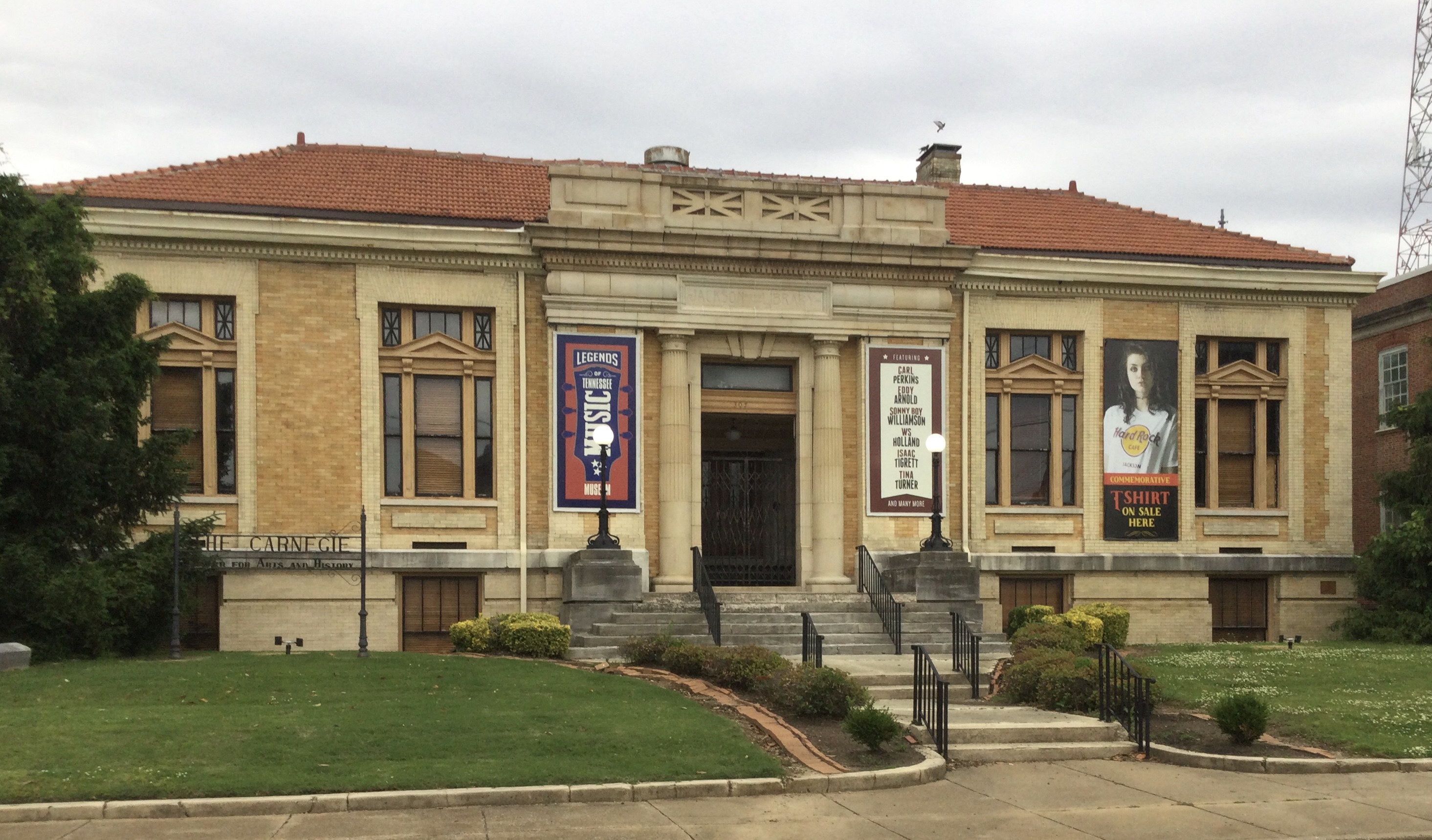
My first destination on this trip was Jackson, Tennessee, for its former Carnegie Library, eighty-five miles northeast of Memphis.  With my early start that was within range of my first day despite a gentle headwind.  I was rewarded, as I generally am, with a beauty, constructed of yellowish stone, with inset columns and four large windows in front and Jackson Free Library inscribed over its entry.  It now serves as the Legends of Tennessee Music Museum.  Jackson considers itself the birthplace of rockabilly.  The Rockabilly Hall of 
Fame is a few blocks away.


With Jackson I could celebrate having visited all fifteen of the still standing Carnegies in Tennessee, the fifth state I’ve completed after Colorado, Indiana, Illinois and Ohio. There had been twenty in the state. Six still serve as libraries  including two branch libraries in Nashville.  I’d gotten to the other fourteen on rides through Tennessee in 2010, 2014, 2015 and a visit to Wendy and Michael  in the Far East of the state in 2019. Now it’s on to Mississippi and Alabama where I’ll complete their states and drop in on some Strengthen the Arm of Liberty Statues of Liberty as well. Tennessee is a state without any.

I headed south nine miles out of town with at last a bit of a tailwind before finding a forest to disappear into.  It would have been nice to make my first day a century, but rain was imminent, leaving me six miles short.


Tuesday, March 16, 2021

The Obama Memoirs and the Bicycle

Basketball may be the most frequently mentioned athletic endeavor in the recently published memoirs of Michelle and Barack Obama, “Becoming” and “A Promised Land,” what with Michelle’s older brother a star high school and college player, and Barack an ardent fan and practitioner of the sport, but the bicycle offers a pleasant counterpart to the ball sport in their books.  Bicycling has been enough of a feature of their lives to earn more them half a dozen mentions in both of their highly detailed and personal reflections on their time in the White House and before.  

If the bicycle hadn’t won a significant place in their regard, their highly-attentive editors scrupulously managing their word count would have found reason to take a scalpel to such seemingly incidental references. Barack had so much to squeeze into his book, his one-book deal within Crown Publishers turned into two books.  The first was over 700 pages, taking him up to the capture of Osama Bin Laden, eight months before the end of his first term.  Michelle managed to hold her book to 426 pages, but only had one less bike mention to his eight.  With a higher per page percentage, she may take the honor of  holding the bicycle in higher regard than her husband.  

Neither of the Obama’s recount that seminal moment when they learned to ride a bike, nor does either offer that of their daughters, but Michelle at least writes of riding her bike in her early years, unlike her husband. She liked to swing over to a girl friend’s house on her bike, where they’d watch boys ride past on the sidewalk trying to attract their attention. Barack made no mention of his early days of biking in this book nor previous books either, so I sought out the biography of his mother, “A Singular Woman,” hoping to find a mention of it there.  

The only bicycling relating to Barack was of him being transported by bike to school by his mother’s servant during the four years he spent in Indonesian before his mother sent him back to Hawaii to live with her parents to have access to better schooling.  She knew he was brilliant, calling him a combination of Einstein, Gandhi and Bellafonte.  She was a very proud mother, who thought he could become president one day.  She remained in Indonesia with her Indonesian husband and Barack’s sister, nine years younger than him, working for an aid organization while pursuing a PhD in anthropology.

Growing up on Chicago’s South Side, Michelle was quite taken aback when she went to Princeton for college and saw students leaving their bikes unlocked.  Among the other cultural shocks were the variety of sports she was barely familiar with (lacrosse, squash, field hockey), not knowing what the hell it meant when asked, “Do you row?”  Unattended bikes tempting thieves had an added impact on her, as her brother was once nabbed by a Chicago police officer on the bike path along Lake Michigan not far from their home, as he was riding a brand new bike his parents had just bought him and the officer thought it had to have been stolen.  It was particularly galling, as the officer was African American.  

Michelle wrote that her mother really gave that officer an earful.  Her mother is a strong presence throughout her book, a stay-at-home mother while she and her brother were growing up, while their father, a Democratic precinct captain, worked for the city’s water department. She accompanied the Obama’s to the White House to help look after her two granddaughters, as she had been widowed a few years before, her husband dying at 52 from MS.  She is rock solid, dispensing valuable advice, and always being there for Michelle.  Barack too comments on lessons learned from his mother throughout his book and how pleased she would have been with various things he accomplished as president, though she didn’t live to see him even elected Senator, likewise dying at 52 from cancer.  

Barack three times mentions riding with his daughters. He longingly reflects back on the lazy Sunday afternoon rides they can no longer indulge in at the White House, and the rides they once took from their summer vacation home on Martha’s Vineyard into the nearby town. During his presidency their rides had to follow a tightly prescribed loop monitored by the Secret Service.  He wrote that his daughters rode it exactly once before declaring it “kind of lame.”

Michelle recounts being let down by her daughters too, when they declined to come down from their rooms at the White House to hear Paul McCartney sing.  Barack writes of McCartney’s appearance as well, but doesn’t mention the absence of his daughters, rather Paul singing “Michelle” to his wife and wondering what her parents would have thought back in 1965 when the song came out if someone had told them that someday the Beatle who wrote it would be singing it to their daughter from a White House stage.  Michelle curiously declines to mention the serenade.

Both dwell upon being prisoners of the White House, Michelle not even allowed to open her windows or sit on her balcony. She once managed to escape out a side door with her daughter to witness a celebration going on outside the White House. Barack tells of a recurring dream in which he’s able to ride his bike and no one recognizes him and he has no security detail.  He feels like he’s won the lottery.

When writing of his campaign crisscrossing the country, he establishes local color with the insertion of seeing kids on bikes on three occasions—in Toledo,  in a farm town in Minnesota and in a Nevada housing development.  And thrice he invokes the Little League as an allusion to wholesome Americana.  It’s not unique to this book, as people coaching Little League turn up in his previous two books multiple times as well. His indexer didn’t hold Little League in the esteem he does, as it doesn’t turn up in the index. Whoever it was may have had a bias against baseball, as Jackie Robinson is similarly ignored though Barack twice cites him, once for stealing home and once for someone having the similar good looks of the young Jackie.

Basketball is listed in the index under subjects relating to Barrack, (along with “smoking habit”),  but it only lists a quarter of the nearly thirty mentions, among which is coaching his daughter Sasha’s team.  Ralph Nader will be relieved that Barack didn’t write anything about his picking games in the NCAA tournament, as he liked to chide Barack for taking time from his presidential duties for such activities.  Barack drops the names of Michael Jordan, Kobe Bryant and LeBron James, none of whom are listed in the index, nor is the mention of Sarah Palin having been a basketball player listed under “basketball.” Mike Ditka at least made the index, despite just a passing mention as a potential rival for the Senate when the Republicans were having a hard time to find someone to run against Barack.  

Bill Ayers, a former member of the Weatherman Underground, who was a neighbor and friend of Barack,  is another neglected by the index.  Barack writes of him twice, but he is only noted once in the index, ignoring the instance of Trump calling him the likely author of Obama’s first book, claiming Barack didn’t have the intellectual capability to write such a good book.  

Besides his strong affinity for basketball, actually putting up rims on the White House tennis court so he could go out and shoot hoops whenever the urge struck, he was also known to be drawn to the golf course, which his critics liked to harp on.  He pretty much avoids writing about his golf outings.  The only mention is admitting to getting in a quick nine holes while he is waiting for the raid on Bin Laden’s compound to get underway.  Michelle too avoids the subject, just writing that if Barack was lucky he could squeeze in a round at Andrews Air Force Base.

Both harp on their conflict over how much time Barack was able to spend with the family, though golf isn’t given any blame.  Michelle devotes two pages to some marriage counseling she dragged Barack to back before he ran for Senate, a subject Barack ignores.  He devotes almost as many words to learning to correctly salute as Michelle did to their counseling.  She grew frustrated over being neglected, with it coming to a head when he was serving in the Illinois state senate, having to drive down to Springfield and back, and being away for three days at a time.  When he’d call and say he was leaving and would be back by such and such a time, he’d rarely make it by the appointed time, stopping to talk to some colleague on his way out the door or stopping in at the gym.  He was much more faithful to their dinner hour as president, since his office was a quick walk away. 

One can’t find lapses in Michelle’s index because there isn’t one.  If there had been, one might be surprised to discover twice as many mentions of their dogs in Barack’s book as in Michelle’s.  The only evident oversight of Michelle’s editors was the location of Chicago’s City Hall.  Michelle ventures to the fortress of a building to meet with Valeria Jarret about coming to work for the city, having grown weary of working for the nearby corporate law firm that she started with after college and where Barack served as her intern.  She describes the grand building and says it fills a full block between Clark and LaSalle Streets “north of the Loop” even though it’s well within the confines of the Loop.  I hope it’s not to late to have it corrected in the paperback edition.

Both books acknowledge Barack’s addiction to ESPN.  Barack wrote that he would begin his day in the White House gym with its “wall-mounted TV reliably set to ESPN’s Sports Center.”  Michele added that he’d frequently stay up until one or two a.m. reading memos and replying to email “while ESPN played low on the TV.”  He was known to play golf with ESPN stalwarts Tony Kornheiser and Michael Wilbon, but those moments don’t make the book. There must have been anecdotes galore from those outings that he would have liked to share.

Some of the best come from his interactions with Rahm Emmanuel, his chief of staff until he resigned to run for mayor of Chicago.  Emmanuel was well known for his profanity and forceful personality, “badgering, cajoling and threatening as only he could.” Barack wrote that it was almost a miracle he’d lasted as long as he had “without either killing somebody or dropping dead from a stroke.”  He could have been a bicycling buddy, as the first thing Emmanuel did after he ended his two terms as mayor of Chicago was to take a one thousand mile ride around Lake Michigan, but Barack says nothing about them going off on their bikes together, just strolling the White House grounds. Barack’s descriptive prowess shone when he compared Emmanuel’s office to “the over-caffeinated atmosphere of an air traffic control center...littered with coffee cups, cans of Diet Coke and the occasional half-eaten snack.”  But the distinction of the “most slovenly desk” Barack ever set eyes on went to Cass Sunstein, head of the Office of Information and Regulatory Affairs, who’d been a colleague of his at the University of Chicago Law School.

Though they comment on racial injustice from time to time, only once does Barack invoke the n-word, writing that during the Iowa primary his staff heard people say from time to time, “Yeah, I’m thinking about voting for the nigger.”  Michelle offers just one instance, and of its abbreviated form, recalling that during her freshman year at Princeton she had a roommate from Louisiana “who had been raised in a home where the n-word was part of the family lexicon.”  Her roommate’s mother was utterly appalled that her daughter been assigned to room with a black and was able to move her out of the triple into a single, though Michelle didn’t learn why until years later. 

Both poke fun of Barack’s semi-slovenly ways.  Michelle’s most beloved roommate at Princeton would pile her clothing in heaps and had no compunction of folding her clothes, which prepared her for Barack. One of her pet peeves was Barack hanging his suit coat on a doorknob.  At the White House Barack was proud to show Michelle his well-organized closet, thanks to his three military valets.  “See how neat I am,” he said.  She replied, “You get no credit for any of it.”

Barack’s book distinguished itself as the first I’ve come upon that twice spins out the numbers 5-6-7, my identity as a bicycle messenger.  On the campaign trail it grew tiresome to “say the exact same thing the exact same way five or six or seven times a day.” He lamented that at the White House he was “still smoking five (or six or seven) cigarettes a day...the lone vice that carried over from the rebel days of my youth.”  But he does eventually quit, the day after he signed the Affordable Care Act into law, choosing the day for the symbolism of it and also in response to a frown from daughter Malia a few days before smelling a cigarette on his breath.

From start to finish both books flow with stylish prose and stirring, often heart-touching, moments.  These books are fairytales of a sort.  Both Obamas express great wonder and gratitude for their untold good fortune.  Throughout Michelle’s life she was continually asking, “Am I good enough?”  Both express humility, Michelle acknowledging she gained entrance to Harvard Law School from the wait list, and Barack crediting his success at Harvard Law for being older than most of his fellow students, having spent three years as a community organizer in Chicago after graduating from Columbia.  I won’t mind at all if Barack’s next book goes on for another 700 pages.  I’ll be eager to read what more he has to say about riding the bike and if he feels compelled once again to mention the Little League multiple times.

Thursday, October 29, 2020

Paul Theroux and the Bicycle

 The prolific travel writer Paul Theroux came into prominence in 1975 with his first foray into travel writing with “The Great Railway Bazaar,” his account of thirty or so train trips over four months, from London to Japan and back.  Five of his subsequent travel books continued the train theme, interspersed with books about travel by foot (“The Kingdom by the Sea,” a walk around the perimeter of Great Britain), paddling among the islands of Oceania (“Happy Islands of Oceania”), sailing 1,500 miles down the Yangtze River (“Sailing Through China”)  and driving around the South (“Deep South”) and along the Mexican border and into Mexico (“On the Plain of Snakes”), among others.


Unfortunately, he has never availed himself of the pleasure of traveling by bike. He has contemplated it, but could never summon the resolve for the most noble and independent and engaging form of travel.  It was an option for his trip around Great Britain in 1981 after two books on train travel, but he thought it would be “too dangerous and too difficult“ and also a “stunt,” lame excuses for not having to overly exert himself. 

Twenty-five years later he seemed to have overcome his resistance to travel by bike, when as he passed through Tibet on a train trip around China (“Riding the Red Rooster”) he felt the urge to bike around Tibet.  He wrote that he’d even begun to plan the trip, but in the fifteen years since he has yet to fulfill that urge, actually resorting to the automobile, the antithesis of the bike, for his last two travel books.  Since he is less than six months from turning eighty, there is little likelihood that he has a bicycling book in him. 

He does express great admiration for Dervla Murphy, the intrepid Irish cyclist, who he devotes a chapter to in “The Tao of Travel.”  He commends her as “a wanderer in the oldest tradition.”  Traveling by bike was no stunt for her. In her many bicycle touring books she is always fulfilling a natural inclination, doing something she genuinely longed to do, beginning with a ride from Ireland to India in 1963, recounted in “Full Tilt.”

If anything was a stunt, it was Theroux’s first travel book.  He didn’t simply take a long train trip through exotic lands, but rather he searched out unique train trips all over Asia, hopping from here to there by plane and boat to connect to his next trip in Vietnam and Japan and Siberia and elsewhere.  He was not a traveler fulfilling some inner need, but rather a writer seeking material for a book. 

He had written nine little-read books (a criticism of V.S. Naipaul and eight novels), some the fruition of his time in Africa with the Peace Corps.  Out of desperation for something to write about that might find an audience and get him out of debt, he pitched the idea of the train book to a publisher, despite his strong aversion to travel writing, calling it “the lowest form of literary self-indulgence,” written by “second-rate writers waffling on about themselves and looking for trouble.”  And in his subsequent decades of travel writing he contributed to rail against it. In the introduction to a collection of his travel writing, “To the Ends of the Earth,” published in 2011 he said of travel books, “A bore wrote it and a bore read it.”

Even though he suddenly had a best-seller on his hands (the book went through three printings due to bookstore demand even before it was released), enabling him to achieve financial solvency, he has no fondness for the book,  as it only reminds him that he was “deeply melancholy” for much of his travels, being away from his wife and two young sons for over four months, just missing making it back for Christmas, and having to write about material that wasn’t in his heart.  Compounding his agony was learning that his wife had an affair while he was away.  When he found out, he wanted to kill her.  Though it is the book that launched him and that he’s most famous for, it isn’t always included in the biographical blurb on book jackets of his subsequent books while more recent ones are.

It is almost an embarrassment to him that he is known as a “travel writer,” as his aspiration has always been to be regarded as a novelist. His success with “The Great Railway Bazaar” turned him into a reluctant travel writer.  His heart never seems to be in it. He bemoans travel as “a horror and always a nuisance...It is in the nature of travel to be uncomfortable, if not scared silly.” 

Through it all, he has persisted with his fiction—novels and short stories—to little avail. He had to eventually admit he was a “second-rate writer” like all the travel writers he disdains.  It is little consolation that the polish he gained from writing fiction put a shine on his travel writing, elevating it above most, earning him the acclaim of one of the better travel writers of his time.

He may not have a compulsion to travel, but he certainly has a compulsion to write, with some fifty books to his credit, including a couple of children’s books, and attempts at science fiction and fantasy and four compilations of short stories and several collections of his magazine pieces.   Wading through his more than thirty books of fiction, one can’t help but feel that his writing is often only the fulfillment of trying to meet a certain quota of words a day.  I found myself, time after time, as I persisted at my task of reading them all, asking, “Why am I reading this drivel?”  Of only minimal interest were his semi-fictionalized confessional memoirs “My Other Live,” “My Secret History” and “Motherland,” all a version of one another.

What an ordeal it was reading them all, especially when he all too often lapses into an adolescent preoccupation with sex.  His novels are populated with mopes burdened by a pathetic craving for coupling.  And his travel books aren’t complete without encounters with prostitutes, only observing without admissions of indulging, though he did while in the Peace Corps, as it was intrinsic to the African culture he found himself in, as he confesses in “Sir Vidia’s Shadow,” an unrestrained undressing of his former friend and mentor, the Nobel laureate V. S. Naipaul.

He just writes and writes, perplexed by those who complain of writer’s block, actually wondering if those who don’t complain about the agony of writing are “second-rate.” Even when traveling, especially during those long hours on trains when he is trying to avoid irritating passengers, if he’s not jotting notes or reading, he can be struck by an idea for a short story, that may or may not turn into a novel, and begins scribbling away. 

It is hard to conceive how he has managed to write so much, as he is a prolific reader as well as writer.  He doesn’t read books, but rather authors.  His books, travel and novels, are full of literary allusions, rattling off the heights of authors and other stray details, such as Aldous Huxley dying the same day as JFK. Such drop-ins lend a veneer of depth and intelligence to his travel books. 

Though he can often strike a sour note, his travel writing is still a pleasure, especially in contrast to his fiction.  He is particularly adept at dialogue, sometimes going on for a page or more.  His facility with dialogue has led to nine  screenplays, including for his novels “Saint Jack” and “The Mosquito Coast.” It is writing he places in even lower regard than travel-writing, calling it “a waste of time.“

His frequent carping about being known only as a travel writer, and his slightly veiled lack of enthusiasm when he does travel, have earned him the not-undeserved reputation of being a grump, having a chip-on-his-shoulder, aggravated by one and all.  One can trace it to his childhood, where he bore the burden of being a third-born son, picked-on and competing with two older brothers, including Alexander, who became a distinguished and respected writer, nominated for a National Book Award and earning a Fulbright Grant and a Guggenheim Fellowship.  He taught at Harvard and Yale.  Paul‘s teaching credentials don’t go much beyond a stint in Uganda after being kicked out of the Peace Corps and another in Singapore until his contract was ignominiously not renewed.

Alexander wrote a scathing review in 1996 in “Boston Magazine” of Paul’s semi-autobiographical novel “My Other Life,” dismissing him as “a poseur, a hack, a whore, a slob and a meretricious scribbler...at best a beach read.”  Paul was appalled, responding that “in the long history of literary brothers there was no precedent for this attack...No one in history has ever done this, a guy writing that his brother’s book is crap.  Even Hemingway’s brother didn’t do it.”

He never won the favor of his parents either.  He devoted a 500-page novel, “Motherland,” to his contentious relationship with his mother and his six siblings, who regarded him with ridicule.  His mother did not approve of his writing, wishing he’d become a doctor, as he once aspired to be and regretted he hadn’t.  She  damned his first book, “Waldo,” about a juvenile surviving a dysfunctional family.  She wrote him a letter, that he has kept to this day, calling it “unfunny, sordid, cheap and vulgar.”

He claimed that his father never admitted to reading any of his books.  He blames his cynicism on his family, all of whom were imbued with a sour trait. They shared a “glee at seeing the worst in people, the confirmation that all of us were dogs.”  Such is his portrayal of most of the people he encounters in his travels.  He belittles and mocks, though with enough restraint that it’s not as offensive as it could be, only antagonizing a small percentage of his readership. Unlike most travel writers whose adjective of choice is “glorious,” his is “lugubrious.”   

He well knows his reputation for grumpiness and does his best to put some restraints on it. He doesn’t entirely object to how some regard him, as a blurb on the book jacket of “Hotel Honolulu” quotes a review stating “full of Theroux’s unashamed crankiness.”  A blurb on the book jacket for “The Pillars of Hercules” stated, “His portraits are pleasantly tinged with malice.”  

He is liable to snap at any slight or behavior that irks him.  When an Israeli border official asked him to sit down, he replied, “Only if you say please.”  At the Singapore border he was told by an official with a bad accent, “Your hair is radda rong.”  He replied, “And yours is rather short.”

His low self-regard comes through time after time.  When his oldest brother, a successful lawyer, expressed envy for the life Theroux has led, Theroux couldn’t understand why, as he feels as if he’s been a failure, never realizing his full potential.  In “Ghost Train to the Eastern Star,” a repeat of his first train travels over thirty years later, a woman tells him, “I want to live your life.”  He thinks, “Really!  My nagged childhood, my undistinguished career as a punk, no good at games, bewildered in college, terminated early in the Peace Corps, disgraced in Singapore when my contract wasn’t renewed, hard up in London, refused a credit card by American Express at the age of 32 because I had no visible credit, divorced.”  He has led the dream life of many and he can’t accept it, preferring to bemoan his shortcomings than be proud of what he has accomplished.

One of the revelations in Alexander’s condemnation was that his brother is obsessed with his bowel movements and eats prunes at breakfast.  That explained why he devoted his ridiculous 1994 novel “Millroy the Magician” to a religious movement founded on having regular bowel movements.  The preacher had a Trumpian motto of “I can make America regular once again.”  The novel is narrated by a 14-year old girl who had been seduced by the preacher in the days when he was merely a small-time magician before he was recruited for a morning children’s television show and developed a following that made him a national sensation.  This was another of his novels that one has to ask, “Why would you want to write such a story?  Who could possibly be interested?”

Theroux pretty much keeps his preoccupation with bowels to himself, though his years in Africa and third world countries must have led to more than a few cases of “the runs.” He lets slip his preoccupation here and there.  In his driving venture around Mexico, his latest book, he acknowledges a spell of two days when he had “the squitters.”     In “Waldo” he writes, “Nothing is so underrated as a good crap.”  In his 1978 novel “Picture Palace,” narrated by a 70-year old woman photographer who has Theroux’s  contempt for everyone she encounters, she remarks that Somerset Maugham was known to be constipated. Constipation is hinted at in “Millroy,” as the preacher forbids the term “toilet,” as it implies toil.  In his novel “The Black House” a character comments “travel bores me, constipates, all those bad meals.”

Maybe if Theroux had gotten out on a bike from time to time his digestive tract might not have been such an issue. He did go for a bike ride around a city in Vietnam when he had a free afternoon in “The Great Railway Bazaar,” but he made no comment on what an eye-opening experience it had to have been floating through neighborhoods he never would have seen and how glorious it was to roam, almost soaring like a bird.  But not much is “glorious” in the world of Theroux.

He writes at more length about a bike ride he took with Robin Williams in a profile he wrote of him for “Talk” magazine, one of thirty mostly non-travel  pieces collected in his book “Figures in a Landscape.”   Williams was an avid cyclist and friend of Lance Armstrong, who he would ride with on Rest Days at The Tour de France and elsewhere. Theroux acknowledged that Williams was a better cyclist than him, but “he didn’t rub it in.”   He doesn’t say whose idea it was to go for the ride, but Theroux deserves kudos for making it a strand of his story.  

In “Motherland” he says he turned down doing a magazine story on cycling in the Scottish Highlands, scoffing at the very idea of “a big man on a bike, pedaling up and down Scottish hills looking for something to write about.”   Too bad he didn’t more fully embrace the bicycle.  It could have tempered his life-long malaise, clearing his head, accelerating his heart rate, unclogging his arteries.  A good long bike ride always leaves one with a sense of accomplishment and fulfillment, like finishing a good book.


Sunday, October 18, 2020

Buchanan, Michigan


After completing my gathering of Carnegies, I extended my 1,200 mile ride around Michigan by swinging over to Buchanan on the St. Joseph River having learned from Randy of the Warren Podcast and Everesting fame that it had just been named the “nicest place” in the US by the “Reader’s Digest.” He grew up nearby and recommended a visit.

It was so nice that this quiet, four-stoplight town of 4,500 wasn’t even bragging about its designation.  There were no banners or signs proclaiming the honor, nor had anyone bothered to update the town’s Wikipedia page.  That could be in keeping with its namesake, the most obscure of US presidents, Lincoln’s predecessor.  There are fewer places in the US (towns, counties, roads, parks) named for Buchanan than any president.  


It seemed to be a closely-knit community with a huge American flag dangling over its Main Street, lined with stuffed scarecrows promoting local businesses.  The lamp poles all featured a photograph of a local who had served in the armed forces. 


A local school teacher nominated Buchanan, one of nearly 1,200 submissions, the most ever for the “Reader’s Digest” annual competition.  The nominations came from every state, enough that the magazine named a nicest place for every state along with the letter extolling it’s virtues. Collinsville earned the honor for Illinois.

Buchanan won out for having a spontaneous racial justice parade a week after the George Floyd murder in Minneapolis, despite having its Memorial Day Parade cancelled due to Covid-19. With a population of only eight per cent black, the large gathering, including the police chief, was mostly white.  They marched down the Main Street carrying signs and chanting slogans, stopping at the police station where they paused for those infamous eight minutes and forty-six seconds that the police officer pressed his knee to Floyd’s neck. 

Unlike Three Oaks, twenty miles away and a little closer to Lake Michigan, the town was not tainted with quaint shops and boutiques and restaurants catering to tourists.  It only gussied itself up to please its residents, not to attract outsiders. There was no pretension in its decorations, nor any effort to be anything but true to itself.  The “Reader’s Digest” made a fine choice in naming it the nicest place in America, and coincidentally on the day the story of a militia plotting to kidnap the state’s governor broke.

I was further gladdened to have made the effort to go over to Buchanan, as it brought me back through Three Oaks, a bicycling mecca of a sort, having hosted one of the nation’s preeminent annual cycling events, the Apple Cider Century, established in 1974.  A bicycle sculpture greets visitors when they turn off the highway to enter the town center.  The Visitor Center contains a bicycle museum, which was unfortunately closed due to the virus.


A similar sculpture resides in front of the library in New Buffalo further down the road along Lake Michigan.  The library too had been closed for months.


The sculptures were a welcome antidote to all the political signs that took over the landscape throughout the state.  Halloween decorations provided some relief too.


And all the innovative pumpkin displays.  


I greatly look forward to my next ride post-election when hopefully these divisive distractions will be history. They couldn’t help but undermine the usual escapism that going off on one’s bike provides.  

I could somewhat preoccupy myself with various podcasts.  I had fallen behind during The Tour de France when my podcast-listening was dominated by those devoted to The Tour.  There are quite a few.  I had limited myself to four of those offering daily stage reports during The Tour—those of Lance Armstrong, Bradley Wiggins, Johan Bruyneel and another featuring two English and a French journalist, supplemented by Randy’s weekly podcast.

While I cycled around Michigan I went back to the Cycling Tips daily Tour podcast, allowing me to relive The Tour and gain another perspective on The Race.  Among its five voices was a Dutch woman who gave a distinct female perspective.  She surmised that last year’s Tour winner, the young Colombian Egan Bernal, may have been struggling this year because he had recently broken up with his girl friend of five years, a fact that no one else had brought up.

During a post-Tour podcast on the World Championships, won in dramatic fashion by the French rider Julian Alaphilippe, this Dutch journalist said she had been watching the French broadcast, where Alaphilippe’s girl friend, Marion Rouse, a former French national champion, was a commentator.  Rouse was so overcome by emotion when her boy friend was about to become World Champion she couldn’t speak during the final three miles of the race as Alaphilippe held off the chasers. The Dutch journalist kept hoping she’d hear Rouse yelling encouragement or erupting in glee at his victory, but Rouse couldn’t bring herself to utter a word. 

Though many called this year’s Tour one of the most exciting ever, the Cycling Tips website had far fewer hits this year compared to last year when Alaphalippe animated The Race on a daily basis.  That is until this year’s dramatic time trial on the penultimate stage when its numbers exploded, with the cycling community wanting to read about Pogcar’s spectacular and unanticipated seizing of the Yellow Jersey from Roglic.

Though I needed to replace my rear tire during my ride around Michigan, I didn’t suffer a single flat or any mechanical malfunction.  I went three weeks without a drink with ice, a marked contrast to my June ride when I’d stop two or three times a day at a service station or convenience store to avail myself of their self-serve soda and ice machines.  Not once did I stop at such a store for any reason this fall, not even to fill my water bottles or take a break. That may be why only twice did someone offer me money this time in contrast to a dozen or more on my June ride. 

The second came a couple days ago when I was kneeling beside my bike outside a Walmart making room for provisions.  A young Hispanic woman snuck up on me and tried to give me a five dollar bill.  That I could decline, unlike the bag I didn’t realize contained a stash of coins that someone presented me earlier in the trip.  Some cyclists bemoan the hostility they bring out in motorists.  I prefer to dwell upon the goodwill I draw from those I encounter.  I can almost use that as justification for these meanderings—to bring out the good in others.  I’m not sure when I’ll have the next opportunity in these times of the Covid, but it won’t be soon enough.  

For the first time in years I have no winter travel plans.  I could be reduced to a winter ride in Florida finishing off its slate of Carnegies.  I gathered six this past February on my ride from Miami to New Orleans after riding from Uruguay to Guyana.  I only have four more to get to there to complete the state.  I’ve only completed four states so far—Illinois, Indiana, Ohio and Colorado, even though I’ve been to Carnegies in 36 of the 48 states that have at least one.  The fourteen new ones on this trip brought my total to 829 in the US and 871 world wide.  Only 1,470 still stand in the US, so I’m more than halfway to seeing them all.

Friday, October 16, 2020

St. Joseph, Michigan


When I returned to my bike after walking around the Allegan Carnegie, another dandy with the unique feature of an off-center entry, a police officer was waiting for me.  He was the grandfatherly type and was more welcoming than wary, observing, “It looks like you're traveling.”  It was my first encounter with someone wearing a badge and carrying a gun on this trip.  They can often have an attitude of “what are you doing here” and “the sooner you clear out, the better,” but that wasn’t the case this time.

Seemingly being itinerant earns me attention from the kind-hearted offering money, but also attention from the enforcers of the law considering me a suspicious figure.  None is more offensive than the other, equal representations of how unenlightened the masses are to the noble pursuit of traveling by bicycle. 

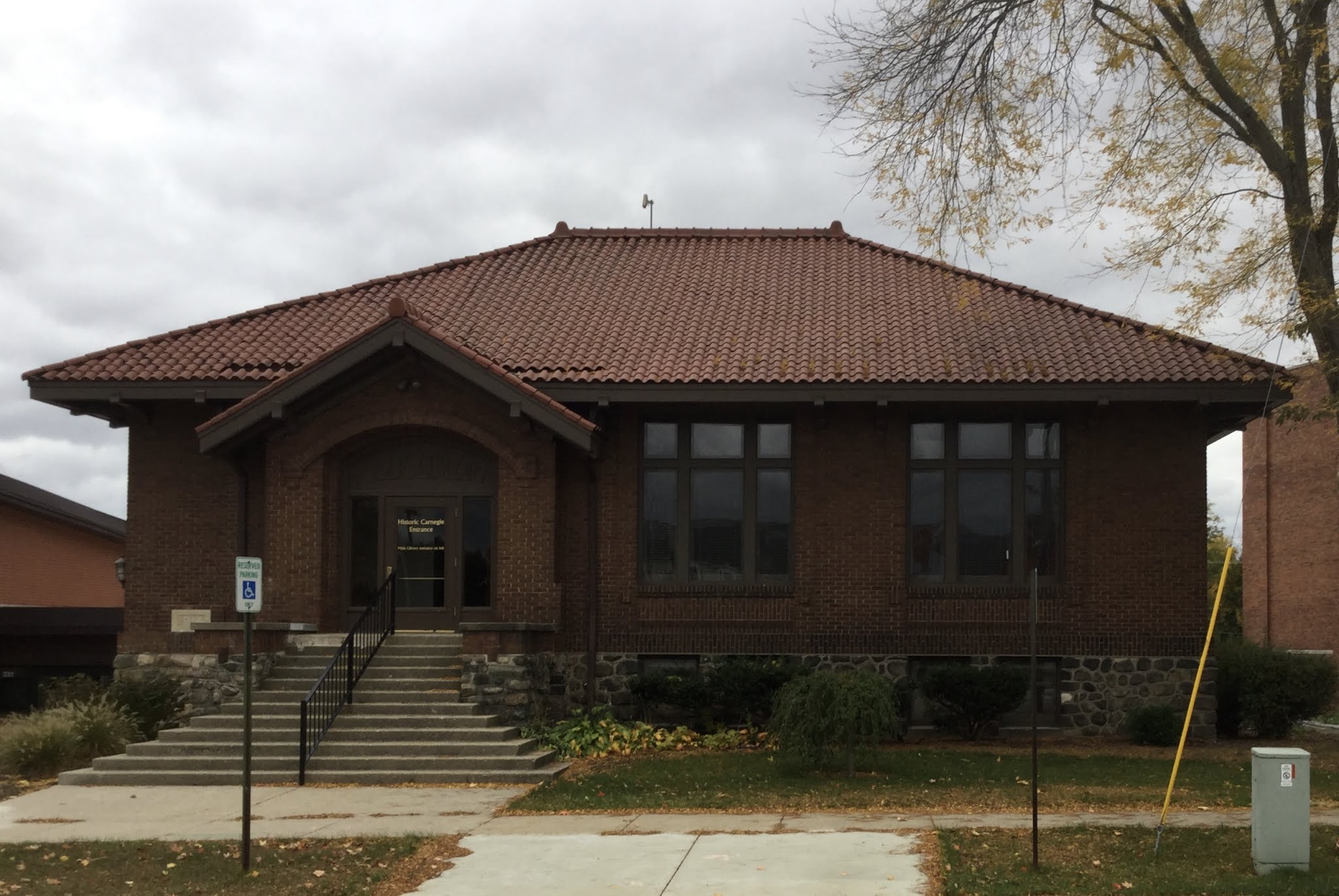
This enforcer was more curious than suspicious, and was happy to engage in conversation after I explained I was riding around Michigan visiting Carnegie Libraries.  He wasn’t aware the library behind us was a Carnegie, as there was no plaque acknowledging its status and only “Public Library” in a florid script on its facade adding to the library’s luster.  If he had been a little more observant he might have noticed “Historic Carnegie Entrance” in small print on the door, though it was no longer the actual entrance to the greatly expanded library.

He could somewhat relate to my endeavor, as he said he had ridden his bike six miles the day before, but not on the job, as his force didn’t have a bicycle contingent.  The state police actually had a lone bike for an officer to patrol festivals and other large local gatherings.

I asked the officer if I needed to lock my bike when I went into the library with the police station across the street and a Mug Shots Coffeehouse down the street.  He said, “Probably not, but I always advise people to err on the side of caution.”  

A few minutes later after I had settled in at a table looking out on to the Kalamazoo River the director of the library came by to give me a tour of the Carnegie portion of the library.  She too was of the wary sort and advised me not to leave my belongings unattended.  But just as I felt no concern about leaving my bike unlocked in this small town, I felt it perfectly safe to leave my helmet and handlebar bag and charging Garmin on the table I had been sitting at.

The original library wasn’t open to the public, as it was only used for meetings and special occasions.  It was a typical large single room with a high ceiling and large windows. An elevator and furnace and auxiliary wall had been added and the light fixtures had been replaced by replicas true to the 1914 originals.  Though the books and circ desk and tables and chairs had all been removed, replaced by a scattering of contemporary chairs for meetings, the room still radiated that Carnegie aura.  

The Carnegie portrait had been moved to the new library, but there were portraits of the three longest-serving librarians, including the first, a stern-faced woman who held the post from 1904 to 1948, beginning her tenure ten years before the Carnegie.  My escort said she looked just like her grandmother.  She said the librarian she grew up with in a small town near the Carnegie in Owosso, which she visited for story-times when she was little, was the kindly, rather than task-master, type. 

This library had had two large additions, the latest offering a wall of high windows looking out over the Kalamazoo River.  The librarian was concerned that the beauty of the view might be altered, as a nearby dam was soon to be removed, as it was deteriorating and could give way as had those dams around Edenville.  It was cheaper to remove the dam than to repair it.


I had thirty-five miles of superlative riding through forests on lightly travelled roads to the next Carnegie in South Haven on Lake Michigan.  The western half of the state, away from all the automotive towns radiating out from Detroit, have a minimum of factories and minimum of traffic on the secondary roads, making for the finest of cycling.  I can wake up feeling lucky that I get to begin my day with a bike ride and feel equally lucky that I get to end my day with a bike ride and luckier yet that I get to spend the rest of the day on the bike with a library or two thrown in.  I have to ask, “Have I died and gone to heaven?”


Though I had visited the South Haven Carnegie with Janina, it was a genuine gem worth another visit, especially via bike.  It had long ago become the home of the South Haven Center for the Arts.  The twin inscriptions of  “Open to All” over the door and “Dedicated to the Advancement of Learning” below the roofline still applied. 


Twenty-five miles south following the shoreline the final Carnegie of these travels awaited me in St. Joseph right on the Red Arrow Highway just two blocks from Lake Michigan.  It had a corner diagonal entrance, Kirk’s favorite.  It now housed an architectural firm and another tenant and was called “The Library Building.”  


I have been a little more conscious of pushing deeper into the forest away from the road the past couple of nights, as people have semi-seriously been advising me to me wary of the Michigan Militia.  There was a chance if they spotted a tent in the woods they might use it for target practice.

Friends I visited after Kirk in Battle Creek, my old roommate of fifteen years, Debbie, the long-time manager of the Rapid Transit Bike Shop in Wicker Park, and her partner Gary, were among those expressing some concern, as one of the thirteen recently arrested for plotting to kidnap the governor, had been photographed with their sheriff.  Debbie and Gary had been living at the Circle Pines Retreat outside of Delton since June of last year, deep in the woods on a 286-acre parcel of land.  They were among a handful of year-round residents making improvements on this property that hosts a summer camp for kids and  gatherings for others seeking some tranquility to recharge their batteries.  Among their projects was installing a sawmill and a solar-powered kiln to cure the wood.


Debbie had spoken of Circle Pines with great fondness and near reverence ever since I had known her.  She had been a camper there some forty years ago and continued to return year after year and had been on its board of directors for years.  She and Gary felt privileged to have the opportunity to take up residence there.  It was easy to understand why.